Sandbach Flashes: birds and wildlife
About the Atlas
During the three breeding seasons 2004–06 and three winters 2004/05–2006/07, Cheshire and Wirral Ornithological Society (CAWOS) organised more than 350 volunteers to survey all of the county, trying to find every species of bird that was breeding or wintering
Barn Owl Tyto alba
Breeding
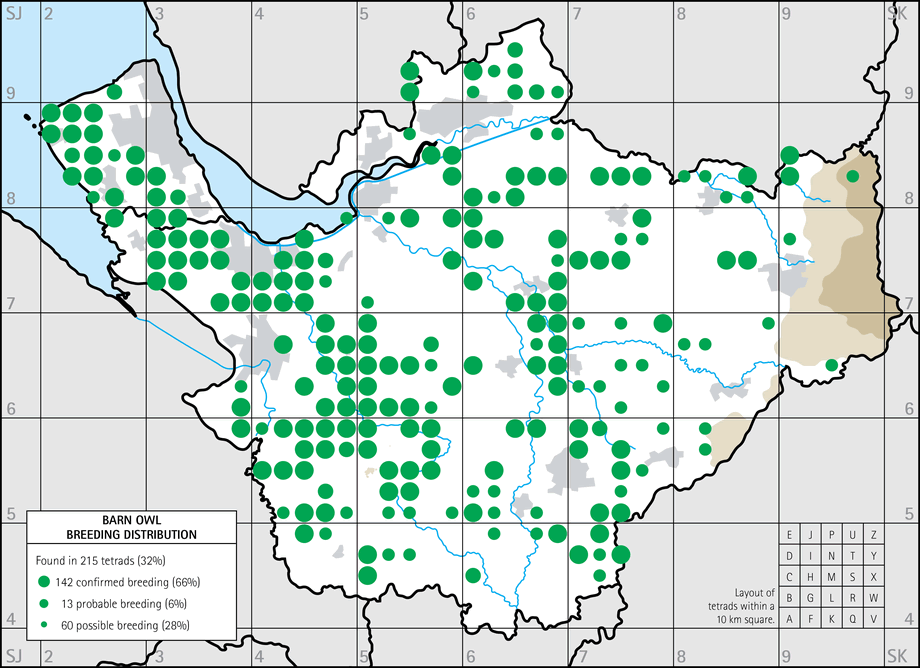
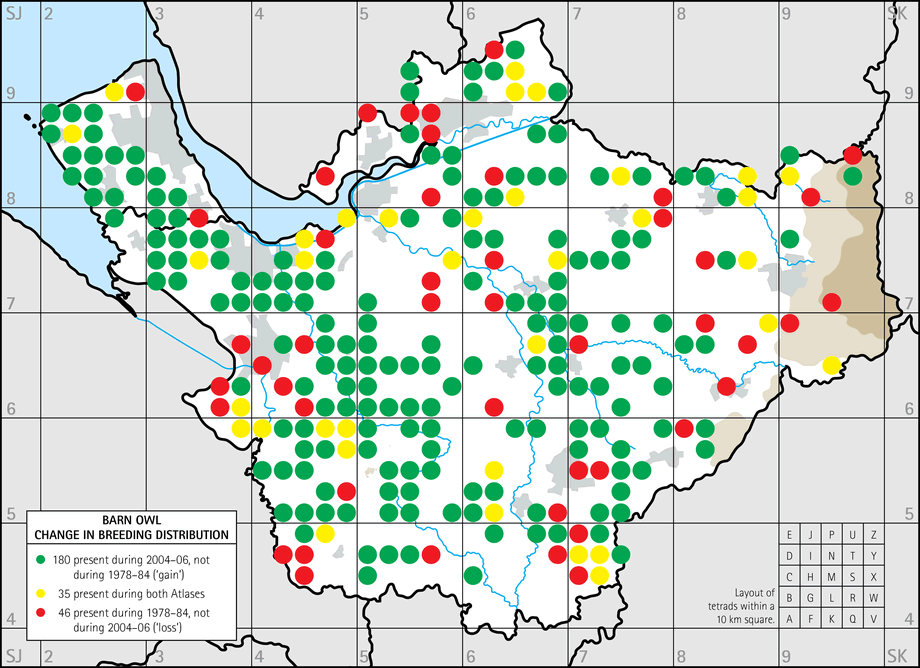
This species’ map is a tribute to direct conservation action by Barn Owl conservation groups. National surveys had shown that the Cheshire population was 240 pairs in 1932 but only 35 pairs in 1982-85 (Shawyer 1987), an 85% drop over 50 years in the county, much more severe than the 69% decline across England and Wales as a whole. In 1998 the known county breeding population was only seven pairs. The combination of causes for their decline included agricultural practice, especially the loss of summer feeding habitat, overstocking of land and intensive use of chemicals including rodenticides applied around farmsteads. Direct mortality has risen especially owing to road traffic (Shawyer 1998).
Previously, some people had tried to help Barn Owls by rearing them in captivity and releasing birds into the wild, where they rapidly died. This was outlawed in 1993 and the work of Barn Owl groups has shown that the key to the species’ conservation is to interest the landowners and improve the habitat, then put up nest-boxes and the Barn Owls will respond naturally.
The increase in nests in west Cheshire illustrates how well the birds have indeed reacted, and the map shows that they are now widespread. They steer clear of conurbations but find some industrial sites to their liking, especially landfill sites such as the Gowy and Maw Green areas which provide ideal hunting habitat. Barn Owl is a bird of low altitude, with over 90% of nests nationally found below 150m, and none in Cheshire and Wirral is known to nest above this level.
Their main natural nesting site is in Ash, which splits and rots to provide suitable cavities. The species was recorded for twelve of the trees used for nesting during this Atlas: eleven in Ash and one in Oak. Shawyer (1987) showed that they tend to choose trees in areas of low rainfall, such as Cheshire, and use mainly buildings in counties with high rainfall. Many suitable old barns in the county have been converted for human occupation, and modern metal-framed farm buildings are seldom used, so there are few sites known in buildings in Cheshire and Wirral. The majority of birds nest in boxes provided for them, on poles or in trees, and there are more than 500 such boxes in the county. A breeding pair often uses two adjacent boxes, perhaps on opposite sides of a field, with the male roosting in one of them whilst his mate and their brood use the other. Barn owl breeding numbers in west cheshire. Although observers reported a wide variety of habitat codes, they were found overwhelmingly in agricultural grassland. They hunt mainly along rough grass margins, and each pair has to bring in 20 or 30 small mammals a day during the breeding season, which needs a length of 15-25 km of 6m wide grassland strips within their normal hunting range of 1-2 km from the nest. This might sound like a lot, but it amounts to only 1% or 2% of the land area, and can easily be provided by suitably-managed banks of rivers and other watercourses, or by the unplanted margins of fields, for which farmers can be paid under Environmental Stewardship schemes. Their favoured prey is Short-tailed Field Voles, which need soft grasses as palatable food and for making their nests, with Wood Mice and Common Shrews taken as well. Vole populations, especially, vary cyclically, with a crash every three or four years. Their main predators, Barn Owls and Kestrels, tend to follow with similar cyclical abundance although they mitigate the worst effects by switching to alternative prey including mice, shrews, rats and birds. The large drop in the number of west Cheshire Barn Owl nests in 2006 was caused by the Field Vole cycle; they rebounded from that, with their breeding total in 2007 even higher than in 2005. Dedicated by the Cheshire Barn Owl Groups to the memory of George Bramall, founder of the Broxton Barn Owl Group and inspiration to the founding of other Barn Owl groups in Cheshire.
Winter
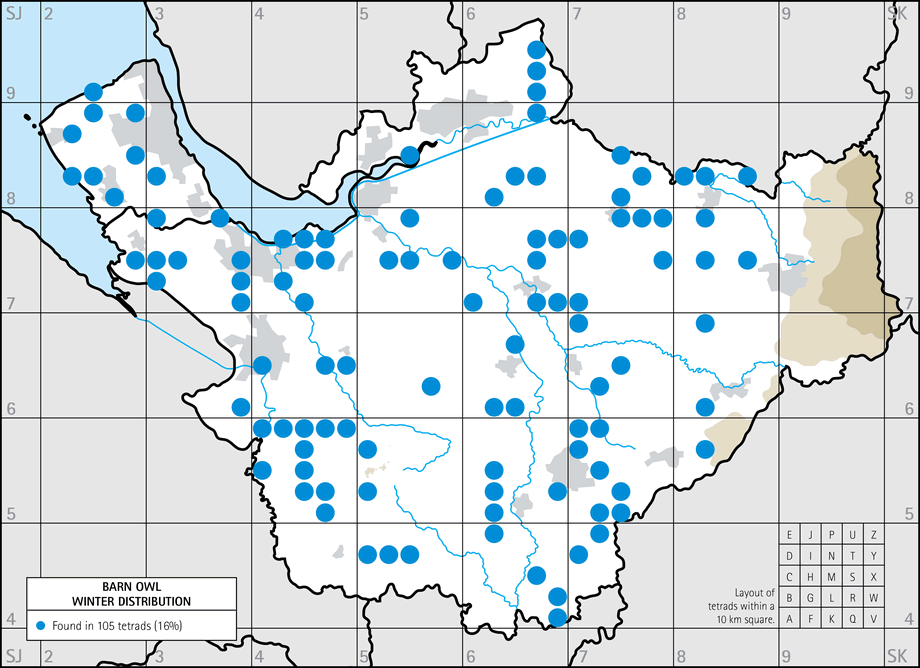
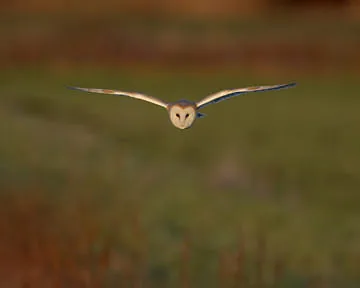
Adult Barn Owls rarely move far from their breeding areas, and the map shows that fieldwork for this Atlas substantially under-recorded them in winter. Apart from a few visits from members of the county’s Barn Owl Conservation Groups, most birds were found by chance. They give few clues, seldom calling in winter, and not eliciting as much mobbing by small birds as other owls and raptors do (Bunn et al 1982). Birds can appear to be secretive, mainly seen unexpectedly when a ghostly bird floats silently past, the paler males especially seeming to be almost white. Although mostly nocturnal, they may often be found active during daylight, especially after a period of wet weather, because they try to avoid hunting in the rain, and have reduced success in high winds. Surveyors saw birds hunting near roads in several tetrads. At Davenham (SJ67Q) their presence was proven with a bird found freshly dead on road, but, more happily, the records in SJ88R came courtesy of Wilmslow Police, whose officers several times saw a Barn Owl from their patrol cars.
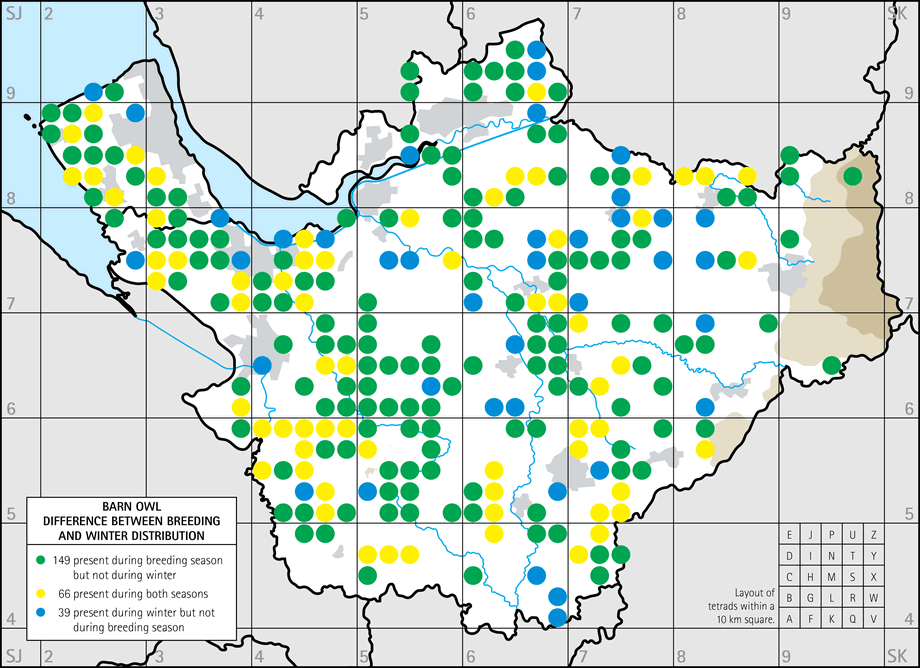
The winter map shows birds present in just 105 tetrads, 39 of them in which Barn Owls were not recorded during the breeding season, but they were not reported from 149 tetrads that were occupied for breeding. They would be expected to have a wider distribution in winter than during the breeding season. Individual birds cover more ground, increasing their typical hunting range from 1-2 km to 4-5 km, and dispersing first-year birds wander about until they can find a territory and a mate for themselves. Ringed chicks typically seem to settle to breed about 5 or 6 km from their natal site.
Of the 133 habitat records submitted, 92 were farmland (69%), with more unimproved grassland (28) than improved grassland (26) indicating their preference for uncultivated land. 24 were recorded as human sites, with 7 semi-natural grassland. Barn Owls’ diet, easily examined by analysis of their pellets, inevitably follows the seasonal availability of their prey. Field Voles peak in late autumn, perfect for the inexperienced young owls attempting to fend for themselves. Wood Mice numbers are at their highest during early winter. Shrews tend to reach maximum numbers in mid-summer and rapidly die off in autumn, but they are especially susceptible to Barn Owls during winter and early spring because, eating live prey of insects and invertebrates, they have to remain active and presumably quite visible (Shawyer 1998). Whatever the species of mammal, Barn Owls preferentially go for the largest males in the prey population (Taylor 1994). As well as rain and strong winds, any periods of prolonged snow cover make hunting particularly difficult for them as their targets are hidden, but it is some years since Cheshire experienced such conditions. As a southern species here at the northern limit of its cosmopolitan distribution, Barn Owls can suffer badly in severe winter weather.
Most birds were found singly, with just eight records of more than one bird, several time attributed by observers to family parties. Although this map is for our defined winter period, some Barn Owls are still breeding late in the year and may have a second brood still in their nest; the chicks fledged from one Wirral nestbox in the last week of December in 2004.
Dedicated by the Cheshire Barn Owl Groups to the memory of George Bramall, founder of the Broxton Barn Owl Group and inspiration to the founding of other Barn Owl groups in Cheshire.