
Sandbach Flashes: birds and wildlife

About the Atlas
During the three breeding seasons 2004–06 and three winters 2004/05–2006/07, Cheshire and Wirral Ornithological Society (CAWOS) organised more than 350 volunteers to survey all of the county, trying to find every species of bird that was breeding or wintering
Bearded Tit Panurus biarmicus
Breeding
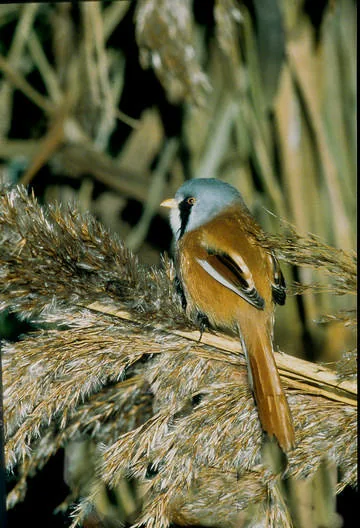
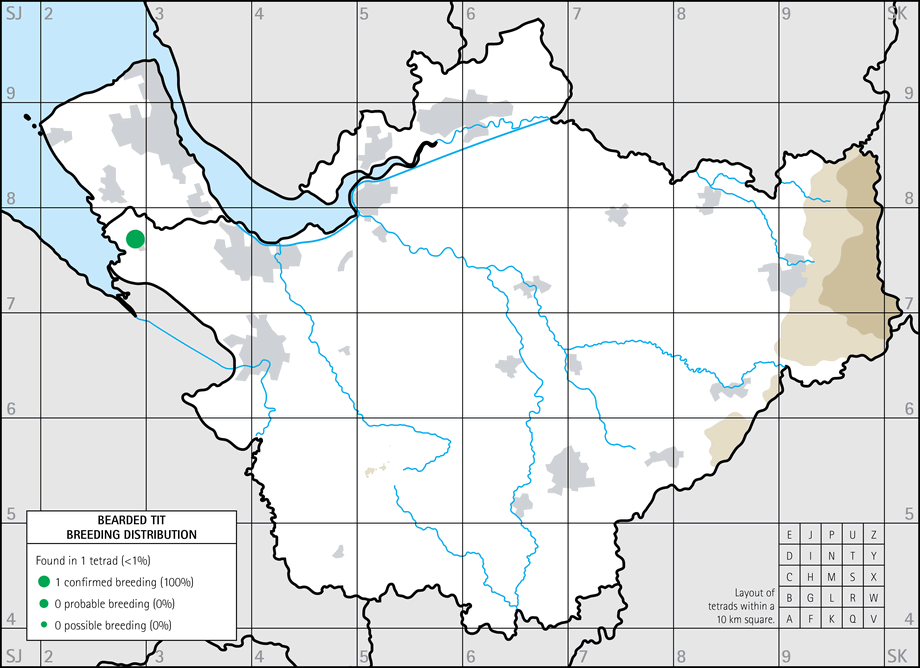
Bearded Tits first bred in Cheshire and Wirral in 2003, at Neston Reed Bed (SJ27Y), and again in 2004 to gain their inclusion in this Atlas. This event came out of the blue, there having been no record of the species in the county during the breeding season from 1985 to 2002, and it seems that no-one even knew the birds were at Neston until they were half-way through breeding, indicating just how elusive Bearded Tits can be, even in a well-watched site alongside a much-used footpath (Wells 2003). They are easiest to detect by ear, Bearded Tits making a loud metallic ‘ping’, unlike the calls of any other British species.
The breeding birds are insectivorous, tending to catch relatively slow-moving insects. Good feeding places can shift suddenly from day to day as a change of wind direction or a synchronous emergence of chironomid midges or wainscot moth larvae suddenly produces easy pickings (Bibby 1981). Colin Wells noted that, at one stage during the 2003 breeding attempt the birds were leaving the reedbed to collect insects from the adjacent rush bed. Researchers elsewhere have noted that the best feeding sites may be some way from the best nesting areas, entailing frequent flights, perhaps up to several hundred metres, for adults feeding chicks. On one day at Neston, the adults took food to the nest eight times in half an hour (Wells 2003).
From the information published in the Cheshire and Wirral Bird Reports, it seems that the Neston birds had just one brood in each year. Elsewhere, they almost always have two broods, often three, and sometimes four in a season lasting as long as September, so that the most successful pairs of Bearded Tits might rear 20 chicks in a year, possibly the highest productive rate achieved by any passerine in Europe. To realise this, some birds overlap nesting attempts, the male building a new nest and his female laying eggs in it whilst they are both still feeding chicks from the first brood; as with most reed-nesting species, the young leave the nest before they can fly, and crawl through the vegetation, and appear to be independent of their parents at 20-25 days old (Bibby 1981). With Bearded Tits at some sites breeding from March onwards, and the birds at Neston not found feeding young until 29 May 2003, could that already have been their second breeding attempt?
They are confined almost exclusively to phragmites reedbeds, and ought to benefit from the national and local Biodiversity Action Plans for that habitat. Bearded Tits have bred at Leighton Moss, the RSPB reserve in north Lancashire, from 1973 on, with a peak of 65 pairs in 2000 (White et al 2008). This is the only regular breeding site in northwest England, perhaps because all other reedbeds are too small, and certainly nowhere can match the 79 ha extent of that at Leighton Moss. The best habitats have a range of water levels: nests are likely to be in the drier parts of reed-beds which support the better undercover, and feeding places are most likely to be wet, especially along margins with open water where emerging chironomids may collect or be drifted by the wind. The birds use freshwater or brackish sites. They build their nests in the thick areas of reed litter, and at Leighton Moss have readily taken to using specially-designed ‘nest-boxes’, wigwam-like structures that mimic their natural sites. Bearded Tits in Cheshire and Wirral might be helped by provision and monitoring of such nest structures by workers suitably licensed under Schedule 1 of the Wildlife and Countryside Act 1981.
Bearded Tits are scarce enough to be monitored by the Rare Breeding Birds Panel: the national population in 2004 was 534-556 pairs, at 51 sites in 15 counties (Holling et al 2007). Numbers have fluctuated over the last thirty years, but there were at least 590 pairs in 11 counties in 1974 and 339-408 pairs at 44 sites in 13 counties in 1992 (Campbell et al 1996). But for now, they are not established members of the Cheshire and Wirral avifauna. In 2005 there were occasional records from Neston in the first three months of the year, and two were heard calling on 14 April, but there were no further records that year, and in 2006 birds were reported at Neston on 4 and 5 April only.
Atlas account sponsored by Jim Martin
Winter
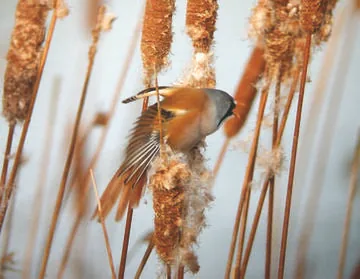
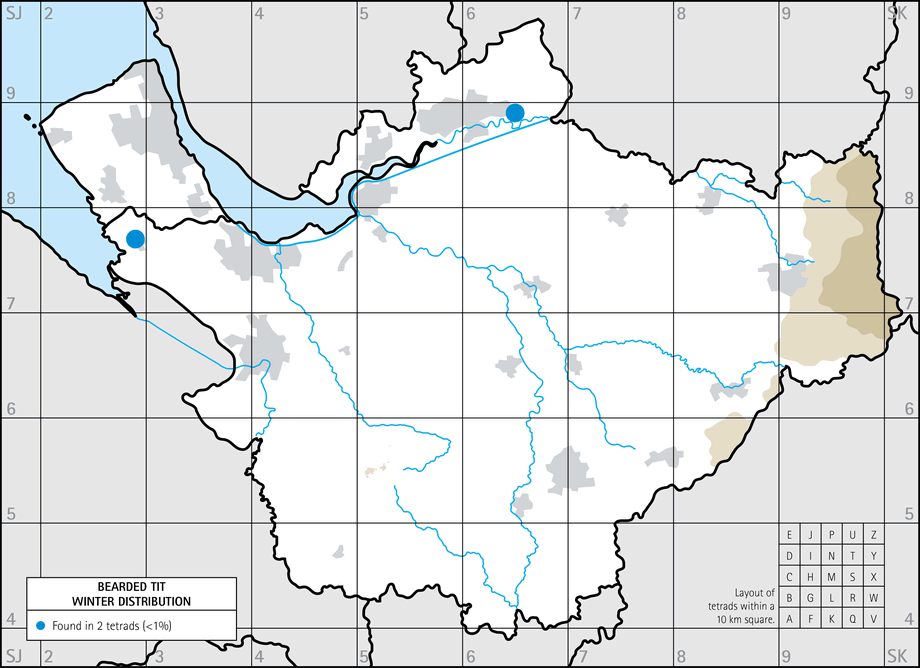
Bearded Tits continue their association with reedbeds all year round. They switch from their insectivorous summer diet to seed-eating during winter, with changes to their digestive system – elongation of the gut – to cope (Bibby 1981). Continuing their dependence on phragmites, this is their favourite seed, but they also eat other grasses and sedges such as nettles and willow-herbs. During this winter Atlas period, birds were seen, and heard ‘pinging’, in Neston Reedbed during winter 2004/ 05, and in the same habitat at Woolston in 2006/ 07. At Neston there were four birds on 27 November 2004 and one, two or three birds reported on other dates through the whole winter period; at Woolston four birds arrived in mid-October 2006 but after a few days, none was found again until two were present on 18 February 2007.
There have been few wintering records of the species in Cheshire and Wirral. In 1965/ 66 there was substantial immigration to Britain and a few reached the county: one caught at Bidston Moss in February 1966 wore a ring from the Netherlands. From 1971 to 1975 a few birds were also reported in the county, mostly in October, but odd ones during winter. Since then, their scarcity is shown by the few records in Cheshire and Wirral Bird Reports, the only birds in winter being a male at Rostherne on 29 and 30 November 1977, one or two at Neston Reedbed for ten weeks over winter 1992/ 93 and two at Arpley Tip (SJ58T) on 4 February 2001.
Bell (1967) described the birds in 1965/ 66 as the first authenticated records for the county, discounting Coward’s (1910) listing of two pairs shot during the 19th century; Coward himself questioned the records, but largely because ‘the Bearded Titmouse is a species that rarely wanders from its usual haunts’, a statement that is now known to be spectacularly wrong.
One of the features of Bearded Tit ecology is their irruptions. In some autumns at some sites, birds gather and rise high above the reeds, perhaps dropping into a new part of the same reedbed, and on occasion leaving the site and flying long distances. During these movements they tend to travel in pairs: a male and female caught just outside our county boundary at Shotton, Flintshire, by Merseyside Ringing Group in October 1965, bore consecutively numbered Dutch rings. There has been much discussion what drives these irruptions. The species’ extreme output of young can lead to high autumn populations, perhaps putting pressure on food resources and forcing them to move in search of reed seeds. But Bearded Tits showed this behaviour every year since they colonised Leighton Moss, regardless of population or seed availability (Wilson 1993). It is not just one-way traffic: some irrupting birds have returned to the continent, including birds ringed in Flintshire in the 1970s subsequently caught in Germany and the Netherlands.
Numbers may be substantially reduced in severe winters, when reed seeds can become glazed with frost or hidden under snow. The breeding population of Leighton Moss fell following hard winters in 1978/ 79, 1981/ 82 and 1985/ 86 to 1987/ 88, and crashed from 65 pairs in 2000 to 7 pairs in 2001 after high water levels in late 2000 had submerged the reed litter, their favoured feeding site, followed by midwinter snowfall (White et al 2008).
Atlas account sponsored by Jim Martin