
Sandbach Flashes: birds and wildlife

About the Atlas
During the three breeding seasons 2004–06 and three winters 2004/05–2006/07, Cheshire and Wirral Ornithological Society (CAWOS) organised more than 350 volunteers to survey all of the county, trying to find every species of bird that was breeding or wintering
Bewick’s Swan Cygnus columbianus
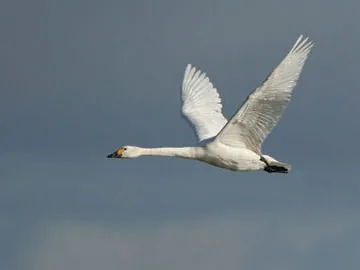
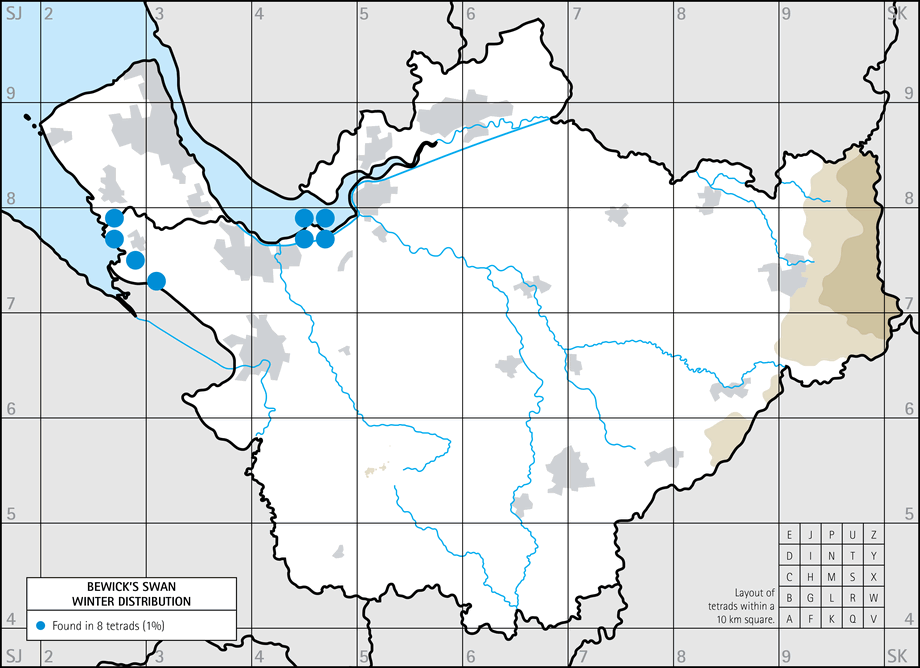
These small swans breed in Arctic Siberia and winter in northwestern Europe, mostly the Netherlands and eastern England. The Wildfowl and Wetlands Trust has been successful in attracting wintering flocks to most of its centres, including Martin Mere in Lancashire. In recent years what are presumably offshoots from this population have taken to wintering on the Dee, and the numbers there make the Dee Estuary of national importance for the species. Although these well-known flocks hold the majority of the country’s Bewick’s Swans, some birds are quite mobile, and colour-marked birds in Cheshire and Wirral have been ringed or seen at Slimbridge, Gloucestershire, the Ouse Washes in Cambridgeshire, and Rutland Water in Leicestershire. Occasionally birds are recorded flying across the county, with the birds often drawing attention to themselves by their melodious dog-like yelping, but the only records of birds on the ground or water during this Atlas came from four tetrads each alongside our two estuaries. The sum of the maximum tetrad counts submitted for this Atlas, probably with an element of double-counting, amounted to 133 birds in 2004/ 05, 129 on the Dee and 4 on the Mersey; with no counts submitted for 2005/ 06 and a maximum in 2006/ 07 of 142 swans, 121 on the Dee and 21 on the Mersey.
The Dee and Mersey birds are unusual in spending much of their time on the estuarine saltmarsh, whereas Bewick’s Swans usually favour freshwater sites. Although they always roost overnight on water, the species has become more terrestrial of late in its feeding habits (Rees 2006). They take copious quantities of leaves and roots of aquatic pondweeds and soft grasses; elsewhere in Britain and Ireland they have learned to favour arable fields, eating root vegetables, but these are seldom found in Cheshire and Wirral.
In the 19th century this species was ‘apparently a very rare visitor to the Cheshire coast’, with only one record, a bird shot on 14 December 1871 (Coward & Oldham 1900). A herd of 27 was found on 15 December 1907 in the Dee estuary (Coward 1910) then Boyd (1951) noted them at Marbury Mere, Great Budworth in eight winters from 1924 to 1950, and they were declared a ‘much more frequent visitor’ (than the Whooper). Bell (1962) noted over sixty records between 1938 and 1960, half of them on return passage in March and April. Most parties are small, fewer than ten birds, and the largest winter flock was Boyd’s 1943 record of 27 birds on Marbury Mere, coincidentally seen later the same day on the Mersey.
Atlas account sponsored by Esther Reinhard