
Sandbach Flashes: birds and wildlife

About the Atlas
During the three breeding seasons 2004–06 and three winters 2004/05–2006/07, Cheshire and Wirral Ornithological Society (CAWOS) organised more than 350 volunteers to survey all of the county, trying to find every species of bird that was breeding or wintering
Black-headed Gull Chroicocephalus ridibundus
Breeding
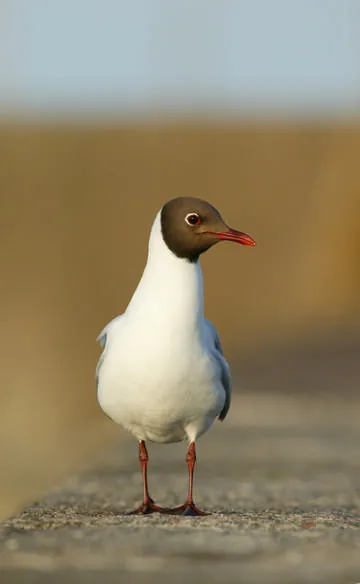
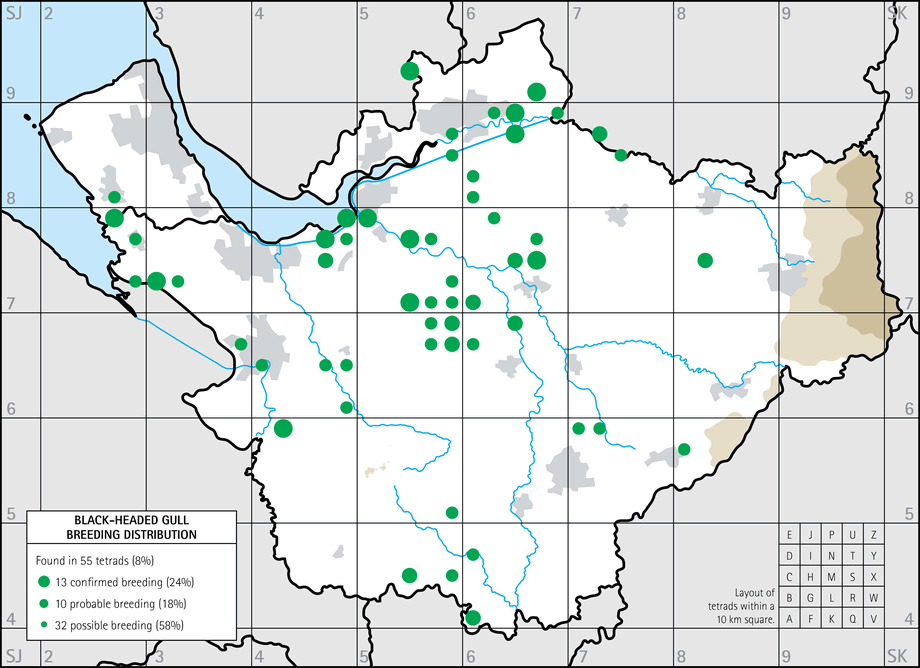
There are three substantial Black-headed Gull colonies in the county. It can be difficult to count the numbers but estimates in 2004 were at least 1,000 pairs at Blakemere (SJ57K), 600-800 pairs at Woolston (SJ68N/ P) and 650 nests at Inner Marsh Farm (SJ37B); in 2005 the figures were at least 1,000 pairs at Blakemere and 500 pairs each at Woolston and Inner Marsh Farm. With fewer than ten nests at any other site, the county total lies in the range 2,000-2,500 pairs. This is the third highest total of inland-breeding Black-headed Gulls of any county in England, with the Cheshire population exceeding 10% of the English total, but unfortunately the county’s records were not submitted to the national ‘Seabird 2000’ survey (Mitchell et al 2004).
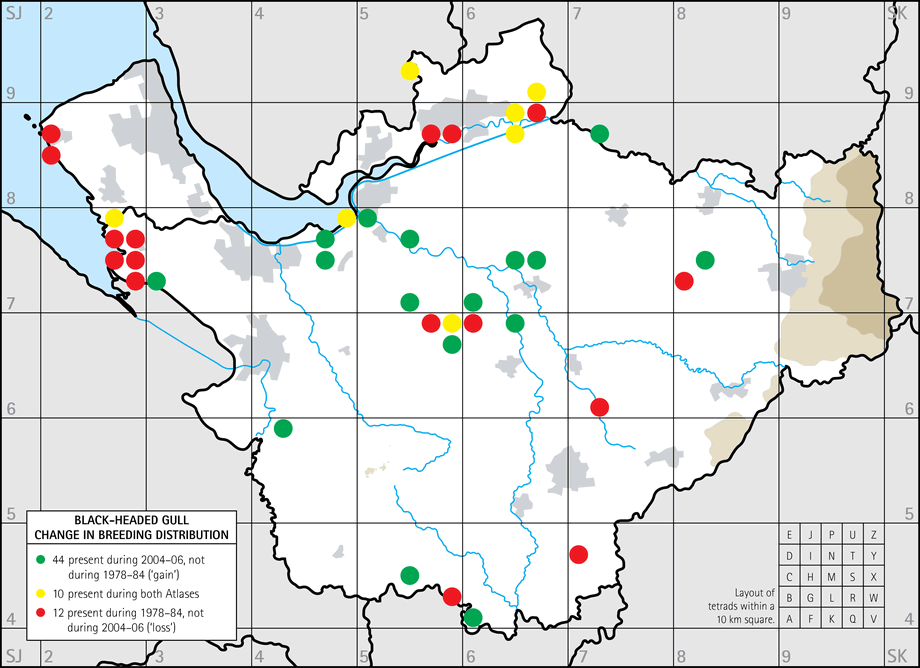
Our First Atlas noted the historical association of Black-headed Gulls with the Delamere area, going back at least 400 years, which had ceased by 1965. Gulls made sporadic attempts to nest in the area but the crucial event was the decision by the Forestry Commission to abandon tree production in the wettest part of Delamere Forest. In late 1996 the Forestry Commission cut down 46.7 ha of trees and allowed the area naturally to flood, re-creating Blakemere Moss. By 1999 Black-headed Gulls had colonised the lake, with their population rapidly rising and estimates of 200 pairs (2000), 400 pairs (2001), 450 pairs (2002), 800 pairs (2003) and 1,000 pairs (2004 to 2006).
Avoidance of ground predators, mainly foxes and rats, is crucial for breeding Black-headed Gulls, and overflying birds are always alert to the formation of a new island. Most nests are on the ground, amongst grass tussocks, or just above the water level in submerged bushes. Even there, they are not safe from minks, which cause havoc when they go through the colony at Woolston, or Lesser Black-backed Gulls, which in some years have taken a large toll of eggs and chicks at Inner Marsh Farm. No significant predation has been noted at Blakemere, although the site is not watched as regularly as the other two. Availability of food provides little constraint on the location of a colony as they obtain little food from the waters immediately surrounding it, and their diet is mostly terrestrial invertebrates obtained from farmland, especially earthworms and the larvae of tipulids and beetles.
Colonies are occupied from February, with the area filled with noise every second of daylight until the birds drift away in July. The cacophony of a Black-headed Gull colony means that no breeding concentration of any size should have been overlooked, but pairs can nest singly or in small groups anywhere and might have been missed. Most sites were recorded as large waterbodies, with odd birds in water-meadow and bog; off Parkgate they nested on the estuarine saltmarsh. One pair nested in 2004 at Frodsham in the top of a rotting wooden post in the Manchester Ship Canal, copying the Oystercatchers there.
The Black-headed Gull is on the UK’s Amber List of species of conservation concern because of its moderate population decline over the last quarter-century and its concentration into a relatively small number of sites, which makes it vulnerable to a localised catastrophe. On the other hand, the Cheshire and Wirral breeding population of Black-headed Gulls is probably higher than it has ever been, and a thorough count of all known colonies would be valuable.
Atlas account sponsored by Hazel J. Raw
Winter
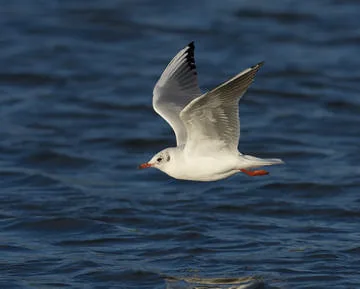
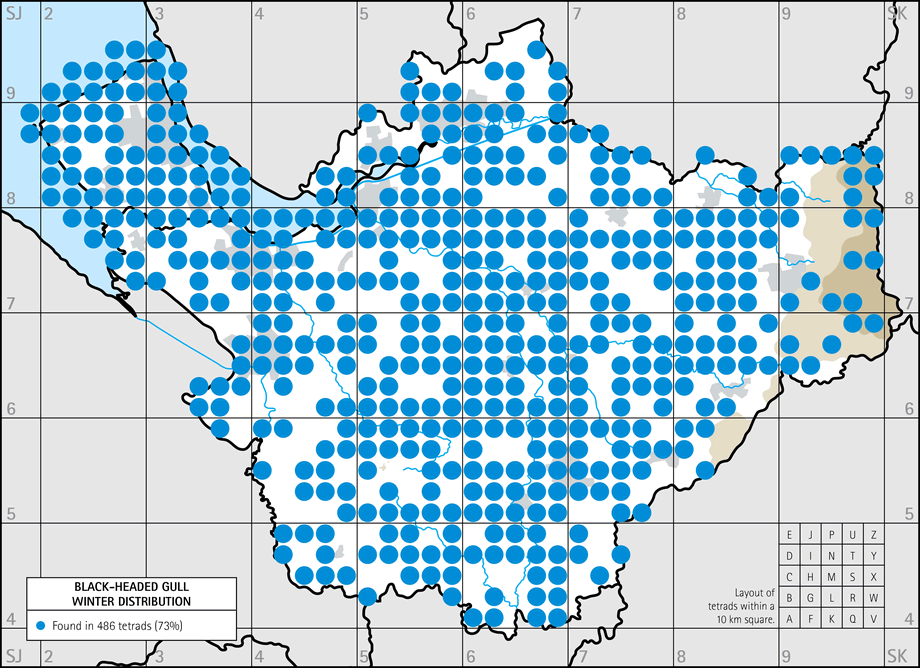
Black-headed Gull is the most widespread gull in winter, being found in almost three-quarters of the county’s tetrads, and seen flying over almost all of them. They avoid the highest land in the eastern hills, and there is a noticeable gap around the environs of Manchester Airport in SJ88, perhaps showing the effects of the airport’s bird-scaring manoeuvres. Not only is it the most widespread gull, it is also the most numerous, found in by far the largest flocks. The median flock size was 60 birds and fieldworkers made 288 counts of 100 or more, and 43 counts of 1,000 or more Black-headed Gulls. The largest gatherings were on water, observers reporting loafing or roosting flocks of 20,000 at Hurleston reservoir (SJ65H), 12,000 on Doddington Pool (SJ74D) and a regular roost of 10,000 birds on mudflats in the river Mersey after feeding at the Arpley landfill site (SJ58T/ Y).
Some three-quarters of the wintering population are immigrants. There are movements of ringed Black-headed Gulls between Cheshire and Wirral and breeding grounds in every country around the North Sea, with the most distant over 1000 km inland in Russia, halfway between Moscow and the Black Sea. On the other hand, some locally-bred birds move out for the winter, with a Woolston-ringed chick wintering in Galway City on the west coast of Ireland.
They feed on a wide variety of soil invertebrates, carrion and marine invertebrates taken in intertidal areas, and domestic waste. 58% of the habitat records submitted for this survey were farmland, with 9% in human sites, 20% on freshwater and 9% in marine areas. Most of the farmland habitats were grassland (42%), with 15% on tilled land or stubble.
They have obviously changed their habits considerably over the years. Until late in the 19th century Black-headed Gulls were almost entirely a coastal bird (BTO Winter Atlas). Coward (1910) commented on their remarkable increase inland, most notably in the north of the county next to the line of the newly-constructed Manchester Ship Canal, which gulls followed along its length. It was worth mentioning that, after 1900, Rostherne Mere had become a regular roosting place for hundreds of birds. Bell (1962) noted that the species was abundant and widespread inland, with ‘a vast roost’ around Runcorn on the Mersey estuary and major roosts at Rostherne, Doddington, and Witton flashes. The Rostherne roost was estimated at 10-12,000 in February 1962 (Bell 1967).
Atlas account sponsored by Hazel J. Raw