
Sandbach Flashes: birds and wildlife

About the Atlas
During the three breeding seasons 2004–06 and three winters 2004/05–2006/07, Cheshire and Wirral Ornithological Society (CAWOS) organised more than 350 volunteers to survey all of the county, trying to find every species of bird that was breeding or wintering
Blackbird Turdus merula
Breeding
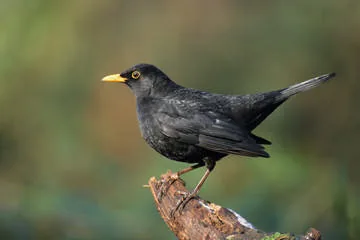
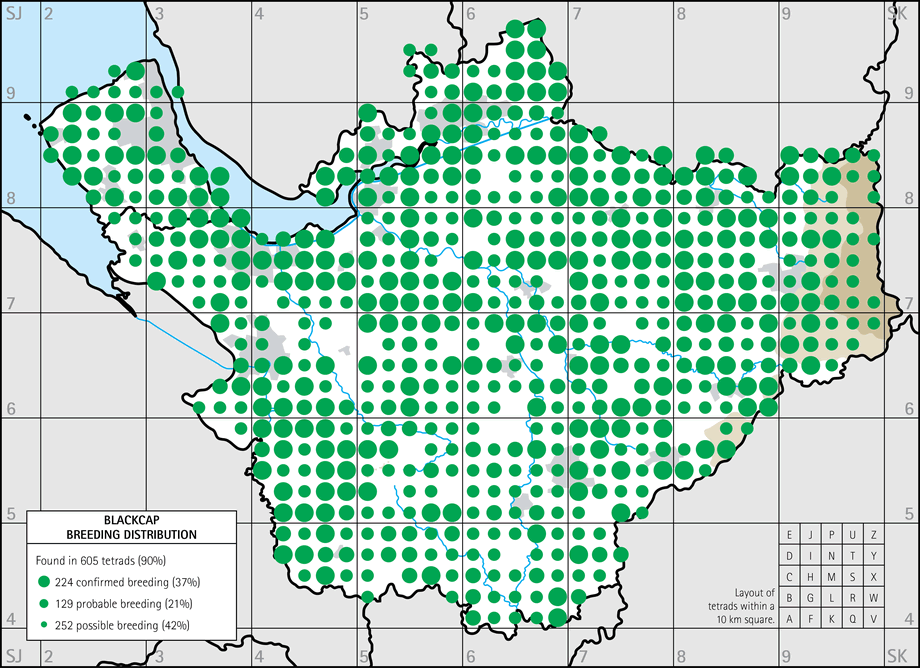
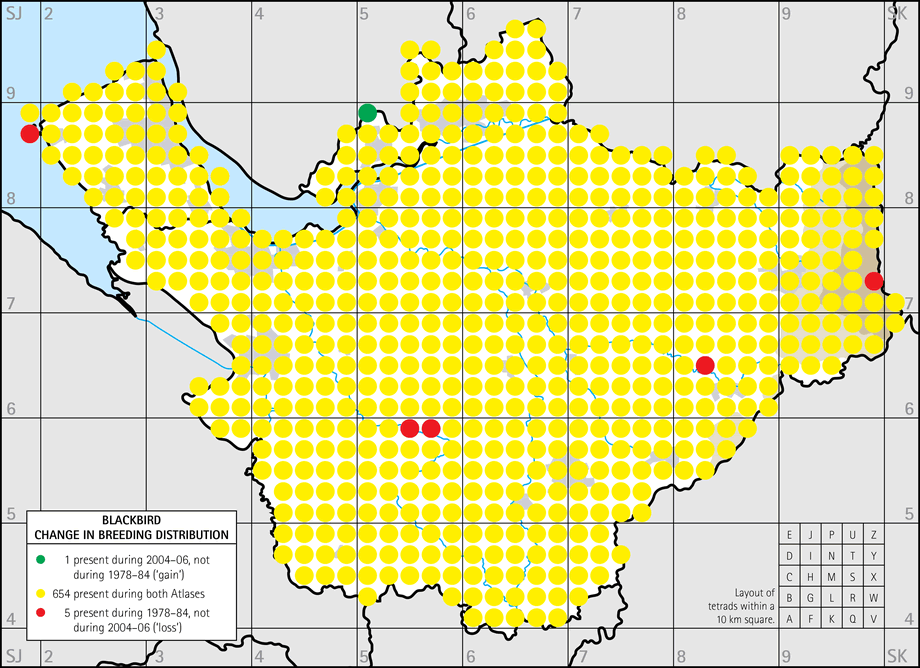
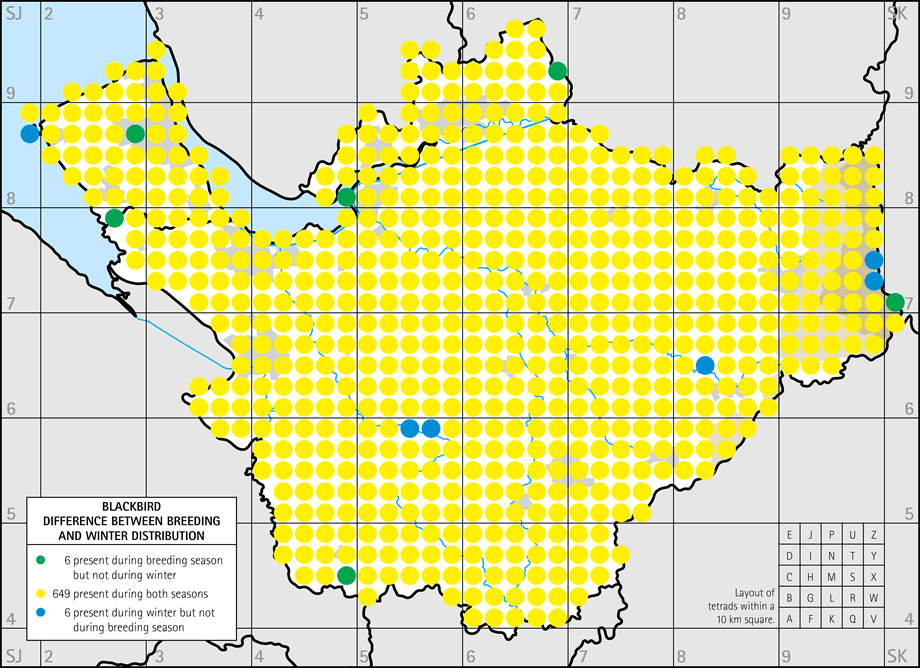
Blackbird was the equal-second most widespread breeding species and appears to be almost ubiquitous, with little change from our First Atlas across most of the county, apart from odd instances of under-recording. They were, however, more difficult to find, and to prove breeding, in some of the highest eastern tetrads: of the county’s twenty tetrads with a mean altitude above 300 m, Blackbirds were confirmed breeding in seven, probably breeding in three, possibly breeding in eight and not found in two, so they have probably declined somewhat in the hill country. They also used to breed regularly on Hilbre at the time of the last Atlas, but then deserted the island, and the female with an incubation patch trapped in 2006 represented the first suspected breeding for some time.
The figure of 89% of Blackbird records being two-letter codes was exceeded amongst the widespread species only by Blue Tit and Starling, showing how easy it is to prove Blackbirds breeding. Such records came from observers seeing adults carrying food (254 tetrads) or with family parties of their spotty-plumaged recently-fledged young (182), with nests found (NE/ NY/ ON) in 146. Observers have multiple opportunities to record them in their long breeding season, from March to August, with birds nesting up to five times following repeated failures, and some successful pairs having multiple broods as well. In 2006 in Chester (SJ46I), Joe O’Hanlon noted one pair that had four broods, although the last one failed.
The main reason for their near-ubiquity in the county is the Blackbirds’ ability to exploit almost any type of habitat. Their most-used category was human sites (34% of habitat records), followed closely by farmland (33%, nearly all grassland and hedgerows), and woodland (25%). They were more likely to be found in scrub (7%) than the other breeding thrushes. As recently as the mid-19th century, Blackbirds were almost solely confined to their ancestral woodland habitat, and were never found breeding near houses (Parslow 1973). Surveyors included an ‘F’ habitat code amongst the returns from 422 tetrads, almost two-thirds of those with the species, with 43 tetrads recording birds in F1, urban areas. Provided that they can find sufficient food and a suitable nesting site, they can breed almost anywhere, and this is one of the species most likely to make the popular press with stories of unusual locations.
Blackbirds eat, and feed to their chicks, a wide variety of food. Earthworms are a staple, with invertebrates discovered in leaf litter, bare soil or grass, and caterpillars and adult insects found above the ground. Such animal matter is probably the most nutritious, but at any time of year they also take fruits and most things provided by man.
The BTO BBS analysis shows that the breeding population of Cheshire and Wirral in 2004-05 was 182,810 birds (156,630-209,000), corresponding to an average of almost 140 pairs per tetrad across the entire county. Average figures are not very meaningful, however, as breeding densities can vary enormously, from as high as 1,000 pairs per tetrad in suburbia, through 100 in farmland, to single figures in the difficult upland terrain (BTO Second Atlas). In the best habitats a breeding territory may be as small as 0.1 ha, equivalent to a circle 35 m in diameter.
The Cheshire and Wirral total amounts to 1.8% of the birds in the UK, indicating that the county is relatively important for the species (Newson et al 2008). Their conservation status is reasonably secure. The national population index was in gentle decline, by about 10% during the period of our First Atlas. This accelerated to reach a low point in the mid-1990s, with numbers on farmland especially reduced and the species Amber-listed for a while, but Blackbirds have recovered since, and the present national population is much the same as in 1980.
Atlas account sponsored by Mrs Edna Draper
Winter
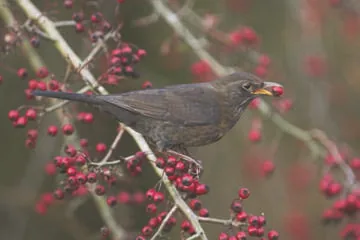
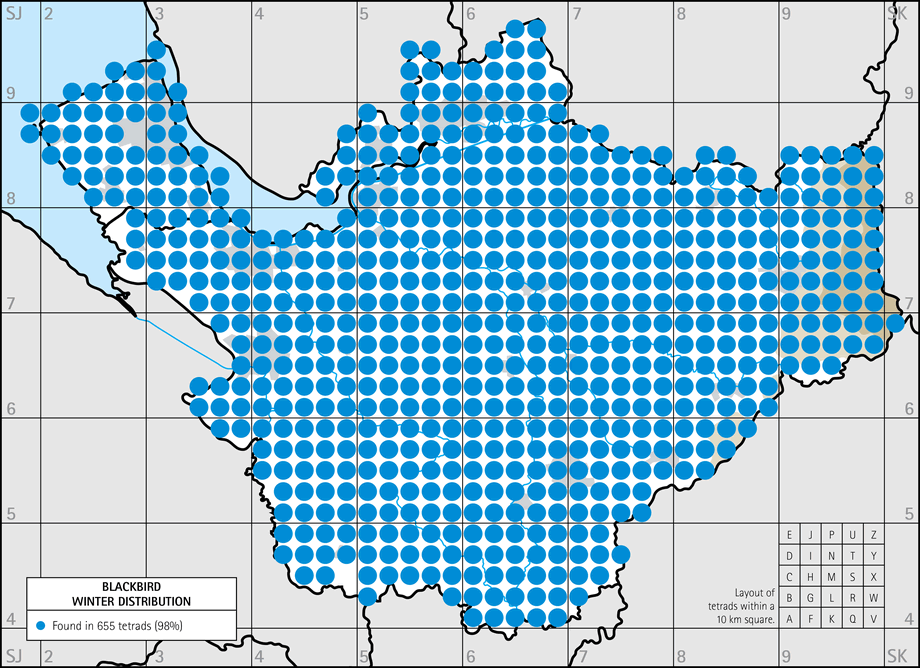
Blackbirds were reported from 655 tetrads in winter, everywhere in the county apart from the estuarine saltmarshes. Many of the birds seen will have been the same individuals as in the breeding season, for most British Blackbirds are sedentary, and have become even less likely to move in the last quarter-century (Migration Atlas). The tendency of some individuals to leave the country has ceased since Coward (1910) wrote ‘in the autumn many of the birds leave us’ and Bell (1962, 1967) detailed several examples of ringed birds. Both members of a pair defend a joint territory in winter, although they might split it and argue over the boundary (Brown & Grice 2005).
Winter numbers are augmented by an influx of birds from Fennoscandia, the Baltic States and elsewhere in northern Europe. The northerly birds tend to be larger, and some can be distinguished in the hand; they are more likely to be found in more remote sites, away from people, although some in gardens are foreign birds, as ringers know. Apart from SK07A, birds were found in all of the tetrads in the eastern hill country, in small numbers, with the largest reported flock being ten birds that Steve and Gill Barber saw, about 450 m above sea level, feeding among a herd of goats at Whitehills (SJ97R).
In winter Blackbirds still like to eat invertebrates whenever they can find them, above all earthworms. On a still, frosty day, Blackbirds in woodland can often be heard from some distance as they noisily scratch through the leaf litter on the woodland floor. But their winter diet contains much more fruit, especially haws, usually taken early in winter, ivy and rowan, with apples as a standby.
The habitats recorded were much the same as in the breeding season – human sites, woodland and farmland, with some in scrub – and the main change is a proportionate reduction in all categories and a huge increase in birds in hedges, with this habitat being recorded in half of all tetrads. More than 40% of the hedge records were in the low (shorter than 2 m) class, and this species may tolerate hedge-trimming better than most, provided that the fruits remain.
Many Blackbirds roost communally, even some of the territorial birds leaving their domain for the night, usually in dense vegetation providing good shelter from winds. Rhododendron scrub under mature trees makes an ideal site, and other suitable roost locations include hedges, conifer plantations, brambles, gorse, and evergreen creepers on buildings (Simms 1978). Surprisingly, as few as eight roosts were reported during this Atlas, with the only substantial count being around 100 at Norton Priory, Runcorn (SJ58L). Other than at roosts, Blackbirds are not often found in large flocks and half of all the submitted counts were of four birds or fewer.
Blackbirds seldom undertake hard-weather movements and are likely to try to tough it out in even the worst of winter conditions (BTO Winter Atlas), probably because of the dedication of most resident birds to a territory. By the time our defined winter period finishes at the end of February, many of the immigrants are preparing to depart – birds ringed in winter in the county have been reported near Stockholm, Sweden as early as 11 March, and in Germany on 15 March – and many of the local birds are starting to breed.
Atlas account sponsored by Mrs Edna Draper