
Sandbach Flashes: birds and wildlife
About the Atlas
During the three breeding seasons 2004–06 and three winters 2004/05–2006/07, Cheshire and Wirral Ornithological Society (CAWOS) organised more than 350 volunteers to survey all of the county, trying to find every species of bird that was breeding or wintering
Blackcap Sylvia atricapilla
Breeding
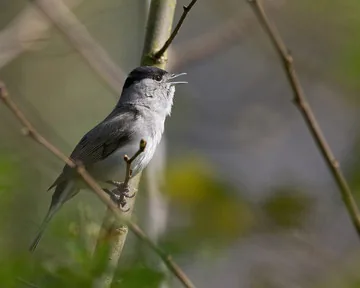
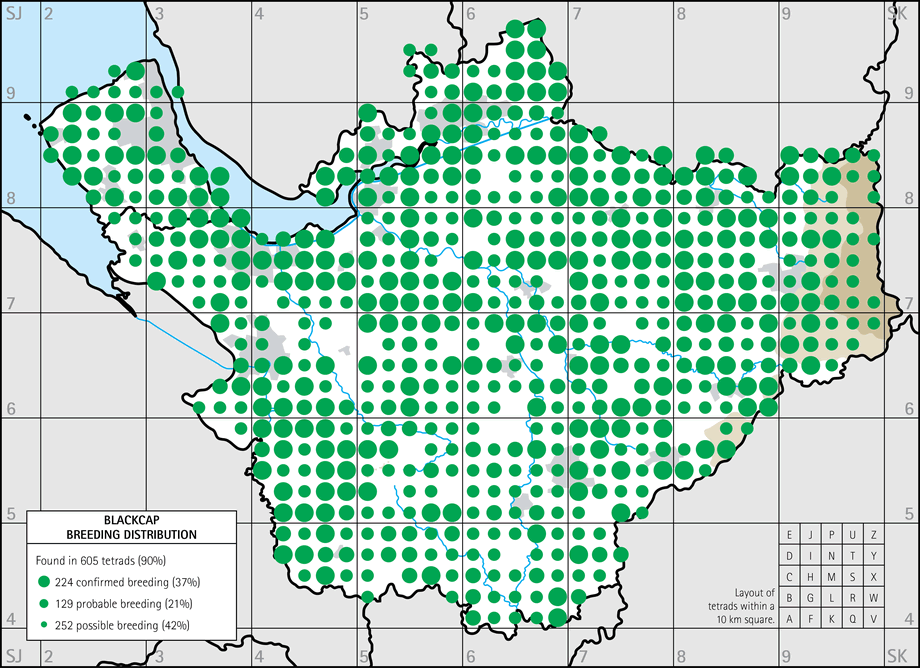
A loud burst of song from a Blackcap deep in the undergrowth is usually the first sign that spring is really here. This is overwhelmingly the woodland Sylvia. Habitat codes submitted for this survey showed 48% in woodland, with 22% in scrub, 18% in farmland and 12% in human sites. Blackcaps mainly frequent mature deciduous or mixed woodlands – fewer than 1% of our habitat records are from coniferous woodland (A2) – with a well-developed shrub layer. They are found especially at the woodland edges, perhaps because greater light penetration makes for more luxuriant shrub growth there. When populations are high, as now, some birds spill out into farmland, where they occupy overgrown hedgerows, especially if they contain some tall trees. They also appear in urban areas, including areas of human habitation and industrial sites, anywhere where there is enough scrubby undergrowth, especially Bramble. Blackcaps were almost twice as likely to be recorded in human sites as any other Sylvia warbler.
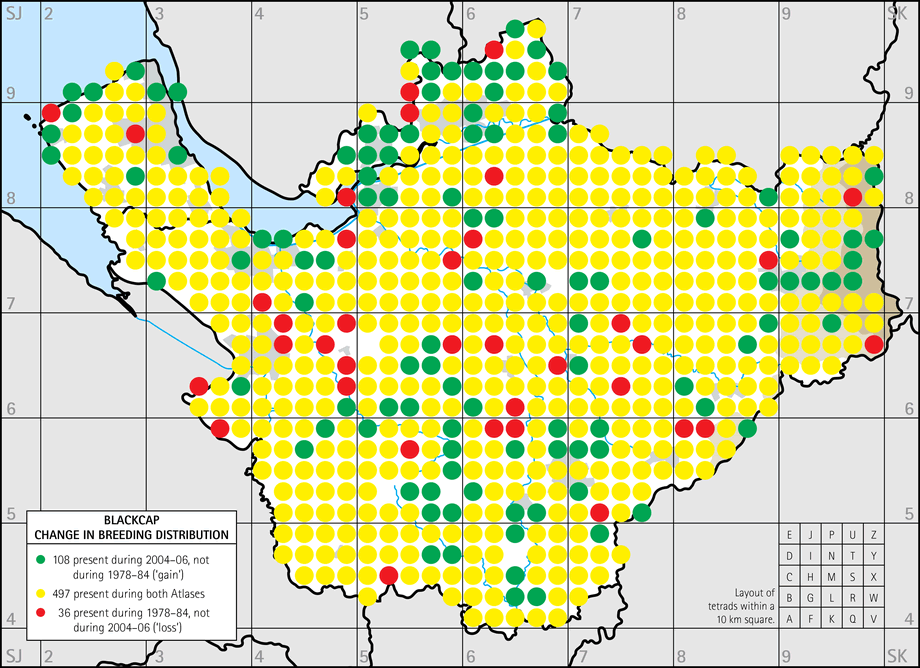
The ‘change’ map shows that in the last twenty years Blackcaps have spread to become almost ubiquitous. They have increased along the Mersey Valley and spread into the eastern hills and onto the least well-wooded farmland in the south and south-west of Cheshire. They are now missing only from the very edges of the county – the highest hills, north Wirral coast, and the Dee and Mersey saltmarshes.
Although the early songs of Blackcap are unmistakeable, once Garden Warblers arrive, usually at least two weeks later, distinguishing the two species can be difficult. They do respond to each others’ songs, with Blackcaps dominating Garden Warblers and trying to keep them out of their territories; but this might just be a reaction against any intruder as they also react against Chiffchaffs entering their area.
As well as singing, the male Blackcap quickly builds a number of flimsy ‘cocks’ nests’, showing them to any arriving female until one decides to stay, choosing one of his nests and lining it. They have a short incubation period of around 13 days, with males taking an almost equal share during daylight hours, and chicks leave the nest after about 11 days, before they can fly properly, and crawl around the undergrowth. The sharp ‘tac’ alarm calls of the parents often alert observers to their best chance of proving breeding, FY accounting for 60% and RF a further 27% of the confirmed breeding records. Caterpillars and craneflies (tipulids) make up much of the chicks’ diet, with beetles especially for late broods when the former have declined in abundance.
Blackcaps have changed their breeding schedule remarkably, and were laying 15 days earlier in 2004 than twenty years previously. This could be a response to climate change: with a relatively short migratory journey to return to breed here, they are well placed to react to rising temperatures. British breeding birds spend the winter around the Mediterranean, with variable numbers from year to year crossing the Sahara. They used only to have one brood, with second attempts uncommon, but now some Blackcaps have more time to fit them in, giving them the chance of increased productivity and also allowing fieldworkers more extended opportunities to record breeding behaviour.
In the first (1964) county bird report Blackcap was said to ‘breed in small numbers’, probably a reflection of the bias in reporting and in birdwatching, but an interesting observation nevertheless. The species has increased consistently in abundance since the late 1970s, although the causes remain unknown. In the twenty years between our Atlas periods (1984-2004) the national population index for Blackcap has risen by 75%. The BTO BBS analysis shows that the breeding population of Cheshire and Wirral in 2004-05 was 12,910 birds (8,570-17,260), corresponding to an average of about 36 birds per tetrad with confirmed or probable breeding, or 21 birds per tetrad in which the species was recorded. Territories can be as small as 0.2 ha, depending on the habitat quality, so there is plenty of room for more Blackcaps in the county.
Atlas account sponsored by Bernard Machin
Winter
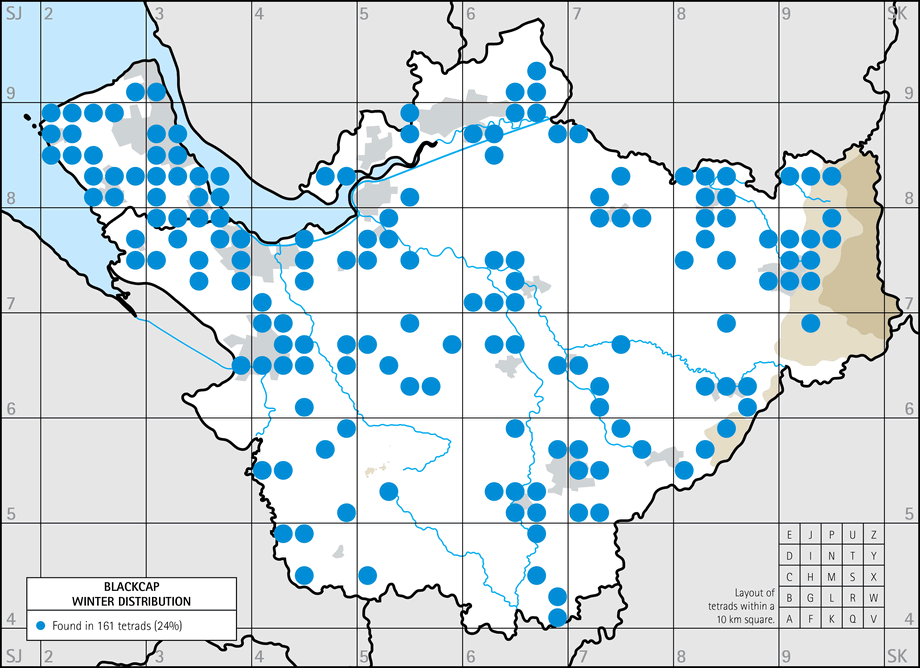
The Blackcap’s winter presence in 161 tetrads, almost one quarter of the county, illustrates an amazing story of rapid adaptability. Contrary to the frequent comments, these are not birds that have ‘stayed’ for the winter. Our wintering Blackcaps are immigrants from breeding areas in southern Germany and Austria which have migrated north-west. When they arrive here, they find a relatively mild climate, and an even warmer urban micro-climate; provision of food in gardens also helps them to survive. In spring, they have a shorter return migration than their conspecifics that have wintered in Africa, and so arrive back on their central European breeding grounds earlier and in better condition, thus being able to claim the best territories and breed earlier. It is easy to see how such an advantageous trait can become established and flourish.
The habitat codes show that most birds recorded (69%) were in human (F) habitats, with 15% in broadleaved or mixed woodland and only 5% in scrub, with 8% in farmland hedgerows. They penetrate even into urban areas, with five records in F1 habitats, 76 in suburban (F2) and 34 in rural areas (F3). Clusters of records around urban areas show up obviously on the map, especially at Macclesfield, Congleton, Wilmslow, Warrington, Northwich, Crewe, Nantwich, Chester, and the Wirral towns. Blackcaps do not seem to call in winter, though, thus being not easy to detect, so a bias towards records from gardens and well-watched places is to be expected.
For a period of seven years in the 1990s, the county bird reports noted the sex of all wintering Blackcaps, totalling significantly more males (255) than females (172). There is, however, no significant difference in the sex ratio of birds ringed in the winter period from 1981 to 2006 by members of Merseyside Ringing Group, so perhaps there are equal numbers present but the males are just more visible to observers. Many of the county’s annual bird reports comment that fewer birds are recorded in mild winters. It is not known if this indicates that there are fewer Blackcaps wintering in the county, or if this observation derives from hard weather driving some birds into gardens from where most of the records come.
They take a wide variety of food, including natural foods, especially the most nutritious fruit – berries of Cotoneaster,holly, honeysuckle and ivy – as well as almost any food provided at a bird-table. Many observers comment on their aggression at communal feeders, and they are well able to hold their own with resident British birds. The national survey in 1978/ 79 – a very cold winter – recorded them taking especially bread, fat, apples and peanuts, plus an eclectic range of items of household scraps (Leach 1981).
Coward and Oldham had ‘no evidence that it ever winters in Cheshire’, and it seems that Boyd recorded the first, on 23-25 January 1944 near Northwich (Country Diary), closely followed by another on 30 January 1944 at Cotebrook (Country Diary). He had never seen one in his Great Budworth parish (Country Parish). It is difficult to tell from the literature when the habit of Blackcaps wintering became more common. Bell (1962) states that ‘there are no recent Cheshire records’ but the first Cheshire Bird Report in 1964 gave the species’ status as ‘winter resident, rare’ and recorded three ‘winter’ birds during that year (two in early November), without any particular comment.
The chart summarise records each winter from the start of the Cheshire Bird Report in 1964. There are some problems in interpreting the reports, not least because some years’ reports jumble the early- and late-winter records. It is always difficult to adjudge the status of late-staying or early-arriving summer migrants, and many records are published without dates. From 1964, birds in November and March were counted as ‘winter’, but from 1975 onwards, November birds were declared to be late migrants. In recent years, with an increased population of birds and birdwatchers, and much extended dates for spring and autumn migration, there is no clear division between breeding or passage birds and those wintering here. With all of those caveats, the chart attempts to count only birds within our defined winter period (16 November to end of February).
Annual records started in 1966/67, but stayed in single figures each winter until 1974/75. The spike in 1978/79, caused by a national survey of the species (Leach 1981), suggested that casual reporting under-estimated their numbers by about a factor of two. From then numbers rose gradually through the 1980s, but more or less reached a plateau from 1992/93 onwards, averaging about 60 birds recorded per winter, although with large year-to-year fluctuations. This Atlas has clearly stimulated a higher level of recording, and the likely total of birds each winter in the county is certainly in three figures.
Atlas account sponsored by Bernard Machin