
Sandbach Flashes: birds and wildlife
About the Atlas
During the three breeding seasons 2004–06 and three winters 2004/05–2006/07, Cheshire and Wirral Ornithological Society (CAWOS) organised more than 350 volunteers to survey all of the county, trying to find every species of bird that was breeding or wintering
Blue Tit Cyanistes caeruleus
Breeding
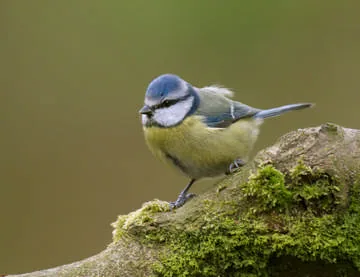
The analysis of Breeding Bird Survey transects shows that this is our second most numerous species, with a breeding population of Cheshire and Wirral in 2004-05 of 195,250 birds (164,480-226,010). This massive total corresponds to an average of more than 150 pairs per tetrad, equivalent to a density of one pair per 2.6 ha across the entire county. This figure is 1.7% of the UK breeding population of 11.3 million birds (Newson et al 2008). National monitoring shows that Blue Tit populations have increased by about 14% in the last twenty years since our First Atlas, aided by mild winters, provision of food in gardens and the availability of nest boxes. The rise in population has been accompanied by decreasing clutch and brood sizes, and a substantial decline in the proportion of young birds in early autumn, in a clear demonstration of density-dependence, suggesting that the British countryside has reached its carrying capacity and is ‘full’ of Blue Tits.
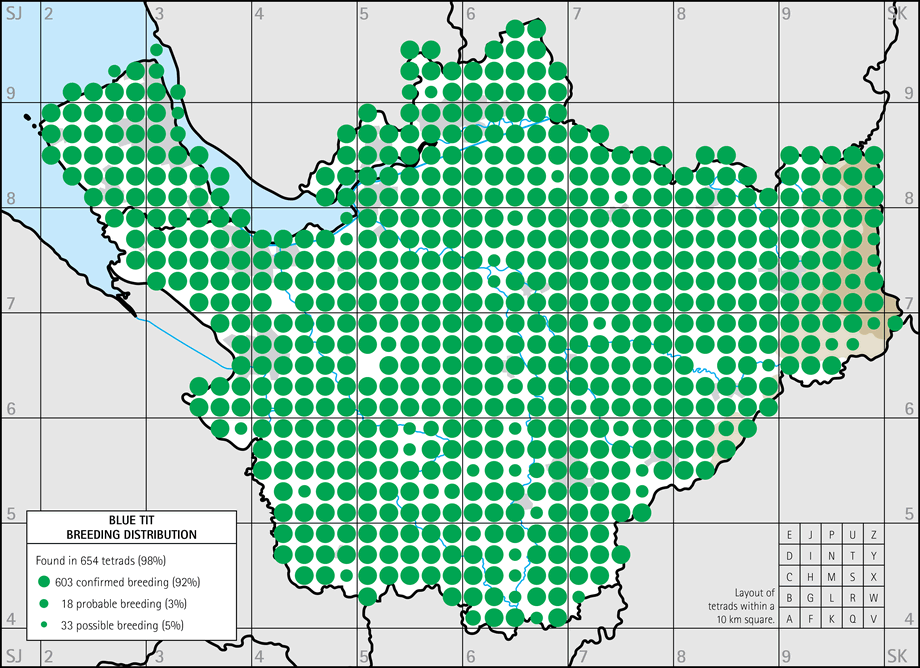
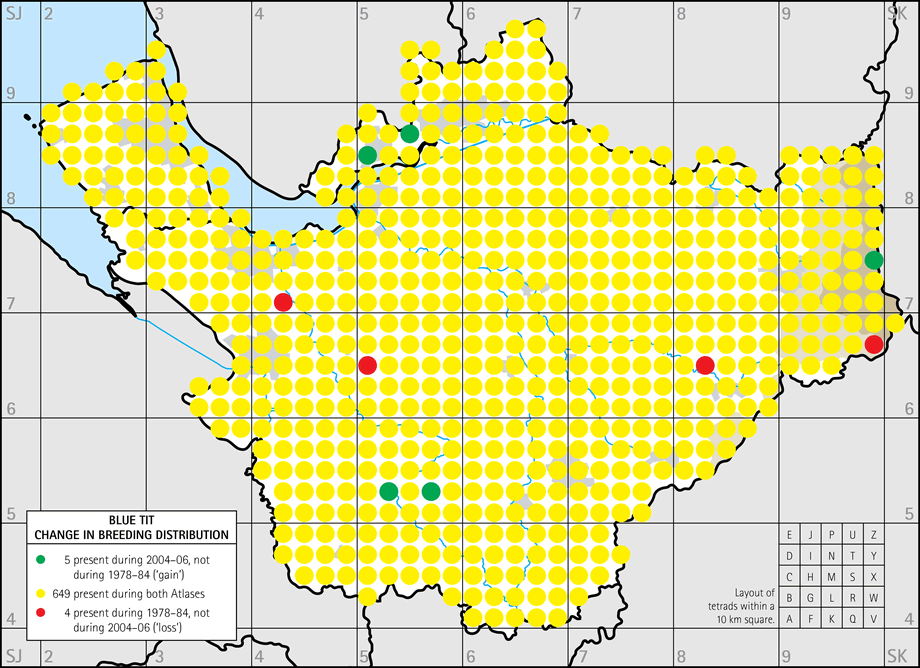
As in our First Atlas, Blue Tits are almost ubiquitous, missing only from a couple of the bleakest upland tetrads, the estuarine saltmarshes, and Hilbre, and a handful of tetrads in which it was just bad luck that an observer could not find them. This species provided the highest number of confirmed breeding records, showing how easy it is to prove breeding (92% of records). Surveyors in 140 tetrads saw them carrying food or a faecal sac, and most records (253) came from fieldworkers seeing parties of recently fledged young, but occupied or used nests were recorded in 32 tetrads, and a nest with eggs or chicks in as many as 178. Blue Tits always nest in a hole or crevice of some sort, and observers reported a wide variety: natural holes in oak, ash and alder; and a range of unnatural sites including holes in metal and concrete gate posts, lamp posts, telegraph poles and walls. Henry Finch noted them nesting in a weathercock atop Kingsley church spire (SJ57M). In 2001 Blue Tits reared seven young at Woolston in the stem of a dead Giant Hogweed, and the feat was repeated in a different part of the reserve in 2002; during this survey, in 2006, Steve and Gill Barber saw birds using the same plant near Tiverton (SJ56K), carrying nesting material into a broken (open topped) stem.
Most Blue Tits were recorded in woodland habitats (375 tetrads), almost all deciduous or mixed, with birds found in scrub in 85 tetrads. The other main habitat categories were hedgerow (125) and farmland (135); in agricultural areas hedgerow trees are crucial for them, in providing nest-holes and caterpillars. The species is quite tolerant of human presence; the 350 records in the F categories comprised 36 urban, 116 suburban and 198 rural sites.
In their prime habitat of broadleaved woodland – which can support up to 1,000 pairs per tetrad (Perrins 1979) – they feed their brood on defoliating caterpillars, especially of winter moths, collected from the tree canopy. The adults bring food as often as once a minute throughout daylight hours for the 18-21 days the chicks are in the nest, a total of perhaps 10,000 caterpillars per pair. The timing of Blue Tits’ breeding season can vary by up to three weeks from year to year as they try to coincide with the short-lived flush of moth larvae. In recent years (notably 1999, 2003 and 2007) there have been days of torrential rainfall in May, often washing many of the caterpillars from the canopy onto the ground. Although they are readily taken by Blackbirds, Robins and other ground-feeders, it seems that tits do not recognise them as food and continue to search the leaves: many chicks have starved as a result.
Atlas account sponsored by Marie Turner
Winter
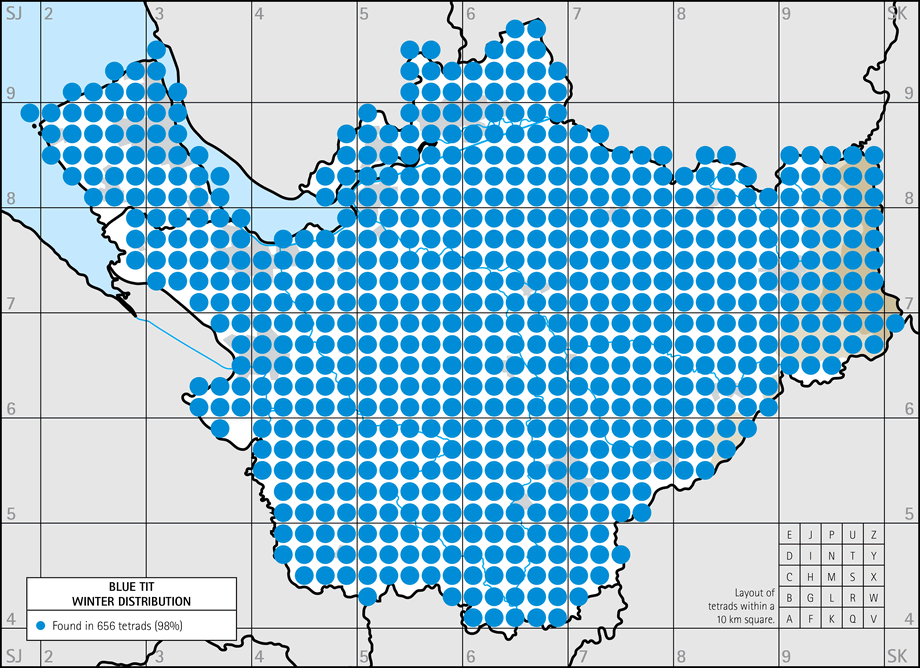
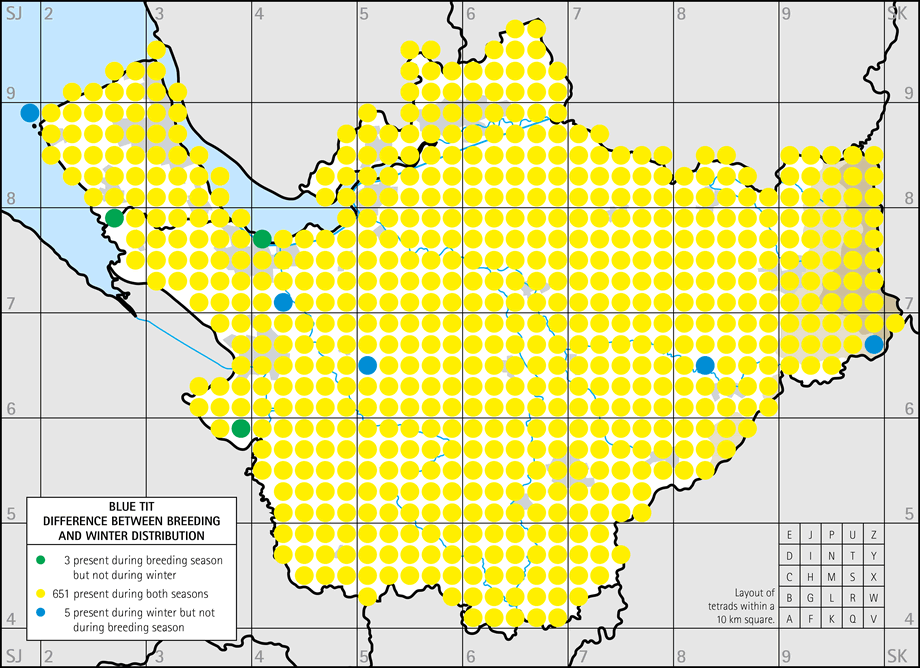
There is little difference in the breeding season and winter distribution of Blue Tits in the county. Odd birds occasionally make it to Hilbre, and also into the highest eastern hills, but not the estuarine saltmarshes. Blue Tits’ habitat use is similar in winter, with most records in woodland and human sites, but there are significant drops in birds reported from scrub (5% of records in winter, 8% during the breeding season) and farmland (8% of records in winter, 13% during the breeding season), with more birds found in farmland hedges (26% of records in winter, 12% during the breeding season).
In natural woodlands, Blue Tits spend most of their time in winter in oaks, searching for insect food amongst the leaves and dead branches, increasingly turning to examining buds when they appear. Beechmast is an important seed, if present, and in gardens they eat peanuts, sunflower and other seeds, bread, suet and other fats. Their former habit – known in Cheshire in the 1930s (Boyd 1946) – of pecking the tops from milk-bottles and drinking the cream is seldom reported these days.
Many writers have had nothing to say about wintering Blue Tits, Coward (1910) and Bell (1962) amongst them, and for many years the annual county bird reports describe only their autumn coastal passage. A detailed study of a relatively small population in suburban Birmingham (Kenrick 1940), which ought to be repeated today, found four components to the population. About 38% of birds were resident, breeding in local nestboxes and visiting bird tables in winter. A further 12% were summer visitors, seen in successive years but only when breeding. Another one-quarter were winter visitors, seen in successive winters but not during the breeding season, and one-quarter of Blue Tits moved through the area, especially in late winter, and were never seen again.
Blue Tits live in flocks for most of the winter, although the median count submitted for this Atlas was just four birds. After the breeding season, birds move around and invade territories, whose owners no longer defend them. A winter flock consists of a small nucleus of dominant residents and constantly drifting, subservient nomads, its composition frequently changing as some individuals leave and new ones join. Even within the winter flocks, however, some birds will be paired, and these birds often display and roost together, probably in an area that they later use for breeding (Colquhoun 1942).
Most Blue Tits live all their lives within a short distance of their natal site. A bird ringed at Meols as a juvenile in 1992 succumbed to a Sparrowhawk at the same site in 2002 when it was a few months short of the national record for longevity. The median distance of movement of chicks to winter areas is only 3 km, although 5% of birds move more than 68 km and females move farther than males. The distances that a few will travel are shown by the bird caught at Woolston on 24 February 2001 that had been ringed as a chick in 1996 in a nest-box in Grizedale Forest, Cumbria, 111 km away. After midwinter the range contracts as birds move back towards their natal site (or the more distant ones die). For those recruited to the breeding population at one year of age, 95% of them are within 15 km of the natal site, and half are within 2 km, showing their essentially sedentary nature (Migration Atlas).
By the end of our winter period, many Blue Tits are on territory and choosing nest-sites, examining every possibility. I put up a nestbox in my garden on 25 February 2002, and had walked no more than 5 metres away before a Blue Tit was looking into the hole, and birds have bred in it every year since.
Atlas account sponsored by Marie Turner