
Sandbach Flashes: birds and wildlife
About the Atlas
During the three breeding seasons 2004–06 and three winters 2004/05–2006/07, Cheshire and Wirral Ornithological Society (CAWOS) organised more than 350 volunteers to survey all of the county, trying to find every species of bird that was breeding or wintering
Bullfinch Pyrrhula pyrrhula
Breeding
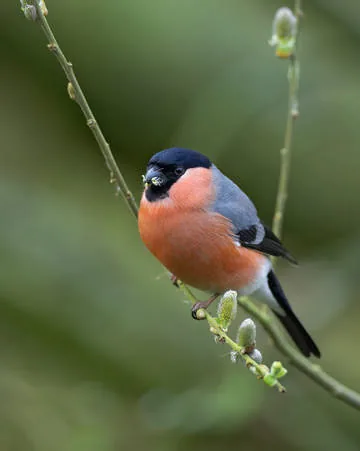
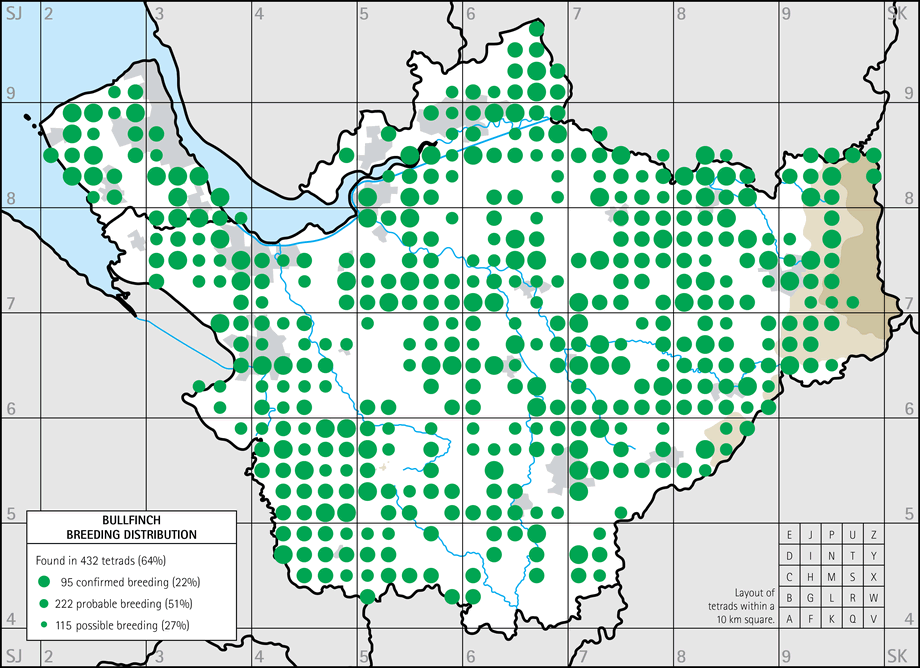
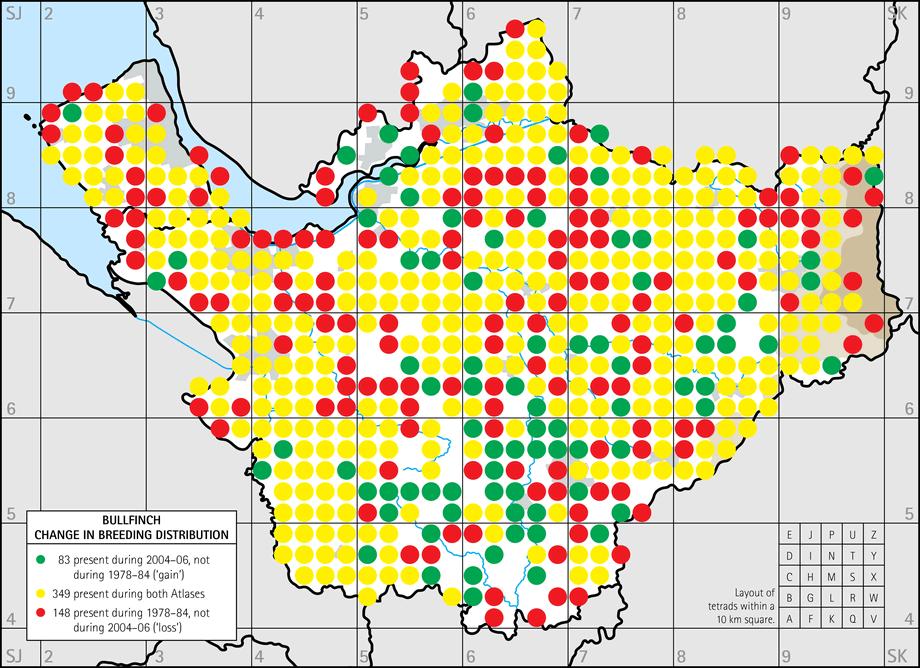
Because of its big decline in population, the Bullfinch is on the UK’s Red List of species of conservation concern, with a Biodiversity Action Plan nationally and locally for its conservation. Bullfinches declined greatly during the period of our First Atlas, the national population dropping by 44% in a decade, from the peak in 1974 to 1984. It has continued to decline, with the national index in 2004 about 20% lower than twenty years previously. It was therefore not surprising to find that the breeding distribution map shows a net loss from 65 tetrads compared to the First Atlas. There are 83 gains, mostly in the central southern part of Cheshire, but 148 losses spread across the whole of the county. They avoid the highest land in eastern Cheshire, and even the sandstone ridge. The habitat records show that most were in broadleaved or mixed woodland (33%), followed by farmland (31%) – where they particularly favour orchards and tall hedges – and scrub (18%). They are the least likely of our finches to use human sites (16% of records), with only three tetrads with an F1 (urban) code.
This is a difficult species in which to confirm breeding, and most records were of pairs seen. Bullfinches are not obviously territorial, and may fly up to 1 km away from the nest if necessary to reach good feeding areas. Their song is thin and scarcely audible more than a few metres away, but they do indulge in exaggerated mutual displays. Nests are usually well hidden in bramble, hawthorn or similarly inaccessible bushes or hedges, and were found in only 23 tetrads. They rear the chicks on a mixture of soft seeds and small invertebrates, with the proportion of animal material gradually reduced as the chicks grow so that, by the time they leave the nest, they are getting seeds alone. The parents do not carry food in their bills but store it in their special throat-pouches – the only British finch that has this adaptation – so adults seen with bulging cheeks are probably on their way back to a brood. Most of the Atlas records (56) of confirmed breeding came from observers seeing family parties including young birds, distinctively different from their parents, plain brown with no black cap, as the adults feed their young for two or three weeks after they leave the nest. Five observers were lucky enough to have adults bringing their young to garden bird feeders. They nest typically from late May onwards and usually have two broods, making a late end to the season: half-grown chicks were ringed in a nest at Woolston on 4 September 1994.
The reasons for the Bullfinch decline are not understood, but the drop has been much more severe on farmland than woodland and is likely to be linked to removal of hedgerows, and frequent trimming of those remaining, impacting on Bullfinches through loss of nesting habitat and food sources (buds, seeds and fruits). There is no link between Bullfinch populations and those of predators, but Sparrowhawks exert an influence on Bullfinch behaviour. When the raptors were scarce or locally extinct in the 1960s and 1970s following poisoning by organochlorine pesticides, Bullfinches were found in some counties in large flocks, sometimes one hundred strong, feeding in the centre of fields and orchards, well away from cover; this habit has died out as Sparrowhawks have increased (Newton 1993). There is unfortunately no information on Bullfinch numbers or behaviour in Cheshire and Wirral during this time as it coincided with the dark period in the county’s ornithology when bird reports were interested only in migration.
The BTO analysis of 2004-05 BBS data puts the breeding population of Cheshire and Wirral as 2,580 birds (2,250-2,920), corresponding to an average of 8 birds per tetrad with confirmed or probable breeding, or just six birds per tetrad in which the species was recorded. The abundance map shows that the only areas with higher densities were the western edge of Cheshire, south Wirral and the mosslands north of Warrington.
Atlas account sponsored by Robin Hart
Winter
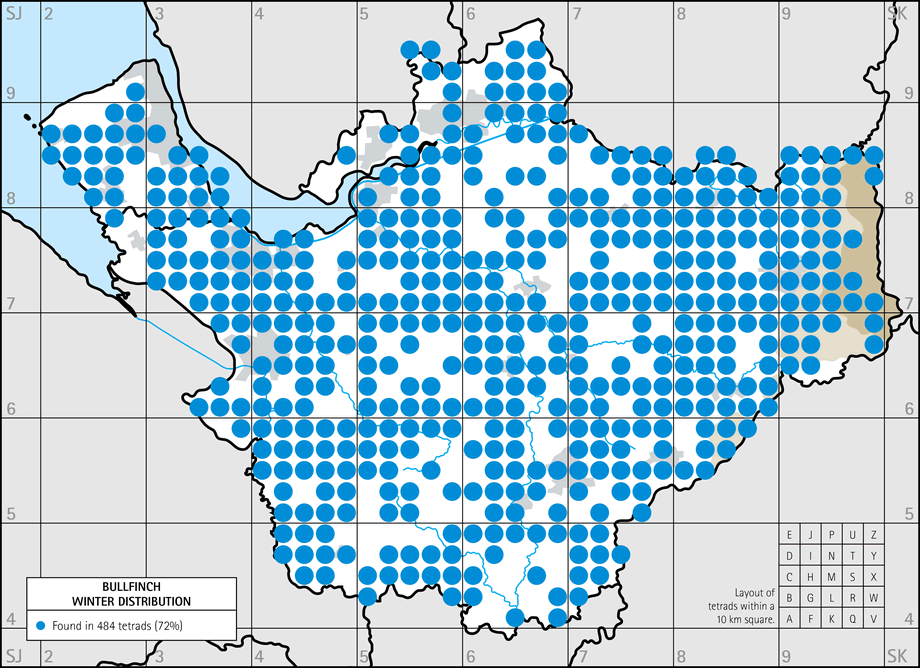
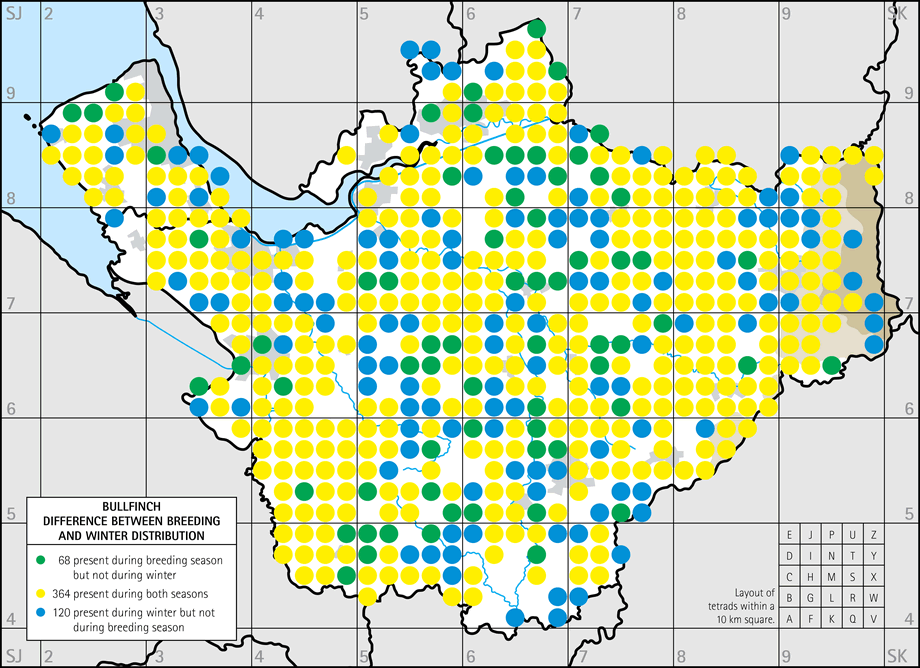
Bullfinches were reported from 484 tetrads in winter, with 364 tetrads occupied in both seasons, 120 in winter only and 68 in the breeding season only. The winter distribution appears to fill in most of the gaps from the breeding season, and some birds move out of breeding areas into farmland for winter (Brown & Grice 2005). The main changes in recorded habitats from the breeding season are significant drops in birds in woodland and scrub, with large increases on farmland and human sites. The number of tetrads recording birds in hedges doubled between the two seasons, and there were half as many again in human sites: Bullfinches were recorded quite frequently as visitors to bird-feeders in gardens or nature reserves. They do not gather into large flocks like some other seed-eating birds, and most counts were of one or two birds, which is how Bullfinches normally spend their lives. Many observers reported seeing male and female together, and Bullfinches appear to pair for life (Newton 1993). Birds may gather together at favoured feeding locations, and fieldworkers reported groups of 8-12 birds in nine tetrads, but they usually arrive and depart from different directions and seldom stay in flocks (BTO Winter Atlas).
Through the winter, Bullfinches eat whichever seeds they can find, initially those of nettle, birch and rowan, and later those of bramble, dock and ash; in upland areas, they eat heather seeds. Weeds in large fields are not important to them, because the Bullfinch does not forage far from hedgerows and woods, but they do eat seed-bearing weeds in field margins. Where it is available, ash forms a major winter food, but Bullfinches are selective and feed from some trees and not others, choosing those with a lower concentration of the bitter, poisonous phenols and higher fat contents (Newton 1993). As the seed supplies are not replenished during the winter, the size of the initial crops, and the rate at which they are depleted, influence the date when they run out, and Bullfinches have to switch from seeds to buds. Their well-known ability to digest cellulose from buds is a life-saver for the birds, but brings them into conflict with man in gardens and fruit-growing areas. Their favourites include blackthorn, hawthorn and crab apple amongst wild species, with cultivated pear and apple trees.
The winter population comprises mostly the same birds as breed here, as Bullfinches seldom move more than a few kilometres. Occasional influxes of birds from Scandinavia – distinguished by their loud ‘trumpet’ calls rather than the thin piping of the British birds – are usually confined to northern Britain and make no difference to the Cheshire and Wirral numbers. Detailed studies have revealed that individuals may remain for weeks or months within a short distance of a good food source, before suddenly moving to a new site that may be several kilometres away (Migration Atlas). This behaviour could account for movements of two local birds. A bird ringed as a nestling at Frankby, Wirral (SJ28M) in June 1986 and retrapped there as a breeding male in June 1988 was found dead in Staffordshire, 74 km away, in January 1989; and another ringed at Woolston (SJ68P) in 1986 as an adult male, and retrapped there in August 1987, was caught in winter 1990 at Aston (SJ57P), 13km away.
Atlas account sponsored by Robin Hart