
Sandbach Flashes: birds and wildlife
About the Atlas
During the three breeding seasons 2004–06 and three winters 2004/05–2006/07, Cheshire and Wirral Ornithological Society (CAWOS) organised more than 350 volunteers to survey all of the county, trying to find every species of bird that was breeding or wintering
Canada Goose Branta canadensis
Breeding
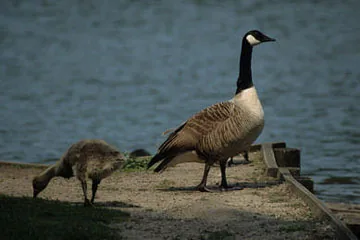
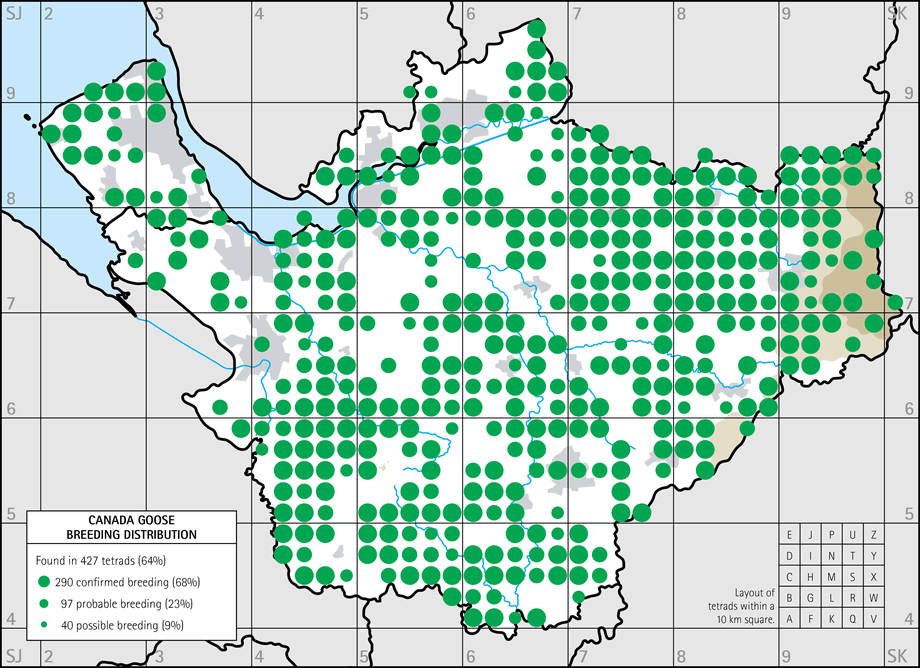
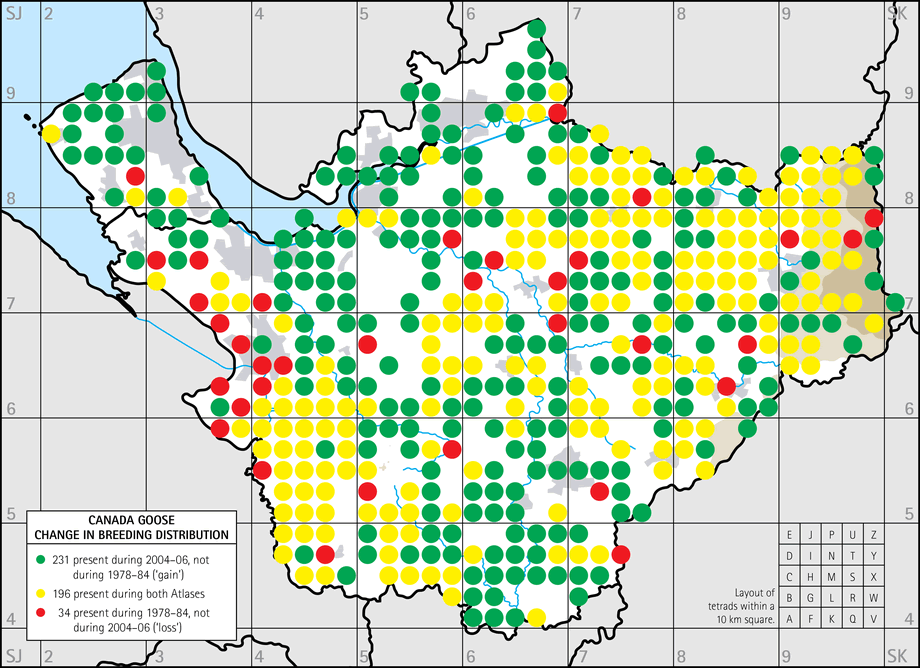
Canada Geese have greatly extended their presence in the county: they are now present in 80% more tetrads than in our First Atlas, and were proven breeding in more than twice as many. They have spread to breed on some very small waterbodies, often where water barely shows up on the map such as on drainage ditches and farm ponds. As expected, most (80%) of the submitted habitat codes were freshwater, with 12% on agricultural grassland. They were overwhelmingly on static water; 349 on ponds, lakes, meres and reservoirs and 43 on linear watercourses, mostly rivers and large canals. Most birds were on quite small waters: 22% of those on standing water (G1-5) were on ponds smaller than 50 m2 in area, with 47% on small waterbodies up to 450 m2 and 31% on larger waters.
This agrees with the results of national surveys, in which from 1991 to 2000 the population grew at a rate of 9.3% per annum, giving a doubling in nine years (Austin et al 2007). The increase since 1991 occurred mainly in habitats that had previously held low goose population densities, particularly small areas of water. Although densities are still relatively low in this habitat, because of its extent it supported more than half of the total British Canada Goose population in 2000.
In Cheshire and Wirral, the BTO BBS analysis shows that the breeding population in 2004-05 was 6,310 birds (1,460-11,160), an average of about 15 birds per tetrad in which they were recorded. Canada Geese do not breed until three years of age, so some of this total will be non-breeding immature birds, but it nevertheless represents a large rise from the estimate in our First Atlas of 600-700 pairs. At 2.8% of the UK total, Cheshire and Wirral holds a disproportionately large population of Canada Geese.
Twenty years ago, most Canada Geese were breeding at sites in a band from the south-west to north-east of Cheshire, with only a dozen tetrads with proven breeding north-west of a line from Chester to Rostherne, and just three of them in Wirral. They have now expanded their distribution to colonise every habitable area in Wirral, the Mersey valley, and all suitable areas of agricultural Cheshire. They are content to breed alongside man, in urban parks, and altitude is no bar to them, being found on the highest waters in the county.
More than two-thirds of records were two-letter codes, proven breeding. Their nests are large and obvious, and adults with their young are conspicuous, either on the water, spread out feeding on grassland or sometimes walking long distances, with a line of chicks led by mother at the front, father bringing up the rear. Where breeding numbers are high, young birds flock together in crèches, guarded by some of their parents, as at Frodsham Marsh where sometimes more than one hundred birds gather on the Manchester Ship Canal. Most of the probable breeding records on the map came from observations of pairs of geese.
Atlas account sponsored by Knutsford Ornithological Society
Winter
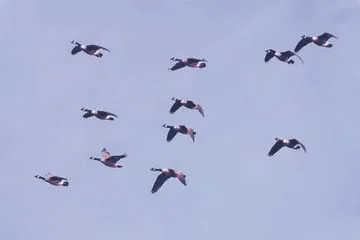
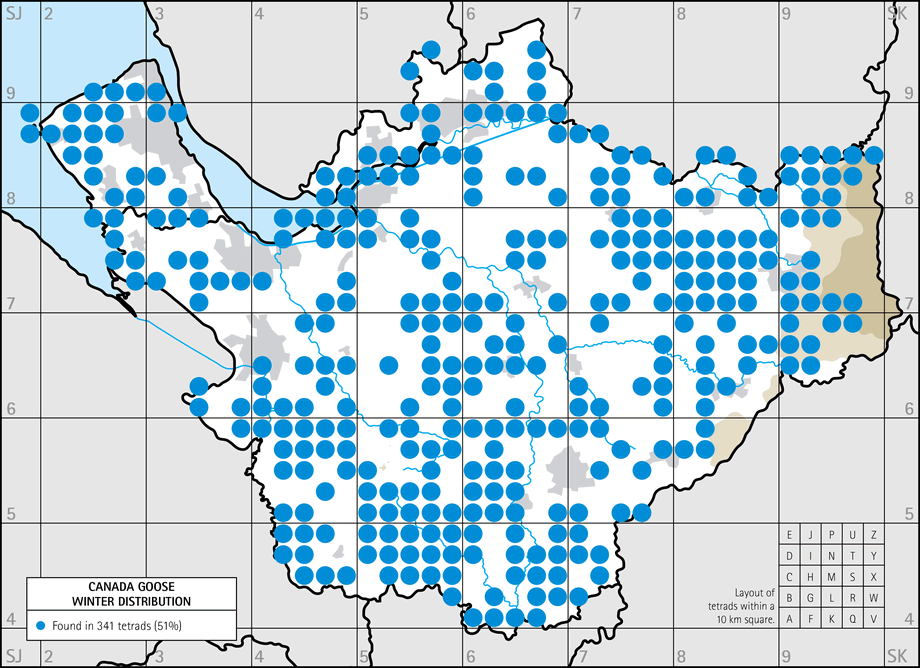
The winter distribution of Canada Geese is broadly similar to that in the breeding season, although they generally gather into flocks and move to larger waters; some birds also spread out into the estuaries. Incomplete counts of the flock on the Dee, up to a maximum of 2,500 in October 2002, place it at the top of the national list of sites for wintering Canada Geese (Banks et al 2006) while the moulting flock on the Mersey, peaking in July and averaging 1,300 birds, puts the estuary in third position of the national table. Winter monitoring by WeBS shows a continuing long-term increase (Banks et al 2006), and the national population, from midwinter WeBS counts, was estimated at 56,000 birds in 2004/ 05.
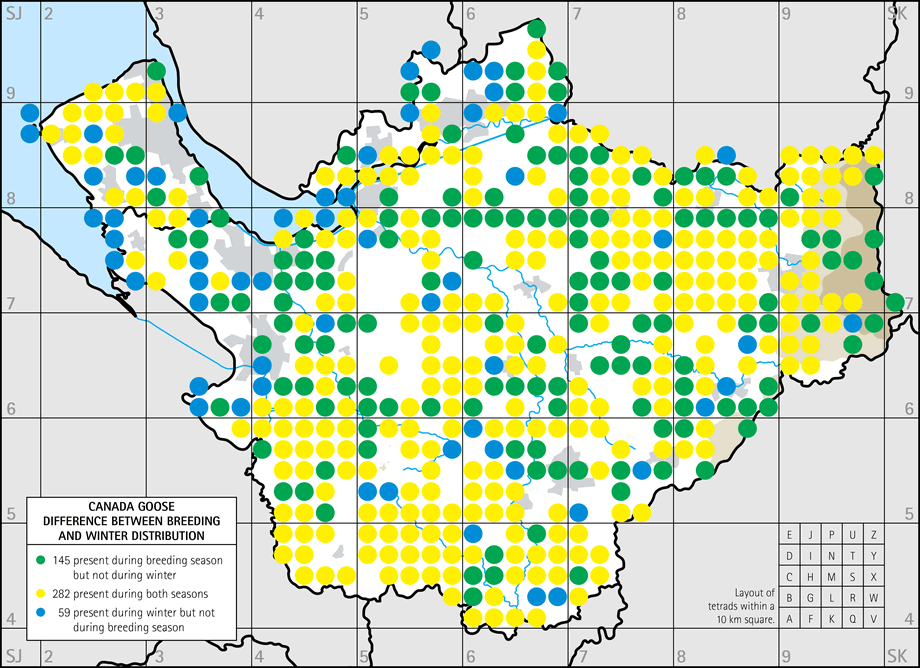
Canada Geese were found in some 56 fewer occupied tetrads in winter than during the breeding season (361 winter and 417 breeding season), perhaps explicable by the species’ gathering into larger flocks for the winter. More than fifty tetrads recorded birds in flight but not on the ground or water and clearly birds move around a lot within the county. There is, thus, much double-counting of some mobile flocks, but as many as 87 tetrads recorded flocks of 100 or more geese, of which fifteen were larger than 500 and five flocks were counted at more than 1,000 birds. Canada Goose numbers have clearly increased greatly since Boyd (1951) commented on ‘good flocks’ numbering up to fifty birds! Coward & Oldham (1900) treated all introduced or escaped birds with disdain. They wrote that the Canada Goose ‘has been long naturalised and today exists in a perfectly wild state in Cheshire, breeding on many of the meres … in winter it is not unusual to see flocks, varying from half a dozen to two or three hundred birds, feeding in the fields or flying from one sheet of water to another’.
Birds mainly feed on grass. 29% of the winter habitat codes were farmland, overwhelmingly grassland, and there were only three records of Canada Geese on stubble fields. Most of the habitat codes were freshwater (61% of records), comprising 8% of the total on ponds, 20% small waterbodies, 23% meres, reservoirs and sandpits, and 9% rivers and canals. 3% of records were estuarine and 5% on grazing marsh and saltmarsh.
Atlas account sponsored by Knutsford Ornithological Society