
Sandbach Flashes: birds and wildlife

About the Atlas
During the three breeding seasons 2004–06 and three winters 2004/05–2006/07, Cheshire and Wirral Ornithological Society (CAWOS) organised more than 350 volunteers to survey all of the county, trying to find every species of bird that was breeding or wintering
Carrion Crow Corvus corone
Breeding
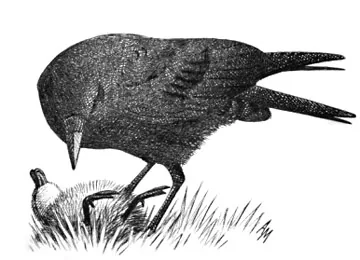
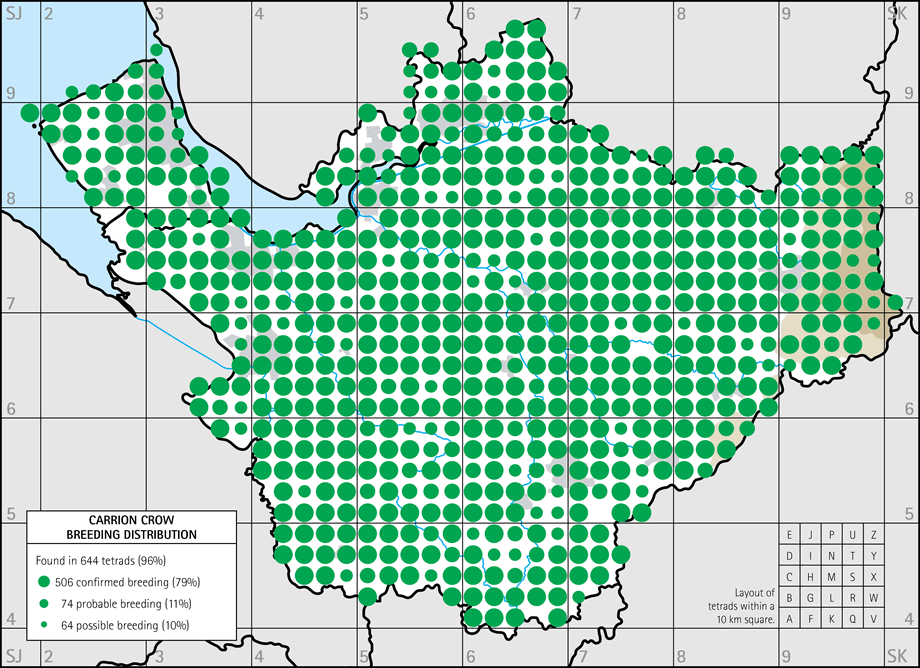
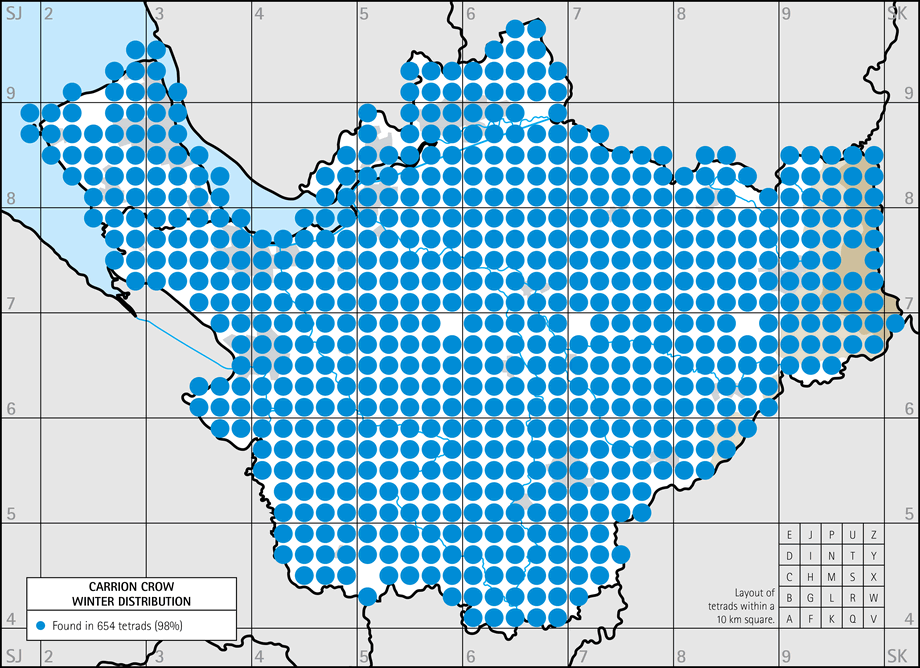
Apart from odd areas of under-recording, the Carrion Crow is ubiquitous in the county, and ranked tenth in order of the number of tetrads occupied. Since our First Atlas they have regularly bred on Hilbre. Although they are wary birds, crows can be found in every town and village as well as all rural areas of Cheshire and Wirral. The habitats recorded were 53% in farmland, 30% in woodland, 4% in scrub and 12% in human sites. The abundance map suggests that the regions of highest density include a band from Runcorn to the southwest of Cheshire and another area in southeast Cheshire, while there are fewer birds around Knutsford and Northwich and much of the Wirral peninsula.
Carrion Crows’ nests are normally high in a tree, from 10 to 20 metres up, usually firmly supported in the middle of the crown. They are very well constructed, of twigs and fibrous material, filled with earth and mud and lined with wool, feathers and other soft and warm materials, and crows’ nests often last for two years or more and are very important structures for other birds. They are seldom re-used by Carrion Crows but may often form the base for the nest of a raptor, especially Sparrowhawk, Hobby or Buzzard. Fieldworkers found nests in 295 tetrads; the only species of tree reported, in five tetrads, was oak. Most chicks fledge by early June and then accompany their parents for several weeks. Records of recently fledged young provided proof of breeding in 170 tetrads.
Their omnivorous diet allows them to survive almost anywhere. They eat a lot of grain and weed seeds, but meat is a particularly important food item during the breeding season; they take small mammals, usually caught alive, and – true to their name – carrion, crows performing an important early-morning job in clearing road-kill (Coombs 1978). On Hilbre, the crows mostly feed by scavenging on the tide line.
The national population has been rising since at least the 1960s (Gregory & Marchant 1996) and the index has shown a 43% rise since 1984. According to the analysis of BBS transects in Cheshire and Wirral, their breeding population in the county in 2004-05 was 30,640 birds (24,080-37,190), an average of 48 birds per tetrad in which they were found. It is not known how that total splits between territory-holding adults and non-breeding flocks, the latter containing one-year-old birds, too young to breed, and subordinate individuals who have not been able to gain a territory. Some of these may be several years old, paired and physiologically ready to breed but, without a territory, are unable to do so (Coombs 1978). The non-breeders are continually testing the territorial birds and pose the biggest threat to Carrion Crows’ successful breeding as they will take eggs or young from the nest if it is not well enough guarded.
Atlas account sponsored by Tom Rowbottom
Winter
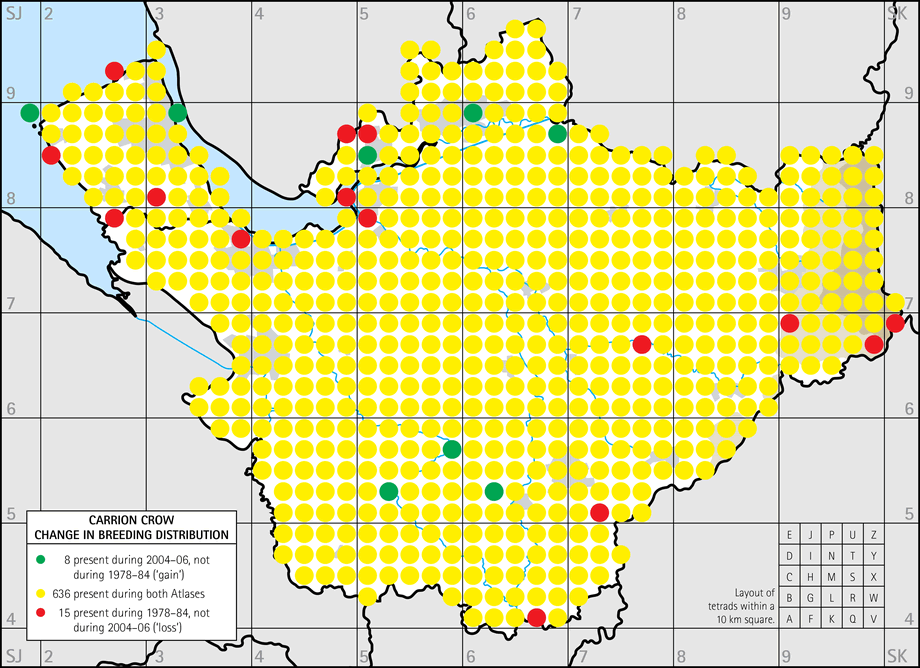
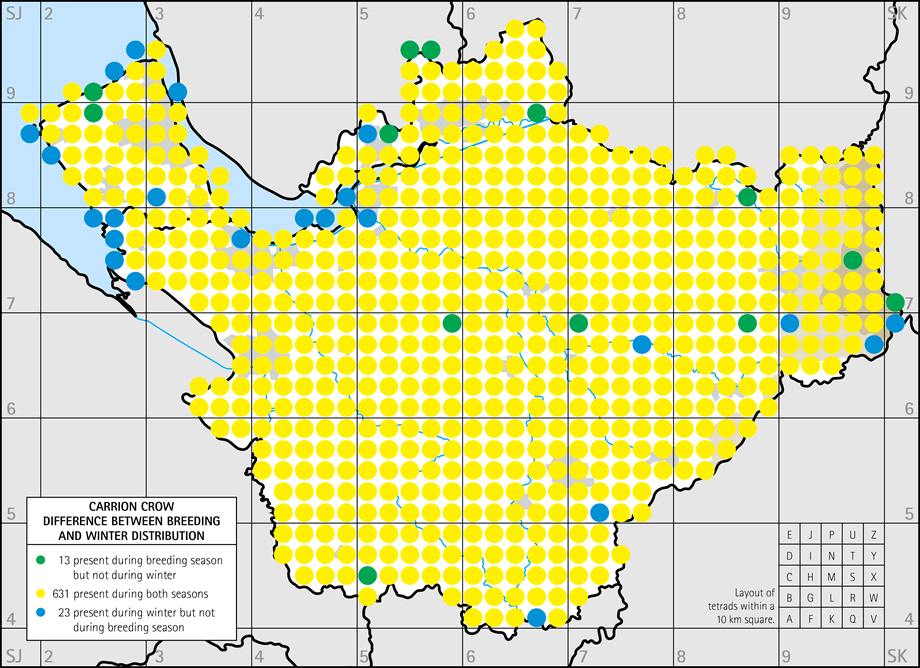
With such a territorial bird, breeding adults maintaining their territories all year round, there would not be expected to be much seasonal change in Carrion Crows’ distribution. Probably the most notable difference, clearly visible on the map showing difference between breeding and winter, is their occupation of coastal and saltmarsh tetrads on the north Wirral and in both estuaries. The birds visiting these squares are members of the non-breeding flocks, exploiting a wide range of food resources including fish, marine molluscs, saltmarsh seeds and almost anything edible amongst the shoreline detritus.
Their main change in habitat for winter is a shift from woodland (14% of winter records) or scrub (2%) to farmland (67%), mostly improved grassland but including unimproved grassland (7%) and stubble (5%), where there were more records of Carrion Crows than any other corvid. They also seemed to use recently ploughed fields more than other species, along with manured fields and sheep pasture. Many of the records comprising ‘human sites’ (13% of the total) came from birds foraging at sewage works or landfill sites and scavenging on refuse in retail areas. Such adaptability in their diet underlies the species’ success.
Despite the advice to novice birdwatchers that ‘if you see one or two, they’re Crows; if you see a flock, they’re Rooks’, the non-territorial Carrion Crows frequently form quite large flocks. Out of 699 counts submitted with Atlas records, only 144 were of one or two birds, with half of them being of ten birds or more, including 30 flocks of 100 or more. By far the largest were the gatherings of 500 birds seen by Steve Holmes and Marion Barlow near Thornton-le-Moors (SJ47M) in 2006/ 07, and 420 on a ploughed field on 3 December 2005 near Kidnal (SJ44U) counted by Neil Friswell.
Carrion Crows also congregate to roost overnight together, usually in traditional sites in dense woodland; six such gatherings of 100 or more birds were reported during this survey, with up to 300 birds near Higher Whitley (SJ68A). Carrion Crows are usually the last birds to go to roost at night, often well after dusk, and the earliest to leave in the mornings at the first glimmer of daylight. Some local territory-holders join the roosting flocks, and presumably they are especially keen to return to defend their areas against potential intruders (BTO Winter Atlas).
Atlas account sponsored by Tom Rowbottom