
Sandbach Flashes: birds and wildlife
About the Atlas
During the three breeding seasons 2004–06 and three winters 2004/05–2006/07, Cheshire and Wirral Ornithological Society (CAWOS) organised more than 350 volunteers to survey all of the county, trying to find every species of bird that was breeding or wintering
Chaffinch Fringilla coelebs
Breeding
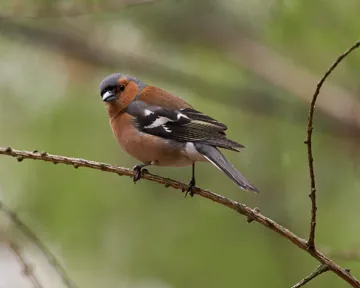
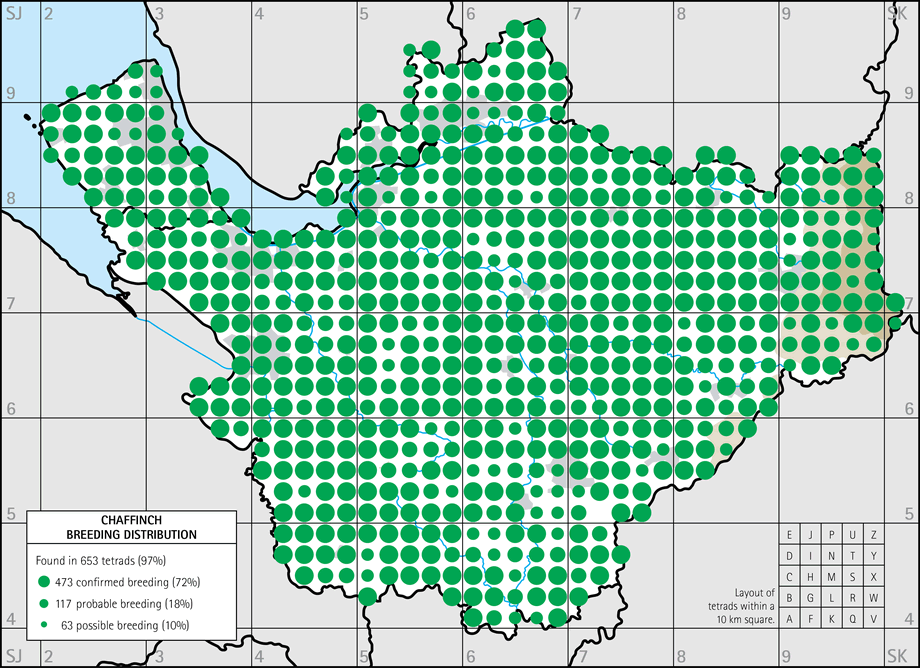
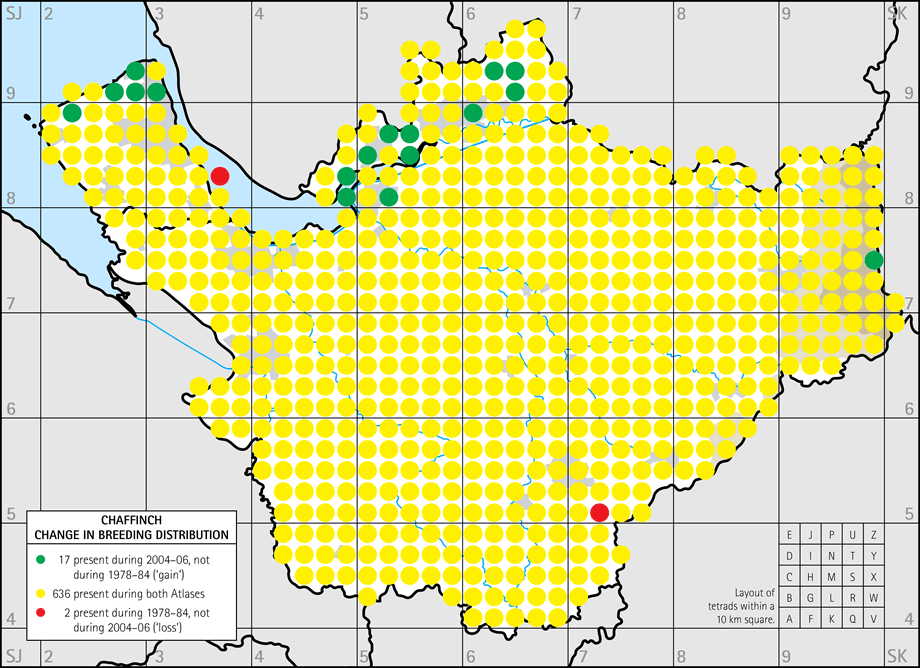
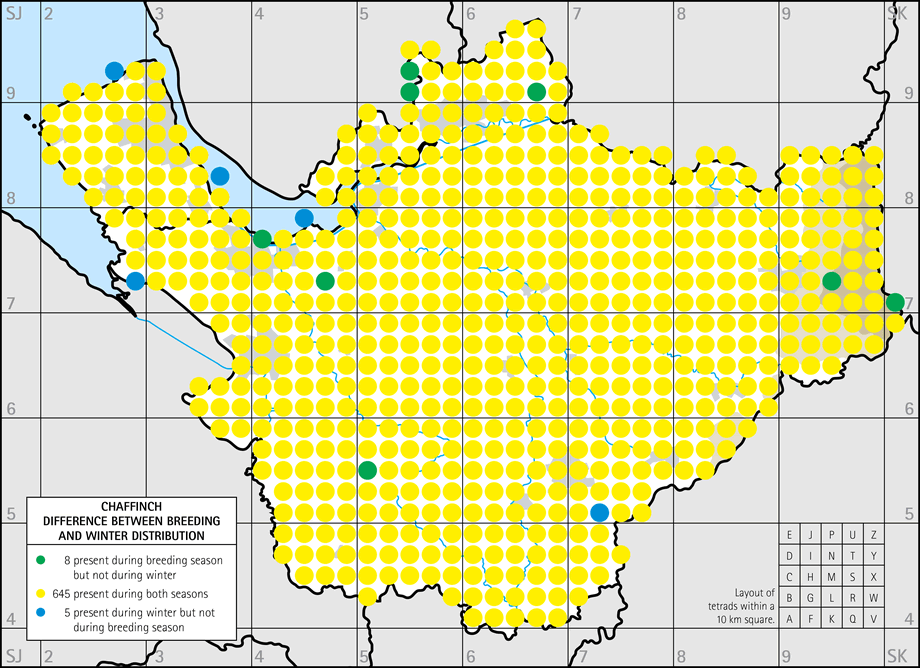
Chaffinch is now one of the most widespread species in the county, being found in the breeding season in 653 tetrads, 97% of the county. The ‘change’ map dramatically shows how Chaffinches have spread into the two areas from where they were missing in our First Atlas, the Mersey valley and north Wirral. In our First Atlas book it was suggested that the cause of their absence was air pollution, which inhibited the growth of epiphytic lichens that Chaffinches use to bind and camouflage the exterior of their nests. During the 1990s these lichens spread throughout the county, as shown in the maps from The Lichen Flora of Cheshire and Wirral (Fox & Guest 2003), and it seems that Chaffinches, and Long-tailed Tits, have responded.
As well as being widespread, Chaffinch is the third most abundant species in the county. The BTO BBS analysis shows that the breeding population of the county in 2004-05 was 185,450 birds (159,260-211,640), corresponding to an average of 315 birds per tetrad with confirmed or probable breeding, or 285 birds per tetrad in which the species was recorded. This equates to an average of about one pair per 2.8 ha across the entire county.
Amongst the characteristics of the fringilline finches (Chaffinch and Brambling) that separate them from the cardueline finches are their defence of breeding territories and their nestling diet, exclusively invertebrates, so in the breeding season Chaffinches behave more like an insectivore than a seed-eater. The adults’ habit of carrying food in their bill makes it easier to prove breeding than for other finches, and many birds draw attention to themselves by their territorial alarm call, only heard in the breeding season, a repeated ‘hoo-eet’, similar to the alarm call of Willow Warblers. Adult Chaffinches are long-lived birds, and they tend to have small broods, four being a typical number, with many pairs only having only one brood each year. The usual nest is in a hedge or low scrub. Breeding was confirmed in 96 tetrads by observers finding nests, with adults carrying food or a faecal sac in 176 and recently fledged young seen in 201. It was not easy to prove breeding in some of the most urban areas where Chaffinches were thinly distributed, however.
Chaffinches are well adapted to suburban and garden habitats, as well as to highly fragmented woodland and hedgerows, occurring less in the open-field, arable habitats that have been affected most by agricultural intensification, so may have benefited by environmental changes from which other seed-eating passerines have suffered. Most of the reported habitat codes were farmland (37%), with 28% human sites, 26% woodland and 8% scrub.
Although mostly eating seeds outside the breeding season, Chaffinches have not been hit in the same way as other granivorous species by the agricultural changes of the past fifty years. The national population index has been stable, increasing by about 10% from 1984 to 2004, and their annual survival appears to have reduced somewhat, perhaps suggesting that the population is self-limiting and near to saturation (Siriwardena et al. 1999). [They are nesting earlier, average dates having advanced by one week in the last thirty years, probably in response to climate change (Crick & Sparks 1999).]
Atlas account sponsored by Alastair Jenkins
Winter
In winter, the population of Chaffinches is roughly doubled by immigration from Fennoscandia (BTO Winter Atlas). There are many ringing records in Cheshire and Wirral of birds from Finland, Sweden, Norway and Denmark, and along their migration route here following the coast of Germany, the Netherlands and Belgium. Our breeding birds are resident all year round: their median distance of movement is less than 1 km at all seasons, 90% move no more than 5 km, and the rest, almost entirely first-year birds, less than 50 km (Newton 1972, Migration Atlas). Coward (1910) gave no evidence for his statement that the numbers of our breeding birds were reduced by autumn emigration, and that has probably never been true. In prolonged periods of frost some birds leave to fly to Ireland, but hard weather movements have not occurred for some twenty years.
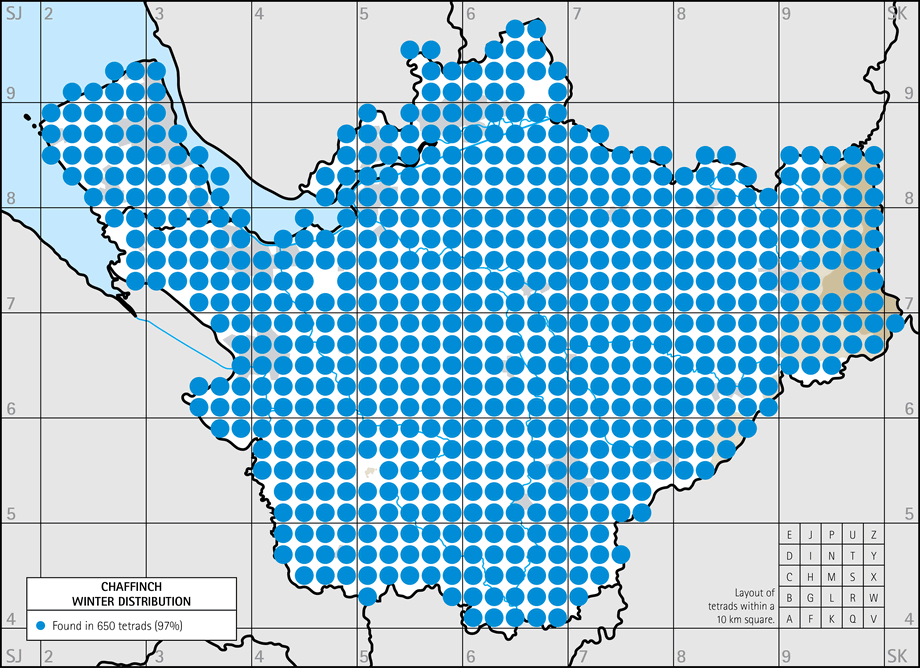
The map shows that they were found everywhere in winter. Their apparent absence from an odd tetrad here and there can only be the result of bad luck for the observers. They are not limited by altitude or vegetation, and were found in a wide variety of habitats. The submitted habitat codes for winter showed a slight shift to farmland (45%, compared to 37% in the breeding season), with commensurate drops in the other three main habitat classes; 25% human sites, 24% woodland and 5% scrub. Half of the farmland codes were hedgerows, with 5% of the total stubble fields.
The sex ratio of wintering Chaffinch flocks is an interesting subject for amateur observation and has aroused much discussion over the years, ever since Linnaeus in 1758 named the species coelebs (bachelor) because wintering birds in his native Sweden were almost exclusively male. Gilbert White, in letters dated 1768 and 1770 in his Natural History of Selborne, commented on the vast preponderance of females – at least fifty to one – in wintering Chaffinch flocks around Selborne in Hampshire. By 1949, however, males were reported to predominate in the Netherlands, Belgium and Britain, with females in the majority in Ireland. In Cheshire, my ringing from 1980 to 2007 in a variety of feeding flocks and roosts has found just a slight excess of males, 52% : 48% females (Migration Atlas).
In winter the Chaffinch’s diet consists almost exclusively of small seeds which they find on the ground. They have catholic tastes, taking a wider range of seeds than any other finch, but cereal and weed seeds are the most important. It is many years since they earned their name as the chaff-finch, and they would not nowadays be noted as the bird that followed the grain harvest. They lack the specialised bill of some other finches, and cannot cope with seeds that are difficult to extract.
The species’ status has probably not changed much for a century or more. Coward and Oldham (1900) wrote ‘in winter the bird is eminently sociable, and large flocks may be seen in the open fields’ and Boyd (1951) said ‘big flocks roam the woods and fields, and roost in hollies and other evergreens’, comments that could be made today.
Although communal roosts are an obvious feature of this species’ behaviour in winter, not many birdwatchers pay them much attention, and roosts were reported in only 12 tetrads in this Atlas, only three of them with flocks estimated larger than 50 birds. The largest was of 200 birds at Norton Priory, Runcorn (SJ58L), taking advantage of the microclimate, especially shelter from winds, provided by rhododendron bushes under mature trees. Chaffinches gather in the tops of the trees from one hour before dusk, indicating that they seldom have difficulty in finding food and have time to spare even on the shortest midwinter days.
Atlas account sponsored by Alastair Jenkins