
Sandbach Flashes: birds and wildlife

About the Atlas
During the three breeding seasons 2004–06 and three winters 2004/05–2006/07, Cheshire and Wirral Ornithological Society (CAWOS) organised more than 350 volunteers to survey all of the county, trying to find every species of bird that was breeding or wintering
Chiffchaff Phylloscopus collybita
Breeding
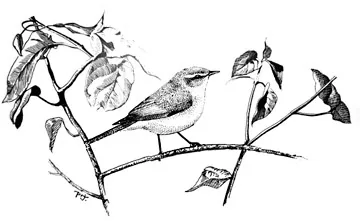
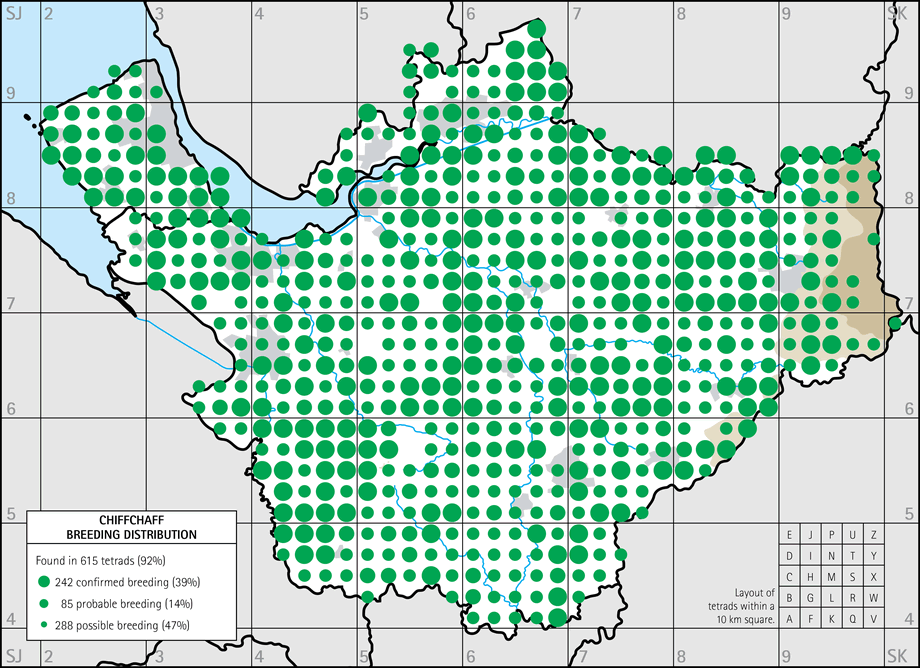
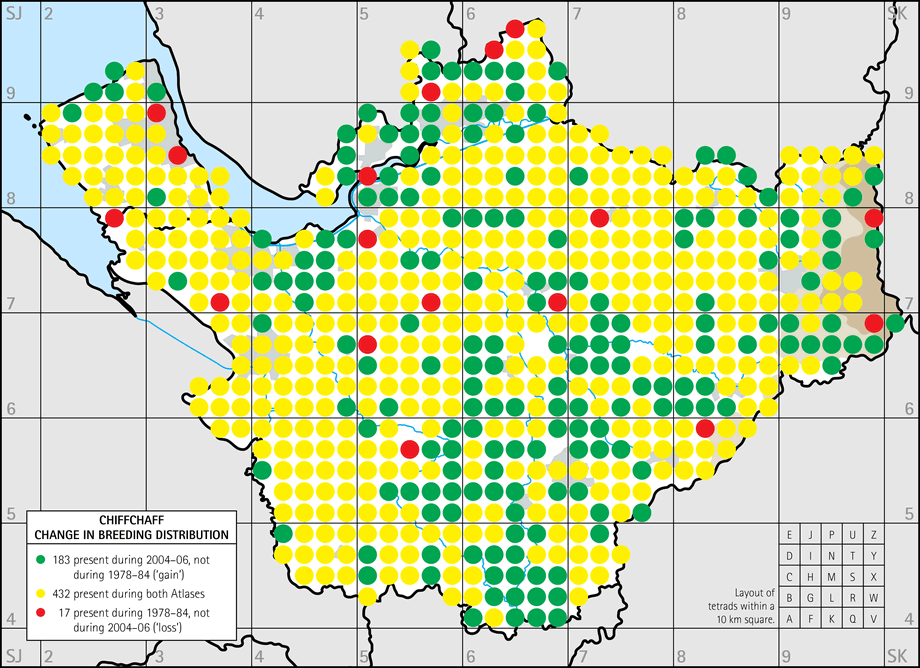
In the last twenty years, Chiffchaffs have flourished and fieldwork for this Atlas has confirmed that it is now our most ubiquitous warbler and our second most widespread summer migrant: they now occur in 615 tetrads, a net gain of 166 since our First Atlas. They are missing only from the treeless areas of the eastern hills and the estuarine fringes, along with the most urban parts of towns such as Birkenhead, Widnes, Northwich and Crewe. The abundance map shows their highest densities in west Cheshire and Wirral. The BTO analysis of Cheshire and Wirral BBS gives a county breeding season population in 2005 of 15,800 (11,630-19,970) Chiffchaffs, an average of 25 birds per tetrad in which they were recorded. The authors of the First Atlas suggested a county population, just twenty years previously, of perhaps 1,500 pairs.
Male Chiffchaffs are usually the first summer migrant to reappear in Cheshire and Wirral woods, and they probably spend the longest period in Britain of any migrant species. One ringed individual at Woolston in 1990 was well-studied from its arrival on 18 March to its final capture on 26 September, having spent over half of the year at the site. Arrivals by mid-March are usual in most years, with birds instantly recognised by their song, not quite as boring as at first it seems, most birds breaking up their monotonic ‘chiff-chaff’ with trisyllabic variations and the ‘trr’ interludes, perhaps increasingly so as the season goes on. When the females arrive, two or three weeks later, they pair rapidly and she quickly builds and occupies a nest. Their typical clutch size is 5 or 6 eggs, rather than the Willow Warbler’s 7, probably because of the increased load on the female. A male Chiffchaff plays little part in anything to do with the nest; he does not feed the female, and does not feed the chicks. His role appears to be to establish and defend the territory, and he stands guard, singing and giving the alarm when necessary, throughout the breeding period.
The Chiffchaff is mostly a bird of woodland, but, as the population has increased, they have spilled out into farmland and other areas. The first birds back each year fill up the preferred deciduous woods, and later-arriving birds – thought to be the one-year-old birds breeding for the first time – occupy poorer quality woods, hedges and elsewhere (Clement 1995). With Cheshire and Wirral being a relatively sparsely-wooded county, it is perhaps surprising that such a high proportion of our Chiffchaffs are in woodland: habitat codes reported in this survey were 61% woodland, 19% scrub, 9% farmland and 10% human sites.
In the twenty years between our Atlas periods (1984-2004) the national population index for Chiffchaff has risen by 180%. Lack of management has accelerated the habitat progression from scrub towards the Chiffchaffs’ favoured more-mature woodland; many well-recorded sites have seen a substantial shift in the relative proportions of these two common Phylloscopus warblers. Further, the consequent decline of the Willow Warbler has allowed some Chiffchaffs to spread into less-wooded habitats. Finally, their migratory strategy might have benefited this species. In winter, British breeding birds go south to the Mediterranean, with some crossing the Sahara to the region from Mauritania to Guinea-Bissau. Short-distance migrants – such as many Chiffchaffs – tend to have prospered at the expense of those undertaking longer journeys, perhaps because they are better able to adjust their seasons to climate change.
Atlas account sponsored by D. and K. Leeming
Winter
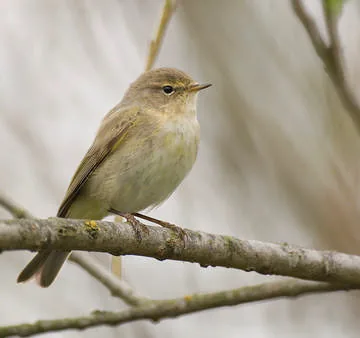
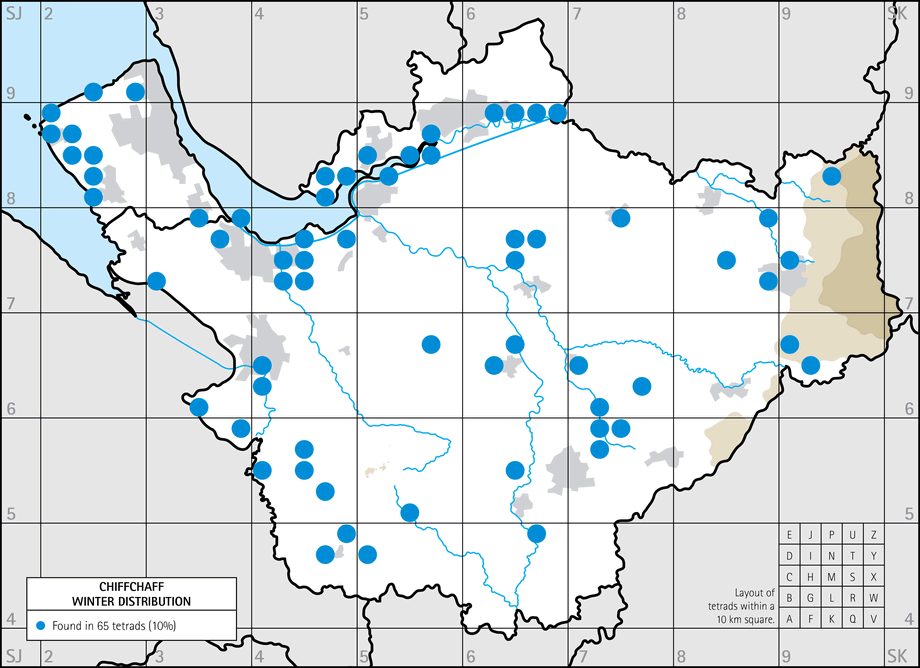
Wintering Chiffchaffs seem to be restless and always on the move, often calling as they go, which helps in detecting their presence. They need to be ever-active to find their insect food, no mean feat in a British winter, adding 10-15% to their body-weight during the day and burning up that fat during the long nights. Four main habitats accounted for nearly all the winter records: suburban and rural human sites (F2 & F3) (in 17 tetrads); broad-leaved woodland (A1) (13); regenerating woodland (B1) (12); and farmland hedgerows (E8 & E9) (9). Only 28% of the total was in human sites, compared to 69% of wintering Blackcaps, probably because Blackcaps take a wide range of foods while wintering Chiffchaffs are almost entirely insectivorous. They are by no means our only winter insectivores, sharing that habit with Goldcrest and Wren at least.
The Chiffchaff is a widespread and adaptable species, wintering across a range of more than 40º in latitude. Three races are present in Britain during winter – the nominate collybita, which make up the vast majority, and the eastern races abietinus and tristis, much scarcer but with their presence over-emphasised by excessive publicity. Out of nearly 700 wintering Chiffchaffs ringed in Cornwall in 1999-2005, 87% were collybita, 6% abietinus, 3% intergrades between collybita and abietinus, 4% intergrades between abietinus and tristis, and only two birds were tristis (Conway 2005). A small proportion of the birds of the nominate race are likely to be British breeders but the majority have probably migrated here from southern Scandinavia or continental Europe (Migration Atlas); as yet, however, there is no definitive evidence from ringed birds in Cheshire and Wirral.
Although there are no records from the highest altitudes, Chiffchaffs have been found in some of the bleakest parts of lowland Cheshire and Wirral, and they appear to be able to stick it out through winter. It is, however, noticeable that well-studied sites record far fewer Chiffchaffs in January and February than in November and December. This could suggest that some move out of the county, or die, during the winter.
Neither Coward nor Boyd makes any mention of any wintering Chiffchaffs in the county, although Boyd (1946) was told of one in Lancashire from November 1934 to February 1935. The first documented bird was apparently one reported by Eric Hardy in mid-February 1961 at Leasowe, although Bell noted two November records, one of which, at Walton on 23 November 1958, fell within our definition of winter. Another was near Warrington on 11 December 1961 and one on the same date in 1966 near Stockport (not within present-day Cheshire) (Bell 1962), and one was ringed on 29 November 1966 at Frankby. The chart summarises records each winter from the start of the Cheshire Bird Report in 1964. There are some problems in interpreting the reports, partly because of changing editorial practice. In the early years, from 1964 to 1976, normal records of this species were ignored and only unusual dates and races were published. In analysing the annual Bird Reports from then on, it can be difficult to rule out late-staying or early-arriving summer migrants, or multiple reports of the same bird and duplication of records across the year-end boundary. Nevertheless, a reasonable picture emerges of the extreme scarcity of winter Chiffchaffs until 1976/ 77, with none or one each winter. Then the number of records from November to February inclusive rose sharply in 1980/ 81 and averaged about 11 birds at 8 sites each winter during the 1980s and about 17 birds at 12 sites from 1990, until the start of this Atlas stimulated a flurry of extra records. Although mild weather is often quoted as a reason for the increase of wintering records, the yearly fluctuations in Cheshire and Wirral show no correlation with the harshness of the winter weather.
With presence in 65 tetrads, and others probably undetected, work for this Atlas shows that the Cheshire and Wirral wintering population of Chiffchaff is likely to be around 80-100 birds. It will be interesting to put this in the context of the national Wintering Warbler Survey, organised by the BTO in 2006/ 07, when the results are published.
Atlas account sponsored by D. and K. Leeming