
Sandbach Flashes: birds and wildlife
About the Atlas
During the three breeding seasons 2004–06 and three winters 2004/05–2006/07, Cheshire and Wirral Ornithological Society (CAWOS) organised more than 350 volunteers to survey all of the county, trying to find every species of bird that was breeding or wintering
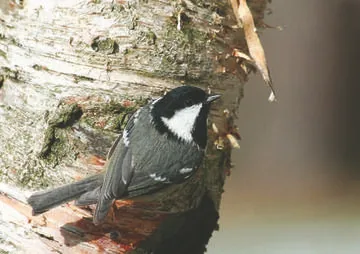
Coal Tit Periparus ater
Breeding
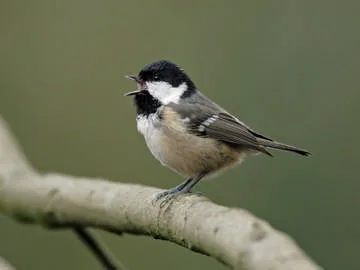
Coal Tits are overwhelmingly birds of woodland, reported in this habitat in 335 tetrads, with only 16 records for scrub, 9 in hedgerow and 16 farmland: the contrast with Blue and Great Tits is stark. Coal Tit is also one of the few species that seems at home in coniferous woodland (A2), with 60 tetrad records. This was exceeded only by Goldcrest (75), and no other passerine registered in double figures. Gardens, in urban, suburban and rural areas, were used by many birds (154 tetrads in the F categories).
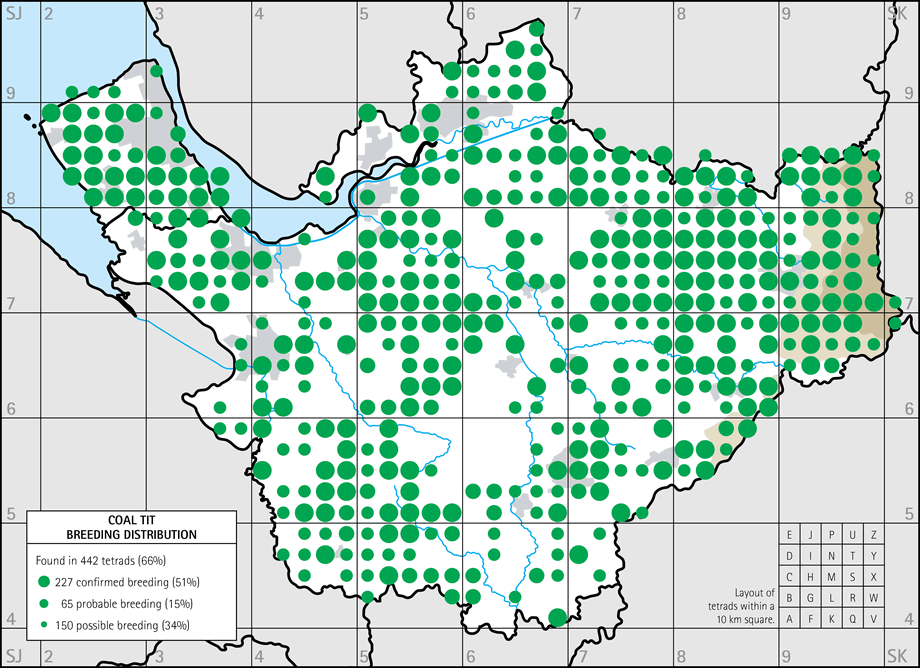
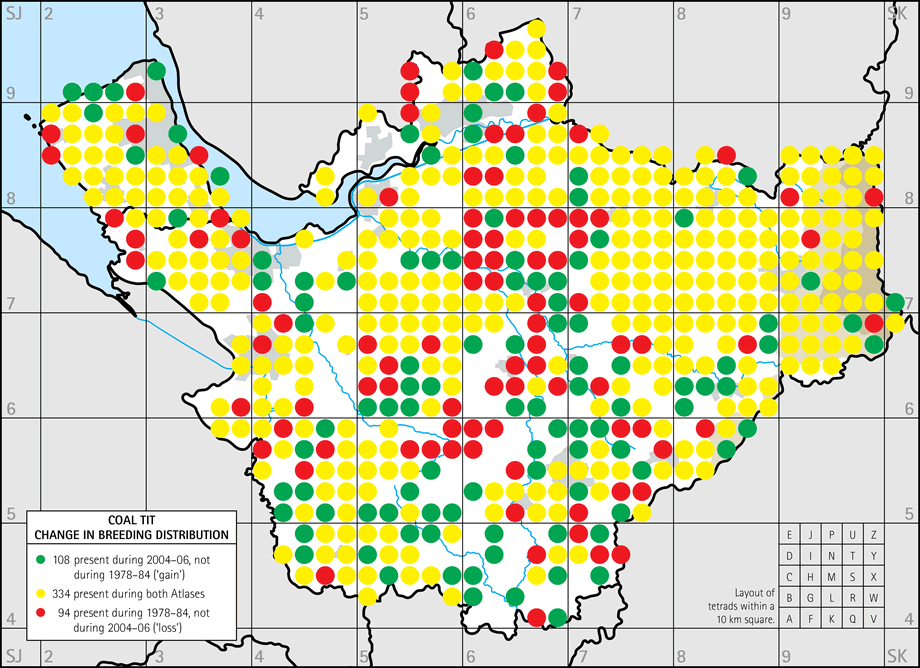
They are widespread across Cheshire and Wirral, present in two-thirds of tetrads, but are absent especially from the sparsely-wooded areas of the county, noticeably that in the central southern part of Cheshire, centred on Calveley (SJ65E), and in a band running as far as Tabley (SJ77D); the industrial and marshland belt across the south Mersey from Ellesmere Port (SJ37Y) to Frodsham (SJ57E); the western parts of Halton in SJ58; and the line of the River Gowy through SJ46 and SJ47. Coal Tits were absent from these last three areas twenty years ago, but have been lost from the former since our First Atlas, for unknown reasons that would repayfurther study. They were present in 334 tetrads in both Atlases, with 108 tetrads newly occupied since 1978-84, and 94 losses, giving little net change since our First Atlas.
This is by far the most difficult tit species in which to prove breeding (51% of records). Fieldworkers found birds carrying food or a faecal sac in 58 tetrads, and parties of recently fledged young in another 132; in only 37 tetrads were nests found. Nest sites reported included natural holes in trees, often low down or even underground amongst the roots, and a variety of man-made artefacts including nest-boxes, pipes and holes in walls, with Martyn Stanyer noting one pair in SJ85H on 15 May 2004 that was taking food into a nest hole in a wall, only 1 metre from an occupied Great Tit nest. Coal Tits apparently feed on a wider variety of invertebrates than other tits, and are more likely to have a second brood (Perrins 1979).
The BTO BBS analysis shows that the breeding population of the county in 2004-05 was 5,750 birds (2,990-8,520), corresponding to an average of about 10 pairs per tetrad with confirmed or probable breeding, or six pairs per tetrad in which the species was recorded. This is less than 0.5% of the UK breeding population of one million birds, reflecting Cheshire and Wirral’s status as one of the least wooded counties in England (National Inventory of Woodland and Trees, Forestry Commission 2003).
The national population has fluctuated but shows no clear trend in twenty years; this statement, however, conceals important habitat-specific changes. The numbers on English CBC plots in woodland have dropped slightly, whilst the totals on farmland plots have roughly doubled (Brown & Grice 2005). This behaviour is usually characteristic of a species whose population is high: it ‘fills up’ its natural habitat, and some individuals spill over into other, sub-optimal, habitats. This pattern of Coal Tits moving in to farmland has not been noted in Cheshire and Wirral, however, and perhaps depends on the detailed land-use of the agricultural landscape.
Atlas account sponsored by Denise Bebbington
Winter
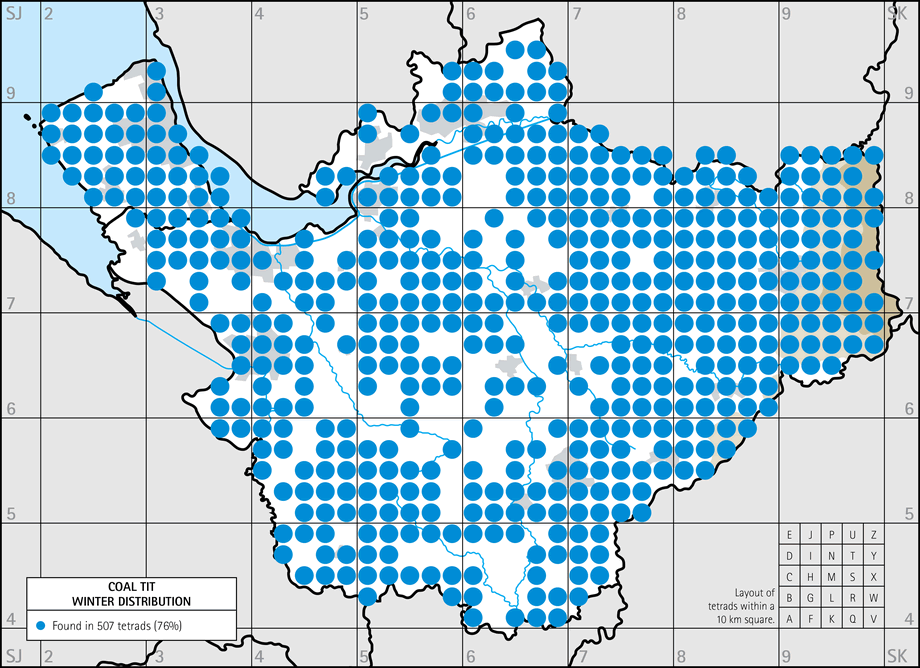
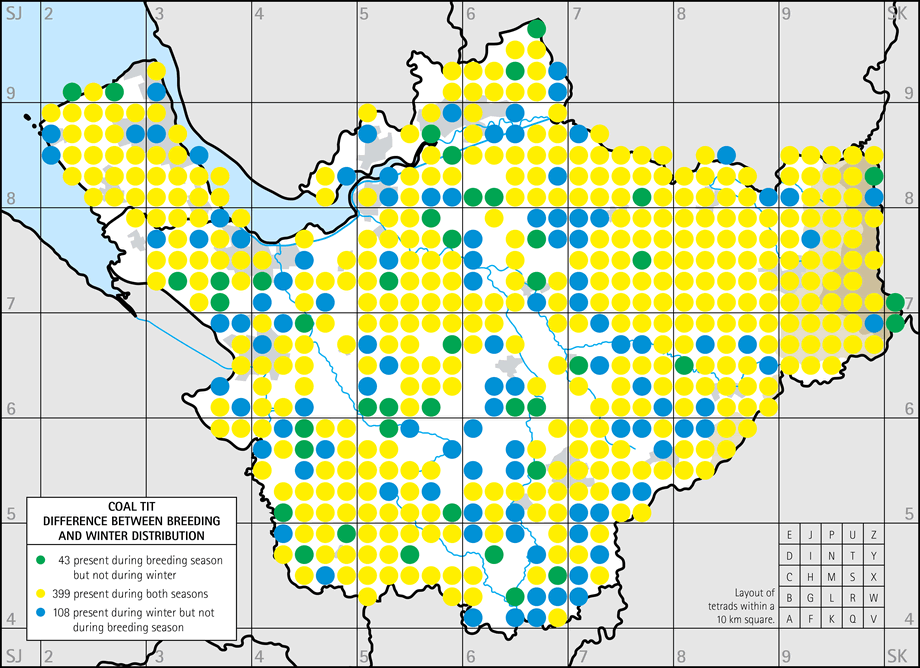
Some Coal Tits spread out and switch habitats in winter, the maps showing them present in an extra 65 tetrads compared to the breeding season, including some of those in the sparsely-wooded areas mentioned previously. Woodland is still the most favoured habitat although in significantly fewer tetrads (51% of records in winter, 63% during the breeding season) with their liking for conifers maintained, but far fewer birds were reported from scrub (7% of records in winter, 17% during the breeding season) and farmland (7% of records in winter, 13% during the breeding season). More birds were found in farmland hedges (6% of records in winter, 2% during the breeding season), mostly in mixed flocks with other tits and far more Coal Tits were reported from human sites, mainly suburban and rural (38% of records in winter, 29% during the breeding season).
Over 400 submitted records over the three winters included a count of Coal Tits, but more than half of them were of just a single individual, illustrating that the way that most people encounter the species is by finding an odd one amongst a flock of other birds. Even at their regular haunts, groups of more than a few Coal Tits are seldom seen. At feeding stations in Delamere Forest, I have found that Coal Tit numbers vary substantially from year to year, presumably responding to the biennial cycle in the crop of natural seeds, and the number of gardens visited also changes depending on the yield of beech mast (Glue 1982 and BTO Garden Birdwatch data). Where they share feeding areas, this species is subordinate to all of the other tits and woodland feeders and can suffer if there is a dearth of food. Coal Tits avoid this in two ways: their finer bill makes them more able to exploit small food items amongst clusters of pine needles, a resource not available to those with chunkier beaks, and they often hide food in caches during autumn, to be retrieved in later times of shortage.
The description of Coal Tit as one of Britain’s most sedentary species (BTO Second Atlas, BTO Winter Atlas) is probably an overstatement. First-year birds disperse up to a median distance of 11 km from their natal site in midwinter (Migration Atlas), although, once settled in an area, birds probably do tend to stay put. One regular customer at a Delamere Forest feeding station, hatched in 1996 or earlier and ringed in winter 1997/ 98, was caught in seven winters and retrapped when at least nine-and-a-half years old in December 2005.
There are occasional influxes of Coal Tits from continental Europe. Although none has been proven to reach Cheshire and Wirral, one wonders about the origins of the first-year bird ringed on 12 October 1985 at Bardsey Island, Gwynedd and retrapped in a ringer’s garden 136 km away at Little Sutton (SJ37T) on 15 February 1986. Coward (1910) noted that they were more in evidence in the winter months, which he ascribed to probable immigration.
Atlas account sponsored by Denise Bebbington