
Sandbach Flashes: birds and wildlife
About the Atlas
During the three breeding seasons 2004–06 and three winters 2004/05–2006/07, Cheshire and Wirral Ornithological Society (CAWOS) organised more than 350 volunteers to survey all of the county, trying to find every species of bird that was breeding or wintering
Collared Dove Streptopelia decaocto
Breeding
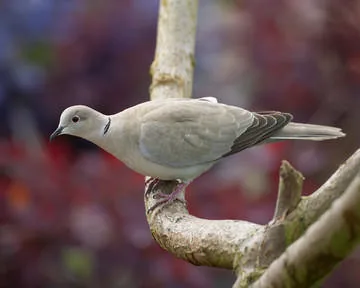
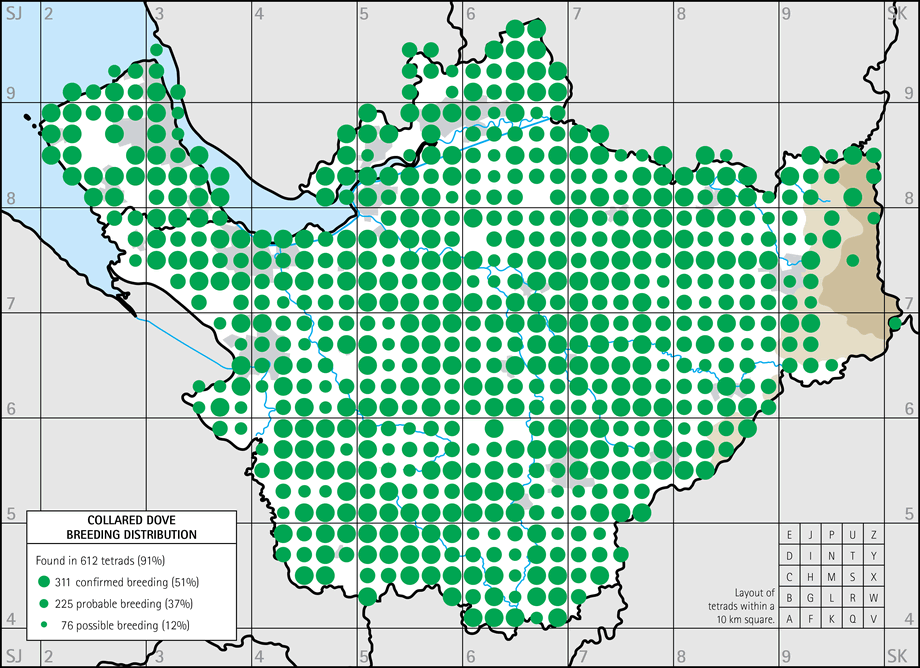
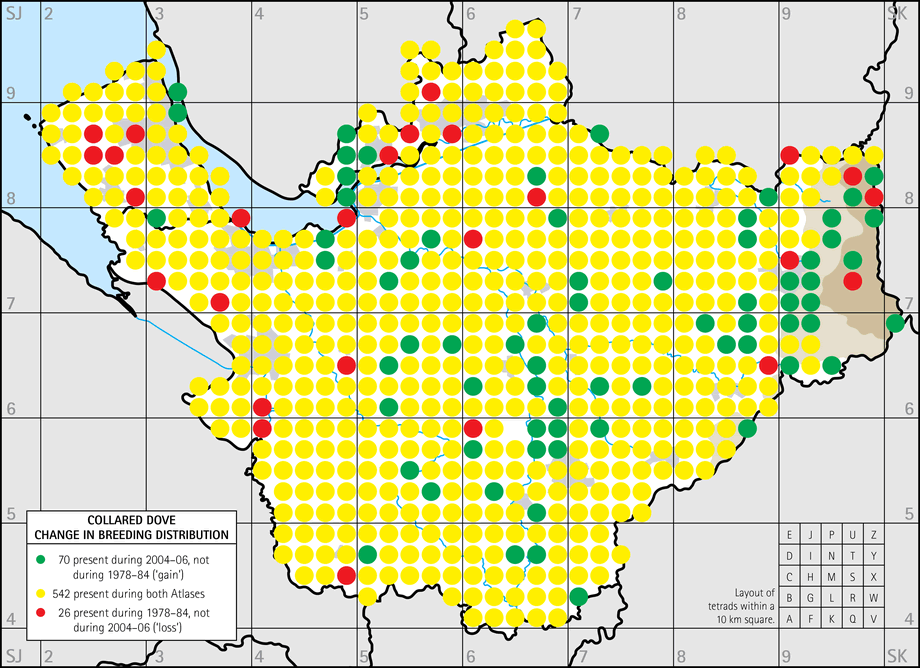
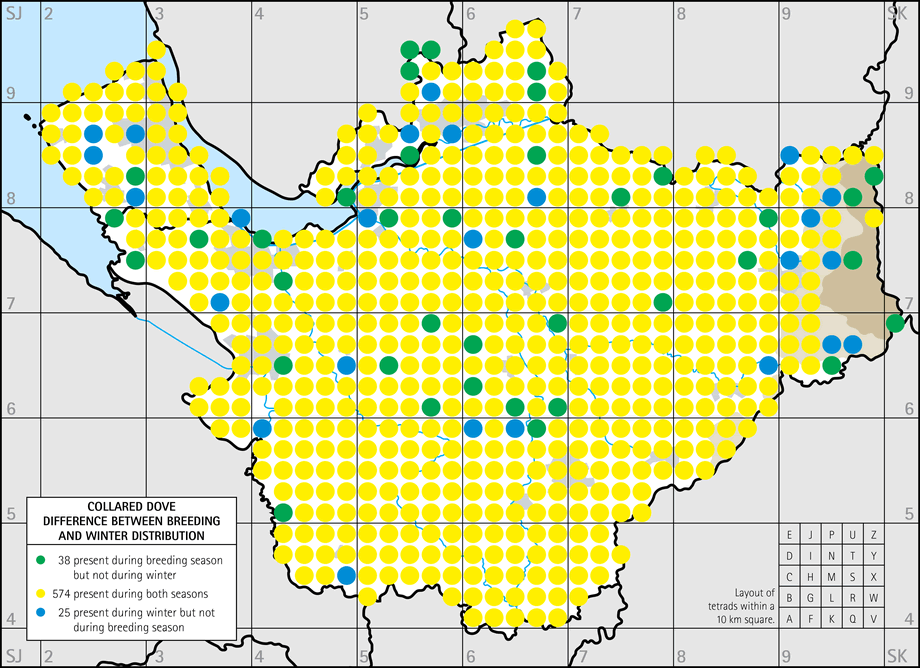
It bears repeating that Collared Doves were not recorded in the county until 1960, with first breeding suspected in 1961 as part of their remarkable spread to the northwest from Turkey and the Balkans that started in the 1930s. Most of Cheshire and Wirral had been colonised by the time of our First Atlas, but this Atlas map shows some further expansion with a net gain of 44 tetrads with birds present in the breeding season. The ‘change’ map shows that there is probably no significance to the 26 tetrads from which they have been lost, but they have filled in almost all of the odd gaps across the county, with a notable cluster of newly occupied tetrads around Macclesfield in SJ97.
One of the factors that helped its expansion of range is that it encountered no opposition and has been able to exploit a vacant ecological niche for a medium-sized granivore tolerant of man. The Atlas habitat codes show 72% of records in human sites (5% urban, 19% suburban and 48% rural), with 14% on farmland, 10% in woodland and 3% in scrub. This is not a bird of dense woods, however, and most of the woodland records are from thinly wooded sites with adjacent fields or urban greenspace in which they feed.
Their spread has also been helped by a high reproductive rate. Birds often start nesting in February, or March at the latest, and some carry on into October. They quickly build a flimsy nest and their clutch of two eggs takes only about 16 days of incubation, with chicks fledging about 18 days later, unusually short periods for a bird of its size. Many birds shorten the cycle even further by laying a new clutch whilst still feeding dependent young, allowing most of them to have three broods a year, and some pairs as many as six. They have taken advantage of our horticultural preferences in their nesting, with leylandii hedges probably their most-used sites, and fieldworkers recorded other examples of their exploiting man, including a nest in April 2006 at the Cheshire Oaks shopping complex (SJ47C) and nests in two tetrads on houses supported by the bracket holding a satellite television aerial.
Observers reported nests in 201 tetrads, with the remainder of the confirmed breeding records coming from recently fledged youngsters. Whilst they are in the nest and for a few days after, both adults share the task of feeding their brood with ‘crop milk’, also known as pigeon's milk, a secretion from the lining of their crop that is rich in protein and fat. Of the 225 tetrads with probable breeding, 133 of them had pairs recorded, 33 arose from surveyors seeing birds with nesting material or visiting an apparent nest site, and 59 from nuptial display, a male flying high into the air and stalling, dropping with closed wings to impress his mate and deter other doves.
The BTO BBS analysis shows that the breeding population of Cheshire and Wirral in 2004-05 was 26,650 birds (19,430-33,880), an average of 44 birds in every tetrad in which they were recorded. The national index shows an increase of 61% in the twenty years from 1984.
Atlas account sponsored by Altrincham and District Natural History Society
Winter
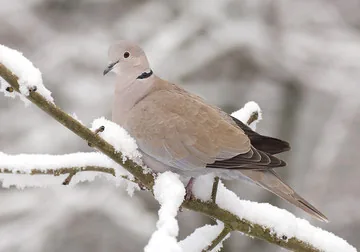
Now that their great nomadic phase is over – and no-one knows what caused it – Collared Doves appear to be sedentary. Since 1980 the median distance of movement of Collared Doves from the national ringing database is only 1 km (Migration Atlas). Prior to that, the archives of Merseyside Ringing Group for the 1960s contain several examples of the species’ expansionary phase, with two Belgian-ringed birds caught here and three birds moving on to Ireland, although one that moved to north Germany, the only one on record, confused the picture. A bird ringed at Chester Zoo in 1980, found dead in 1982 in Strathclyde, 312 km north, was the last to exhibit long-distance movement.
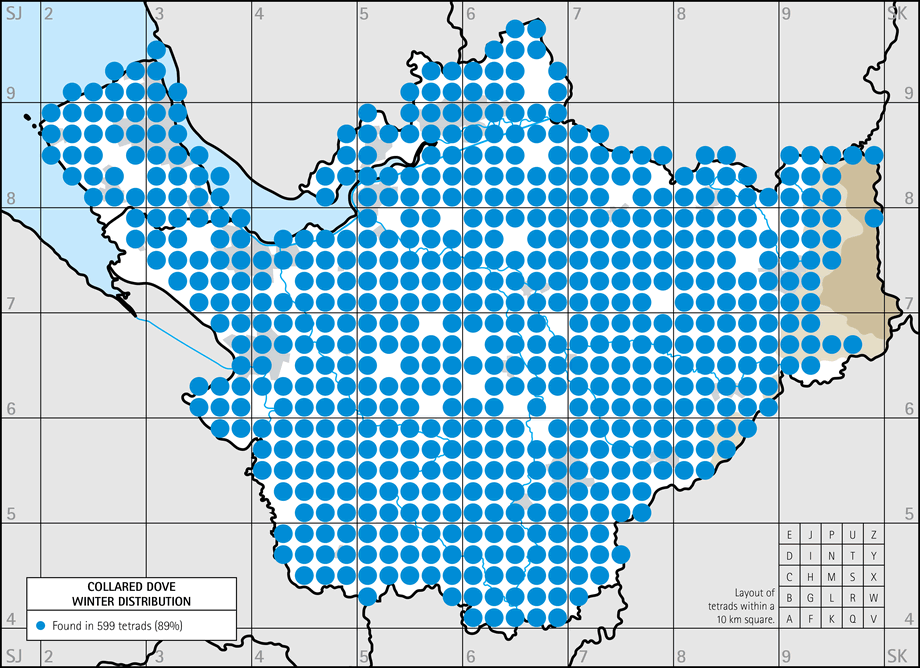
Thus, it is no surprise to see from the Winter Atlas map that their winter distribution in the county is essentially the same as in the breeding season. They were present in 574 tetrads in both seasons, being found in 25 tetrads in winter where they were not reported in the breeding season, and absent in winter from 38 with breeding season presence. They can be rather more difficult to find, especially for surveyors visiting a tetrad, as they tend to be quiet and less obtrusive during the middle of winter, but by the end of our winter period most birds are displaying and starting to breed again.
Although all members of the pigeon family are gregarious, Collared Doves tend not to form large flocks as much as the other species, and the median size of the 537 counts was four birds. Where they do flock, it is usually on a copious source of grain. There were only five groups of 50 or more, with by far the largest flock being 180 birds in a farmyard at Aldford (SJ45J) on 8 January 2007, counted by Neil Friswell: this appears to have been the first three-figure winter gathering in the county since 1999 (CWBRs). Sixteen communal roosts were reported, up to 80 birds in size, mostly in farm buildings or leylandii trees or hedges.
There is no significant difference in the habitats recorded in winter from those used in the breeding season. There were slightly fewer woodland or scrub codes as the association with trees for breeding sites is relaxed, and a handful of birds on winter stubble, but they are seldom found far away from buildings and most birds find all their year-round needs within their breeding area or nearby.
Atlas account sponsored by Altrincham and District Natural History Society