
Sandbach Flashes: birds and wildlife

About the Atlas
During the three breeding seasons 2004–06 and three winters 2004/05–2006/07, Cheshire and Wirral Ornithological Society (CAWOS) organised more than 350 volunteers to survey all of the county, trying to find every species of bird that was breeding or wintering
Common Sandpiper Actitis hypoleucos
Breeding
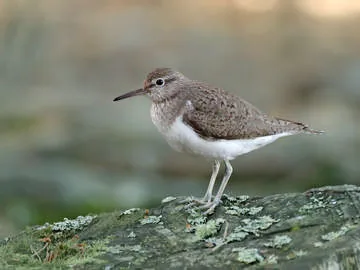
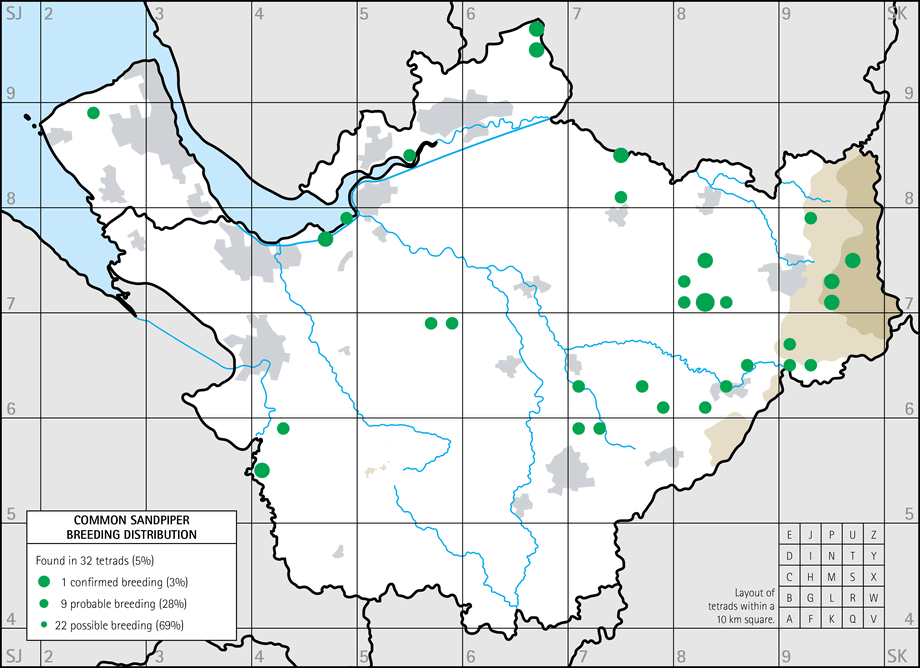
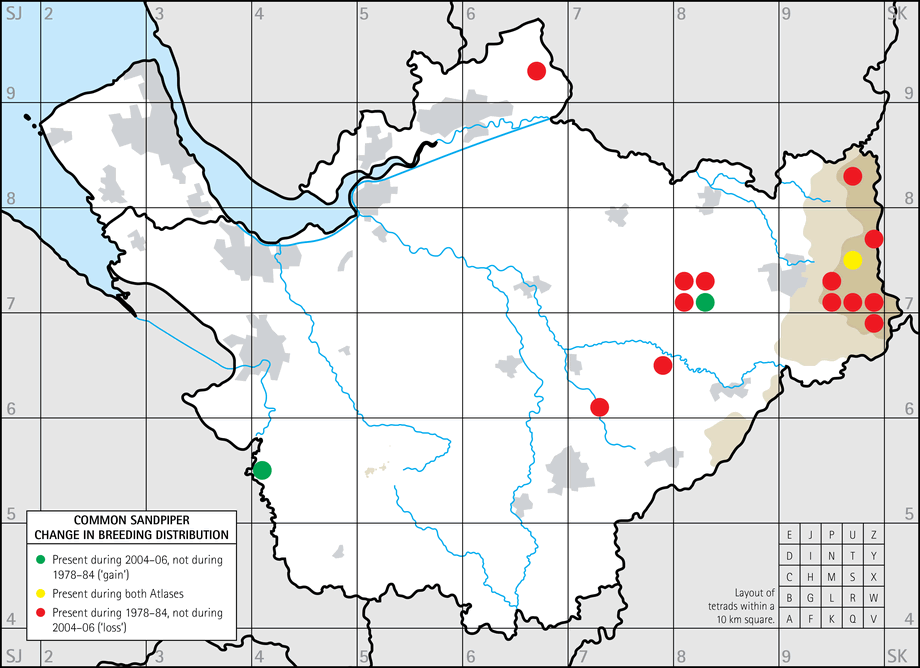
Birdwatchers are familiar with Common Sandpipers turning up on spring passage at locations where they do not breed. Many of these are potentially suitable breeding sites thus meriting an ‘H’ status code and mapping in this Atlas as ‘possible’ breeding. Most move on rapidly, usually within a day, but some favoured sites attract two or more birds and have been recorded as ‘P’, probable breeding. In practice, true breeding behaviour is very noticeable. Adults are very demonstrative whilst they are establishing territories and attracting a mate, although they go quiet for three weeks whilst the female incubates the four eggs. After hatching in early June, their vocal defence of their chicks makes it easy to confirm breeding, and the fact that only one tetrad furnished proof in this Atlas suggests that the county breeding population is very low: in the First Atlas, breeding was confirmed in 14 tetrads. Females often leave their mates when the chicks are half-grown, and males quit the breeding areas almost as soon as the young can fly. Common Sandpipers are recorded widely on return passage, with failed breeders and females from June onwards, and males and independent young birds in July. A few enthusiastic observers also included such birds as ‘H’ in their Atlas submissions, and they are mixed with others on the map.
It is clear that the map gives an inflated impression of the species’ now-tenuous toehold on Cheshire. This is an easy species in which to demonstrate at least probable breeding, and birds only ‘present in suitable nesting habitat’ are likely to have been on passage (Dougall et al 2004). This also applies to some of the ‘P’ records: disregarding ‘H’ and ‘P’ records, observers in only three tetrads found evidence of breeding: a pair with chicks in 2004 at Acre Nook SQ (SJ87F), a pair displaying in 2005 alongside the River Dee in SJ45C, and two pairs at Lamaload Reservoir (SJ97S) in 2005 ‘defending territory with much calling’. Common Sandpiper is normally regarded as one of the characteristic breeding birds of upland hill streams, but none was found in such habitat during this survey; in fact all but three of the habitat codes recorded – in SJ45 and SJ47 – were standing water, especially sand quarries and the upland lakes or reservoirs.
Nationally, the BTO’s Waterways Bird Survey, albeit based on small samples, shows a population decline of 37% from 1984 to 2004. Derek Yalden, writing in our First Atlas, noted that recruitment barely balanced adult mortality in his Peak District study area, and birds there were badly hit by an April snowstorm in 1989, from which they did not recover to their former levels; this could have been caused by poorer breeding success or reduced survival of first-year birds over winter in West Africa (Holland & Yalden 2002). However, surveys of the South Pennines Moors SPA showed that the breeding population of Common Sandpipers more than doubled between 1990 and 2004-05, so the drop in Cheshire is likely to have been caused by some local factors (Eaton et al 2007).
It is not clear when the Cheshire decline started as the records submitted annually to CAWOS depend on the vagaries of recording effort. Immediately after the end of concerted effort for the First Atlas, when the national population was probably at its peak, the county bird report for 1985 noted that records were submitted from only four sites with no proven breeding, and commented that ‘if this reflects the true situation, then the species is in danger of becoming extinct as a breeding bird in the county’. The call for ‘more relevant records’ was not heeded immediately but during 1988-1992 from 9 to 15 pairs were confirmed or probably breeding, at Acre Nook and Arclid SQs and the reservoirs in the eastern hills. The recorded population then dropped and from 1995 onwards (apart from 2001 when there could have been up to 9 pairs present) the maximum in any year has been four pairs.
Atlas account sponsored by Mike Allsopp
Winter
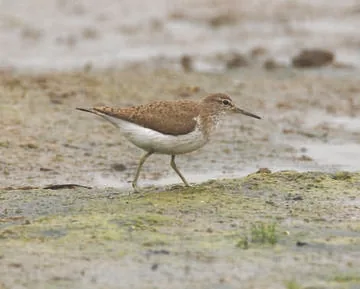
Most Common Sandpipers migrate to west Africa but odd birds are found here in winter. There is no evidence to show whether or not it is birds of our breeding population that remain here, but it is most likely that the wintering birds are breeders from farther north, or continental immigrants. The Fennoscandian breeding population numbers some half a million pairs (European Atlas), and they migrate in a south-southwesterly direction in autumn, bringing some of them to England (Migration Atlas).
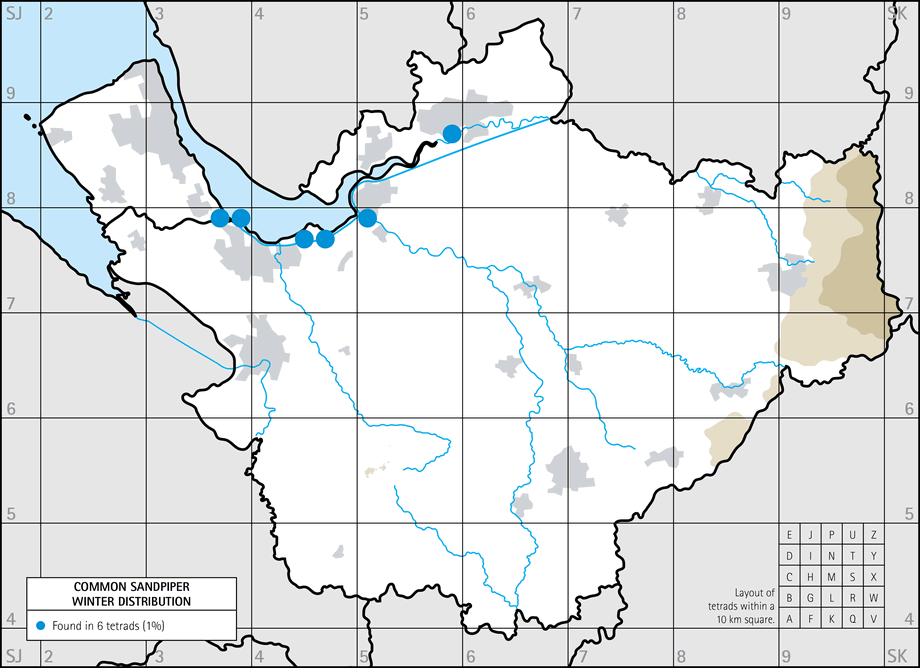
The BTO Winter Atlas (1981/ 82 to 1983/ 84) found about 100 Common Sandpipers annually, with half of them in southwest England. It was noted that the national distribution of wintering birds was almost an exact reversal of their breeding situation, with virtually no overlap in the ranges. The same applies here at a local level, with none of the wintering birds found in the eastern areas of the county where they breed. Indeed, all of the winter records are close to sea level, five of them along the Manchester Ship Canal and the other next to the River Mersey. This also indicates a habitat shift, with almost all of the breeding birds being alongside standing water (lakes, reservoirs and sand-quarries) but the wintering records on flowing water.
The split is not as absolute as this description makes it sound, however, and in the last twenty years birds have been found in winter at several of the inland waters including Rostherne Mere, Pickmere, Hockenhull Platts and Arclid SQ, with occasional individuals along the River Dee.
Most Common Sandpipers in winter are solitary, but occasionally two or three can be found on the same stretch of canal, when they might defend a feeding territory. As in the breeding season, their diet comprises terrestrial and freshwater small invertebrates collected from the water’s edge. In both of these respects they are the opposite of most waders, flocking in large numbers on estuarine sites.
It would be expected that more birds would winter here in mild weather but so far there is no evidence of a correlation with winter temperatures. Records submitted to the annual Cheshire and Wirral Bird Reports over 43 winters from 1964/65 to 2006/07 show that wintering Common Sandpipers have totalled from none to five. The figures suggest that such records have become more common, but considering the increase in observers and their mobility, and the improvement in quality of optical equipment, the change in numbers of birds found does not seem striking.
Atlas account sponsored by Mike Allsopp