
Sandbach Flashes: birds and wildlife

About the Atlas
During the three breeding seasons 2004–06 and three winters 2004/05–2006/07, Cheshire and Wirral Ornithological Society (CAWOS) organised more than 350 volunteers to survey all of the county, trying to find every species of bird that was breeding or wintering
Coot Fulica atra
Breeding
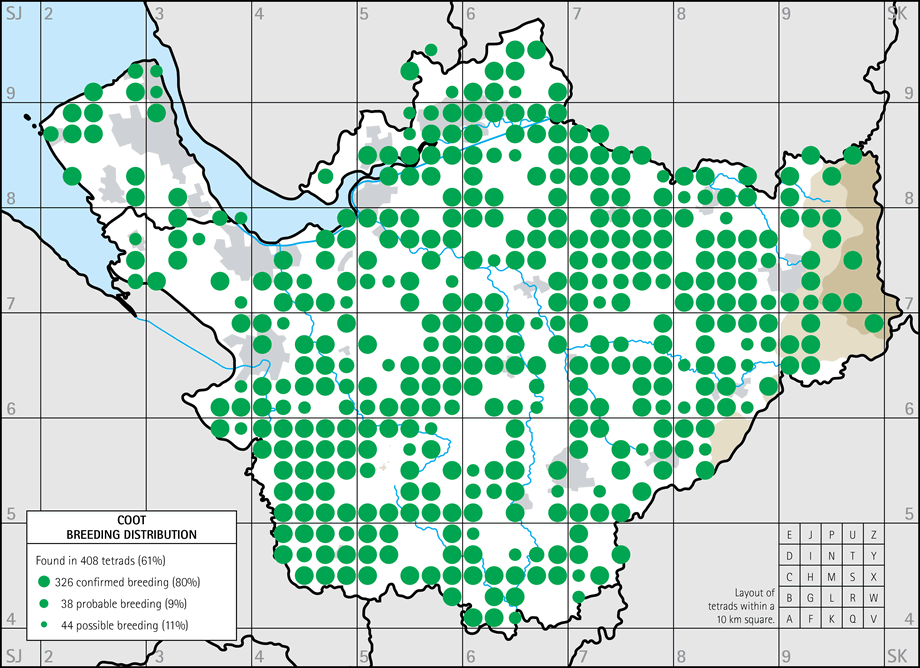
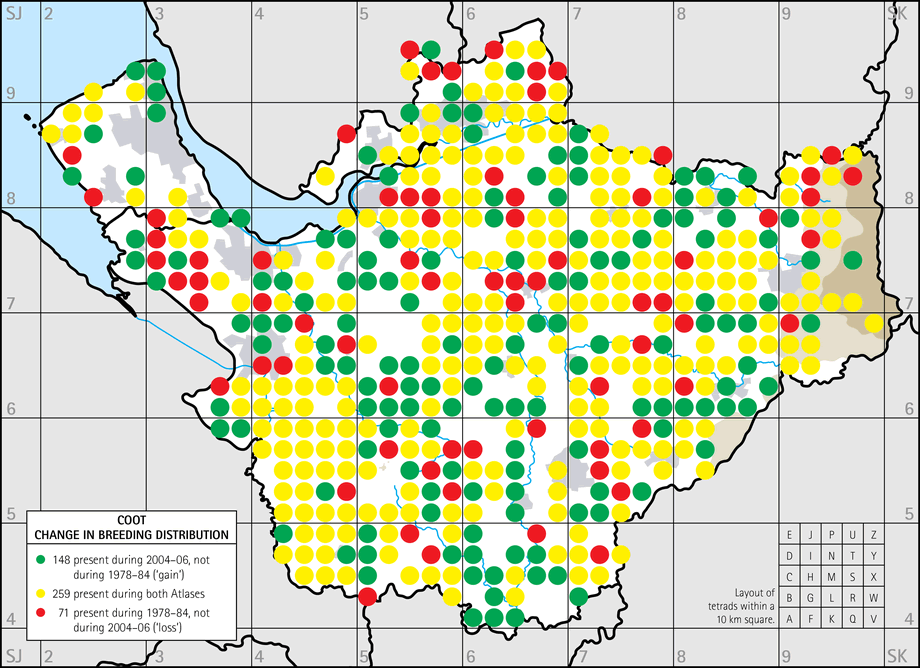
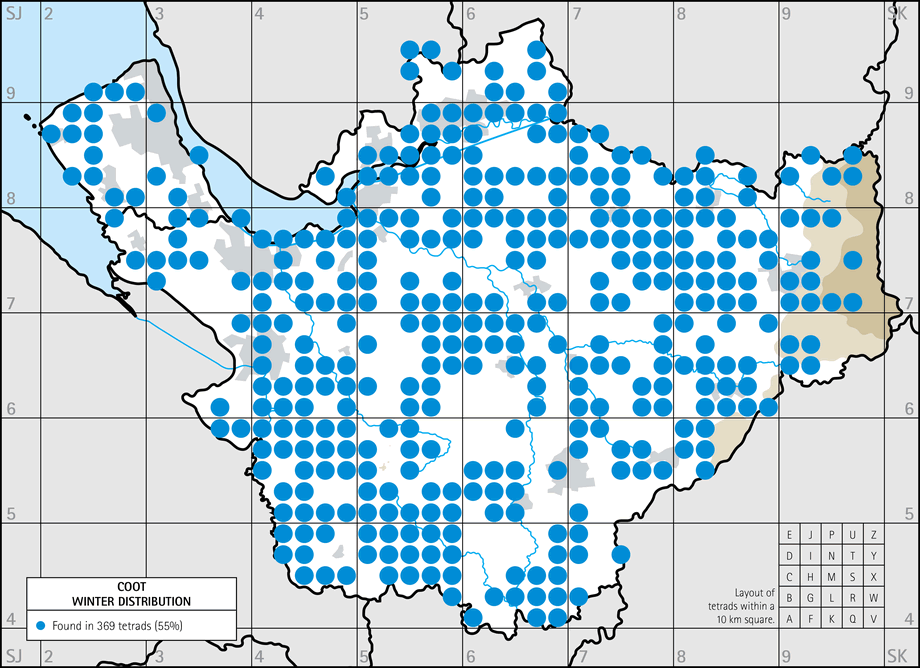
‘A typical bird of all bit the smallest waters in the county’ were the first words of the text for Coot in our First Atlas, but in the last twenty years they have spread to smaller waters and this has allowed them to extend their distribution by as many as 77 extra tetrads. The recorded habitats show 20% on ponds and 41% on small waterbodies, with 31% using meres, lakes and reservoirs; 8% of breeding Coots were on linear watercourses, mostly canals. The species is now widespread across Cheshire but Coots are missing from much of the highest land, in the east of Cheshire and in the Delamere area: they need water with abundant supplies of floating or submerged vegetation to provide the diet for themselves and their chicks. They have spread to most of north Wirral but are scarce on the rest of the peninsula, in line with the sparsity of inland waters there, and have abandoned parts of Ellesmere Port and Neston district that were occupied in the First Atlas.
Since then, the national population index for Coot has risen substantially, by around two-thirds in the BTO’s general breeding bird surveys although by much less on linear waterways. The BTO analysis of the county’s BBS transects shows that the breeding population of Cheshire and Wirral in 2004-05 was 4,430 birds (2,000-6,850), corresponding to an average of more than six pairs per tetrad with confirmed or probable breeding. This is about 1.9% of the British population, showing that the county is disproportionately important for the species. Some locations hold quite high numbers of Coots. In the last decade, at least ten broods in a year have been recorded at many of the county’s well-watched sites: Chelford SQs, Radnor Mere, Sandbach Flashes, Budworth Mere, Moore Nature Reserve and Inner Marsh Farm. High counts were 21 broods at Rostherne in 2000, at least 19 nests seen on Frodsham no.5 bed on 13 May 2000, and at least 49 broods at Woolston in 2004, the highest total there for twenty years.
This is an easy species to prove breeding, with 80% of records being two-letter codes. Most of these (267 out of 326) came from observers seeing Coot chicks, but the conspicuous nature of their nests is illustrated by as many as 59 tetrads for which the highest level of proof was an adult on eggs: their bulky nest may be hidden in a reedbed, but often is clearly visible.
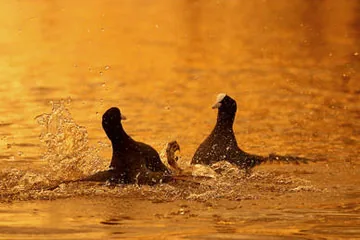
In February or March, Coots switch behaviour from their winter flocking to become aggressively territorial as the breeding season approaches. Disputes with neighbours can turn into fights, birds using their sharp claws to strike at each other, sometimes causing injury. Most Coots do not breed until two years of age, so there can be a lot of immature birds to test the boundaries of territories. The typical clutch of six eggs, maybe up to ten, is incubated by the female for three weeks with the male nearby.
The chicks start out with spiky red down and only gradually change to look like their parents during the two-month long fledging period; they are fed by their parents, who often split the brood and care for two or three chicks each. Coots usually rear only one brood, but may have multiple nesting attempts until they are successful, so the breeding season can extend from March to July. Their nests and chicks are vulnerable to predation, perhaps especially by mink: Sheila Blamire recorded the mustelid equivalent of chutzpah when she saw a mink asleep in an empty Coot's nest at Mere (SJ78F)!
Atlas account sponsored by Roger and Kay Millen
Winter
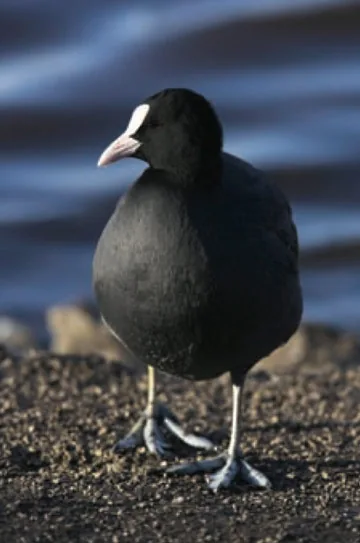
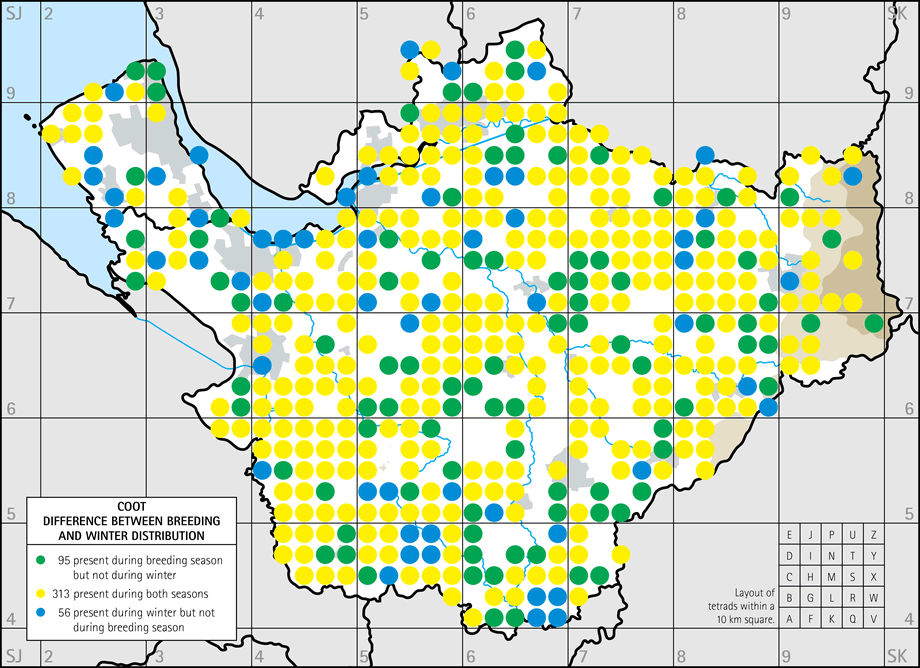
After the breeding season, Coots abandon their territoriality and gather into flocks, where our resident birds are joined by immigrants from continental Europe (Migration Atlas). Birds are seldom seen in flight, however – they mostly migrate at night – and little is known about the origins of Coot wintering in Cheshire and Wirral. They abandon some of their breeding tetrads for the winter: this Atlas shows that they were found in both seasons in 313 tetrads, with 95 occupied in the breeding season but not in winter, and 56 used in winter but not for breeding.
The major site for Coots in Cheshire and Wirral is Doddington Pool (SJ74D), where 884 birds were counted in November 2004, not far short of its record winter flock of 1,300 in November 2001. The Doddington gathering was more than twice the size of the next largest reported flock during this Atlas period, 400 on Redes Mere (SJ87K), and Deer Park Mere (SJ55F/ K) was the only other site counting flocks more than 200 strong. Other sites that have sporadically recorded more than 200 birds in the last decade include most of the larger lowland waters: Budworth Mere, Chelford SQs, Houghton Green Pool, Sandbach Flashes, Radnor Mere, Moore Nature Reserve, Rostherne Mere and, briefly, Frodsham Marsh no.6 bed when pumping of dredgings from the Manchester Ship Canal first started in 1995/ 96. No site in the county approaches the threshold for national importance, currently set at 1,730 birds.
Several of those sites have long been favoured by Coots: Bell (1962) lists Radnor Mere, Doddington, Rostherne, ‘and particularly Tabley, where flocks of up to 400 have occurred’. Doddington Pool was the most frequently mentioned location in the early years of the Cheshire Bird Reports, holding 400 or more birds in the mid-1960s. The sizes of the large flocks have grown over the years, and their national winter population index on sites monitored by WeBS has also increased, by about one-third in the last twenty years (Banks et al 2006).
The habitats used by Coots during winter are much the same as in the breeding season, although there is a small shift away from the smallest standing waters (G1 and G2) to linear watercourses (G6 to G10) whose proportion rises from 8% to 13%: most of these birds are on canals. This is a freshwater bird and there was only one estuarine record, two birds in the Mersey (SJ48V): the three-figure totals in the Dee WeBS come from the inclusion of birds on the pools at Inner Marsh Farm with those of the estuary. Coward (1910) reported that Coots were common in the Dee estuary in severe winters. This, however, has not been borne out by any records published since (Bell 1962). In periods of hard weather in recent years, birds have flocked together on unfrozen waters, including the deeper meres and rivers, especially the lower Weaver.
Atlas account sponsored by Roger and Kay Millen