
Sandbach Flashes: birds and wildlife
About the Atlas
During the three breeding seasons 2004–06 and three winters 2004/05–2006/07, Cheshire and Wirral Ornithological Society (CAWOS) organised more than 350 volunteers to survey all of the county, trying to find every species of bird that was breeding or wintering
Cormorant Phalacrocorax carbo
Breeding
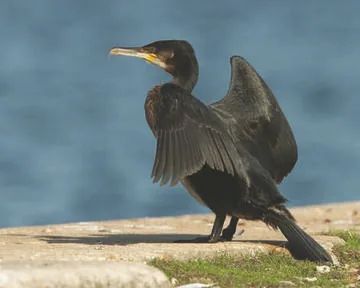
After years of hanging about in the county, occasionally building nests that came to nothing (including a pair laying eggs on a platform at Fiddlers Ferry in 1999), Cormorants marked the start of this Atlas in 2004 by their first successful breeding in Cheshire. Amazingly, this happened simultaneously at four widely-spaced sites – Frodsham Marsh, Fiddlers Ferry, Rostherne Mere and Trentabank Reservoir. What triggered this breeding is not known, but it seems that they just needed that stimulus, and three of these sites now host significant colonies.
The Cormorant was almost exclusively a coastal breeder in the UK until 1981, but has since established colonies in many inland areas of England. The species account in the ‘Seabird 2000’ book (Mitchell et al 2004) seems especially prescient, concluding with the comment ‘Many of these new inland colonies have been established at sites used as winter roosts. Given the large number of roost sites and the availability of suitable feeding areas nearby, further expansion of the inland-breeding habit in England (and beyond) seems inevitable.’ All of the Cheshire breeding sites indeed hosted substantial winter roosts, and at Frodsham and Trentabank there is a clear association with an established heronry.
There has been much speculation about the origins of the birds, and it is impossible to mention breeding Cormorants without hearing the word ‘sinensis’. Cormorant is a cosmopolitan species, breeding in every continent except South America and Antarctica, with probably six races/ subspecies (HBW). The nominate race carbo nests on rocky cliffs from eastern North America, through Greenland and Iceland to the British Isles and Norway. The sinensis race is found from China (as its name implies) through India and across continental Europe where they usually nest in trees. Sinensis are smaller and greener in colour, normally with more white on the throat and with more filoplume feathers on the neck, but there is much individual variation and some old carbo show a lot of white on the head, so racial attribution on the basis of appearance or behaviour is not as straightforward as some birdwatchers believe.
Cormorants have occasionally nested inland in Britain for centuries, but this habit really took off in 1981. In the quarter-century to 2005, breeding had been recorded at 58 inland sites, and the inland population rose to at least 2,096 pairs, exceeding the coastal total of 1,564 pairs (Mitchell et al 2004, Newson et al. 2007). Detailed study (Newson et al. 2007) at colonies in eastern and central England, including observations of colour-ringed birds and DNA sampling, suggests that inland breeding has probably been sparked by birds of the continental race sinensis from the Netherlands and Denmark, but many carbo chicks from coastal colonies in Wales and England have also moved to inland sites to breed. The proportion of carbo increases in longer-established colonies, suggesting that inland colonies might be founded by sinenis but more and more carbo thenjoin them. Cormorants are faithful to their natal colony, but as a site nears its carrying capacity an increasing proportion of mostly younger birds breeds elsewhere, either by moving to existing colonies or founding new ones.
Although Cheshire’s nests have not been studied, Cormorants normally lay 3 or 4 eggs and the parents share incubation for 28 - 31 days. Chicks are in the nest for around seven weeks before fledging. Research elsewhere shows that inland-breeding Cormorants achieve significantly higher rates of productivity (2.3 to 3.0 chicks per pair) than coastal breeders (1.8 to 2.4) (Mitchell et al 2004). Some more in-depth study of the Cheshire colonies would be valuable, including searching for rings or colour-rings on the adults, monitoring the productivity of the nests, taking DNA samples from the birds and observations of food items.
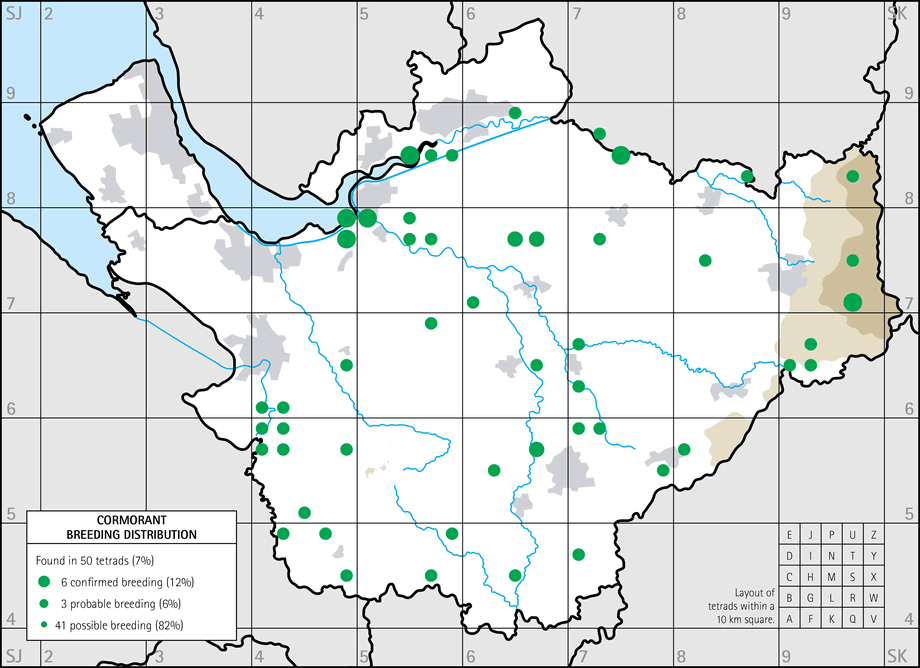
The map appears somewhat to exaggerate their status because the nests at Frodsham span three tetrads. Birds often display, carry sticks and occasionally build nests in years before they successfully establish a new breeding site, so all such observations are worth recording. This survey found birds displaying in trees next to the River Weaver (SJ65T). There are also records of non-breeding Cormorants from many waters in Cheshire. They normally start breeding from the age of 3 to 5 years (occasionally 2), so there are many immature birds present all summer.
Atlas account sponsored by A M Broome
Winter
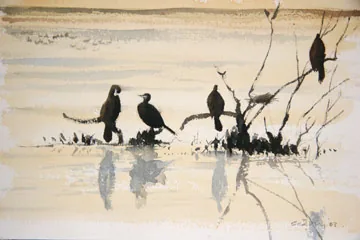
This winter Atlas map would have come as a great surprise to earlier generations of ornithologists. A century ago it was something of an event to record a Cormorant inland, although they were regular non-breeding residents at the coast (Coward 1910). Writing in 1951, Boyd noted that ‘thirty years ago Cormorant was seldom seen on the meres, but it has become a much more regular visitor in the last ten years in every month of the year’. The largest inland flock known to Bell (1962) was 44 birds at Tatton, but he thought that numbers had not increased since the 1940s. They must have not reached east Cheshire because a single bird seen in February 1961 on Langley Reservoirs was suggested as indicating an extension of range (Bell 1962). Bell (1967) noted a rise in numbers at Rostherne since the National Trust took over Tatton, and a count at Rostherne of 28 birds in April 1963 was thought noteworthy. Although the move inland drew most comment, Bell (1967) pointed out that they were seen throughout the year at the coast, with highest numbers in autumn and winter, with up to 500 at Hilbre in winter 1957/ 58 as an exceptional count.
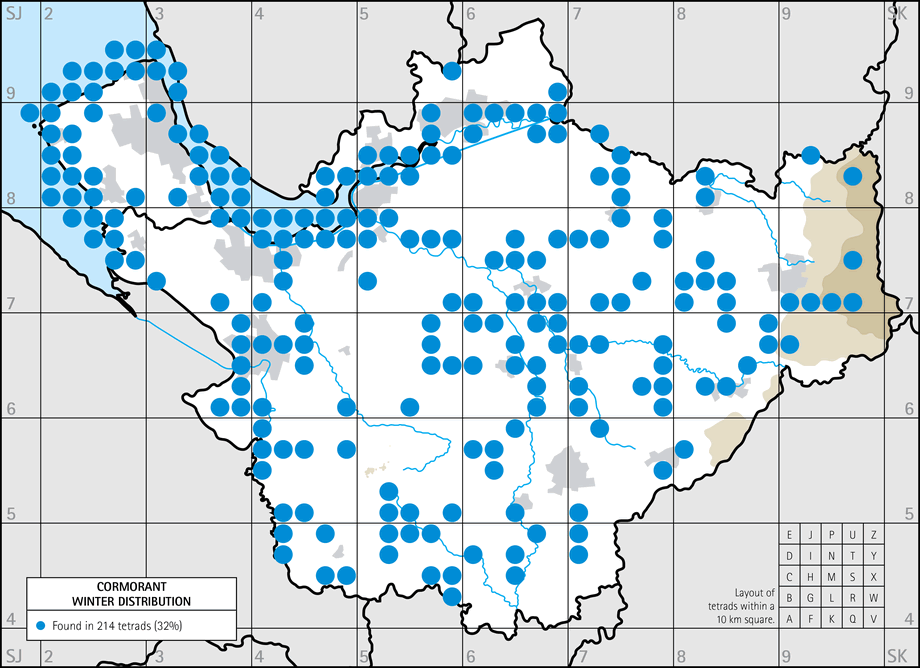
This Atlas map shows Cormorants to be widespread across the county, at the coast, both estuaries, the major rivers and most of the meres and lakes, including regularly in small numbers on the upland reservoirs. The shift inland is illustrated by the submitted habitat codes, showing that only one-quarter of the occupied tetrads were marine or estuarine, with three-quarters of them freshwater. The latter comprised about one-third on linear waterways and two-thirds on meres, sandpits and other waterbodies. However, the largest numbers are still in the Dee estuary, where the WeBS counts show a five-year peak mean of almost 700 birds, the fourth highest for any site in the UK (Musgrove et al 2007). Cormorants often gather into large flocks, but of the 314 counts submitted for this Atlas, half of them were of four birds or fewer. There were just twenty counts of 50 or more, with the largest flocks 420 birds off Hilbre (18Z) in 2006/ 07 and 300 birds in SJ28C (off Caldy) in 2004/ 05. Cormorants do not need to spend much of their time fishing, and many of the larger counts came from their diurnal roosts, birds perching prominently on trees (often dead trees) or electricity pylons, or standing on a sandbank. 212 birds were in the roost at Rostherne (SJ78M) in 2004/ 05, almost ten times the figure of forty years before.
Our wintering birds are mostly from colonies around the Irish Sea (Migration Atlas). Outside the breeding season, adults may move 100 km or more from their colony, and immature birds, below breeding age, disperse similar distances or farther. The index of wintering numbers in Britain, from WeBS counts, has shown a steady increase from the mid-1980s to 2003/ 04, but might have levelled off in recent years.
Cormorants’ diet is almost exclusively fish, with a few crustaceans and amphibians, perhaps taken incidentally. At sea, they stay close to land and mostly take flatfish, sandeels and cod. Inland, they especially favour roach and perch. The Cormorants’ move to breeding and wintering inland in the UK is an apt metaphor for man’s abuse of the environment. Man has overfished the seas and overstocked some inland waters; it is not surprising that this adaptable seabird has responded.
With their diet almost exclusively fish, however, some of the birds have made a nuisance of themselves by fishing in areas where angling clubs have stocked the waters, and some anglers have campaigned to be allowed to kill Cormorants, stigmatising them with the name ‘Black Plague’. In recent years the UK Government’s Department for Environment, Food and Rural Affairs has issued some licences for shooting Cormorants. Their guidance states that a shooting licence will only be issued to reinforce the effects of scaring measures being carried out at a site where: there is clear evidence that serious damage is being caused by cormorants, or on recent past evidence, that it is likely to occur; other non-lethal measures have been found to be ineffective or impracticable; other factors are not likely to be responsible for the serious damage; shooting will be successful in reducing the damage, and there is no other satisfactory solution.
Atlas account sponsored by A M Broome