
Sandbach Flashes: birds and wildlife
About the Atlas
During the three breeding seasons 2004–06 and three winters 2004/05–2006/07, Cheshire and Wirral Ornithological Society (CAWOS) organised more than 350 volunteers to survey all of the county, trying to find every species of bird that was breeding or wintering
Crossbill Loxia curvirostra
Breeding
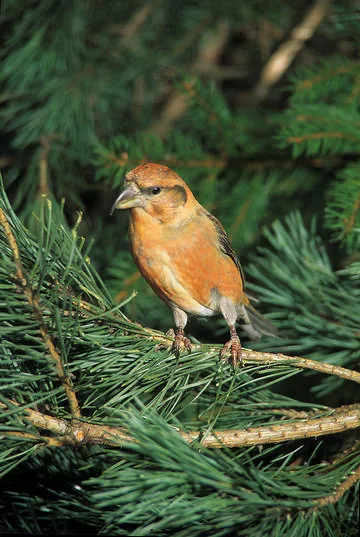
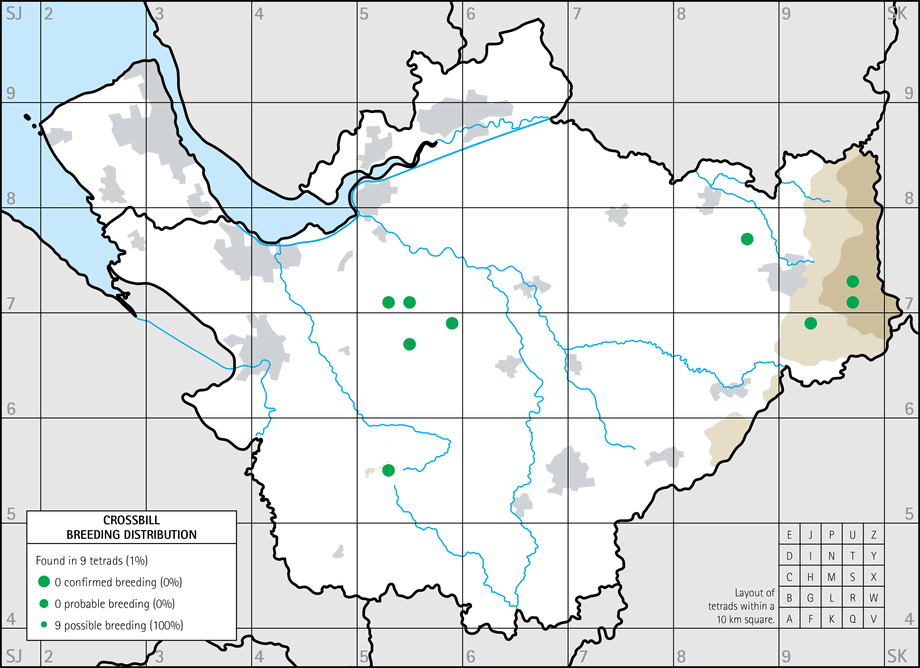
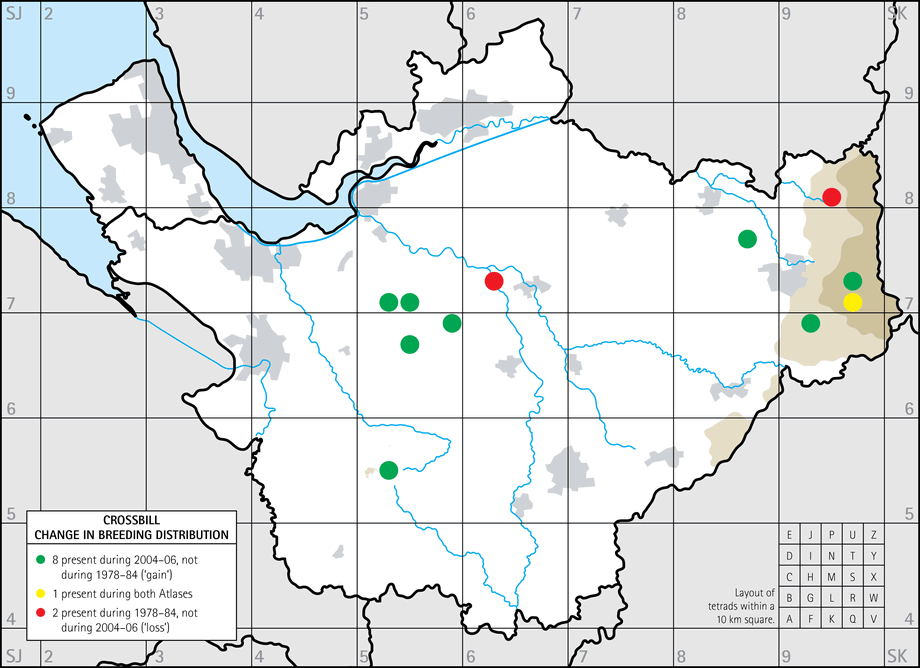
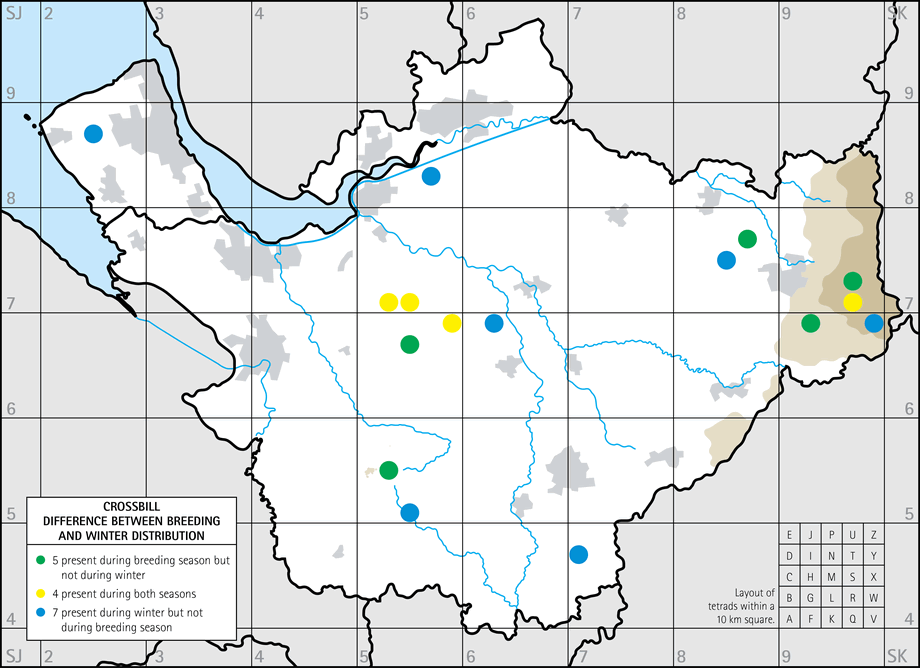
For a species that feeds almost exclusively on the seeds of coniferous trees, it is not surprising that Crossbills were found mostly in the Forestry Commission plantations of Delamere and Macclesfield Forests, or that all of the habitat codes were coniferous or mixed woodland. They almost certainly nest in some of these areas but it is very difficult to confirm breeding and all nine tetrads with birds present are recorded just as possible breeding. The closest to proof of breeding came when Roger Wilkinson reported a family party, including one adult male and at least two birds of year, just south of Blakemere (SJ57K) on 9 April 2006, and I recorded a flock of twenty birds in the same tetrad on 14 May 2006. Richard Elphick saw two males and one young bird at Alderley Edge (SJ87T) in 2005.
The lives of Crossbills are dictated by the seed crop: they eat little other than conifer seeds, spruce, pine and larch. They are capable of extracting seeds at any stage of ripeness, using their unique bill to prise apart the cones, but it takes extra time and effort on unripe cones and feeding is easiest when the cones are opening naturally, typically during winter and early spring in Scots and Corsican pines. When they are feeding in an area, Crossbills usually stay in the tops of the trees and are best detected by their ‘chup’ calls and by seeing flakes of cones drifting to the ground. The evidence is completed by finding cones on the ground, open and with the scales forced apart but intact, completely different from those taken by grey squirrels, on which only the inedible centre of the cone remains.
Crossbills are so linked to conifer seeds that they are stimulated to nest by an abundance of food rather than the changes in daylength that induce breeding in most other birds. In European spruce forests they can breed from August to May on occasions, but in English pine plantations the season is shorter. Nests with eggs have been recorded in every month from December to June but mostly from February to April (Newton 1972). The timing of Atlas fieldwork does not fit well with the Crossbills’ life, and evidence of breeding is perhaps more likely to be obtained during winter surveying.
After the two instances of proven breeding in 1981 described in our First Atlas (one of them not mapped, however), the records submitted to the annual county bird reports concentrate on influxes to the county and the only suggestion of breeding in the last quarter-century was in 1998 in Macclesfield Forest when a male was singing, a female seen carrying material into a nearby tree and the male feeding the female. In 1999 Crossbills were ‘reported to have bred at Cholmondeley’ but with no more information. In other years, flocks including singing males and immatures were in Delamere Forest on 29 April 1989 and from March to May 1990; birds were said to be on territory or singing at Blakemere and The Cloud, Congleton (SJ96B) in 2000; and in 2003, juveniles were noted at Abbots Moss (SJ56Z) and Cholmondeley (SJ55F/ K), with family parties seen at Sound Common (SJ64J). Short of dedicated effort and sustained watching, always difficult with flocks of birds at the top of trees in dense woodland, this is as close as it gets to recording breeding in the county.
Atlas account sponsored by Michael S. Twist
Winter
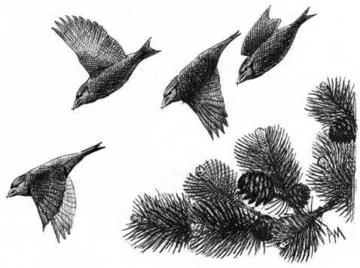
Depending on a single food source with crops that vary sporadically from one year to the next, Crossbills undertake some large post-breeding movements as they try to find another area with enough conifer seeds. These movements occur in summer, usually from late June, as the new year’s production of cones is forming. There are occasional massive eruptions from their continental breeding areas, when Crossbills may be seen in large numbers in new places. If the birds find sufficient food to sustain them for a few months, they often then breed in the new area, but are likely to quit for a different site in the following year. The numbers present may vary by a factor of ten from one year to another, the years of high population coming after an irruption when extra birds have stayed in the area. The largest influxes to the county in recent years were in the summer of 1990 and 1997, the observation of birds showing breeding intent in Macclesfield Forest in 1998 following the latter irruption.
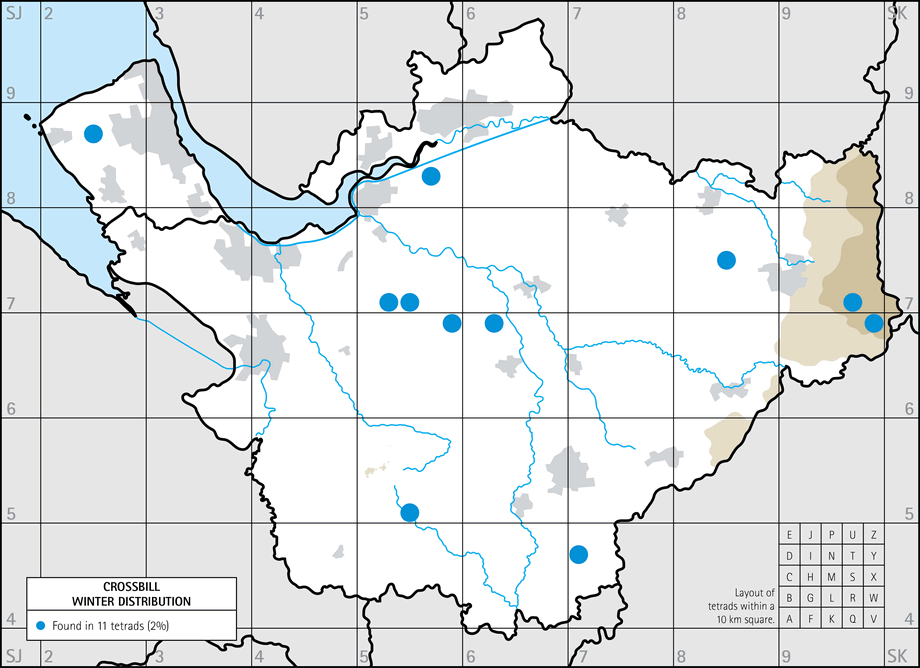
The Atlas map shows birds sparsely distributed in winter, in only eleven tetrads, but broadly in four general areas of coniferous or mixed woodland: Delamere and Macclesfield Forests, Alderley Edge, and the southern end of the Sandstone Ridge. Others were found at Doddington (SJ74D), Daresbury Firs (SJ58R) and Frankby cemetery (SJ28N). Crossbills were reported from just three tetrads during 2004/ 05, six in 2005/ 06 and five in 2006/ 07. Most were in groups of six to eight, with two larger flocks in the Delamere area of 12 and 17 birds.
A century ago, Coward (1910) wrote ‘At irregular intervals flocks of Crossbills have occurred, chiefly in the winter, in woodlands in various parts of the county’. Larches were noted as the main attraction, before the mass planting of pines and spruces in the early 20th century. Boyd (1946) noted an influx into ‘the forest country of Cheshire’ in July 1935 and noted a flock among the Scots pines in Delamere Forest in March 1943, commenting that ‘we have seen little of Crossbills in Cheshire for some years’. Bell (1962) concurred with Coward’s general assessment of their status, and since then, Cheshire and Wirral Bird Reports contain few relatively records in the winter period. Large numbers were in Macclesfield Forest in 1993/ 94, with 59 birds on 15 January 1994, but none at all reported there in the following winter. They were ‘very obvious’ in Delamere Forest in 1997/ 98, but the maximum count was only 14, and the only other winter with substantial numbers was 2002/ 03, with up to 85 in Macclesfield Forest and 16 in Lyme Park (SJ98R).
The three years of this Atlas survey were ‘normal’ years for Crossbills in Cheshire and Wirral, uncomplicated by irruptions or subsequent extra breeding birds.
Atlas account sponsored by Michael S. Twist