
Sandbach Flashes: birds and wildlife
About the Atlas
During the three breeding seasons 2004–06 and three winters 2004/05–2006/07, Cheshire and Wirral Ornithological Society (CAWOS) organised more than 350 volunteers to survey all of the county, trying to find every species of bird that was breeding or wintering
Curlew Numenius arquata
Breeding
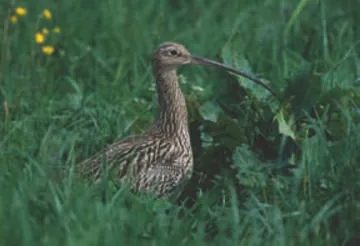
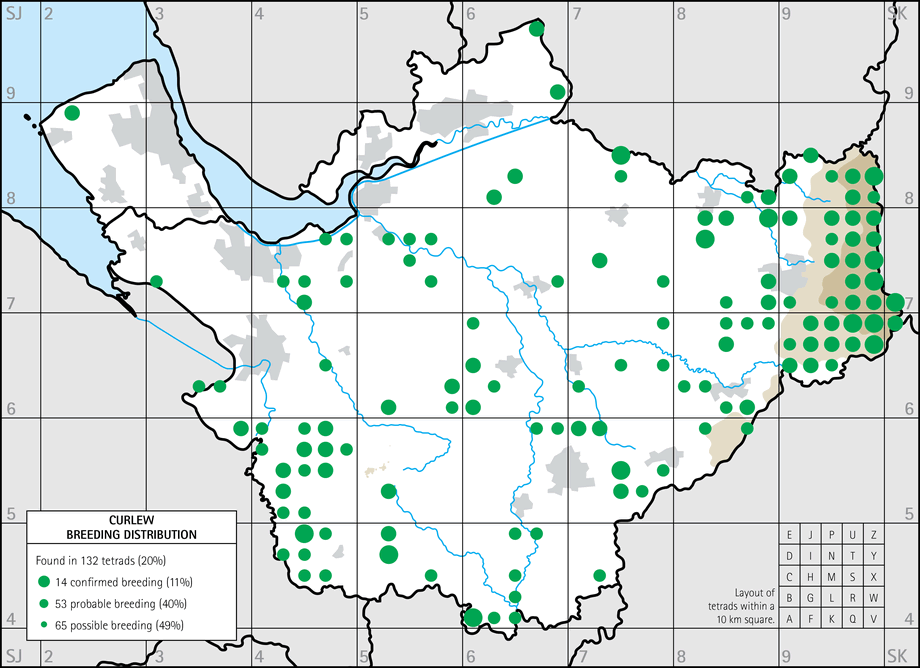
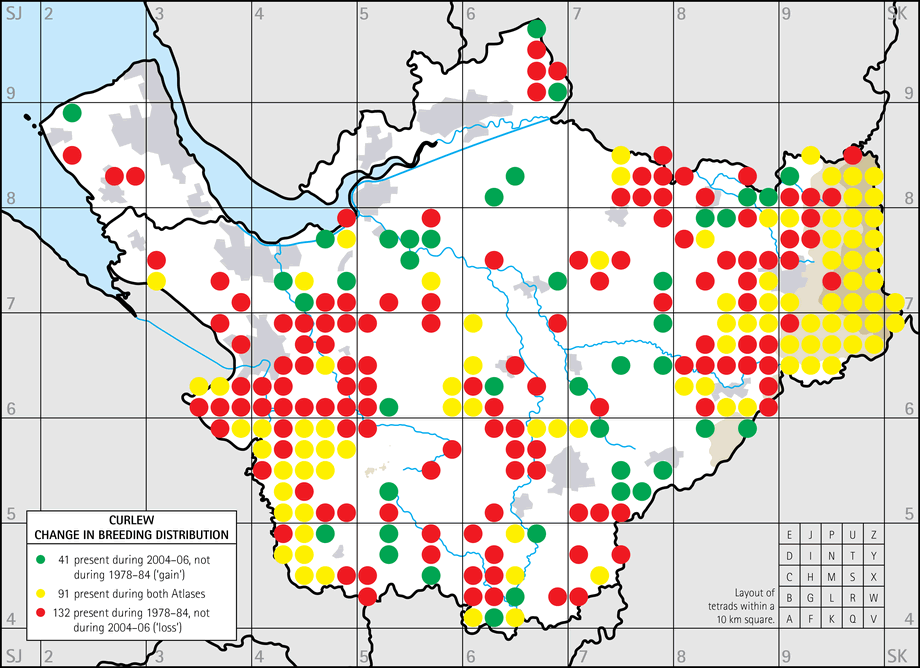
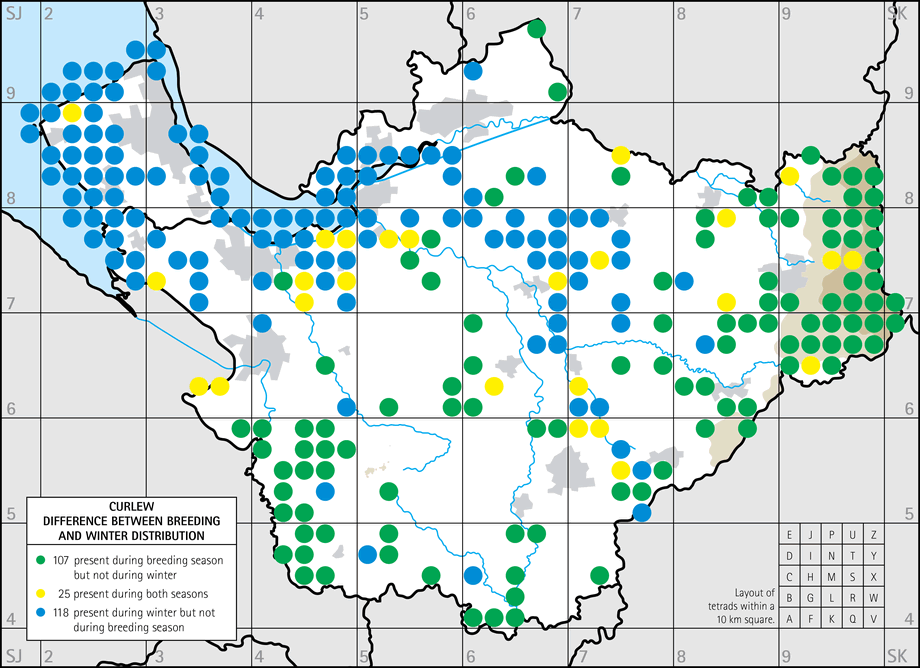
In the last century, the Curlew has waxed and waned as a breeding bird in the county, but is now definitely waning. Their breeding areas used to be only the eastern hills, but from about 1940 to 1965 they occupied much of southwest and central Cheshire as well. By the time of our First Atlas they may have been decreasing, and the ‘change’ map shows that, in the last twenty years, they have been lost from large parts of the county: almost all of Wirral; around Chester; much of the agricultural south of Cheshire; and many tetrads in the vicinity of Wilmslow and Congleton in the east. In terms of breeding season presence, there is a net loss from 91 tetrads. The picture is probably worse than that figure suggests, however, because almost half of the tetrads have only a small dot on the map (‘possible’ breeding) because the only evidence was one or more birds seen in potentially suitable habitat. In many instances there was no sign of the species later in the season – some of these will have been one-year-old birds, too young to breed – and observers felt sure that Curlews had not bred in the tetrad. The number of tetrads with confirmed or probable breeding is now only 67, a 55% drop from the figure of 149 in the First Atlas. Observers proved breeding in only 14 tetrads (a big fall from 61 twenty years ago) when birds with chicks were seen in ten tetrads, with adults performing distraction display in a further four. Probable breeding was recorded in 53 tetrads (down from 88) with 12 instances of birds showing agitated behaviour, 19 of display, and 22 tetrads with pairs present.
The reasons for their decline across much of Cheshire probably lie in changes in agricultural practice, especially early cutting of grass for silage, and continued drainage. The habitat codes in the 67 tetrads with confirmed or probable breeding show the species’ dependence on farmland: 37 were recorded as E1 (improved grassland), 17 E2 (unimproved grassland) and six E3 (mixed grass/ tilled land), with six on grass moor and three on heath or bog. This is a higher proportion of records on unimproved grassland than any other species in the county.
Curlews were lost from much of lowland southern England between the national breeding atlases of 1968-72 and 1988-91, and surveys in England and Wales revealed a decrease of 39% in breeding birds in wet meadows between 1982 and 2002 (Wilson et al 2005). On the other hand, the breeding population of the South Pennines Moors SPA, of which the Cheshire moors are a part, showed a 31% rise between 1990 and 2004-05 (Eaton et al 2007). The analysis of Breeding Bird Survey transects shows that the Curlew breeding population in Cheshire and Wirral during 2004-05 was 180 birds (with a wide confidence range of zero to 420), a considerable drop from the estimate in our First Atlas of 250-350 pairs. The abundance map shows that the highest densities of Curlew are in the eastern hills.
Atlas account sponsored by Peter Mathews
Winter
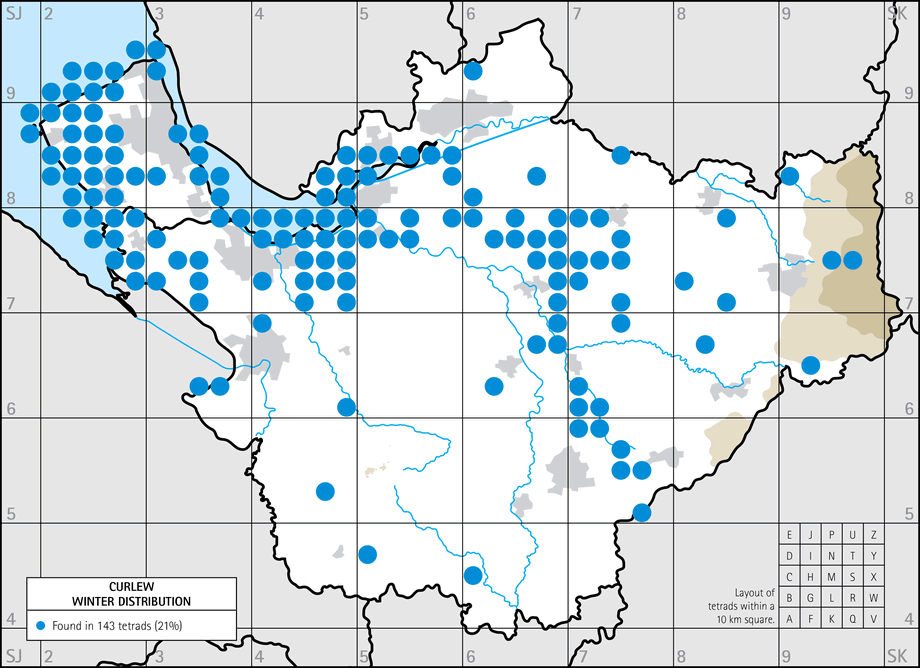
The winter distribution of Curlew is almost the opposite of that in the breeding season, with birds in both estuaries and adjacent areas, and concentrations east of Northwich and towards Sandbach, whilst they are absent from most of agricultural Cheshire and the eastern hills; some of the records in the latter areas were noted by the observer to be from birds in February returning to their breeding sites. There are only 25 tetrads with birds present in both seasons, compared to 107 with birds only in the breeding season and 118 with Curlews in winter only. They are different birds. Most British-breeding birds move out, to the west coast, southwest England, the south of Ireland or France, while there is a large influx of birds from the northeast, especially Finland (Migration Atlas).
The habitat codes showed that 56% of the tetrads with wintering Curlews were farmland, mostly improved (34%) or unimproved (11%) grassland, with few on tilled land. Most of the rest (34% of the total) were on tidal sites or saltmarsh. Although there were more records of Curlews on farmland, the large flocks are in tidal areas so that most of the birds are on the estuarine mudflats where they feed on worms such as ragworm, and crabs and molluscs. Especially in hard weather, ragworms burrow deeper and the shorter-billed males cannot reach them as easily, so the sexes often form separate flocks, with the females at the coast and males tending to feed inland, but there is considerable movement between the tidal areas and inland fields, often daily.
On the estuaries, this is one of the easiest birds to count as Curlews often fly past in long lines or are scattered across the mudflats, and this is one of the few species for which the county avifaunas give any numbers. Coward (1910) wrote that they were most abundant on passage, but at all seasons Curlews may be seen on the mudflats and sandbanks of the estuaries of the Dee and Mersey. In winter he had observed flocks, generally from 50 to 100 birds, scattered all over the miles of banks exposed at low tide. Bell (1962) said that, on the Dee estuary, numbers build up in September and October and into the winter. As many as 3,000 were in the Mersey estuary in December 1933 and flocks of varying sizes up to 2,000 were common in the Dee estuary at any time during winter. Nowadays, WeBS counts show that four-figure flocks are present in every winter month on the Dee, and in at least one or two of the winter months on the Mersey. Both of the estuaries are nationally important for Curlew, with five-year peak mean figures of 3,750 and 1,500 respectively, the maximum usually being recorded in November or December (Musgrove et al 2007). The national totals for wintering Curlew have shown a shallow long-term increase, in which the county’s estuaries have shared.
It is not just WeBS participants who enjoy counting Curlews, and almost every record for this Atlas was accompanied by a number. The median flock size was 40 birds, with the largest gatherings counted by Richard Smith in 2005/ 06, 960 off Heswall (SJ28K) and 900 on Hoylake shore (SJ28E), while the largest flock in a Mersey tetrad was 730 birds off Stanlow Point (SJ47I) in 2006/ 07. Flocks of up to 200 or 300 birds can often be found in Wirral fields. Away from the tidal areas and adjacent fields, 200 were estimated at Billinge Green (SJ67V), and 177 on 29 January 2006 in fields north of Lach Dennis (SJ77B). Many Curlews were found in traditional sites, and observers noted the tendency for birds to frequent the same fields from week to week and indeed from one winter to another.
From records submitted to the annual county bird reports, the inland roosts, which used to be a feature of the county in the 1970s and 1980s (Elphick 1979) now seem to be occupied in autumn but not into winter. The habits and movements of our largest wader would repay further study.
Atlas account sponsored by Peter Mathews