
Sandbach Flashes: birds and wildlife
About the Atlas
During the three breeding seasons 2004–06 and three winters 2004/05–2006/07, Cheshire and Wirral Ornithological Society (CAWOS) organised more than 350 volunteers to survey all of the county, trying to find every species of bird that was breeding or wintering
Dunlin Calidris alpina
Breeding
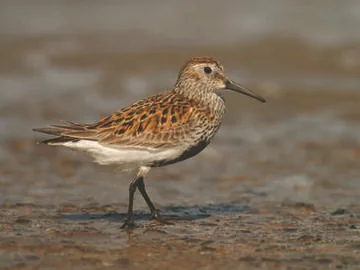
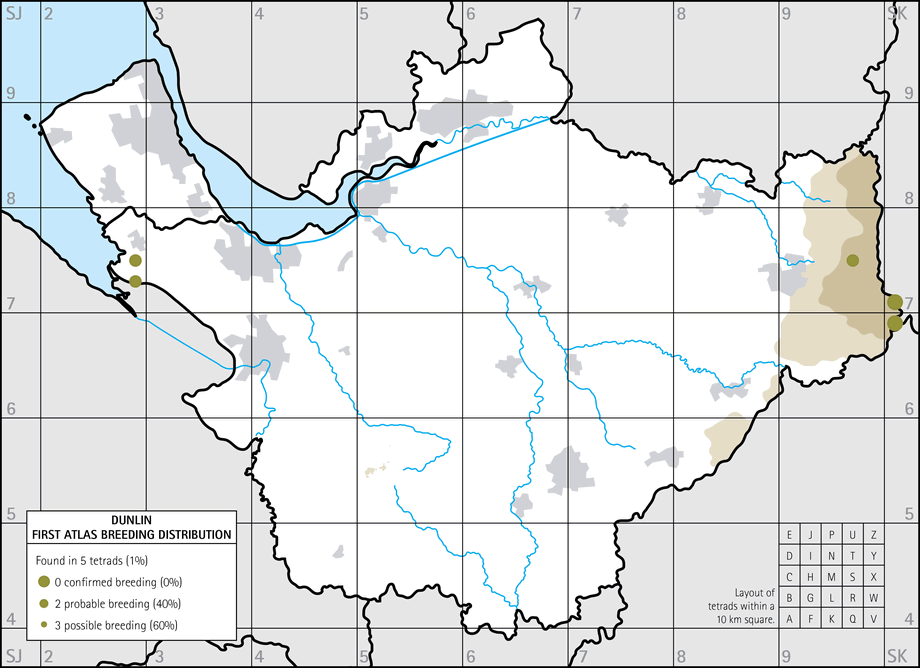
The Dunlin has been on its way out as a breeder in the county for many years, and our First Atlas remarked that it had only the slenderest of toe-holds here. The last on record was the year after fieldwork finished for our First Atlas, in 1985, when the stark ‘one or two pairs bred in the Cheshire hills’ in the annual Cheshire Bird Report does not, with hindsight, do justice to the occasion.
The decline in breeding Dunlins is not restricted to Cheshire. Between the first two BTO national Atlases (1968-72 and 1988-91), they were lost as a breeding bird from many of their southernmost 10-km squares, in the Pennines, Wales, the Scottish borders and Ireland. The BTO Second Atlas has birds ‘seen’, the equivalent of possible breeding, in three 10-km squares in Cheshire (SJ58, SJ68 and SJ69) but the instructions for that Atlas made no requirement for birds to be in suitable breeding habitat, and it is certain that birds in those 10-km squares had no intention to breed there.
Many possible reasons have been put forward for the decline in breeding birds of the uplands across Britain, including habitat deterioration and loss, perhaps through overgrazing, or drainage; increased predation following reductions in gamekeeping; disturbance by ramblers; and increased afforestation. Climate change is implicated for many other northern species, and presumably Dunlin as well. It is not clear to what extent, if at all, these varied factors have operated in the Cheshire part of the Peak District, but Dunlins would struggle to find much of their preferred wet moorland habitat, especially with areas of cotton-grass Eriophorum latifolium that they favour.
A survey of the South Pennines Moors SPA, of which the Cheshire moors are a part, showed a 32% drop between 1990 and 2004-05 in the breeding population of Dunlins and none was found south of Kinder Scout in SK08 (Eaton et al 2007).
There is still a substantial spring passage of Dunlins through the estuaries, with odd birds at other sites, but none in suitable breeding habitat although they sometimes sing on spring migration. Dunlin was recorded as possibly breeding in two of the Dee saltmarsh tetrads during our First Atlas, and the species probably bred in this habitat during 1997-2000 on the Ribble and Morecambe Bay (Pyefinch & Golborn 2001).
The birds in England and Wales are the most southerly breeding Dunlin in the world, and the species is predicted to be lost completely as an English breeder later this century, as climate change takes effect (Huntley et al 2007).
Atlas account sponsored by www.deeestuary.co.uk
Winter
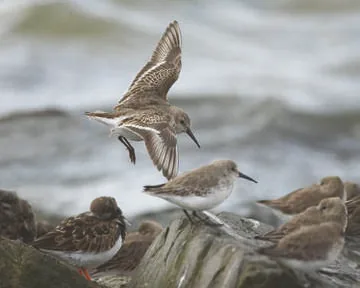
This is the most abundant coastal wader wintering in Europe, with totals of 1.3 million in western Europe, about half a million in Britain and up to 70,000 of them in Cheshire and Wirral. Both of our estuaries are internationally important for the species, with the Mersey estuary the second site in the UK ranking because of its five-year peak mean of almost 45,000 birds, and the Dee estuary in fourth place with a five-year peak mean of nearly 27,000 birds, only about 5,000 of these being in Wales (Musgrove et al 2007). The totals on both estuaries have been dropping in recent years, along with those elsewhere in Britain, and the national total in 2005/ 06 was at its lowest level since 1970. This decline is mirrored by a rise in the Netherlands, suggesting that birds migrating here from the north-east – the origin of most of our wintering Dunlin – are stopping in the Wadden Sea, aided by warmer winter weather. As sea levels continue to rise, especially in southeast England, and squeeze coastal habitats, it will be interesting to monitor how the Dunlin populations respond.
Three races visit the county, with schinzii passing through in spring and autumn between winter quarters in Africa and breeding grounds in Iceland, southeast Greenland, and Britain, accompanied by small numbers of arctica on their way to and from northeast Greenland from the same wintering areas. The birds that come here for the winter are alpina, the larger, longer-billed race that breeds from northern Scandinavia to Russia. One ringed at Hoylake by Merseyside Ringing Group was found in May on a Hull-based trawler fishing off Bear Island, Svalbard, well within the Arctic Circle at 74ºN, and others have been ringed or caught on Great Ainov Island in the Murmansk region of Russia; the MRG files contain details of 25 birds between here and Finland, and 82 movements involving Sweden. Once birds are here for the winter, they are faithful to a site and seldom move more than a few kilometres during the season; they also usually return to the same area in subsequent winters. This site fidelity does make them vulnerable to coastal zone development, oil spills and other man-made hazards.
Our knowledge of Dunlin races and migration has advanced since Hardy (1941) wrote that the majority of winter Dunlin were schinzii, although he had found alpina amongst birds killed by hard weather in January 1940. No previous Cheshire ornithologists have given any numbers, but Coward (1910) described Dunlin as an abundant winter resident, and Bell (1962) wrote that it was common in both estuaries.
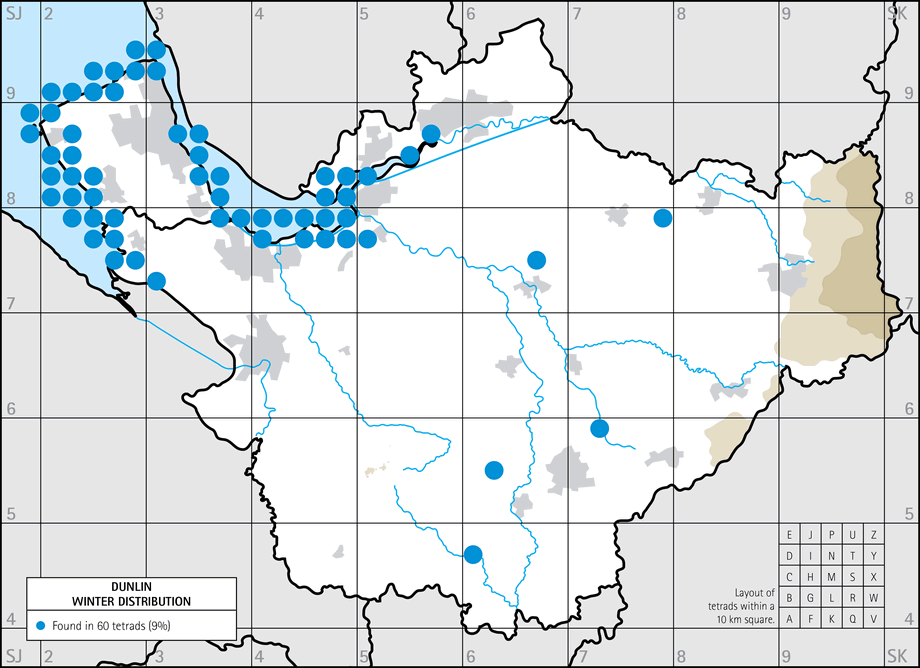
The Atlas map shows that Dunlins were recorded in every tidal and adjacent tetrad with suitable habitat. WeBS counters logged enormous concentrations in some tetrads, with the largest totals in the Mersey 28,000 birds on their main low water feeding ground, Stanlow Banks (SJ47E), in 2004/ 05 and 37,000 at the high-tide roost on Ince Banks (SJ47U). Birds on the Dee tend to spread out over a larger area, with fewer huge flocks, but even so, a maximum of 21,000 birds massed on Hoylake Shore (SJ28E). By contrast, the five inland tetrads recorded only one or two birds at a time.
Dunlins feed on a wide variety of invertebrates, especially ragworms and hydrobia snails, probing into the mud to reach their prey. When winter storms disturb the estuarine mudflats, it is noticeable that sometimes the Dunlin flocks shift their preferred feeding areas according to the sediments and the worms they contain. In hard weather, and sometimes at roost sites on saltmarshes or inland fields, they feed on earthworms and other soil invertebrates.
Atlas account sponsored by www.deeestuary.co.uk