
Sandbach Flashes: birds and wildlife
About the Atlas
During the three breeding seasons 2004–06 and three winters 2004/05–2006/07, Cheshire and Wirral Ornithological Society (CAWOS) organised more than 350 volunteers to survey all of the county, trying to find every species of bird that was breeding or wintering
Dunnock Prunella modularis
Breeding
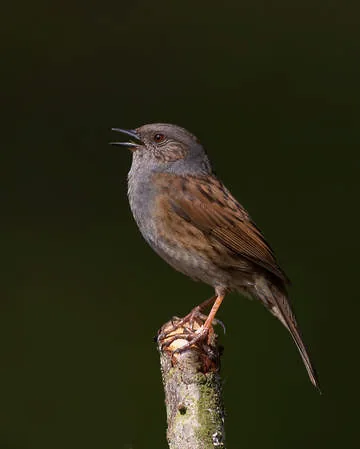
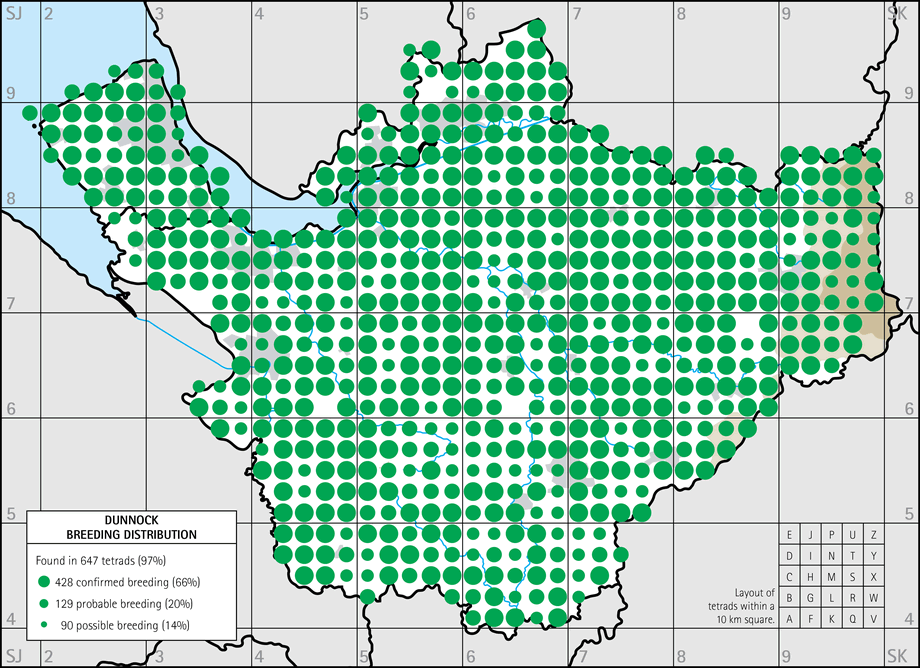
The Dunnock is one of the most overlooked common birds, but this Atlas shows it to be the ninth most widespread species in Cheshire and Wirral, present in 647 tetrads. Its unusual mating systems and susceptibility to Cuckoo parasitism have made it the subject of much professional study (Davies 1992), and its recent placing on the Amber List of species of conservation concern has concentrated the attention of ringers, nest-recorders and some birdwatchers.
Their national population fell by 47% from its peak in 1974 to the zenith in the mid-1990s, much of the drop taking place during the seven years of our First Atlas. The reasons for the decline are not well understood but the removal or heavy trimming of farmland hedges cannot have helped. The species has now recovered somewhat from its low point and the national index in 2004 was a little higher than twenty years previously. The BTO BBS analysis shows that the breeding population of Cheshire and Wirral in 2004-05 was 71,680 birds (57,070-86,280). The population corresponds to a mean of almost 110 birds per tetrad in which they were recorded, but the abundance map shows that this average figure covers an enormous range from some suburban areas where there were more than 200 birds per tetrad to some moorland sites where it was quite difficult to find any. By far the highest proportion of recorded habitat codes were farmland (38%), mostly hedgerows (20%) and improved grassland (10%), with 32% in human sites, 19% in woodland and 11% in scrub.
In this Atlas survey, relatively few nests were found for such a common bird, and Dunnocks had the lowest proportion of confirmed breeding of any of the top ten most widespread passerines. NE/ NY/ ON/ UN was recorded in 75 tetrads, with another 24 ‘probable breeding’ records of birds visiting a likely nest site or carrying nesting material, often moss. Observers found birds carrying a faecal sac or food in 165 tetrads: this can be difficult to see because, when chicks are small, their parents carry tiny food items that are mostly hidden in their bill. Also, Dunnocks are sneaky birds and, if they feel they are being watched too closely, adults often swallow the food they were carrying for their chicks. As usual, many locations furnished proof of breeding through observations of adults with dependent young (188 RF records).
This unobtrusive little bird does not form pairs, but breeds in groups of up to three males and three females, with two males and a female being the most common, making a mockery of the 19th century vicar who thought that the Dunnock was a perfect example of humility and exhorted his parishioners to emulate their behaviour (Davies 1987). Many Atlas fieldworkers noted three or more birds together. This is most likely in prime habitat where population densities are high. In hedgerows in Shropshire, only monogamous and polyandrous (two or three males sharing one female) groups were found (Bishton 2001).
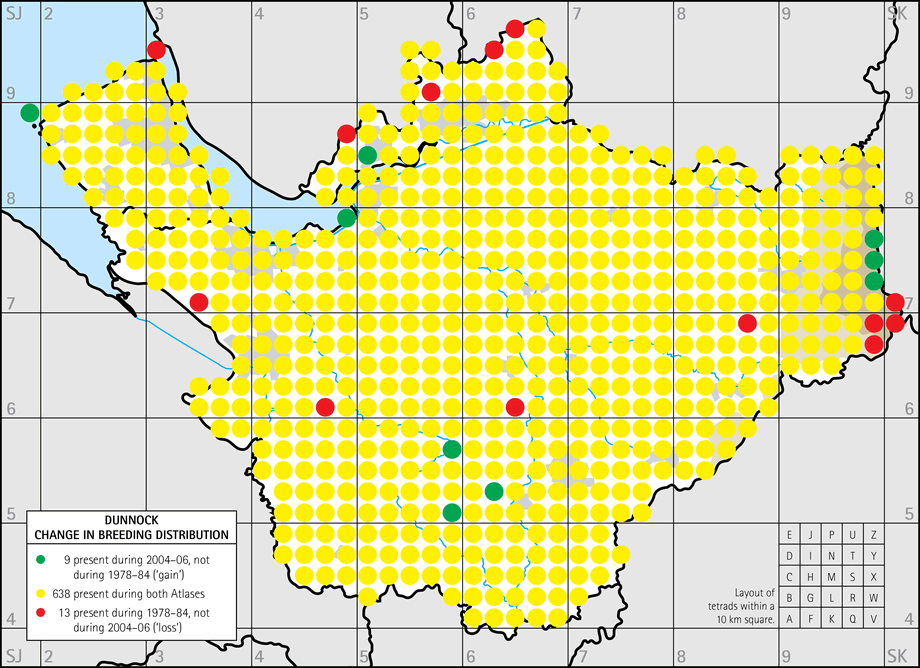
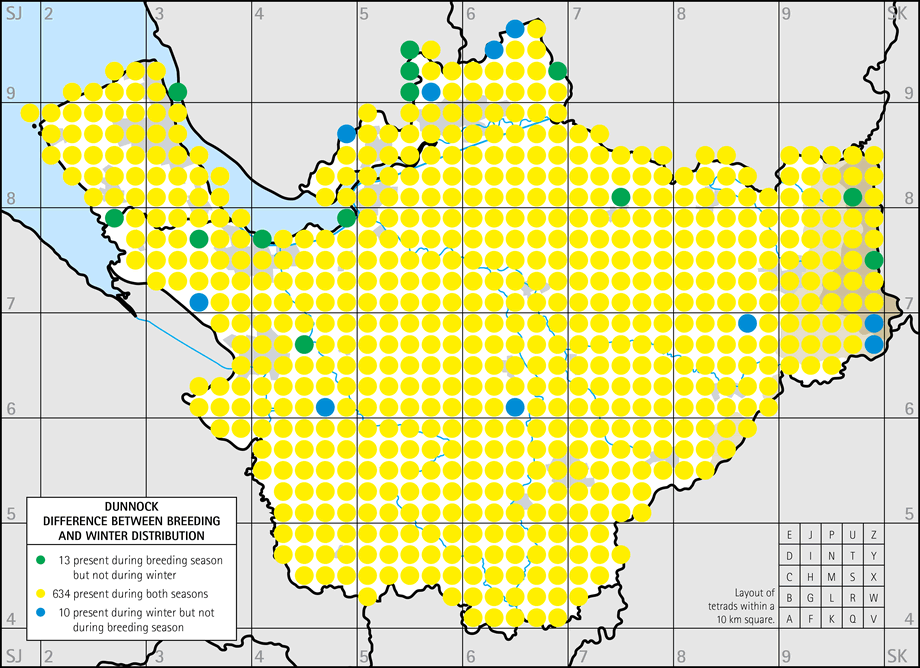
The map shows that Dunnocks were unaccountably missed from a few tetrads, but the only significant gains or losses were at the extremes of the county. They are now probably breeding on Hilbre, where a female with an incubation patch was trapped by ringers, a gain since our First Atlas. At the highest altitudes, above about 350 m, birds were found in three tetrads at the eastern edge of SJ97 where they were absent twenty years ago, but on the other hand, are now missing from four adjacent tetrads at the south-east of the hill country.
Atlas account sponsored by Peter Walton
Winter
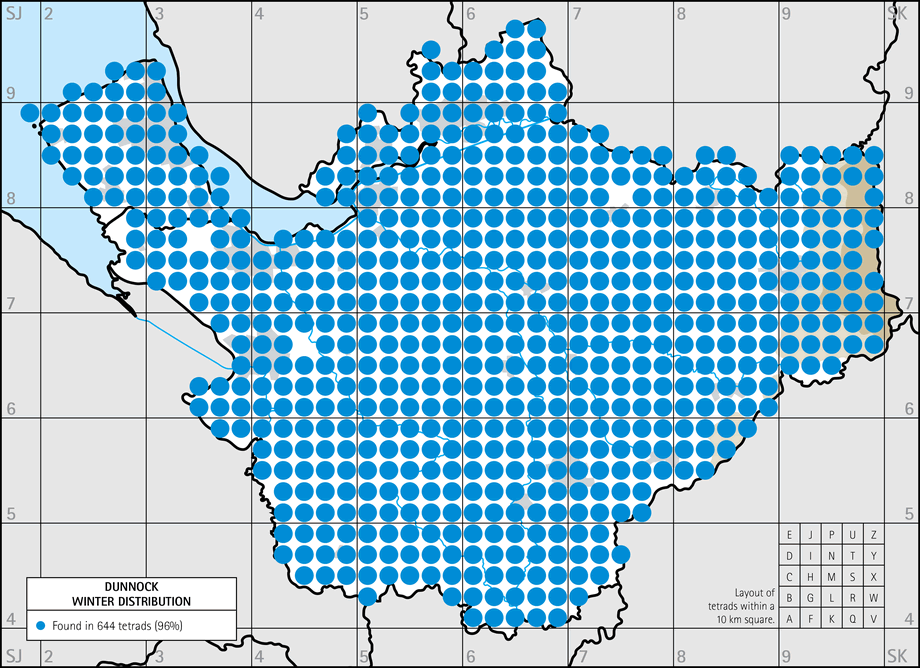
There is little difference between the Dunnocks’ distribution or numbers in the breeding season and winter, and the birds recorded are likely to be the same individuals in both seasons. British Dunnocks are very sedentary, most individuals probably spending their whole lives within an area of radius 0.1 to 1 km. Some of the migratory population from Scandinavia appear on passage in eastern Britain, but there is no evidence of any reaching Cheshire and Wirral. The Atlas map shows the species to be missing from three of the highest eastern tetrads, just as it was found to be scarce above 300 m on the moors around Sheffield (Bevington 1991). The main difference in habitat recorded in winter is a drop in the proportion in woodland and scrub, with a substantial rise in birds in hedgerows.
At all seasons, Dunnocks find most of their food on the ground, by gleaning or turning over small leaves. In winter, the diet consists largely of small invertebrates (e.g. beetles, snails, spiders, flies, earthworms and spring-tails) but where food is provided for birds, they take a wide variety of small seeds, fragments of peanuts, bread crumbs and, less often, berries, small pieces of fat, meat and fruit. The BTO’s Garden BirdWatch shows that this is one of the species most likely to be found, Dunnocks ranking as the fourth most widely reported species in the gardens of northwest England.
Wintering Dunnocks tend to be solitary; observers recorded counts for more than 500 tetrads, but half of them were of single birds. I have been surprised to be able to ring up to twenty different birds in a morning at Meadow Bank Farm, Broxton (SJ45W) where they congregate to feed on wildbird seed crops, especially favouring the energy-rich quinoa.
Life can be hard for Dunnocks. In midwinter, individuals feed for over 90% of the daylight hours, dropping to 60-70% in March (Davies 1987) and in hard winters, the slightly smaller, and subordinate, females have to wander in search of food, and suffer higher mortality (BTO Winter Atlas).
Despite the rigours of winter, many Atlas fieldworkers noted Dunnocks in song from late January onwards, anticipating an early start to the breeding season.
Atlas account sponsored by Peter Walton