
Sandbach Flashes: birds and wildlife
About the Atlas
During the three breeding seasons 2004–06 and three winters 2004/05–2006/07, Cheshire and Wirral Ornithological Society (CAWOS) organised more than 350 volunteers to survey all of the county, trying to find every species of bird that was breeding or wintering
Feral Pigeon Columba livia
Breeding
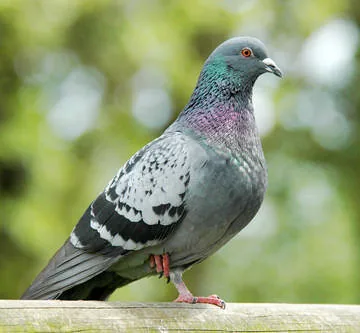
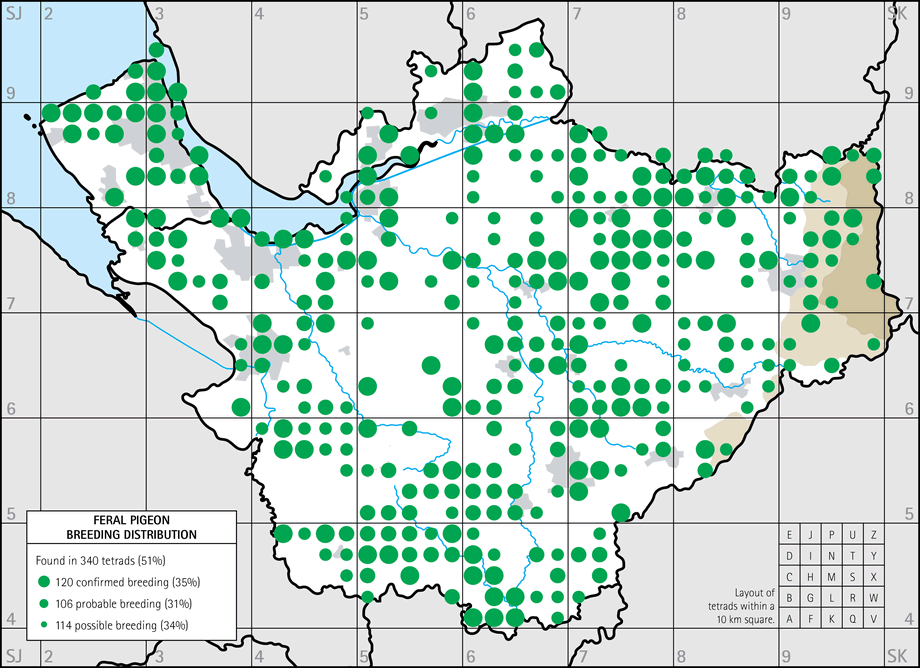
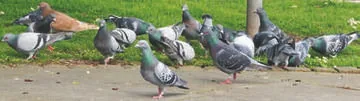
Feral Pigeon holds the curious distinction of being the species most familiar to those who know nothing about birds and most ignored by those who do. It is a bird of two habitats, apparently being equally at home scavenging amongst shoppers’ feet in a town centre or foraging for seed in farmland. Their nest is normally on a ledge, often in buildings and under bridges, with many sites holding several nests close together. The 120 tetrads with confirmed breeding included 93 where observers found nests. Sites included farm barns and cow sheds, quarry buildings, a demolished power station, many railway and road bridges, town centre tower blocks and other artefacts from a Macclesfield gasometer to Bidston Windmill. They seem especially drawn to railway buildings, perhaps because they are tall and open, with copious gantries and ledges to support nests.
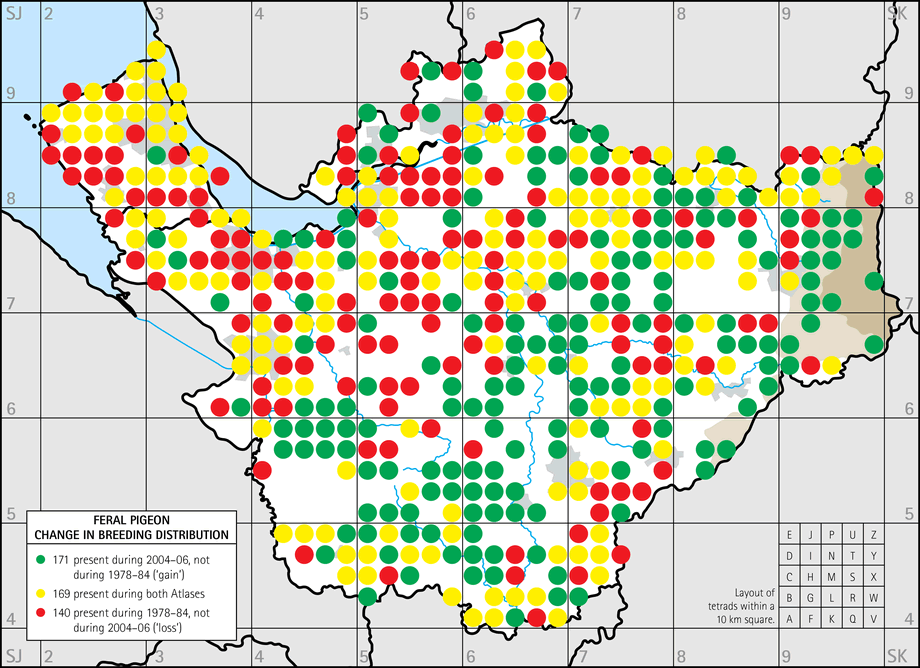
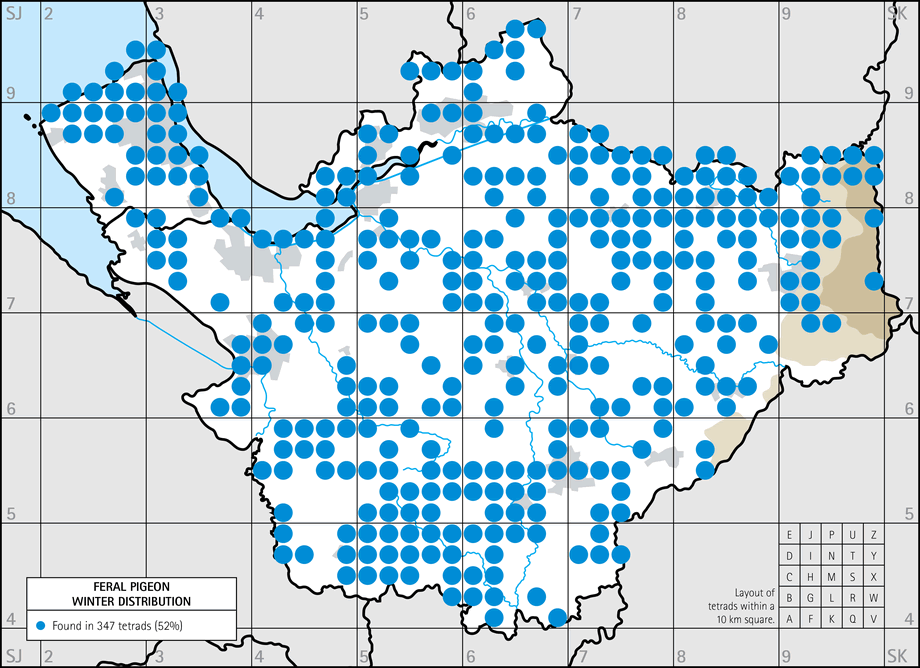
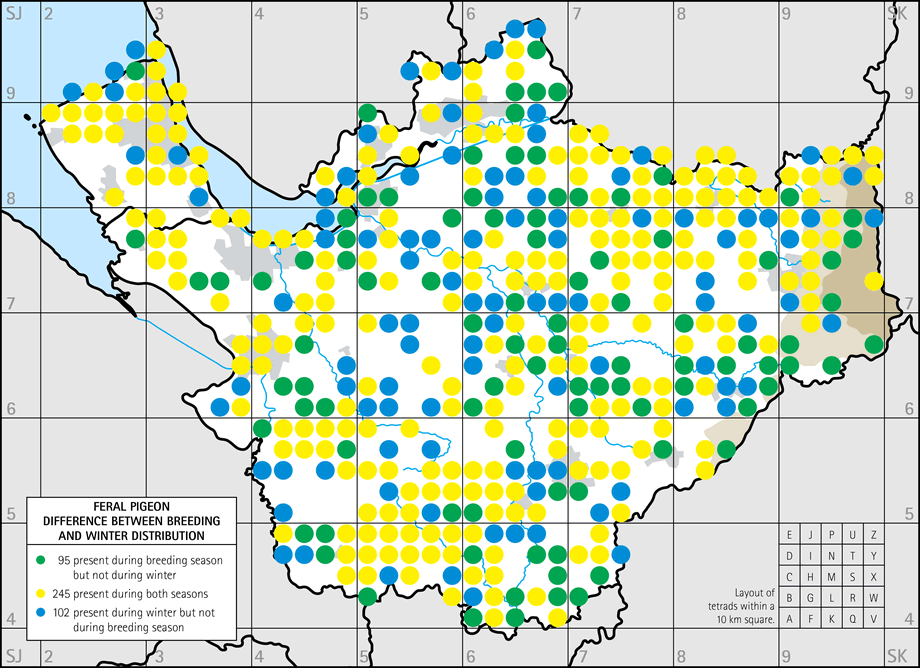
Analysis of the habitats show that 74% of records were in human sites, with Feral Pigeon having the highest proportion of F1 – urban – habitat codes of any species (13%), with 15% suburban and 46% rural. Most of the rest (22%) were farmland. Our First Atlas showed them mainly in the north and west of the county, almost ubiquitous on Wirral, with clusters around Chester, Runcorn, Warrington and Northwich but sparsely distributed elsewhere. This map shows a much more even spread, with pigeons lost from many tetrads in their former strongholds but now present across much of the rest of the county: they were gained in 171 tetrads and lost from 140. They have apparently spread to upland areas in SJ96 and SJ97 and altitude is not a bar to their distribution. The First Atlas map was said to be ‘undoubtedly incomplete’ and perhaps this species was not included by all fieldworkers in that survey, but the widespread losses across the north of the county suggest a real decline in population there.
Young birds are able to breed from about six months of age, and Feral Pigeons can nest all year round so their numbers can rise rapidly, but shortage of nest sites limits the population and many birds spend their lives in non-breeding flocks (BTO Second Atlas). This large pool of non-breeders, continually topped-up by wayward racing pigeons, militates against many efforts to control their numbers.
It is only since the inception of the BTO’s Breeding Bird Survey in 1994 that Feral Pigeon numbers have been monitored alongside all other species. The national data suggest a stable population, with, as yet, no obvious trend up or down. The BTO BBS analysis for Cheshire and Wirral in 2004-05 shows that the breeding population was 12,710 birds, although with very wide confidence intervals of 2,010 to 23,400. This figure averages 56 birds per tetrad with confirmed or probable breeding but an average is likely to hide wide variations. Some conurbations hold 50 or 100 pairs whilst some farming areas have only a few birds.
Atlas account sponsored by Andy Harmer
Winter
Many Feral Pigeons are resident all year-round, some of them indeed breeding in almost any month, and they occupied a similar number of tetrads in both seasons. There appears to have been quite a bit of local movement, however, with 95 tetrads holding birds in the breeding season and not in winter, whilst 102 had birds wintering but not breeding. There is some shift in habitat, with 65% of winter records in human sites and 29% in farmland, and a few in semi-natural grassland or saltmarsh. This suggests that some birds leave their man-made sites, especially in rural (F3) habitats, and flock into agricultural areas. 5% of the records were from stubble fields, often of mixed flocks with Woodpigeons and Stock Doves.
Most Feral Pigeons spend their lives in flocks, and Atlas fieldworkers submitted 287 counts, with a median size of 12. Twenty-three gatherings were estimated at 100 birds or more, headed by a maximum of 500 at Fiddler’s Ferry (SJ58M) in 2005/ 06. Pigeons also gather communally to roost in a variety of places including urban buildings and farm barns; they prefer to be underneath a canopy or a bridge to keep the rain off, but in some sites they have to make do with spending the night on an exposed roof. 15 roosts were recorded during this Atlas, holding up to a maximum of 200 birds in Crewe (SJ75C).
Feral Pigeons were apparently unknown to Cheshire ornithology until a quarter-century ago. They were not mentioned by Coward (1910), Boyd (1951) or Bell (1962), or in the annual county bird reports until 1981. Since then, some large winter flocks have been reported annually, usually 100 or more in most town centres or stubble or slurried fields. In Arctic weather on 9 January 1988, 1,500 birds took to feeding on the saltmarsh at the Gayton Sands RSPB reserve.
Few of the larger landbirds excite birdwatchers (gamebirds, pigeons and doves and corvids) but they constitute the majority of the country’s avian biomass and we should do our best to record as much as we can about them. Feral Pigeons are certainly not everyone’s favourite bird, and probably still under-recorded as a result, but this Atlas provides the most comprehensive assessment ever of their status in the county.
Atlas account sponsored by Andy Harmer