
Sandbach Flashes: birds and wildlife

About the Atlas
During the three breeding seasons 2004–06 and three winters 2004/05–2006/07, Cheshire and Wirral Ornithological Society (CAWOS) organised more than 350 volunteers to survey all of the county, trying to find every species of bird that was breeding or wintering
Gadwall Anas strepera
Breeding
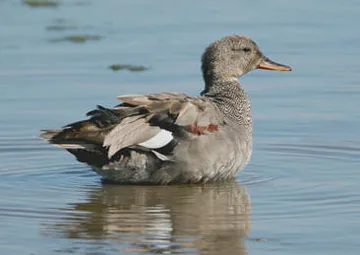
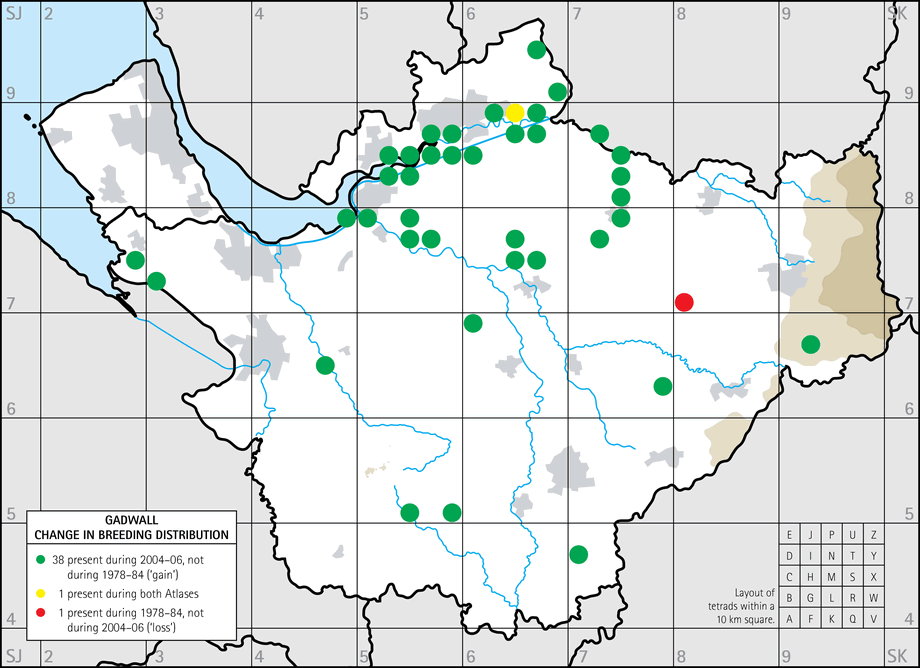
Recent recruits to birdwatching are amazed to learn that Gadwalls had never bred in Cheshire until 1981, when they first nested at Woolston, but they are now widespread along the inner Mersey valley, and steadily spreading from there to other suitable waters. Probably all of the birds breeding in Britain derive from man’s intervention. The first nesting in England was in the mid 19th century in Norfolk, when a wild wintering pair was trapped, pinioned and later released to breed. These acted as the nucleus of a growing population, but the species did not spread beyond East Anglia. In the mid 20th century, birds started breeding at a variety of sites elsewhere, mostly near to wildfowl collections, and wildfowlers released captive-reared birds as well. The origin of the Cheshire birds is not known, but could be the Wildfowl and Wetlands Trust’s centre at Martin Mere in Lancashire.
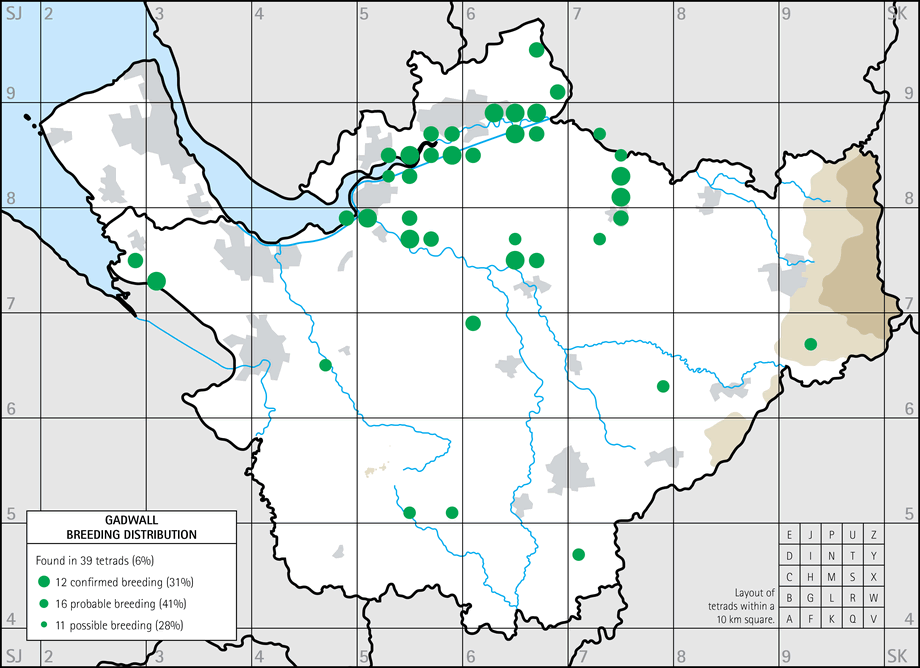
Whatever their source, Gadwalls have found several sites in the county to their liking, and the population is steadily growing. This is still a scarce species nationally, and its numbers are monitored by the Rare Breeding Birds Panel. In 2004, the Cheshire and Wirral population was reported to the RBBP as 31 pairs, clearly an under-estimate, out of a national total of 1520 pairs (Holling et al 2007). Most of the county’s birds are at Woolston: at least 20 broods from an estimated minimum of 30 pairs; 20 broods again in 2005 and 15-17 broods in 2006.
Gadwalls forage almost exclusively on the green parts of plants, particularly emergent and subemergent macrophytes. This food is of such poor nutritional quality that they have to eat vast amounts, so the ducks have to be able to feed undisturbed for long periods, and have access to lots of the plant material, so they tend only to breed in areas where the biomass of food plants is high, predominantly in eutrophic waters. On deeper waters, such as gravel pits and reservoirs, Gadwall steal food from Coots which bring up macrophytes from deeper water normally inaccessible to the dabbling Gadwall, and food obtained in this way can account for such a high proportion of their intake that this habit has allowed them to colonise waters that would otherwise be unsuitable for them. Kleptoparasitism from Coots does not seem to have been recorded in Cheshire and Wirral, however, and it would be interesting to record its occurrence and spread.
In this survey, Gadwalls were reported using a range of wet habitats: two-thirds were on lakes, reservoirs and sand quarries, but one pair was on a small pond in Tatton Park (SJ78L) and in six tetrads they were using small waterbodies, two of them holding broods of chicks. Breeding birds were also found on the river Weaver Bend (SJ57E) and at two sites on the Manchester Ship Canal, although perhaps the birds had nested elsewhere nearby. Four were found in wet grassland (C6, C7, C9) including, unusually, a pair on a Dee saltmarsh pool; they are almost invariably birds of freshwater. The actual nesting site may be well away from water, however: nests at Woolston have frequently been found in the dry centre of no.4 bed, about 500 m from water. The females lead their chicks to the pools, with the first hatching from about late May, and new broods of chicks still being seen into early July.
Atlas account sponsored by James Coyne
Winter
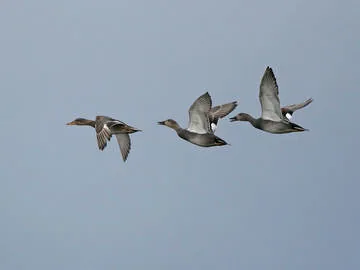
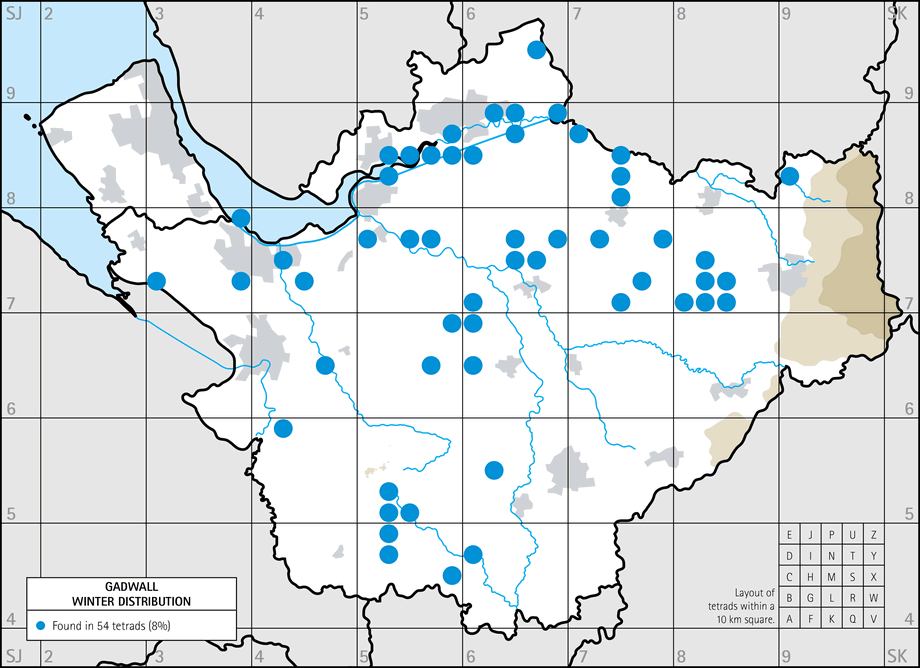
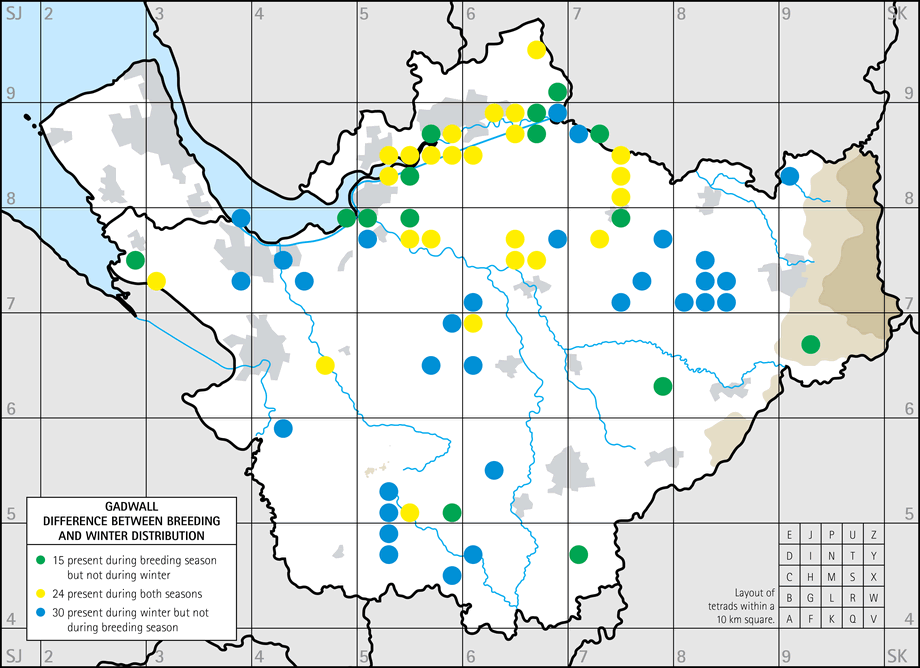
Gadwalls were found wintering in 54 tetrads, rather more than the 39 with birds recorded during the breeding season, the extra sites being especially in the west and south-west of Cheshire, and SJ86 and SJ87 in the east. Birds were recorded in similar habitats to the breeding season, with 59% on lakes, reservoirs and sandpits, although with a higher proportion (21%) on ponds or small waterbodies, perhaps suggesting that, without the demands of a growing brood, even ponds and small waters can provide the food to satisfy their needs. Two birds seen on the Mersey in SJ37Z and in SJ58G were the only estuarine birds.
Between one-third and a half of the Gadwalls wintering in Britain and Ireland originate in eastern Europe, normally as far as the Baltic States, supplementing the largely resident breeding birds and their progeny (Migration Atlas). However, the movements of Cheshire and Wirral birds are not known and perhaps some of them could, like Icelandic and Scottish breeders, winter in Ireland.
The British wintering population has risen ten-fold in the last forty years, leading to frequent revisions in the qualifying figures for the national or international importance of a site. Nowhere in the county currently approaches the threshold for international importance of a five-year peak mean of 600 birds, but Woolston is in the top thirty British sites and is nationally important. This species, however, seems to have a history of erratic fluctuations in numbers at a site, with WeBS counts sometimes rising or falling dramatically from one year to another, for reasons that are not understood (Banks et al 2006).
It was only in 1989 that the first three-figure count was recorded anywhere in the county, at Woolston and at Rostherne Mere, and Rostherne was Cheshire’s premier Gadwall wintering site until 1997 as Woolston no.3 bed recovered from the drainage in 1991, emphasising both the vulnerability of birds being too concentrated on one site, and the value of having alternative suitable refuges. Numbers at Woolston usually peak in August or September, averaging around 250 (Banks et al 2006) – the 470 on 19 September 2004 was a county record – but the highest count during this winter Atlas was 160 birds on 8 February 2006, most of them on the Loop of no.4 bed, an area specially created for nature conservation. Other than parts of the Woolston complex, the only sites with significant counts, just over 50 birds each, were Moore Nature Reserve (SJ58X) and Abbots Moss (SJ56Z).
Atlas account sponsored by James Coyne