
Sandbach Flashes: birds and wildlife

About the Atlas
During the three breeding seasons 2004–06 and three winters 2004/05–2006/07, Cheshire and Wirral Ornithological Society (CAWOS) organised more than 350 volunteers to survey all of the county, trying to find every species of bird that was breeding or wintering
Goldcrest Regulus regulus
Breeding
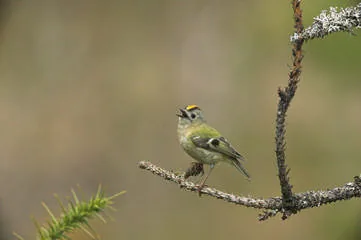
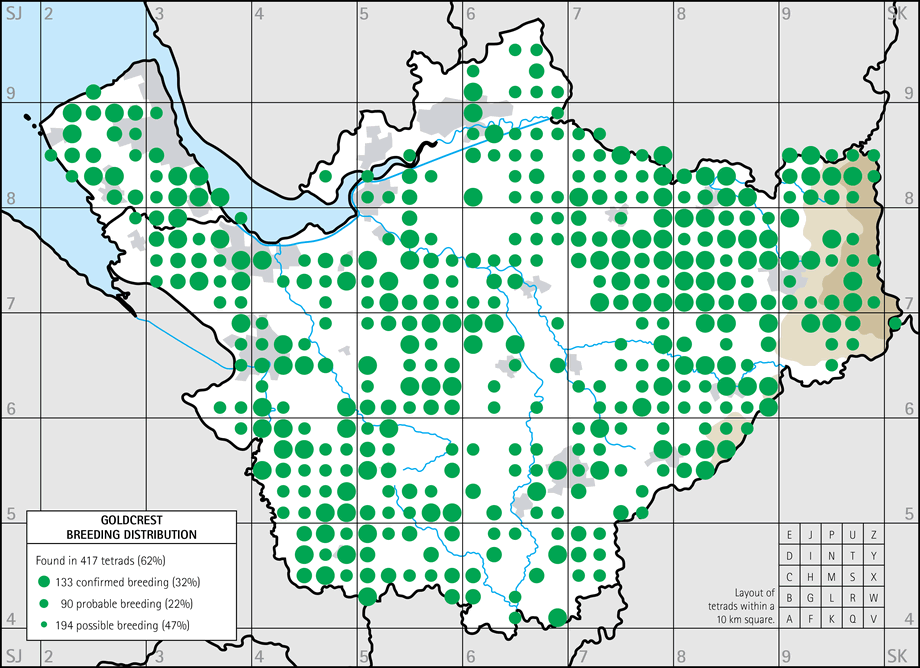
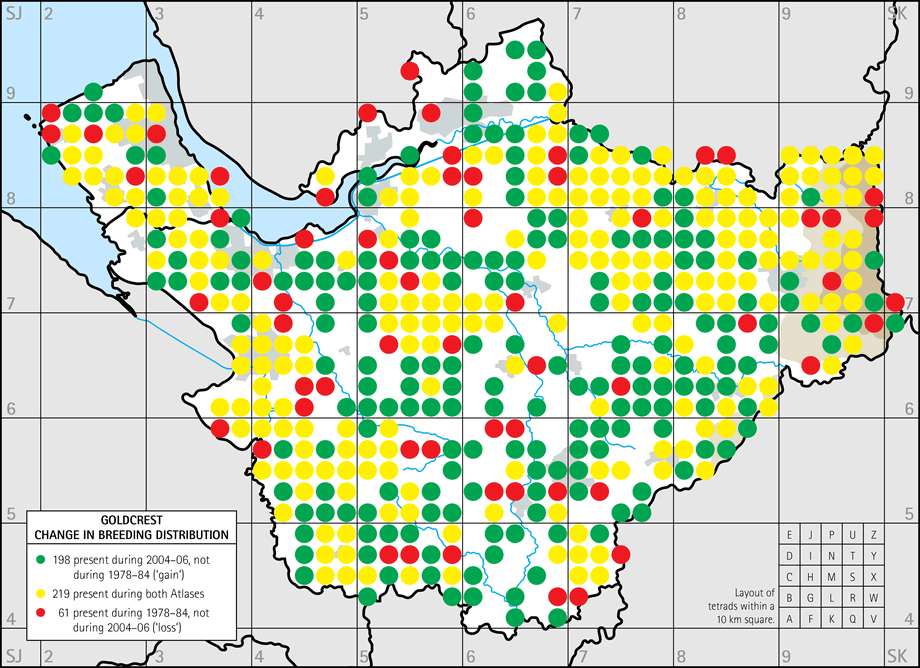
The maps show that the range of this, our tiniest bird, has increased greatly since our First Atlas: it is present in half as many tetrads again (417 compared to 280) and was proven breeding in almost twice as many (133 compared to 70). There is nothing in the national statistics to explain the major increase in Cheshire and Wirral. Although the numbers of this species, as a small resident insectivore, are reduced following hard winters such as those of the late 1970s and early 1980s, the national breeding population was higher throughout our First Atlas period than it is now: the English breeding index now is similar to, but somewhat lower than, that during our First Atlas. Indeed, the species is currently on the Amber List of species of conservation concern because its population had fallen by more than one quarter over the period 1975-2000.
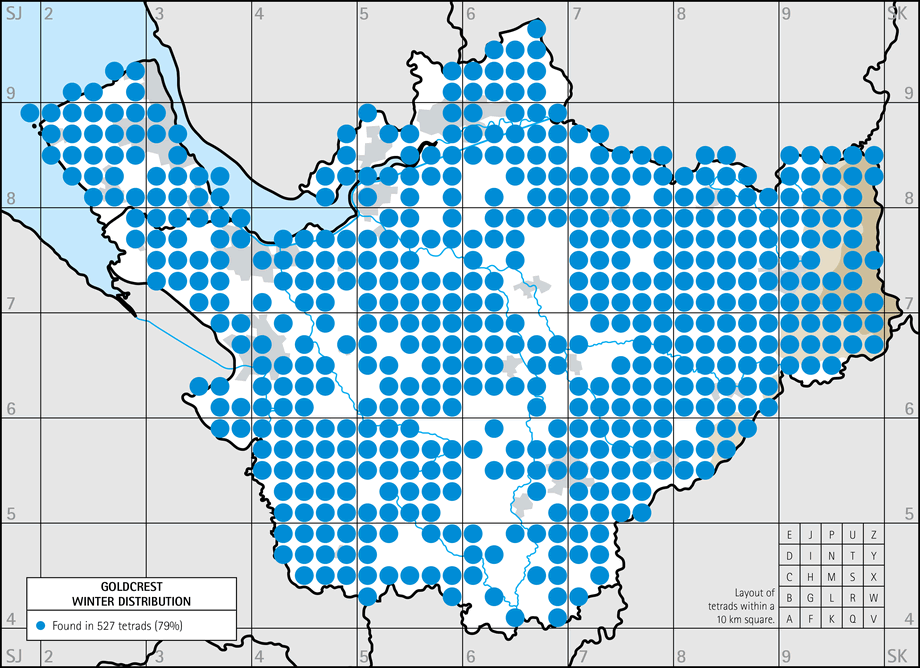
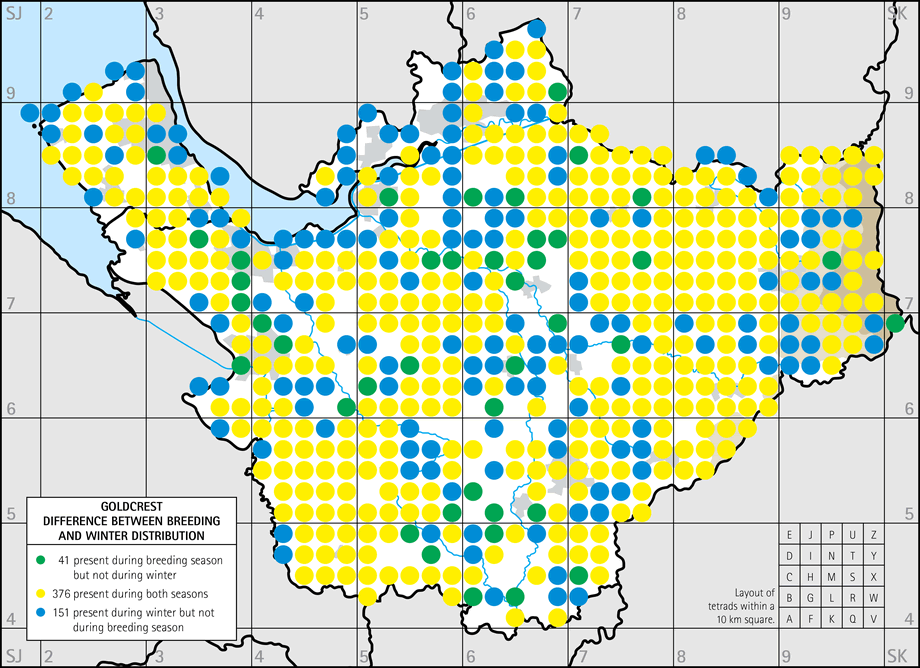
Their expansion has taken Goldcrests across most of the county. Their strongholds are the north-east and south-west of Cheshire, with much of Wirral, and around Chester and Congleton. Birds are found at high densities in the Forestry Commission woods around Delamere and Macclesfield Forests. [They are missing from much of a line running from the edges of the Cholmondeley estate (SJ55L) to Tabley (SJ77D); the industrial and marshland belt across the south Mersey from Ellesmere Port (SJ37Y) to Frodsham (SJ57E); most of Halton in SJ58; and the line of the River Gowy through SJ46 and SJ47.]
This is a difficult species to prove breeding, and most records were of possible breeding through observers hearing their high-pitched song (149 tetrads) or finding birds in suitable habitat (45). Probable breeding was scored with records of pairs of birds (59), display or courtship (7), birds visiting a probable nest site (10), carrying nesting material (9), or anxiety calls (5). Most confirmed breeding, in 84 tetrads, derived from observations of recently-fledged young: Ann Pym near Swettenham (SJ76Y) noted that a brood ‘must have just left the nest when we saw them, like tiny balls of fluff’. Fieldworkers in a further 34 tetrads saw adults carrying a faecal sac or food – Goldcrests feeding themselves and their chicks on insects, especially aphids, springtails and caterpillars, and spiders – and records from just 15 tetrads referred to nests (NY, NE or ON). Their nest is difficult to find, a delicate structure of moss, lichens and spiders’ silk, usually suspended beneath a branch of an evergreen tree.
Atlas account sponsored by Astra Zeneca, Club AZ Natural History section
Winter
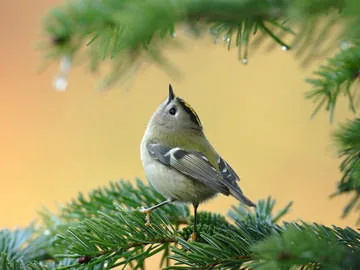
Goldcrests become even more widespread in winter, occupying an extra 110 tetrads compared to the breeding season. As noted by Coward (1910) and Bell (1962), they broaden their habitat use and are no longer defined by coniferous woodland, although, as in the breeding season, this is the species most likely to be found in that A2 habitat, recorded in 66 tetrads. They switch to a higher proportion of broadleaved woodland, with more broadleaved (157) than mixed (117) – reversing the breeding season order of 103 to 148 – perhaps because in winter, they have few competitors as insectivorous feeders amongst the twigs in the tree canopy. There are almost the same number of human site records: apart from a slightly warmer microclimate, the environs of habitation have little to offer Goldcrests in winter. The key factor in allowing it to spread out into the relatively tree-less areas is the winter occupation of scrub (51 winter records compared to 24 for breeding) and especially of farmland hedges (86 compared to 12). Thus, wintering Goldcrests fill in most of the gaps in their breeding distribution.
Most of the birds recorded in the extra tetrads, however, are likely to be different individuals. Breeding birds probably stay put on or near their territory (BTO Winter Atlas), and these are presumably those that are occasionally heard singing, even in the depths of winter. Juveniles disperse locally, with the population augmented by some Scottish birds moving south for the winter and some immigrants from northern Europe (Migration Atlas). Some birds move around within a winter. One ringed at Norton Priory, Runcorn on 31 December 1994 was found dead in April 1995 near Haverfordwest, Dyfed, 233 km southwest, a classic destination for a hard-weather movement.
They eat almost exclusively small invertebrates and it is remarkable that Britain’s smallest bird, weighing about 5 g, can survive through most winter conditions. They spend much of their time searching the undersides of leaves, the needles of conifers and twigs, so that snow affects them rather little, and the only adverse weather that impinges on their feeding is frosting or glazing of trunks and foliage. They forage at all heights from the neck-aching (for the observer) tops of tall trees to ground level if need be, with two reports of birds feeding on the ground in snow. One observer found two small flocks feeding on seed heads and on dead thistles, where it was most likely that they had found some invertebrate larvae or eggs amongst the plants, and in a garden at Poynton (SJ98B) Goldcrests had learned to feed on fat balls.
Some Goldcrests join mixed-species flocks, especially with Long-tailed Tits and other tits, usually squeaking as they go. Substantial flocks of ’crests are sometimes found: as many as 40 birds were reported in Little Sutton (SJ37T) and similar numbers in a hillside wood near Wildboarclough (SJ97V), with other flocks of around 25 in Abbots Moss (SJ56Z) and Woolston (SJ68U). But three-quarters of records were of just one or two birds, indicating the way that most Goldcrests lead their lives.
Atlas account sponsored by Astra Zeneca, Club AZ Natural History section