
Sandbach Flashes: birds and wildlife

About the Atlas
During the three breeding seasons 2004–06 and three winters 2004/05–2006/07, Cheshire and Wirral Ornithological Society (CAWOS) organised more than 350 volunteers to survey all of the county, trying to find every species of bird that was breeding or wintering
Golden Plover Pluvialis apricaria
Breeding
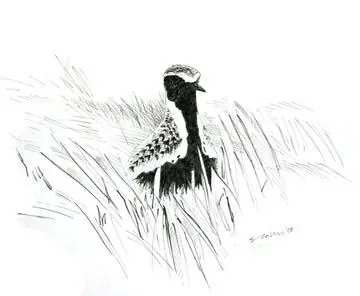
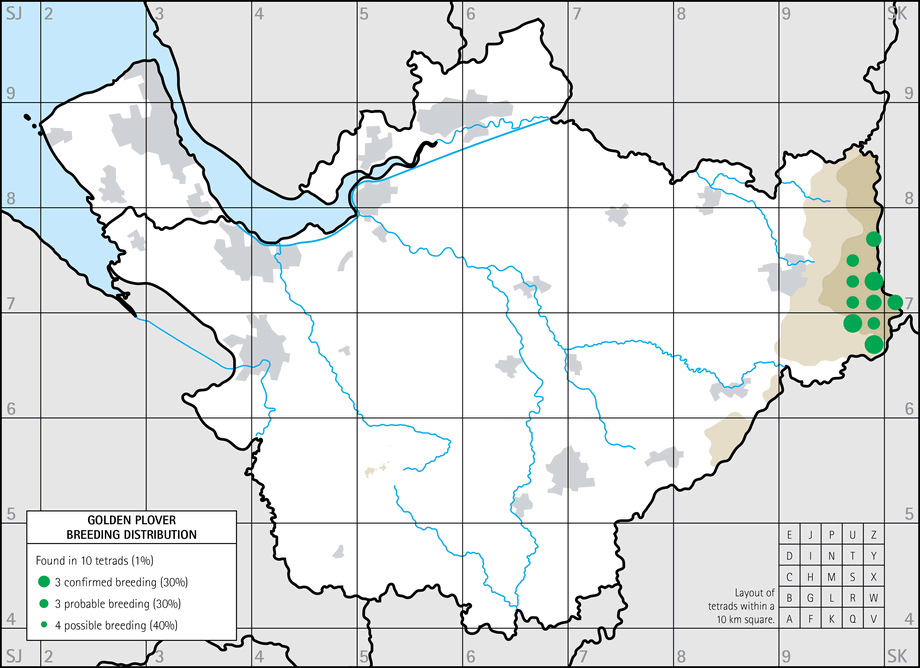
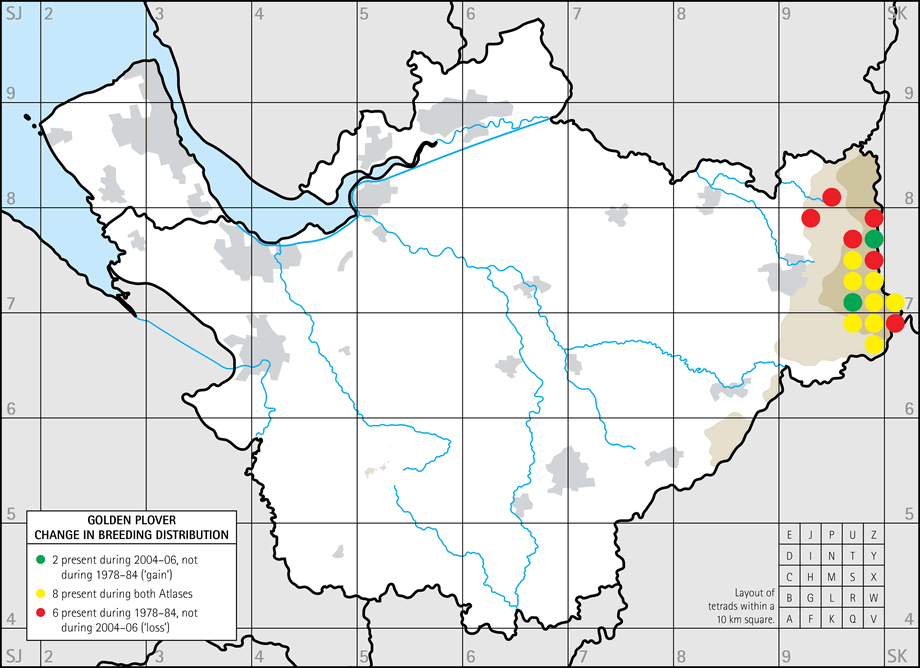
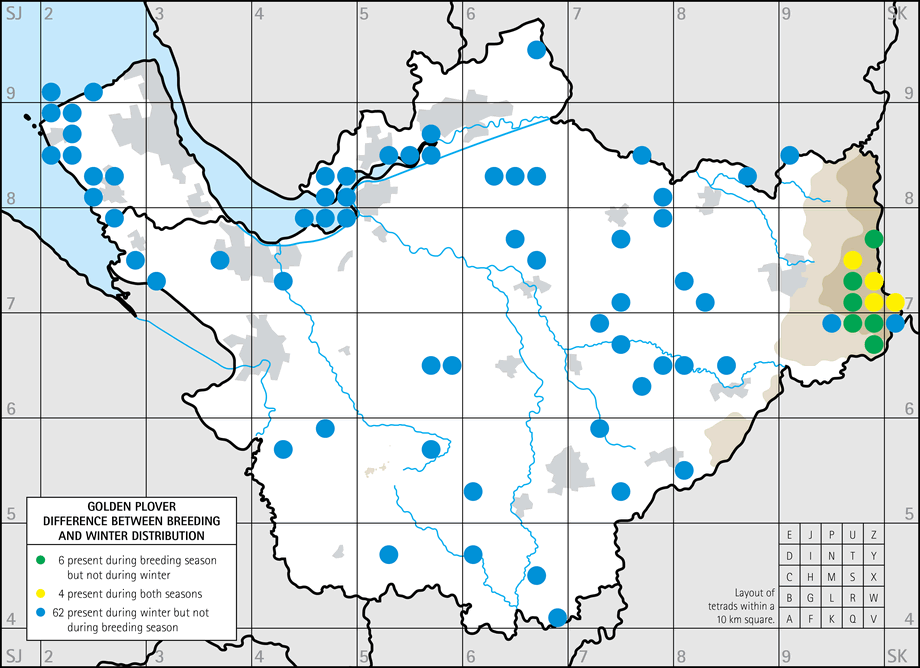
Despite concern over their status, and the comment in our First Atlas ‘that this species is clearly endangered as a breeding bird in the county’, Golden Plovers appear to be maintaining their range and numbers in England, although declining significantly in Scotland (Sim et al 2005). Surveys of the South Pennines Moors SPA, of which the Cheshire moors are a part, showed no change between 1990 and 2004-05 in the breeding population of Golden Plovers (Eaton et al 2007). This Atlas map shows that their range has contracted somewhat since our First Atlas, when they were present in 14 tetrads, with breeding confirmed in six of them, but an annual total of only seven or eight territories. They have been lost from six of those tetrads, including four at the northern end of the hills, but were recorded in two where they were not seen twenty years ago. Birds were proven to breed in three tetrads, all in 2006, when adults with chicks were seen on High Moor/ Piggford Moor (SJ96U); in the Shining Tor tetrad (SJ97W) and in the Birchenough Hill tetrad (SJ96Y). Probable breeding records came when agitated adults were found in SJ97V (above Yarnshaw Hill) and near the Cat and Fiddle (SK07A), with birds displaying near the county boundary near Jenkin Chapel (SJ97Y). All of these tetrads are above 350 m in altitude.
In SJ97R, north of Macclesfield Forest, it is not thought that they breed in the tetrad but since 1999 Steve Atkins has noted flocks of up to 28 birds feeding there from April through to July, with birds seen flying in from the east and displaying in flight. These are probably off-duty birds, especially females as males do much of the daytime incubation of the eggs, who fly up to 10 km from their nest to feed in fields rich in earthworms, cranefly larvae and other invertebrates. Such fields are as important to their breeding success as is suitable moorland itself (Brown & Grice 2005).
Golden Plovers have been returning to the Cheshire hills noticeably earlier in recent years, and breeding earlier in warmer springs, although ultimately, the warming climate will probably put an end to their breeding in our area, and they are predicted to be lost completely from England as a breeding bird later this century (Huntley et al 2007). Tipulids are the main food taken by chicks, totalling 60% or 70% of their daily intake, both as larvae (leatherjackets) and adults (cranefly or daddy-long-legs); timing the breeding cycle to coincide with emergence of the adults is important for chicks to grow well. They also eat beetles, spiders and caterpillars, with a few berries. Adults may move their chicks up to 2 km to find better foraging sites, which include bare peat and small marshy areas (Pearce-Higgins & Yalden 2004).
In prime habitat they can achieve densities of 20-30 pairs per tetrad, with nests every 400 m (BTO Second Atlas) but the Cheshire moors are very different. The county bird reports during the 1990s gave annual figures that varied from four to twelve territories. During this Atlas period, John Oxenham thought that there were three pairs in SJ96Y in 2004, and the Cheshire total must be at least six pairs, but a coordinated count would be valuable to arrive at a definitive figure for the Golden Plover population.
Atlas account sponsored by Dr J. D. Atkinson
Winter
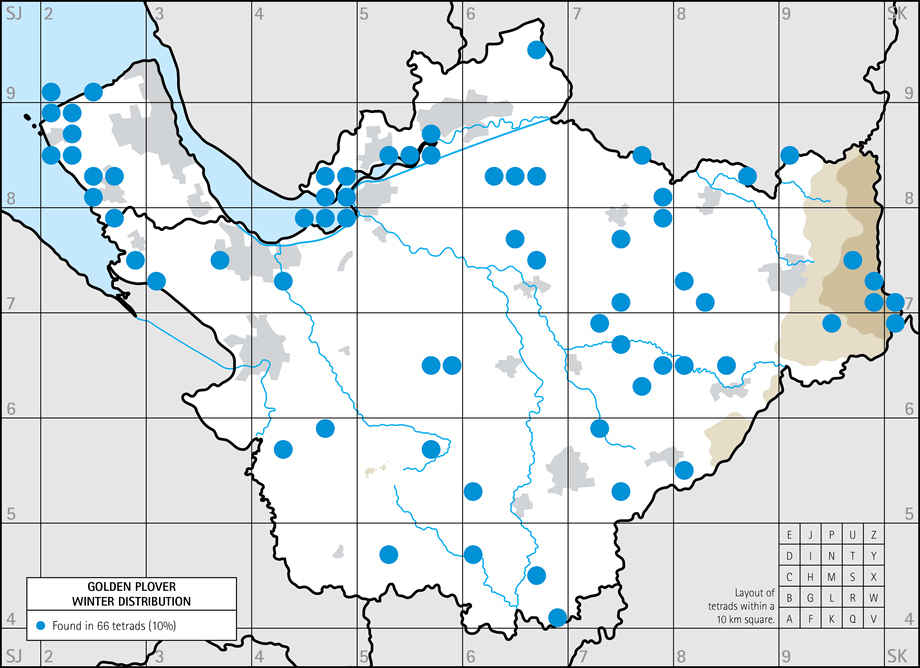
The Atlas map shows that Golden Plovers are scattered widely across the county during winter. Local birds leave their breeding grounds and move to the British coasts, France and Iberia, to be replaced by immigrants from Iceland, most of whom winter in Ireland with some in western Britain, and from Scandinavia and possibly Russia (Migration Atlas). They have long been known for their propensity to occupy the same groups of fields every winter, and seldom visit other sites (Coward 1910, Boyd 1946). They normally quit the moorland for the winter, and many of the occupied tetrads on the map are from birds that have returned early to their breeding areas. The county bird reports have noted that some Golden Plovers have considerably advanced their return dates, from mid-March during the 1990s to 24 February 2000, 17 February 2001, 9 January 2002, 18 January 2003, 11 February 2004, 9 February 2005 and 10 February 2006.
By far the most favoured site, holding perhaps half or more of the county’s birds, is Frodsham Marsh, as it has been for over forty years; in the 1960s it was not unusual to find winter flocks up to 1,000 birds there (Bell 1967). During this Atlas period, there were reports of seven flocks of 1,000 or more, all in the area of Frodsham or Hale on the opposite bank of the Mersey, with maxima of 1,300 on the north side at Hale Marsh (SJ48W) on 6 February 2005, and 4,000 on the south side at Frodsham Marsh (SJ57E) in January 2006. Elsewhere, the highest counts were 360 birds in 2004/ 05, roosting next to boats in the Heswall gutter (SJ28K) and 400 birds on 17 February 2005 at Ashley (SJ78S), which was one of their favoured sites mentioned by Coward, still in use one hundred years later. Most birds were in much smaller flocks, with a median size of 40 birds. They often form mixed flocks with Lapwings, and sometimes Fieldfares, but try to avoid Black-headed Gulls who often wait for the plovers to extract worms then rush in to steal the food. This kleptoparasitism drives Golden Plovers and Lapwings to feed at night, provided that there is sufficient moonlight, usually in different fields from their daytime haunts (Gillings et al 2005).
This is not normally an estuarine species, except in hard weather, with only 10-15% of the winter population found on coastal mudflats (Migration Atlas), but they feed in inland fields, mostly on earthworms and other soil invertebrates. Nearly two-thirds of the 71 submitted habitat codes were farmland, 26 of them improved grassland, with only one on unimproved grassland, and six each on stubble, tilled land and mixed grass/ tilled land. These proportions are similar to those for Lapwing, except that Golden Plovers are significantly more likely to be found on improved grassland and less likely to be on unimproved grassland than Lapwings: this seems surprising in view of Golden Plovers’ adherence to long-established feeding sites, many of them pre-dating the chemical era of modern agriculture and the establishment of lush grass. The remainder of the habitat records were grass moor with heather (C3) in three of the hill tetrads, one on grazing marsh at Inner Marsh Farm, three each of small waterbodies and sand quarries, one open shore (a small flock of four birds at Hoylake), and 4 records of saltmarsh and 11 habitats with estuarine codes.
Since the 1980s, there has been a substantial shift of wintering Golden Plovers to the east of England, perhaps in response to the warming climate, with more birds on arable fields and estuaries and fewer on grassland (Gillings et al 2006). There has been little change in the flocks at the county’s main site, implying a likely reduction at sites that are not regularly monitored, although this has not been noted in the records submitted to the annual bird reports. Revisiting all the areas mentioned by Coward and Boyd would make an interesting and worthwhile little project.
Atlas account sponsored by Dr J. D. Atkinson