
Sandbach Flashes: birds and wildlife
About the Atlas
During the three breeding seasons 2004–06 and three winters 2004/05–2006/07, Cheshire and Wirral Ornithological Society (CAWOS) organised more than 350 volunteers to survey all of the county, trying to find every species of bird that was breeding or wintering
Goldfinch Carduelis carduelis
Breeding
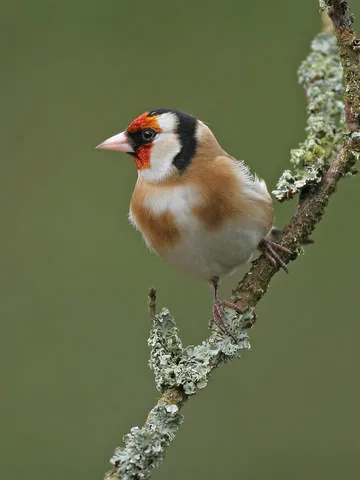
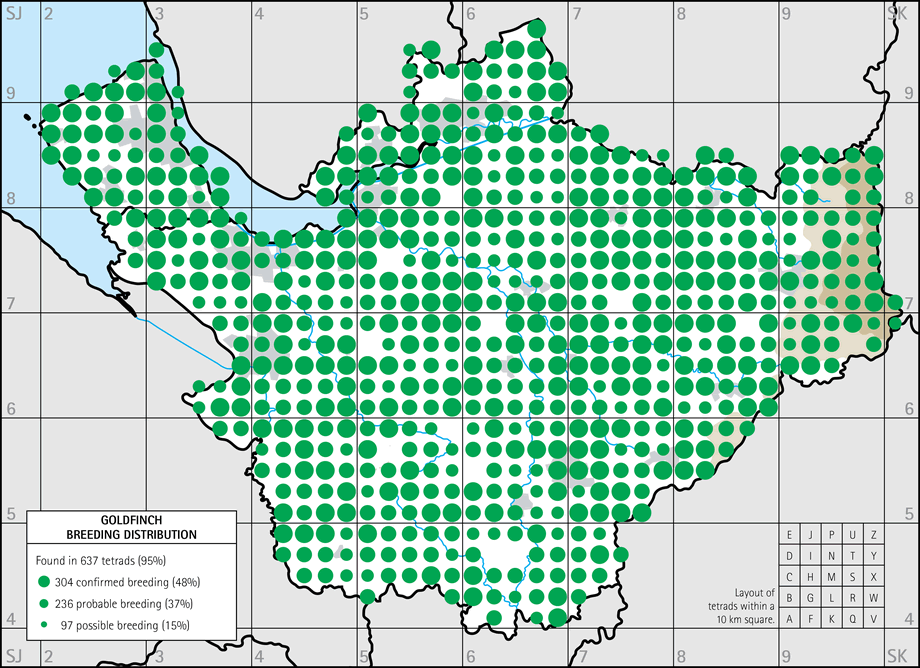
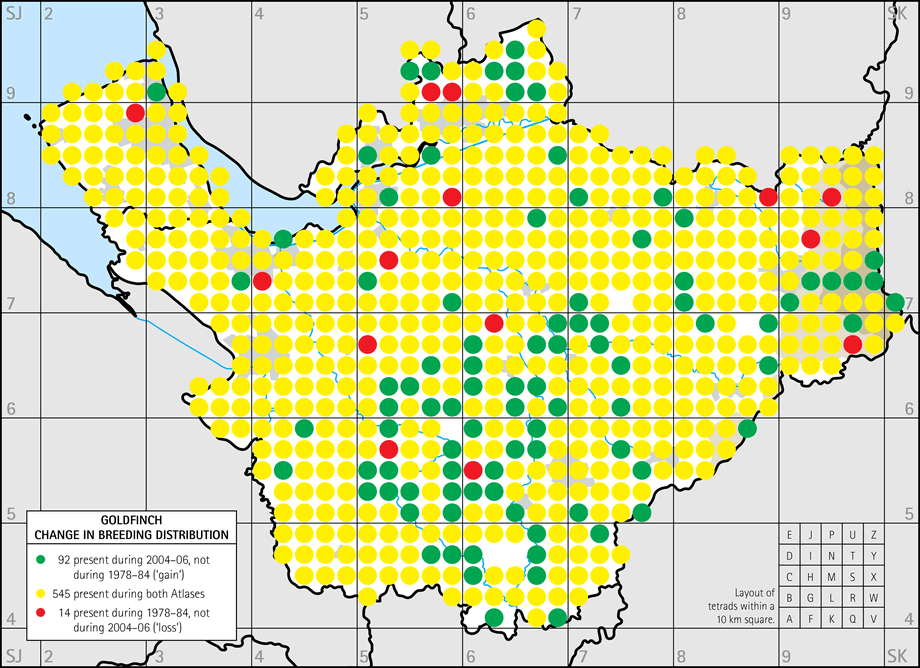
The Goldfinch has continued to increase and spread since our First Atlas and is now the thirteenth most widespread breeding species in Cheshire and Wirral. Compared to twenty years ago, they are present in 92 new tetrads, with just 14 losses, a net gain of 78 tetrads. They have filled in almost all of the breaks in their distribution in central southern Cheshire and there are now no significant gaps. The abundance map, however, indicates relatively few birds in many of these newly-colonised areas. There is a significant cline in their density, with totals of 100 birds per tetrad northwest of a line from Chester to Warrington, decreasing to figures of fewer than 15 birds per tetrad in patches of southern Cheshire and the eastern hills. The average across the whole county is 48 birds per tetrad, and the analysis of Breeding Bird Survey transects shows that this is our seventeenth most numerous species, with a breeding population of Cheshire and Wirral in 2004-05 of 30,440 birds (21,640-39,240).
The Goldfinch’s fortunes have undergone massive changes over the last thirty years. A rapid decline in population from the mid-1970s to mid-1980s, in parallel with many other seed-eaters, caused them to be placed on the Amber List of species of conservation concern, but numbers have recovered and their status has returned to ‘green’; the national index in 2004 was 68% up on twenty years before, although still somewhat lower than at the beginning of our First Atlas fieldwork in 1978. These population changes can be explained almost entirely by changes in annual survival rates, probably arising from a reduction in the availability of weed seeds, due to agricultural intensification, and subsequent increased use of other food sources such as garden bird tables (Siriwardena et al 1999). The warmer weather of the last two decades has probably also helped this partial migrant to thrive.
Newly-fledged chicks can be very obvious when they beg from their parents, and accounted for 214 of the 304 confirmed breeding records. Their nesting season can extend from April to August, allowing plenty of time for two broods, and occasionally three: a very recently-fledged chick was being fed by parents in my garden (SJ57K) on 1 September 2006. Some of their nests are very well concealed, often precariously placed near to the end of a long branch, but others can be obvious, especially in their favourite specimen trees such as flowering cherry or laburnum. Goldfinch can be one of the commonest species nowadays in suburbia provided that there are some not-too-tidy areas providing seeds of their preferred food-plants, especially dandelions and groundsels early in their breeding season, with burdocks and thistles for later broods. They feed their chicks with regurgitated seeds and a few small caterpillars. This is mainly a bird of farmland (41% of habitat records) and human sites (36%), with fewer in woodland (11%) or scrub (10%).
Atlas account sponsored by Ray and Janet Thorp
Winter
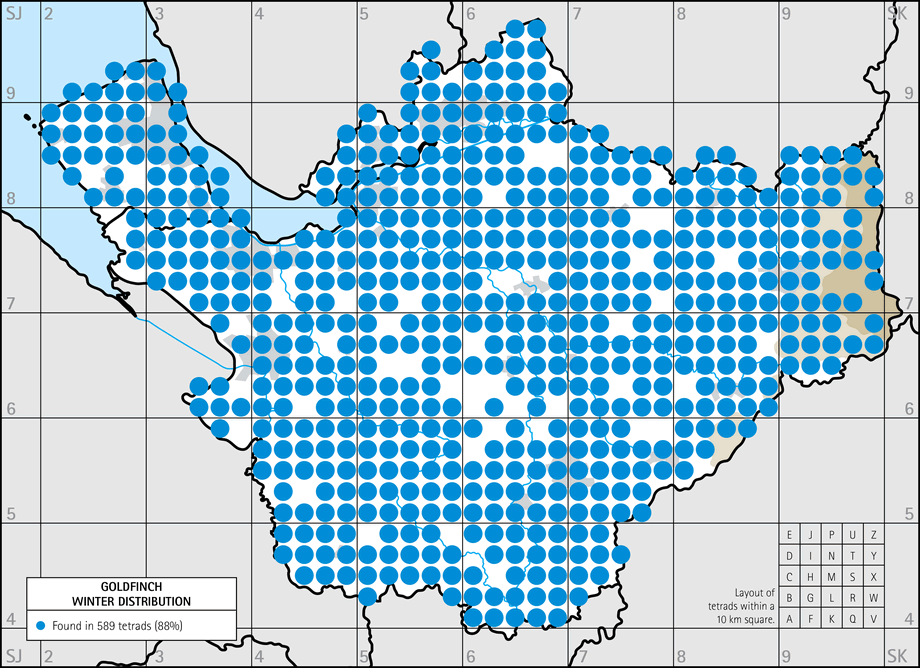
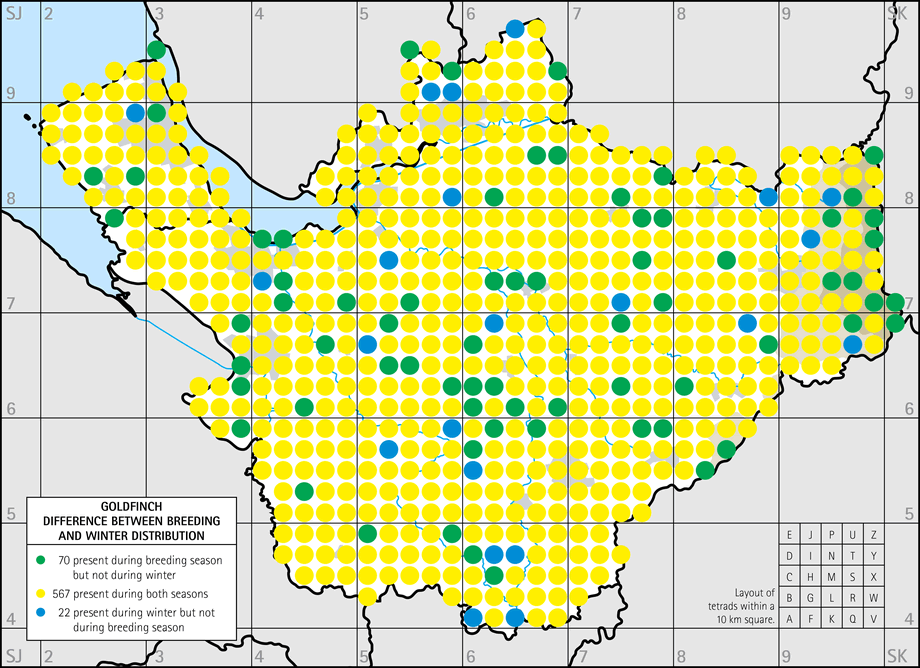
Goldfinches were somewhat less widespread in winter than during the breeding season, quitting some of their areas of lowest breeding density, including withdrawing from some of the highest altitudes. There is little difference in habitat occupation between the breeding and winter seasons. Most wintering birds were in farmland (41% of habitat records) and human sites (32%) with an increase in those in woodland (17%) and fewer in scrub (8%). A few birds were reported in seed-rich areas of semi-natural grassland and marsh. A total of 567 tetrads was used in both seasons, with 22 newly occupied in winter and 70 with breeding season presence but birds not found in winter. The empty tetrads are probably because birds have either migrated or joined local flocks. Although many British Goldfinches stay on or near their breeding grounds, most birds leave in the autumn to winter as far south as Iberia and Morocco (Migration Atlas). There have been fewer overseas recoveries of ringed birds in recent years, but this could be because hunting has decreased on the continent and this finding has not been tested statistically; the great rise in numbers wintering in the county suggests that the proportion of emigrants has fallen, however, perhaps driven by climate change.
Goldfinches form sizeable flocks, especially early in winter when there are copious supplies of their favoured foods, including thistles, burdocks and teasels. Some birds join Lesser Redpolls and Siskins feeding in alders and birches, but mostly they form single-species flocks to feed on plants where their long, thin bill allows them to exploit seeds not available to other birds; indeed, those able to perform the difficult task of extracting teasel seeds are mostly male Goldfinches that have slightly longer bills than females (BTO Winter Atlas). The median flock size reported by Atlas fieldworkers was six birds, but there were fifteen flocks of 50 or more, including two different groups of 150 birds but the largest was an estimated 280 birds found by Andy Ankers on Ince Marshes (SJ47T). Goldfinches also roost communally, and nocturnal roosts were reported in four tetrads, with the largest of 50 birds in a roadside hazel bush near Bostock Green (SJ66U).
The habit of visiting gardens was almost unknown twenty years ago (BTO Winter Atlas) but has become common since then. Thelma Sykes in 1988 described how Goldfinches were attracted to her garden at Saughall, near Chester to drink in warm, dry weather, and elsewhere, birds entered gardens to take seeds of ornamental thistles, teasel, lavender, cornflower, forget-me-not, Mexican aster, pansy and evening-primrose (Glue 1996). Some Goldfinches experimented with hanging on peanut feeders and eating sunflower seeds but the real breakthrough in garden feeding came with the widespread provision of niger seed, which closely approximates their natural food in size but is even more nutritious, containing some 40% of fat and 18% protein. Not only has this changed behaviour enabled many people to enjoy watching Goldfinches, but it may well have helped the species’ overwinter survival and assisted an earlier start to the breeding season. Just one (human) lifetime ago, they were scarce birds such that Boyd, on 12 November 1937, wrote ‘in much of Cheshire it is still almost an event’ to see one, and that they were seldom found in large flocks as in some parts of England (Boyd 1946).
Atlas account sponsored by Ray and Janet Thorp