
Sandbach Flashes: birds and wildlife
About the Atlas
During the three breeding seasons 2004–06 and three winters 2004/05–2006/07, Cheshire and Wirral Ornithological Society (CAWOS) organised more than 350 volunteers to survey all of the county, trying to find every species of bird that was breeding or wintering
Goosander Mergus merganser
Breeding
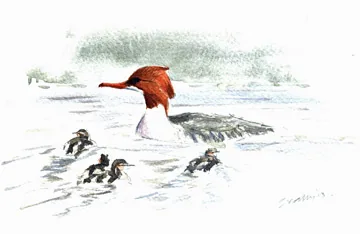
This species was not even mentioned in our First Atlas as there had never been any hint of its presence in the breeding season in the county. It was a bird of Scotland and northern England, first recorded breeding in Northumbria in 1941 and Cumbria in 1950. The national BTO Second Atlas, with fieldwork in 1988-91, showed that Goosanders had spread greatly since the BTO First Atlas (1968-72) and they have been converging on Cheshire from all sides. To the west, the Welsh population rose rapidly from one pair in 1968-72 to 10 pairs by 1977 and 100 pairs by 1985, and they spread over the English border to Shropshire in 1987. In the Pennines they had reached Lancashire by 1973 and first bred in Derbyshire in 1981.
In the context of this speedy expansion of range, it was perhaps a surprise that the first breeding in Cheshire was not until 1995, when a nest with eggs was found in a hollow tree in the east of the county (Higginbotham 1995). According to the county bird reports, the same site was occupied in 1996 and 1997, then a pair was present, but with no confirmed breeding, in 1998 to 2000, and no indication of breeding at all in 2001. In 2002 unfledged juveniles were noted on the River Dane, Congleton, in late May and in 2003 ‘the usual records came from the River Dane during the breeding season with a female and four chicks on the river by the Macclesfield Canal aqueduct (SJ96C)’.
This Atlas spurred more recording. Although no confirmed breeding was reported in 2004, pairs were found on two more river systems, the Dee on the Welsh border and the Weaver in central Cheshire. Goosanders were not proven to breed on the River Weaver, but a pair was present near Stapeley (SJ64U) for about two weeks in the breeding season of 2006, frequently visiting an old poplar tree alongside the river, with the female seen entering a hole.
Birds were proven breeding on the Dane in SJ76Y in 2005, and in SJ76N and SJ96C in 2006, and on the Dee near Crewe-by-Farndon (SJ45G) in 2006. In all four tetrads, surveyors found a female with a brood of chicks, a delightful experience whose effect was nicely summarised by Ann Pym: “Fantastic!! Observed a female swimming with 11 young, quite well grown. In next few weeks saw three more times.” Young chicks eat aquatic invertebrates, graduating to small fish as they grow. They are tended alone by the female; as soon as their mates are incubating eggs, the drakes migrate to moult in northern Norway, not returning until November (Migration Atlas).
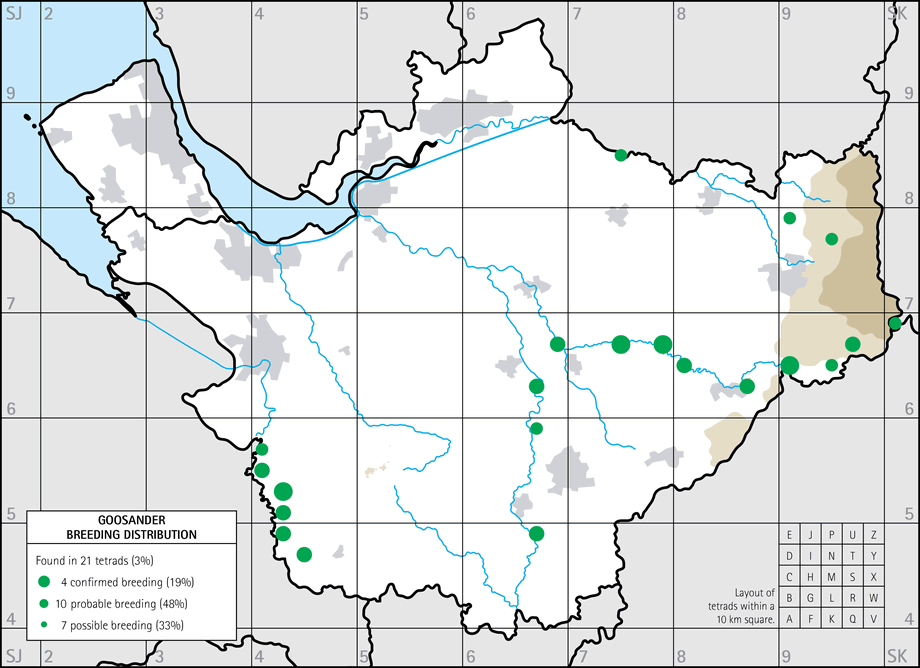
The county population is only 4 pairs confirmed and 10 pairs probably breeding, but with birds on three of Cheshire’s river systems the Goosander seems firmly established as a breeding species. In other parts of Britain Goosanders have been encouraged by provision of nest-boxes, and discouraged by illegal shooting by anglers, but neither is know to have occurred in Cheshire.
Atlas account sponsored by Phil Oddy
Winter
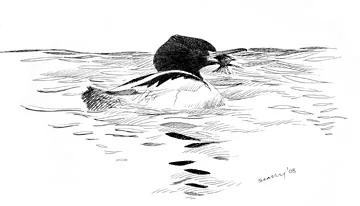
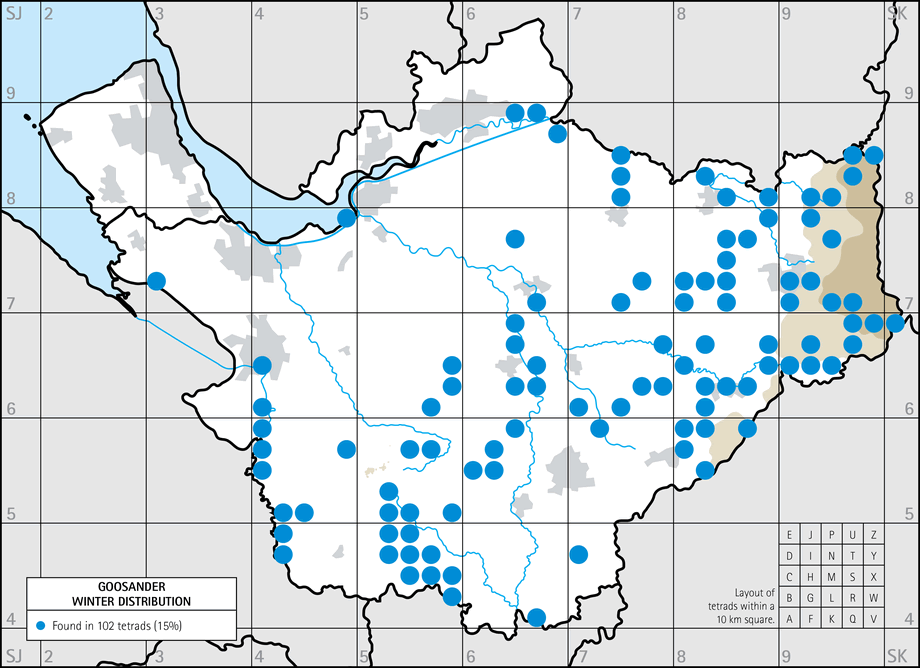
This is by far the most widespread and numerous sawbill wintering in the county, being found in this Atlas in 102 tetrads, compared to 20 for Red-breasted Merganser and 12 for Smew. The female and immature ‘red-heads’ usually considerably outnumber the distinctive adult males. Goosanders are almost all found inland, especially in the south and east of Cheshire, as was the case one hundred (Coward 1910) and fifty (Bell 1962) years ago. Records from Hilbre, and sometimes other Dee sites, have been almost annual, especially in migration periods, and Hilbre had one or two on single dates in three of the four winters 2000/ 01 to 2003/ 04, but none during this Atlas. The map shows that Inner Marsh Farm (SJ37B) and Frodsham Marsh (SJ47Z) are the nearest that Goosanders got to the estuaries during the three years of this winter survey. The origins of those wintering in Cheshire are unknown, but the birds are likely to comprise some from northern Britain and some from continental Europe and Fennoscandia (Migration Atlas). After completing their moult, British Goosanders return from Norway late in the year, few birds being seen before November.
The largest gatherings of Goosander during this Atlas period were on waters not normally featuring at the top of the lists for wildfowl flocks: 59 birds on Oulton Park Lake (SJ56X), 52 at the Chelford SQs (SJ87A/ B/ G), 35 roosting at Bosley Reservoir (SJ96H/ I), 30 on Radnor Mere (SJ87M/ N), a maximum of 23 on the Dee floods near Worthenbury (SJ44I), and 20 on Chapel Mere (SJ55F/ K). More than half of the Atlas records were of just one or two birds.
In contrast to the breeding season, when three-quarters of habitat codes were G7 (river), with 20% on small waterbodies and just one bird on a mere (Rostherne), in winter two-thirds of the birds were using standing water, mostly meres and reservoirs, with the rest on rivers, streams and small canals. They feed almost exclusively on coarse fish, mainly small specimens up to 7.5 cm long.
Some Cheshire waters have been particularly favoured by Goosanders. Bell (1962) wrote that they were liable to visit any of the meres between November and March but they seldom stayed except at Doddington Pool, where they were usually present throughout the winter so long as the water remained open. The maximum count there was 76 in January 1958, although 30 was more normal. He suggested that their predilection for Doddington would provide an interesting subject for research by a hydrobiologist (Bell 1967): forty years on, still little is known about the species’ winter ecology. The annual county bird reports show that a count of around 100 at Doddington in January 1969 was probably the largest flock ever seen in Cheshire. During the 1970s this was still their preferred site when quiet, but was suffering increasing disturbance. From about 1980 onwards the Cholmondeley meres took over as Goosanders’ favoured spot, although numbers were low during much of the 1980s. Goosanders often use different waters at night from their daytime haunts (Brown & Grice 2005) and in 1990 a night-time roost was discovered at Lamaload Reservoir, later found to move between there and the upland reservoirs at Bosley and Trentabank. The normal annual maximum count was 50 or 60 birds, reducing to 30 or 40 from the year 2000 onwards. There have been suggestions that those on the south Cheshire meres and the eastern hill reservoirs are in fact the same birds, making circadian movements. It would be a worthwhile, if challenging, task to test this hypothesis, perhaps using radio-tracked birds, coordinated counts and a team of observers on their flight-lines.
Atlas account sponsored by Phil Oddy