
Sandbach Flashes: birds and wildlife
About the Atlas
During the three breeding seasons 2004–06 and three winters 2004/05–2006/07, Cheshire and Wirral Ornithological Society (CAWOS) organised more than 350 volunteers to survey all of the county, trying to find every species of bird that was breeding or wintering
Goshawk Accipiter gentilis
Breeding
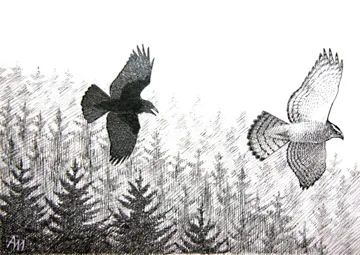
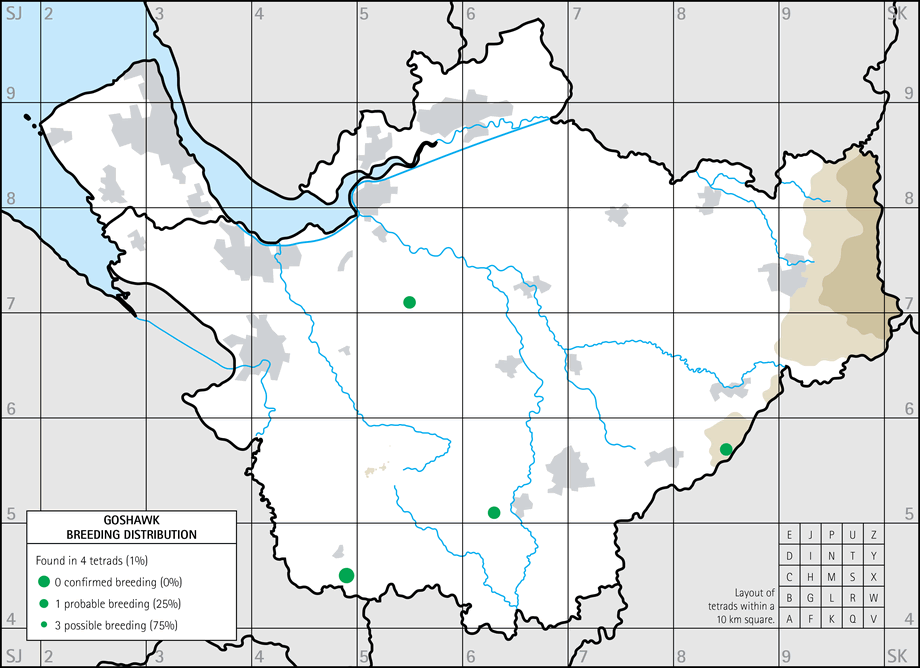
There have long been rumours of Goshawks breeding in the county, most reports coming from the vicinity of the dense conifer plantations of Macclesfield and Delamere Forests. Published records are few, however: submissions are assessed by the County rarities panel, and sightings are frequently not described to their satisfaction. Goshawks are big birds, with many females being larger than Buzzards. Their sexual size difference means that males are not much more than half the weight of a female, but even so, a male Goshawk is considerably larger than any female Sparrowhawk, and three times their weight (Marquiss & Newton 1982).
Knowledge is sketchy, but the current status in the county is probably much the same as during our First Atlas, when breeding was confirmed at three sites, at one of which the nest contents were regularly taken by man. RSPB reports show that even now, Goshawks are close to the top of the list of species illegally targeted, by egg-collectors, would-be falconers and gamekeepers.
At least some of the county’s Goshawks have escaped or been released from captivity. Deforestation and persecution led to their extinction as a British breeder in the 1880s and there was no known natural breeding in England in the first half of the 20th century until resurgence of interest in falconry in the 1960s and 1970s led to the import of large numbers of birds from central Europe and Fennoscandia. The accidental and intentional release of some of these birds and their captive bred descendants provided a foundation for the current feral breeding population (Marquiss & Newton 1982). The origin of birds currently seen in Cheshire is unknown but the median recovery distance of 47 km (Migration Atlas) could encompass dispersing birds from nests in the South Pennines or Wales.
Goshawks display prominently over their woodland territory but these may be unpaired individuals as there is a significant pool of prospecting first-year birds: they can breed at one year of age, although not very successfully. Birds start breeding early in the year, often nest-building in February. There is not much suitable habitat in the county, Goshawks occupying extensive areas of mature woodland. They favour more open stands of woodland than Sparrowhawks, with a mean distance between trees from 2.5 m up to 6 m or more, presumably because their larger wingspan means they need wider flyways (Newton 1986). The smaller bird uses the denser woods, thus achieving ecological separation. Goshawks do not tolerate Sparrowhawks, frequently killing them, and Sparrowhawks instinctively avoid areas with the larger bird present. So, in a naturally balanced environment, Goshawks act to limit the population of Sparrowhawks. They probably also keep in check the burgeoning corvids, although their main prey is pigeons, gamebirds, rabbits and squirrels.
Atlas account sponsored by Syngenta CTL
Winter
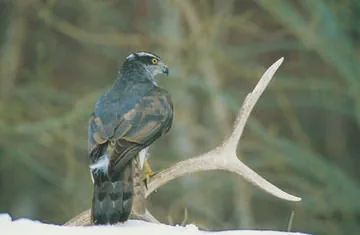
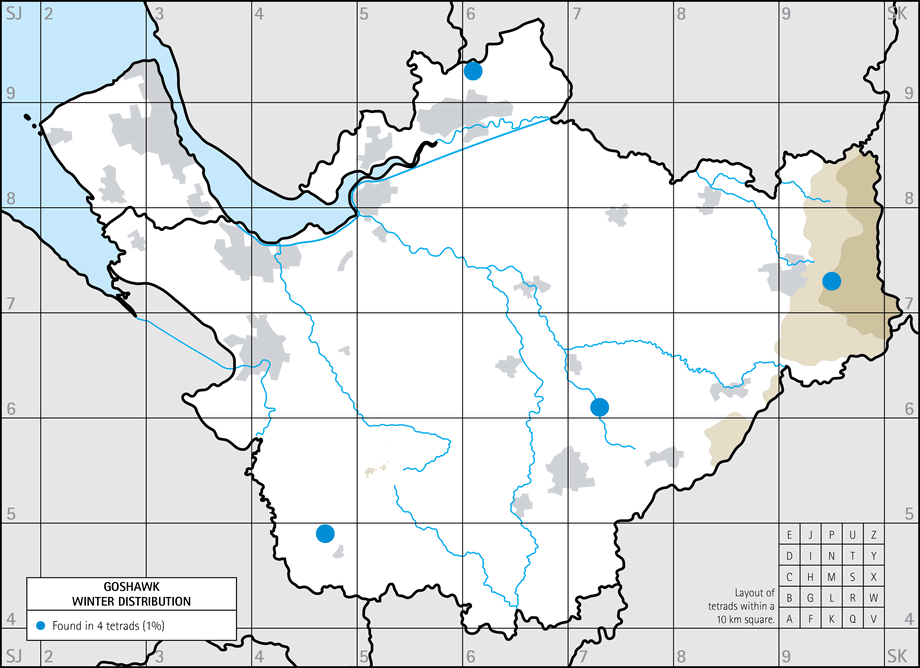
‘Goshawks are rarely seen in Britain and Ireland, even in those areas where there are established populations’: so began the text for the BTO Winter Atlas. Thus, it is no surprise that there are few records on the winter Atlas map of Cheshire and Wirral. In only four tetrads were observers able to provide a description that satisfied the county rarities panel, the four birds being an adult and immature of the two sexes. None of these tetrads had a breeding season record, despite this species’ sedentary nature and early display, perhaps another measure of their secretive nature. The extent of under-recording can be quantified from the tetrad atlases of Northumbria, where there were at least 50 pairs breeding producing more than 100 young a year. So, fieldworkers are well used to seeing Goshawks, but only 70 birds were recorded in the three seasons (1996/ 97 to 1998/ 99) of the county’s wintering atlas (Day & Hodgson 2003).
However, despite the difficulty in recording the species, Goshawks are unlikely to be common or widespread in Cheshire and Wirral because they need substantial areas of woodland. In winter this requirement is relaxed somewhat and birds spend more time hunting in open areas. The observers of these four records provided seven habitat codes, all different: broadleaved and coniferous woodland; scrub – ‘regenerating natural or semi-natural woodland’; dry semi-natural grassland, unimproved agricultural grassland and mixed grassland/ tilled land; and dry heath. These indicate the wide range of area over which Goshawks can be found.
Wherever they are, Goshawks should have no difficulty in finding food in a Cheshire winter. As well as large birds – of the size of Woodpigeons, Moorhens, corvids and the like – they also prey on the larger thrushes, especially Fieldfares, and regularly eat medium-sized mammals, mainly squirrels and rabbits.
The ornithological history of Goshawk in Cheshire and Wirral appears straightforward but for the last quarter-century is clouded by rumour, doubts over identification and caution on publishing records. Coward and Oldham, and Boyd, make no mention of the species. Bell’s only reference is to one seen on Christmas Day in 1955, which was such an unusual record that it was published in British Birds. The annual county bird reports contain few records from the winter period, excluding the occasional cryptic references to ‘well-known resident pairs’ and birds known to be escaped captive birds. The plot shows a mean of only one per winter, and a maximum of four birds in any of the thirty years before this winter atlas; thus, the four birds recorded in three winters of this project is about average.
Atlas account sponsored by Syngenta CTL