
Sandbach Flashes: birds and wildlife
About the Atlas
During the three breeding seasons 2004–06 and three winters 2004/05–2006/07, Cheshire and Wirral Ornithological Society (CAWOS) organised more than 350 volunteers to survey all of the county, trying to find every species of bird that was breeding or wintering
Great Crested Grebe Podiceps cristatus
Breeding

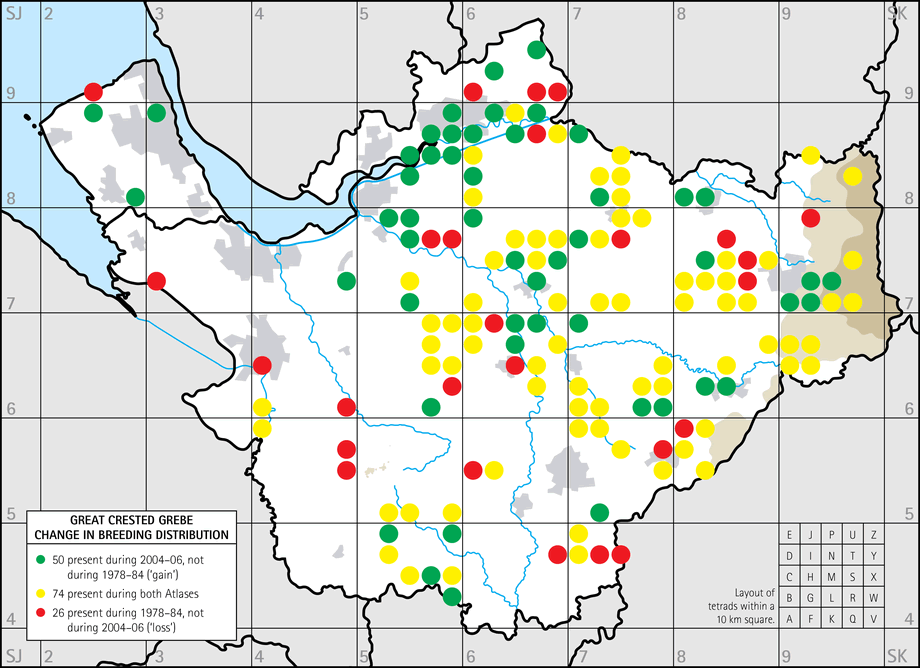
This Atlas confirms a significant increase in Great Crested Grebes. The ‘change’ map shows a net gain of 24 tetrads with the species, 50 gains and 26 losses. The latter are scattered across the county, with no consistent pattern, and the gains are especially in the Mersey Valley, around Northwich and on the upland reservoirs, with grebes consolidating their previously tenuous hold on Wirral. With most of the gains being in or near urban areas, it is tempting to suggest that improvements in water quality underlie their rise.
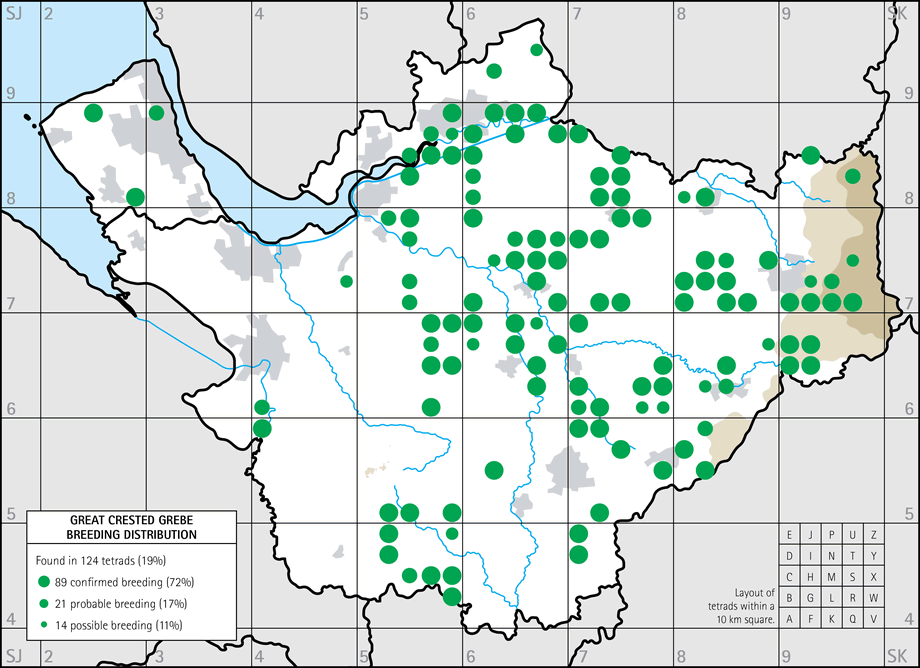
The distribution map illustrates their clear easterly bias in county, with only six of the 124 tetrads with records west of the 50 line. This mostly follows the presence of large waterbodies. The submitted habitat codes show clearly their preference for the county’s larger standing waters: 1 pond; 12 small water-body; 76 lake/ unlined reservoir; 3 lined reservoir; 21 sand pit, etc; 7 river; and 3 large canal. Their diet is mostly coarse fish up to about 20 cm in length, caught by diving. At Woolston, most nests are on the river Mersey or the Manchester Ship Canal, rather than on the dredging deposit beds themselves, probably reflecting the availability of fish. The oligotrophic eastern reservoirs have obviously become more suitable for them in the last twenty years.
This is a conspicuous bird – even when out of sight, their distinctive croak can betray their presence – and most fieldworkers found it easy to obtain a two-letter code. As in our First Atlas, 72% of records were confirmed breeding. In 68 tetrads observers found adults with their stripy chicks, often carried on their parents’ backs, and a further 21 tetrads held occupied nests or nests with eggs. Pairs were found in another 21 tetrads, with nest material in three of them and in seven of them fieldworkers saw them engaged in their spectacular displays. There is plenty of time to record breeding: they can have an extended season, starting in February in some years, with a month of incubation and ten or eleven weeks before chicks can fly. Some of the early breeders might have a second brood, although most raise just one family of two or three chicks in a year. The latest chicks in the county may still be dependent on their parents into November.
There were 110 tetrads with confirmed or probable breeding, and several sites held multiple pairs, headed by Rudheath (SJ77K) and Woolston (SJ68P) with eight pairs reported at each site: the county population is at least 150 pairs. In the First Atlas it was thought unlikely to exceed 100 pairs in any one year. In the mid-19th century the secluded Cheshire meres were vital in saving Great Crested Grebes from extinction in the period of persecution for their fur and ornamental feathers, and even now the county holds an above-average proportion of the national population: there are around 4,000 pairs in Britain (Brown & Grice 2005).
Atlas account sponsored by Lymm Ornithology Group
Winter
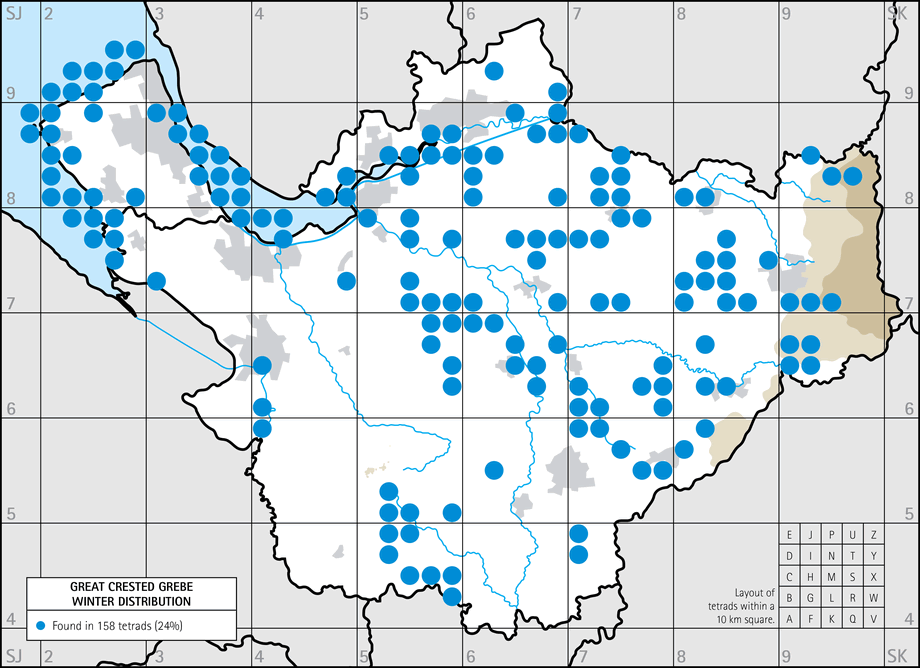
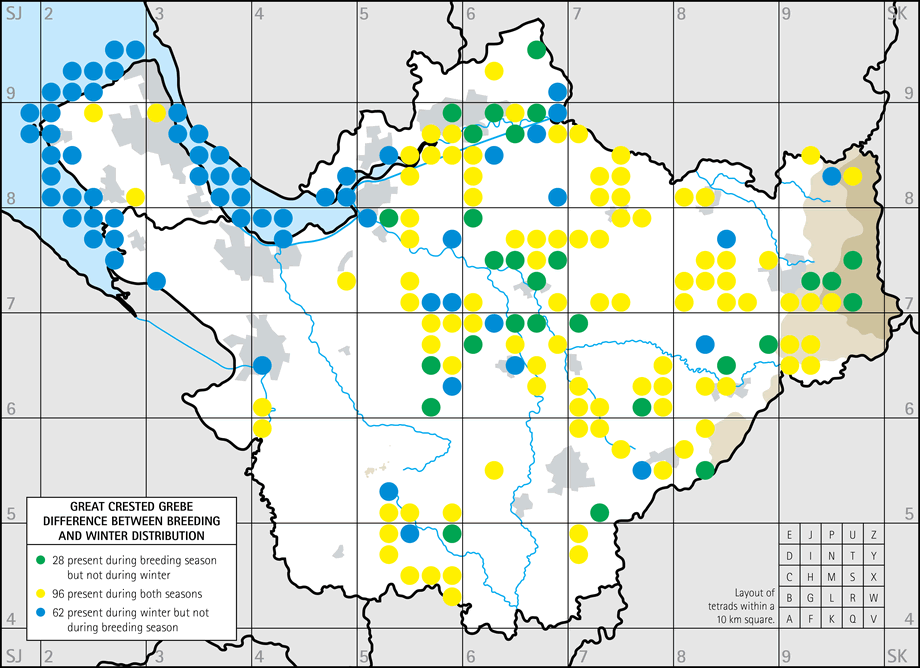
In winter most (96 out of 124 tetrads) of the Great Crested Grebes’ breeding areas are also occupied, probably by the same individuals, with the birds either remaining resident year-round or returning to make an early start to the breeding season; a century ago Coward (1910) noted that ‘… in autumn and early winter the numbers on the meres are frequently less than at the end of the breeding season, but in January and February, especially after gales, there is often a marked increase’. They usually pair during mid- to late-winter, Simon Wood seeing courtship display on 7 January 2007 at Rudheath (SJ77K). Of the 28 that were vacated in winter, 20 of them are tetrads newly occupied since the First Atlas, perhaps suggesting that they are more marginal sites and that it was their unsuitability in winter that left them unused previously.
In addition, 62 tetrads were occupied in winter only, most of them off the north Wirral coast and in the estuaries, where they favour the deeper waters in the centre of the channel. The saltwater habitats were adjudged to be 2 open shore, 9 open sea, 1 brackish lagoon (West Kirby Marine Lake) and 31 estuarine. There was little difference from the breeding season in the freshwater habitats submitted: 1 pond; 9 small water-body; 71 lake/ unlined reservoir; 7 lined reservoir; 18 sand pit, etc; 6 river; 1 small canal and 3 large canal. Their diet is much the same all year round, fish that they catch by swimming underwater.
The north-west corner of the Wirral is the place to find the highest numbers of Great Crested Grebes. 120 were off Hoylake (SJ29A) in 2004/ 05, with 100 off Hilbre (SJ18Z) in 2005/ 06 but these were trumped by an amazing flock off Dove Point, Meols (SJ29A/ F) on 7 February 2007, counted by Richard Smith at 458 birds and probably the largest flock ever in the county. Otherwise, the median count from the 232 submitted counts was just four birds, and only 29 flocks were in double figures. The largest inland flocks were on Marbury (Budworth) Mere (SJ67N), peaking at 36 birds in 2006/ 07. Nowhere in the county approaches the threshold for national importance by regularly holding 159 birds each winter.
WeBS counts show that many British sites record large differences in numbers of Great Crested Grebes from one winter to another, for reasons unknown. Similarly the migrations of grebes are poorly understood (Migration Atlas) although some birds from continental Europe have been found in southern England. Nothing is known of the movements of Cheshire and Wirral birds.
Atlas account sponsored by Lymm Ornithology Group