
Sandbach Flashes: birds and wildlife
About the Atlas
During the three breeding seasons 2004–06 and three winters 2004/05–2006/07, Cheshire and Wirral Ornithological Society (CAWOS) organised more than 350 volunteers to survey all of the county, trying to find every species of bird that was breeding or wintering
Green Woodpecker Picus viridis
Breeding
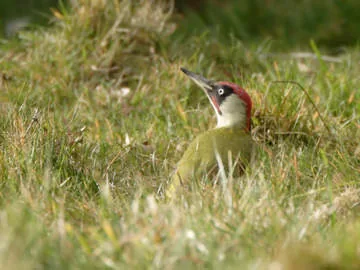
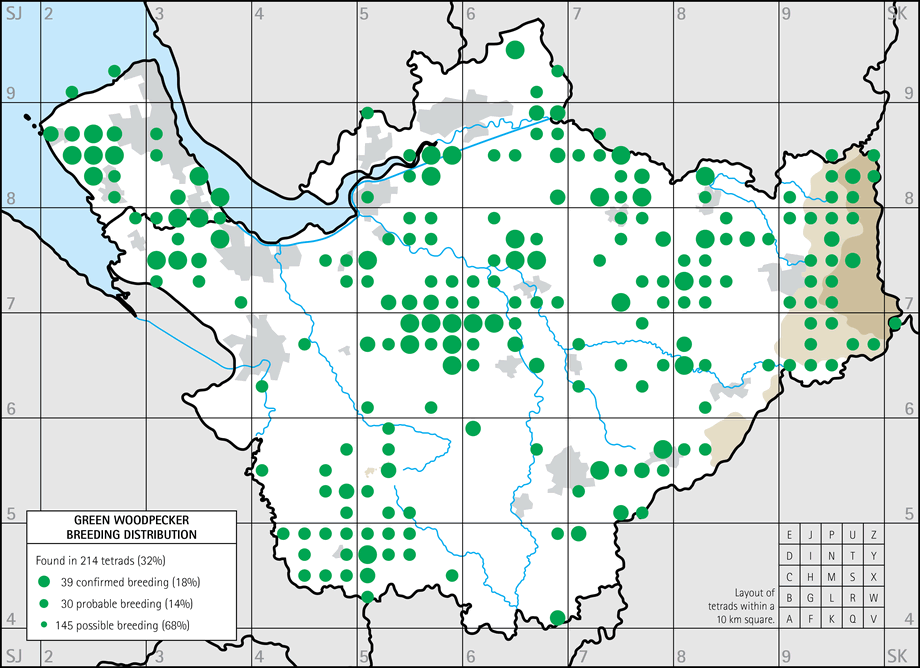
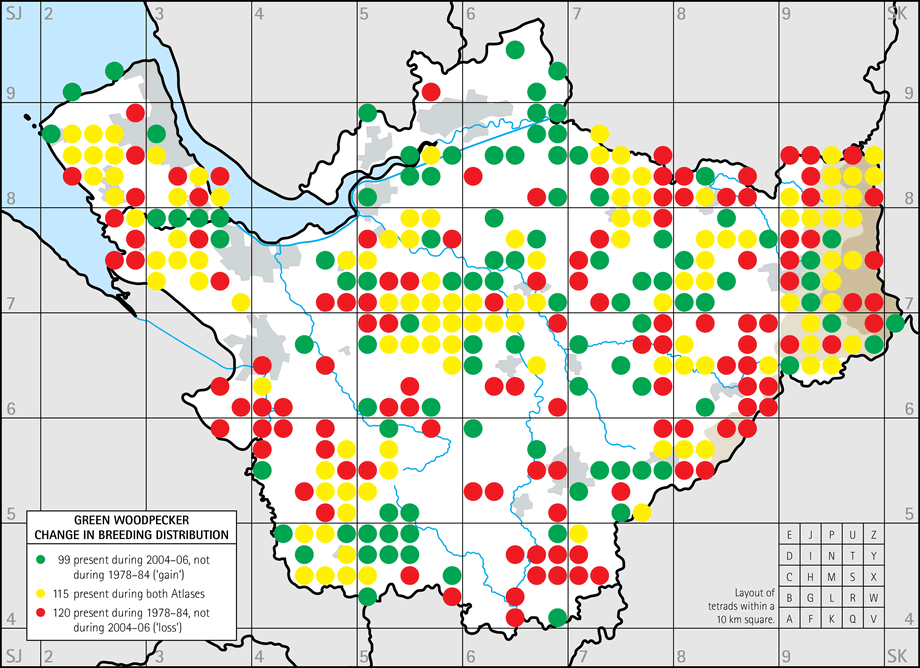
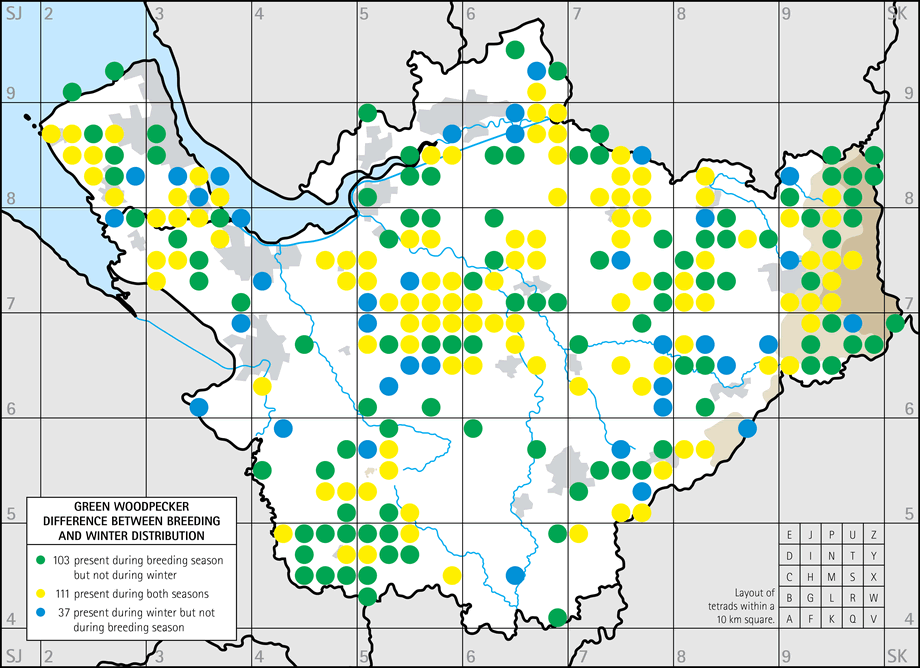
Green Woodpecker numbers have risen widely across Europe and in Britain since the early 1980s, with the British breeding population having more than doubled in the period from 1984 to 2004. The ecological factors underlying the increase have not been established, but this is one of the most vulnerable species in cold weather and their rise in the last twenty years must have been helped by the milder winters. So, against this background it is a surprise that this Atlas shows a contraction of Green Woodpeckers in Cheshire and Wirral, a net loss of 21 tetrads in the breeding season since our First Atlas. The map shows clear concentrations around Delamere in the centre of the county, stretching as far as Marbury Country Park (SJ67N) and south of Winsford (SJ66S), and along much of the Wirral peninsula. There are many occupied tetrads south and west of Wilmslow in SJ78, 77 and 87, and in a large area of southwest Cheshire centred on Malpas, and in the lower levels of the eastern hills, although with very few tetrads in these last two localities furnishing other than ‘possible’ breeding records, many of them detected by the birds’ far-carrying ‘yaffle’ calls. Although the losses have been widespread across the county, there are notable clusters in the areas around the Eaton estate (SJ45E), Audlem (SJ64R) and Congleton (SJ86R), with clear gains in the north of the county, east of Runcorn (SJ58R) and east and south of Warrington (SJ68T).
Like all woodpeckers, this species needs holes in trees for nesting, and they feed their young largely on caterpillars found in woodland; but adult Green Woodpeckers mostly feed on the ground, using their long sticky tongue, armed with barbs at the end, for extracting wood ants. These especially are found in light sandy soils, explaining why the areas of sand outcrops account for much of the Green Woodpecker’s distribution.
The Atlas habitat codes show 52% of records in woodland, by some way the lowest figure of the three woodpeckers, and they were almost exclusively in broadleaved or mixed woodland, with none in coniferous areas and only four records in waterlogged (carr) woodland. The proportions in scrub (6%) and farmland (30%) are more than double those of the black-and-white woodpeckers, with only 7% in human sites. The human sites rarely included habitation, but Green Woodpeckers are associated with two types of man-made sites that can provide good feeding areas for them: golf courses and sand quarries. There were notable records for birds in other feeding areas: grass moor (2 records), other dry semi-natural grassland (4), heath (4) and unimproved grassland (12), all of which are more likely to provide their diet of ants than agricultural grassland.
Atlas workers proved Green Woodpeckers breeding in 39 tetrads, in two of them by seeing adults carrying food and in 19 by seeing groups of speckly-looking recently fledged youngsters, who are fed by their parents for a month or so after they leave the nest: in 2004 near Alderley Edge (SJ87I) David Hulse had the enviable experience of seeing three young with a parent on the same branch. In a further 18 tetrads observers found active nests although the species of tree was not recorded for any of them. Analysis of the national nest record collection showed that Green Woodpeckers chiefly nest in oak or ash, and less often in birch, beech and other trees, digging out large nest-chambers in the tree trunks (Glue & Boswell 1994). Like the spotted woodpeckers, they used to suffer eviction from nest-holes by Starlings, often excavating a nest-cavity only to be dispossessed, but since the decline of Starlings in woodland in the last twenty years, eviction of woodpeckers seldom happens, probably another factor that has allowed the species to increase (Smith 2005).
Based on the rising British population, and our First Atlas estimate of 150 pairs breeding in 1978, with perhaps 75 pairs in 1982 after a series of hard winters, the present Green Woodpecker total in the county ought to exceed 200 or 250 pairs. But few tetrads hold more than one pair and breeding was confirmed or probable in only 69 tetrads, so a current estimate is 100-150 pairs.
Atlas account sponsored by Dr Paul Brewster and Dr Carys Brewster
Winter
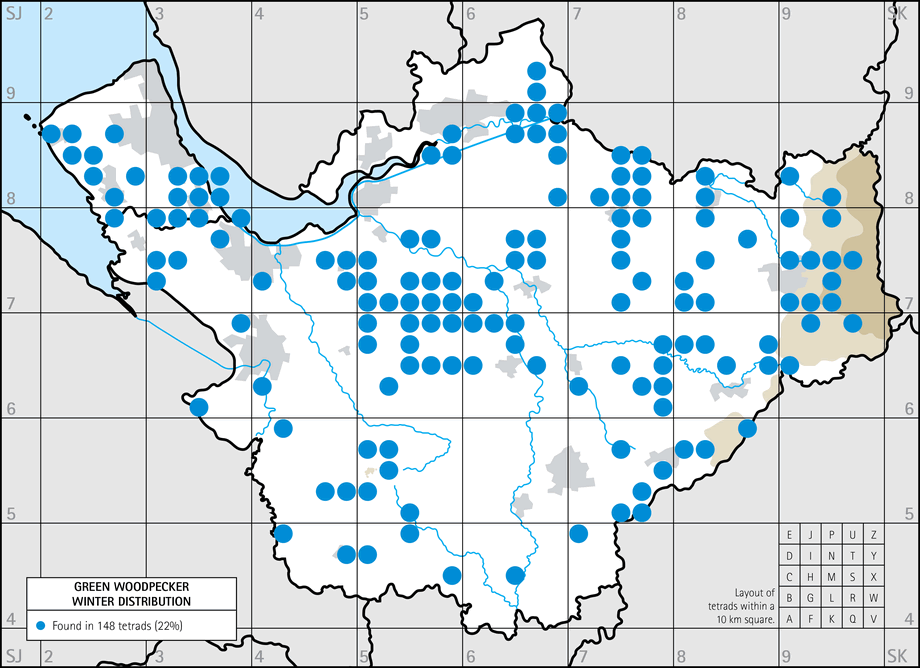
Green Woodpeckers were found in winter in only 148 tetrads, 66 fewer than in the breeding season. The areas with birds missing in winter were widespread across the county, but there were obviously fewer in SJ44, SJ96 and SJ98. Most of the records were of solitary individuals: there were two counts of 3 birds, 13 of 2 birds together and 194 of single birds, many of them heard calling.
There is virtually no difference in any of the categories of habitat recorded in winter from the breeding season. They mostly forage on the ground, with adult ants, and their eggs and larvae, remaining a key part of this species’ specialised diet all year round, explaining their susceptibility to spells of freezing weather. In 1967, Bell wrote that ‘no species has been slower to recover from the exceptional frost of early 1963’ (Bell 1967). He had earlier stated that Green Woodpeckers were much commoner in south and central areas than in the north of the county (Bell 1962), no longer true today, but ‘its chief stronghold remains in Delamere and surrounding areas where it has always been regarded as abundant’. The present winter Atlas map shows that the largest contiguous group of tetrads is in exactly that part of the centre of Cheshire.
In the Wirral, the species’ status has changed markedly. In Coward’s time a century ago, it was rare there. Hardy (1941) knew Green Woodpeckers as occasional winter visitors to Wirral and Bell (1962) wrote that they had noticeably increased during the last 15 to 20 years. Nowadays, at both seasons, they are widely distributed on the peninsula.
Atlas account sponsored by Dr Paul Brewster and Dr Carys Brewster