
Sandbach Flashes: birds and wildlife

About the Atlas
During the three breeding seasons 2004–06 and three winters 2004/05–2006/07, Cheshire and Wirral Ornithological Society (CAWOS) organised more than 350 volunteers to survey all of the county, trying to find every species of bird that was breeding or wintering
Grey Partridge Perdix perdix
Breeding
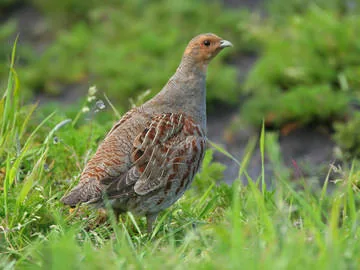
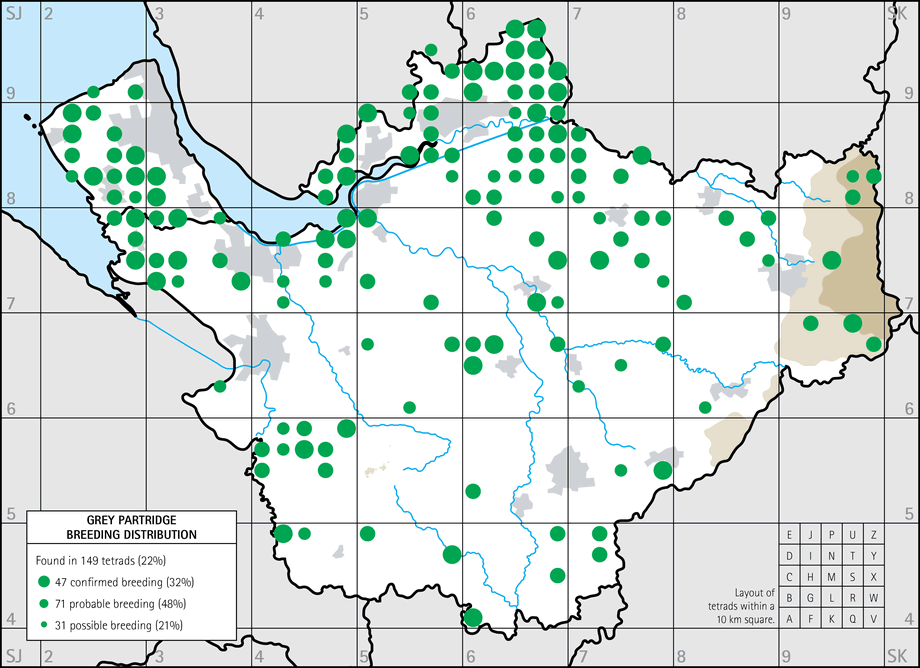
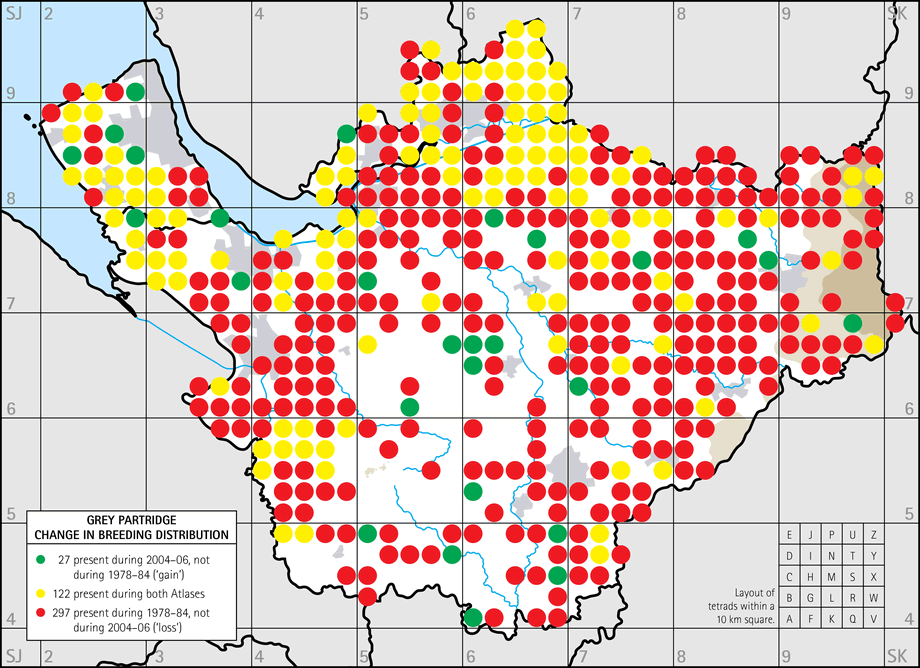
The Grey Partridge is one of the farmland species whose population has crashed in the last quarter-century. Their distribution in the county reflects that decline, and they have been lost from two-thirds of their breeding areas since the First Atlas, down from 420 tetrads to 149. Any species that feeds on weeds, their seeds, and farmland insects will surely have a tough time in an intensifying agricultural régime.
The presence of Grey Partridges is easy to detect at dawn or dusk by the far-carrying ‘creaking’ calls, but it is not easy to prove breeding except by finding adults with chicks, which often surprise observers by flying short distances well before they are fully-grown. The nest is well-hidden in long grass, usually under a hedge. During 25 days of incubation the female conscientiously broods her large clutch, averaging 14 eggs, leaving the nest only three times a day, and less often if the weather is wet. This devotion to the nest can carry a heavy price, and up to one-quarter of hens are killed on the nest, mostly at night by foxes.
Adults teach their newly-hatched chicks to find invertebrates, especially plant bugs Hemiptera and larvae of sawflies and beetles. Such food forms 80-90% of their intake in the first two weeks of life, as their usual vegetable food provides insufficient nutrition for the energy-intensive early stages of growth: low chick survival has been the key to the species’ decline. The main food of adults and fledged young is seeds, of grasses and most of the broadleaved weeds, with invertebrates taken only incidentally. When they can find them, preferred seeds include Cerastium and Stellaria chickweeds, fat hen Chenopodium spp. and hemp-nettle Galeopsis tetrahit, all of which were recorded as common in the Flora of Cheshire (Newton 1971). On arable land, if available, they favour undersown crops, which contain much higher densities of invertebrates (Shrubb 2003).
As expected, observers found most birds on farmland (83% of records), with 24% improved grassland, 12% unimproved grassland, 27% mixed grassland and tilled land and 8% tilled land. Compared to Red-legged Partridge, relatively fewer were recorded on improved grassland, with more on semi-natural grassland (6% of records) and in the edges of scrub (3%).
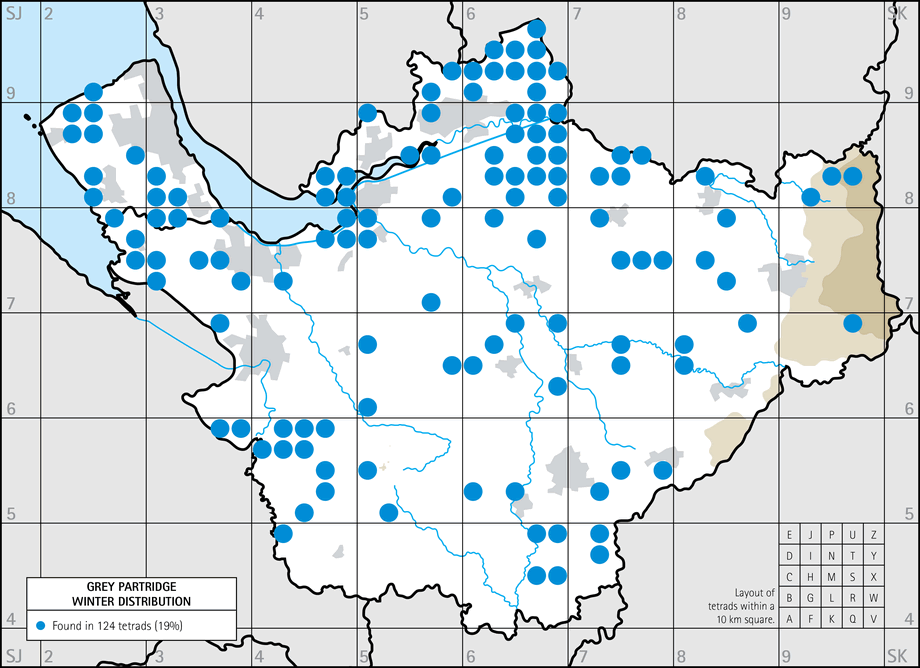
National population indices show a drop of 85% from 1978 to 2004, and there is still no sign of a recovery, despite years of research and the application of a BAP (Aebischer & Ewald 2004). The breeding population of Cheshire and Wirral in 2004-05 was 2,020 birds (650-3,390), an average of about 14 birds per tetrad in which they were present. According to Potts (1986), under modern agriculture, around 4 pairs/ km2 would be expected on optimum ground and 2 pairs/ km2 on suboptimum land, with higher densities expected if suitable management is undertaken. The Cheshire figure is below even the suboptimum density, doubtless owing to the low proportion of arable farming in our predominantly pastoral county. The abundance map shows that the area north of Warrington, where much of Cheshire’s arable farming is concentrated, holds the highest densities of Grey Partridges. Since the polarisation of England into the pastoral west and the arable east, Cheshire can never have been a key county for Grey Partridges, but it is a species being given special conservation effort, under the Farmland Birds LBAP, and it is important that we monitor its local status.
Atlas account sponsored by Altrincham and District Natural History Society
Winter
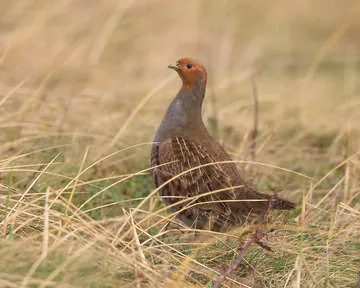
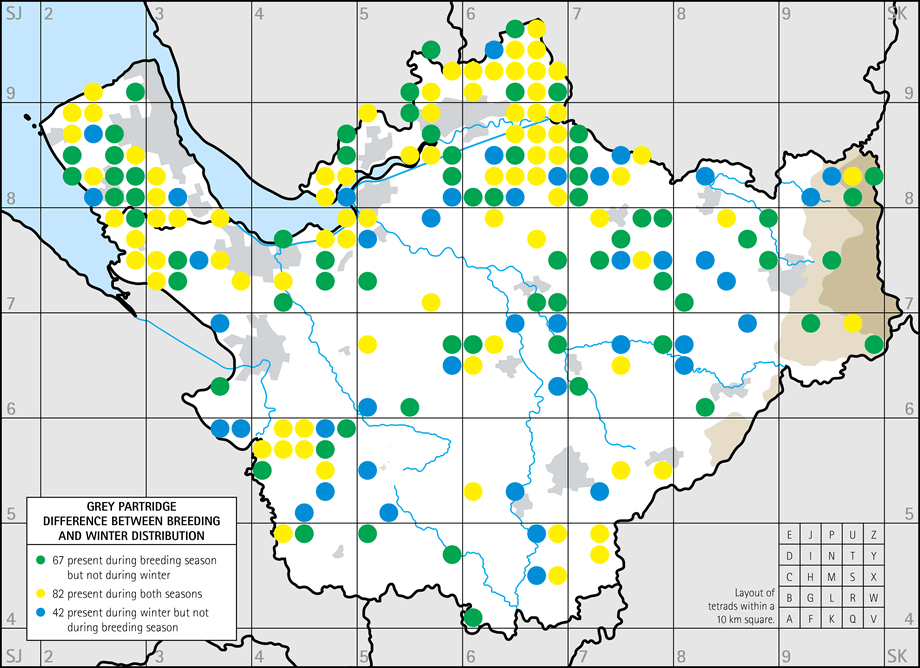
As expected for a sedentary bird, there is not much difference between the breeding and wintering distribution of Grey Partridges. They appear to quit the eastern hills in winter, and there might be some altitudinal migration, as has been suggested also in Northumbria Winter Atlas. Even in the lowlands they will undertake small-scale local movements, and they were found in 42 tetrads in winter where there was no breeding season record, although not found in 67 where they had been present in a breeding season. Farmland made up the great majority of habitat records (88%), with 23% improved grassland, 12% unimproved grassland, 19% mixed grassland and tilled land and 13% tilled land, with 11% on stubble.
None of the twentieth century Cheshire ornithologists (Coward, Boyd, Bell) makes any significant comment on the winter status of Grey Partridges, testament to their relative abundance in their lifetimes. This is, however, one of the best-studied birds in the world, owing to its economic importance as a quarry species.
After the breeding season, they gather in family groups or coveys, comprising two to five or more old birds together with their young, which might number on average as few as two or as many as eight depending on the year-to-year fluctuations in productivity (Potts 1986). The females in a covey are mostly sisters, but the young males not their brothers, since they disperse, the natural mechanism that avoids inbreeding. There is usually a surplus of adult males because of the high mortality of hens from predation on the nest. Flocking in coveys helps with guarding against predators, and they take it in turns for one bird, the sentinel, to have its head up whilst the others concentrate on feeding. Coveys usually break up in the New Year as the birds form pairs, and prepare for the breeding season. Observers for this winter Atlas reported 24 flocks of more than ten birds, but only six larger than 20, and more than half of counts were of four birds or fewer.
In winter they mainly eat grain and the seeds of grasses and weeds, especially Polygonum spp., knotgrass and black bindweed, but these dwindle during the season and proportionately more green food is taken, especially winter wheat or barley and chickweed. Leaves are much less nutritious, however, and to obtain its energy needs, a partridge in a field of wheat has the daily choice of about 1,000 pecks feeding on grains or 25,000 pecks at the leaves (Potts 1986)!
They roost overnight on the ground, and sites can often be identified by concentrations of their droppings. They tend to choose slight depressions such as a ploughed field or tractor tramlines at the edge of a crop, and sometimes they keep a roost site frost-free by the heat of their bodies, huddled into the ground. Indeed, they appear not to be bothered by the vagaries of British winters, and are well able to survive through periods of frost or snow, even starving for several days in sub-zero temperatures if food is scarce.
Some Grey Partridges are shot during a season lasting from 1 September to 1 February. With the shootable surplus usually calculated according to guidelines from the Game Conservancy Trust, such a bag has no effect on the population level; indeed, many shooting groups maintain partridges at a higher density than in areas where they are not shot, through control of mammalian predators in the breeding season. Despite such measures, numbers continue to dwindle, and members of Frodsham and District Wildfowlers Club, for instance, have not shot Grey Partridges from 2002-2007 owing to their concerns about the decline of the local population.
Atlas account sponsored by Altrincham and District Natural History Society