
Sandbach Flashes: birds and wildlife
About the Atlas
During the three breeding seasons 2004–06 and three winters 2004/05–2006/07, Cheshire and Wirral Ornithological Society (CAWOS) organised more than 350 volunteers to survey all of the county, trying to find every species of bird that was breeding or wintering
Grey Wagtail Motacilla cinerea
Breeding
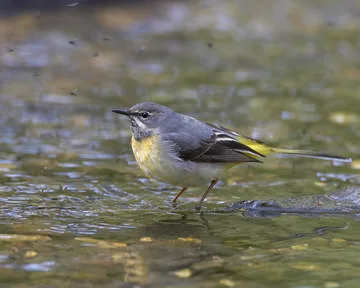
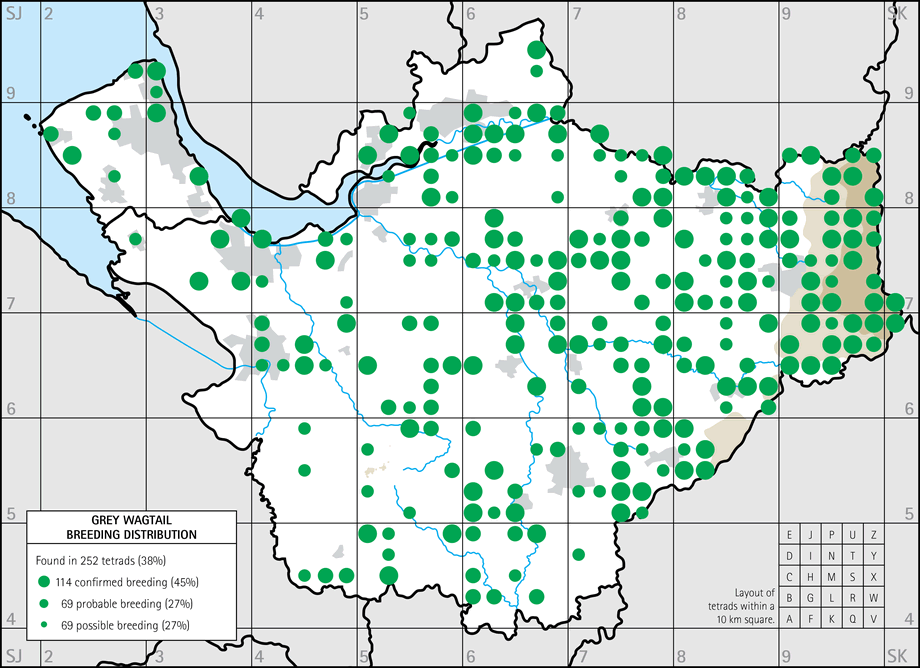
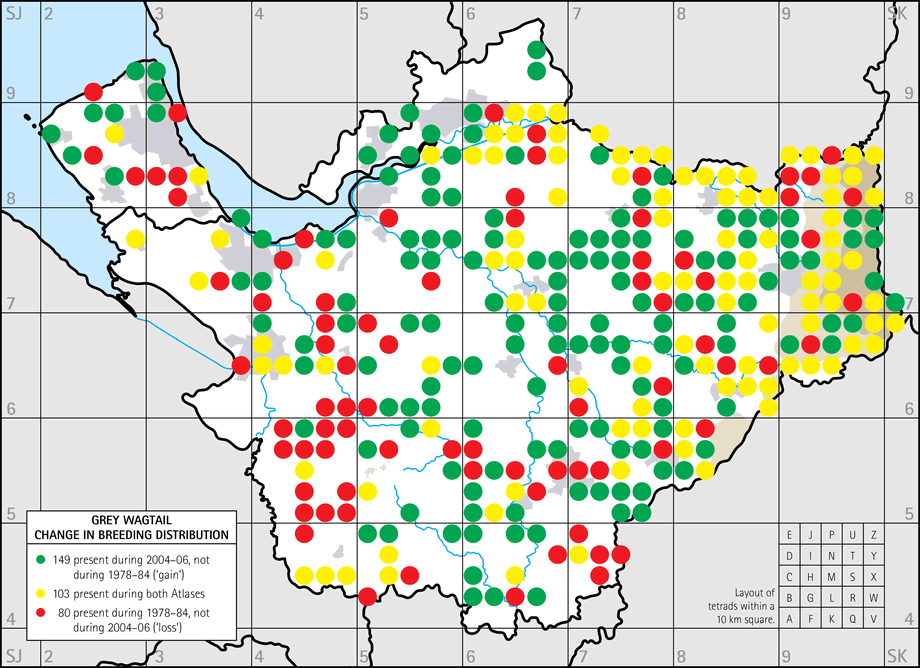
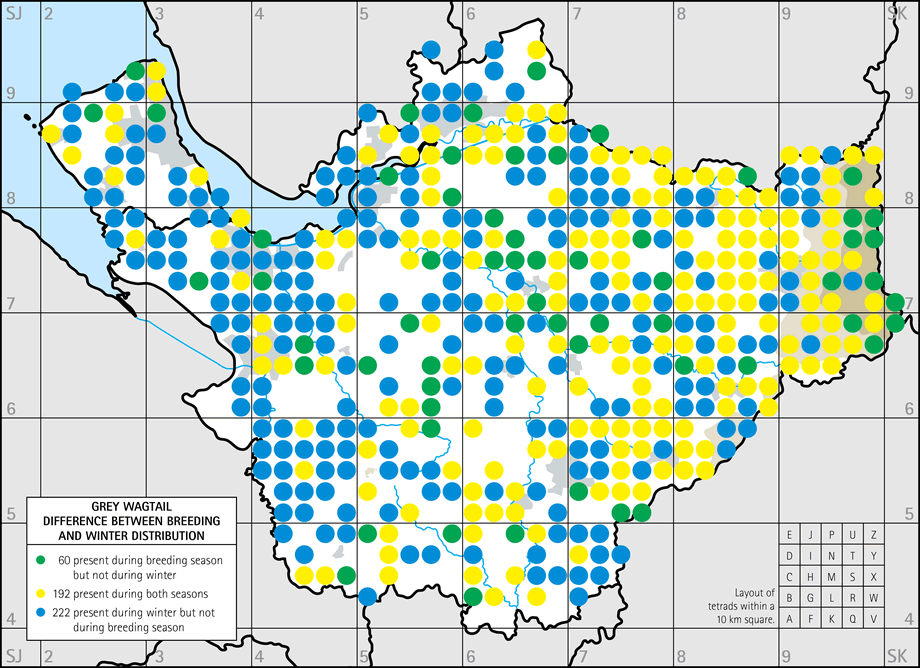
Grey Wagtails have a generally easterly distribution in the county, with a preference for higher altitudes. As in the First Atlas, the lines of some of our rivers and canals show up on the atlas map, notably the Bollin, Dean, Dane and the Mersey/ Manchester Ship Canal. But Grey Wagtails have considerably expanded their distribution and have noticeably spread into some urban areas, including Wallasey/ Birkenhead, and Widnes/ Runcorn. Although the general picture is of strong increase in the last twenty years, with 149 tetrads gaining breeding presence and 80 losses, the decline in much of western Cheshire is puzzling.
They used to be confined to sites alongside water, usually fast-flowing, and especially when bordered by native broadleaved trees, but are now more widespread as a breeder. However, almost three-quarters of the submitted habitat codes are G – freshwater, with the overwhelming majority running water (G6 – G10), mostly streams and rivers; the rest are mainly human sites and farmland. Although they are primarily associated with water, their food is mostly flies, caterpillars and spiders of terrestrial origin, so the Grey Wagtail is less susceptible to the effects of stream acidification than species such as the Dipper which share its riparian habitats.
Grey Wagtails make an early start to the breeding season, nesting on a ledge, amongst tree roots or beneath man-made structures such as bridges or culverts from late March and April. Young from second, third or replacement broods may still be in the nest in August. This lengthy season gives observers plenty of opportunity to record high-level breeding status codes, so it is a little surprising that they were proven to breed in only 45% of the tetrads in which the species was found, mainly from records of adults carrying food (37) or observations of recently-fledged young (49). Their incessant calls, similar to those of the Pied Wagtail but rather more clipped, readily draw attention to birds with chicks in the nest or nearby.
There were too few registrations of Grey Wagtails on the BBS transects in 2004 and 2005 to produce a robust population estimate for the county, but modelling using a detection probability derived from the national dataset suggests a Cheshire and Wirral total of 870 birds (confidence range of 10 to 1,740), considerably higher than the estimate in our First Atlas of 120-150 pairs. As largely insectivorous residents, their population can be adversely affected by severe winter weather and numbers may vary considerably between years, but the national Waterway Birds Survey index has increased by more than 40% since 1984, and the species has clearly spread into new areas in the last twenty years, so this figure seems not unreasonable. Assuming this to be 435 pairs it corresponds to a density of ~2.5 pairs per tetrad in which breeding was confirmed or probable. Workers studying the species usually quote a linear density, which can vary widely, but averages ~0.5-1 pair/ km on a variety of rivers (Simms 1992); the Cheshire and Wirral figure probably lies within this range.
Atlas account sponsored by Astra Zeneca, Club AZ Natural History section
Winter
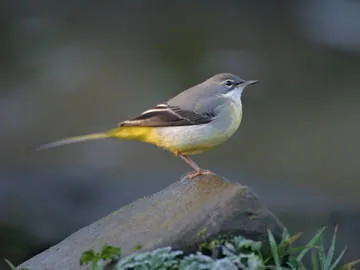
In winter, most Grey Wagtails quit their upland and northern areas to move into the English lowlands. Many Scottish birds move to England for the winter, and a few come here from continental Europe (Migration Atlas). In Cheshire and Wirral, some stay on their breeding territories while others spread out into a wider range of habitats, not necessarily associated with water. Sewage works, farmyards, slurry pits, canal towpaths and gardens all attract them, and they are a common wintering bird in urban areas. Individuals often seem faithful to particular sites, within a season and from year to year, as Coward (1910) had noted.
The submitted winter habitat codes showed that Grey Wagtails have much less attachment to water (47% of the total, down from 76% in the breeding season), with 22% human sites and 27% on farmland of all types. Observers noted them feeding in slurried fields and in flooded parts of stubble, even in the normally sterile maize fields. They take a wide variety of food: flies, worms and midge larvae when they can find them, small fish and even household scraps.
A century ago, Grey Wagtails left their breeding areas in autumn … ‘the birds descend to the Plain, and from October to March are distributed over the lowlands, where they haunt the meres and smaller streams. In the west, the bird is seldom seen, even in winter. Brockholes (1874) observed it only occasionally in Wirral.’ (Coward and Oldham 1900). Boyd (1951) described the bird as a winter resident in mid-Cheshire, appearing in October by Marbury Mere and in wet ditches and remaining, often throughout the coldest weather, until March. As now, they were noted visiting farmyard middens and gardens. Bell (1962) echoed these comments, writing that in the autumn the hill streams are deserted and as a winter resident the bird is fairly common along the river valleys and meresides on the plain, returning to the hills between February and April depending on the season.
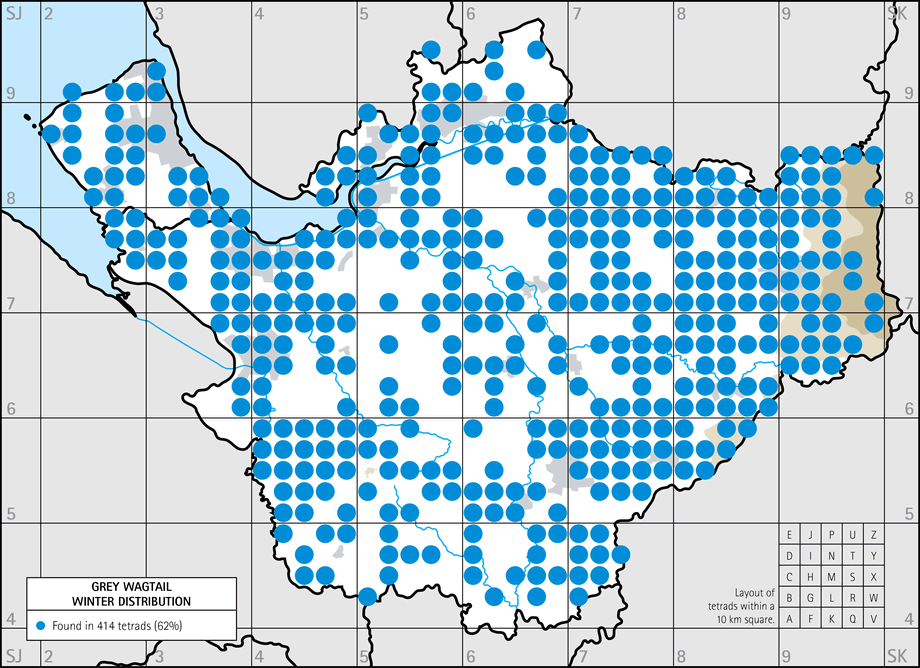
In this Atlas they were found in 414 tetrads in winter, almost twice as many as in the breeding season. Only 60 of their breeding tetrads were unoccupied in winter, including 11 of those over 250m in altitude. They are widespread in Wirral and west Cheshire, in areas where they do not breed. It is likely that they would be more restricted in range in hard weather, and the county bird reports over the years link the species’ numbers with cold winters. There was no difference between the three years of this Atlas survey, with 211, 201, and 211 tetrads with records: the total numbers counted were incredibly stable at 250, 248 and 252 in the three winters.
Ten birds were seen in one group with 8 Pied Wagtails in 2004/ 05 at Maw Green (SJ75D), and two flocks of six birds were reported elsewhere, but almost three-quarters of counts submitted were of single birds. Grey Wagtails sometimes join Pied Wagtails in their communal roosts, or form a single-species gathering on their own, usually in small numbers. Up to 40 were reported in 1993/ 94 in a tree growing out of a wall at The Groves, Chester, and a maximum of 17 at Poynton Pool in winter 1995/ 96. The regular autumn roost at Arclid SQ from 1985 to 2003 sometimes held a dozen or more birds into the start of the winter period, and occasionally lasted through the winter, with up to ten birds in 1989/ 90 and eight in 1992/ 93. There were, however, no roosting birds reported anywhere in this survey.
Atlas account sponsored by Astra Zeneca, Club AZ Natural History section