
Sandbach Flashes: birds and wildlife

About the Atlas
During the three breeding seasons 2004–06 and three winters 2004/05–2006/07, Cheshire and Wirral Ornithological Society (CAWOS) organised more than 350 volunteers to survey all of the county, trying to find every species of bird that was breeding or wintering
Greylag Goose Anser anser
Breeding
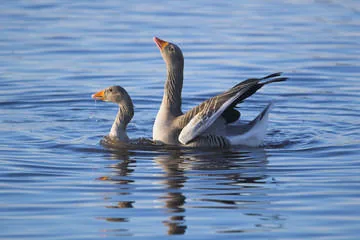
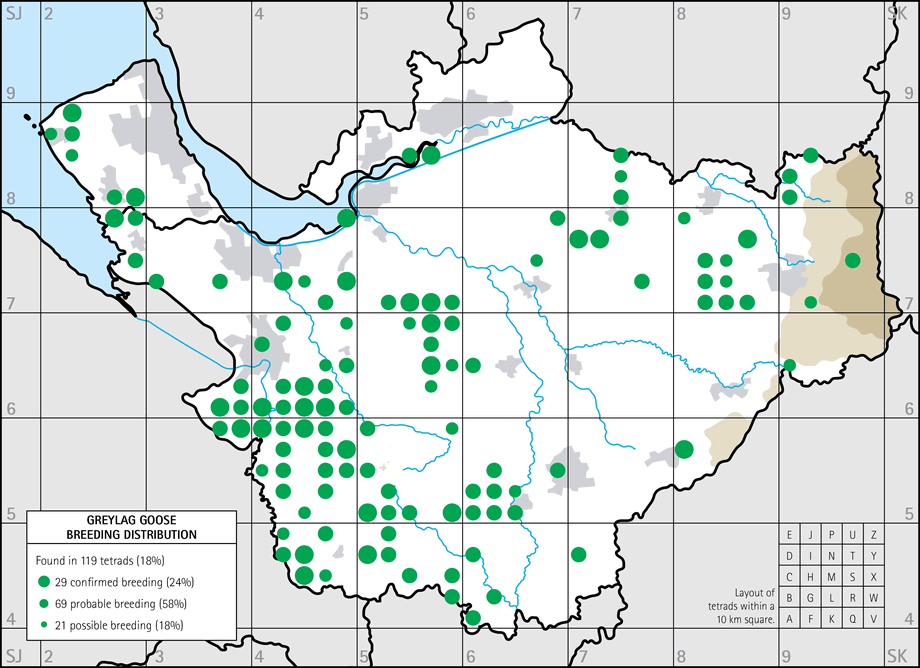
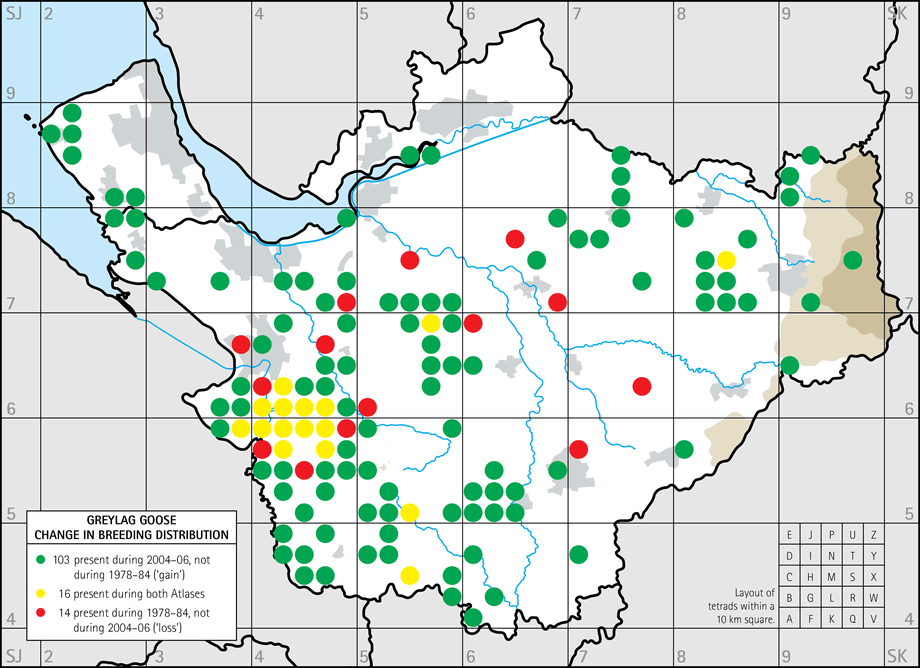
This Atlas has revolutionised our knowledge of breeding Greylag Geese in the county. Our First Atlas showed birds present in 31 tetrads, with breeding proven in 10 and probable in a further 8. But since then, presumably because of many birdwatchers’ usual scorn for introduced/ escaped species, annual bird reports have contained almost no information. From 1985 to 1994 there were no published breeding records whatsoever, and in the nine years 1995 to 2003 observers submitted reports of just twelve breeding attempts in total. The picture revealed by fieldwork for this Atlas shows Greylag Goose with breeding season presence in 119 tetrads, out of which breeding was proven in 29, probable in 69 (mainly records of pairs) and possible in 21 tetrads.
They have increased greatly in numbers and range since our First Atlas, spreading out from their original stronghold on the Eaton Estate to colonise most of south and west Cheshire, the mid-Cheshire sand-quarries, parts of the south Manchester fringe and western Wirral. Their status in the county appears commensurate with the picture elsewhere. From 1991 to 2000 the national population grew at a rate of 9.4% per annum, giving a doubling in eight years (Austin et al 2007). The Cheshire and Wirral population is not known, but is likely to be more than 200 breeding pairs.
The national surveys show that the greatest increase in Greylag Geese came from an expansion into lowland habitat with some water cover. Most of the county’s birds are in low-lying areas, but they were reported at all altitudes from the lowest to the highest waterbodies in the county (Lamaload Reservoir). The dystrophic upland reservoirs are not very suitable for waterfowl breeding, though. The submitted habitat codes show no obvious habitat separation from Canada Geese, although Greylag have a tendency to use larger waters: 48% of Greylag Geese were on G3, G4 or G5 compared to only 31% of Canada Geese. 82% of the submitted habitat codes were freshwater (74% on ponds, lakes, meres and reservoirs and 8% on linear watercourses, mostly rivers and large canals); most of the remainder (11%) were agricultural grassland.
They only need sufficient water to provide a nesting site safely away from predators, especially foxes, and somewhere for them to retreat to overnight. The geese and their goslings feed mostly by grazing short-cropped grass but head for the water whenever danger threatens. They usually nest in April, on the ground, preferably on an island if at all possible. Greylag Geese typically lay 5-7 eggs, incubated by the female for four weeks. From the moment they hatch, their downy young can walk, swim and feed themselves but it is seven to nine weeks before they can fly. This long season gives fieldworkers ample time to find the species and the low proportion of confirmed breeding records (only 25%) is probably explicable by their delayed maturity, Greylag Geese not normally breeding until 3 years of age, with consequent large numbers of non-breeding sub-adult birds.
Atlas account sponsored by an anonymous CAWOS member
Winter
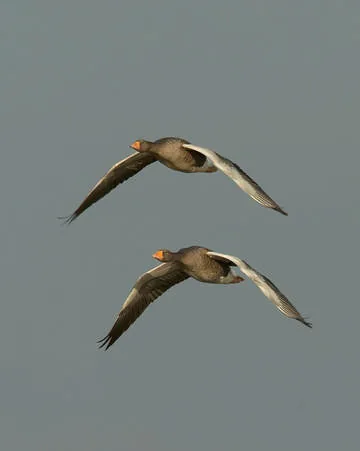
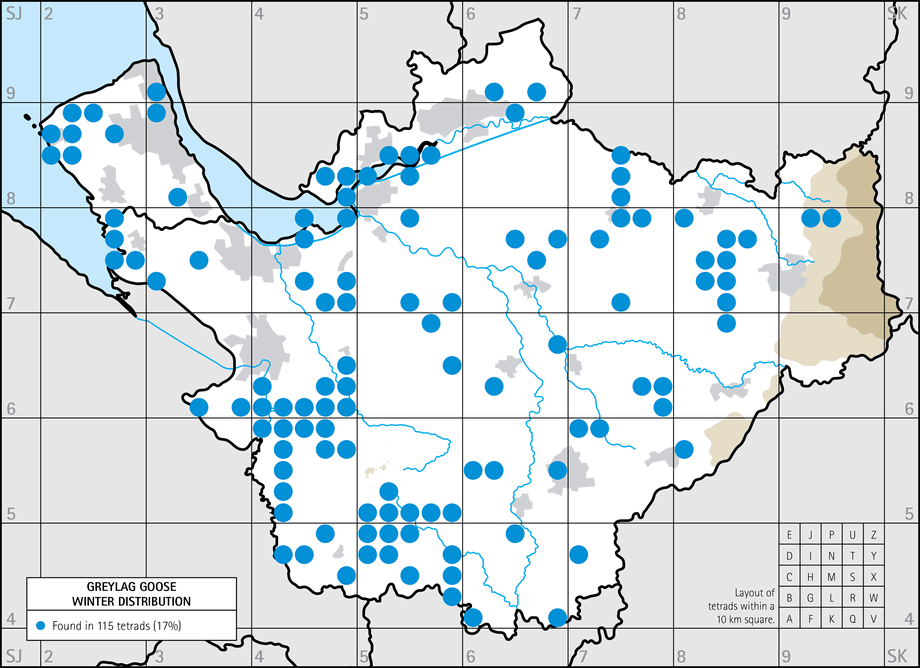
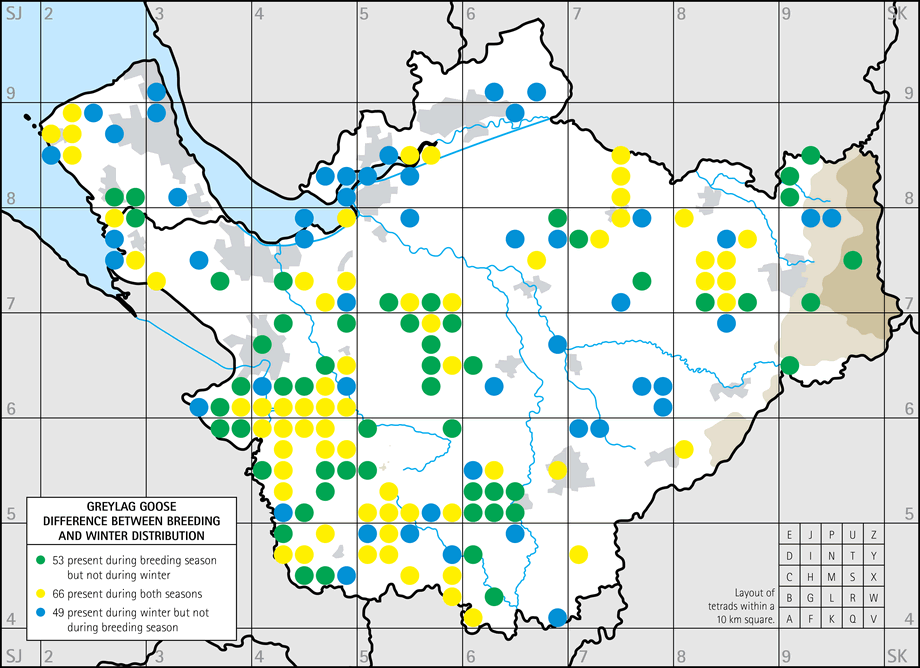
The map shows that the winter distribution of Greylag Geese is similar to that for the breeding season, suggesting that they are not likely to move far. Indeed, a characteristic of some flocks of Greylags is that they can be found from week to week in exactly the same spot. Some birds do move around, though, and there were 49 tetrads newly occupied in winter, as well as 53 with the species present in the breeding season only; observers also submitted 22 records of birds in flight, not mapped in this Atlas.
They feed on any plant material, including roots, tubers, shoots and leaves, both in water and on land, but are seldom far from a waterbody on which to take refuge if danger threatens. There are a few records on the Dee and Mersey saltmarshes but they are less likely than Canada Geese to move onto estuarine waters outside the breeding season. The winter habitat codes showed 57% of records on freshwater, almost all of them small waterbodies, meres and sand quarries, with only four records on rivers and canals; 28% on farmland, all on improved or unimproved grassland apart from two records on stubble; and 10% on grazing marsh or saltmarsh.
The species’ growth in the county has paralleled a steady climb in their national population. The WeBS index for the re-established population of Greylag Geese was at its highest ever in 2004/ 05, having risen almost fivefold in twenty years (Banks et al 2006). Nationally, 30 sites had five-year peak means over 500, and 46 sites over 400, but none in Cheshire and Wirral has reached those levels. By far the largest flocks were on the Dee floods above Chester, with the maximum exceeding 500 birds in 2004/ 05 and 2005/ 06. At the other extreme, half of the flocks counted for this Atlas were of ten birds or fewer, possibly just one family.
The previous scarcity of Greylag Geese was emphasised in the county avifaunas. Coward & Oldham (1900) remarked on the species’ great rarity: they knew of only three records during the 19th century. Bell (1962) traced sixteen published records from 1910, usually of single birds or small skeins of less than ten, most of them between November and February, but commented that, as the species is commonly kept in captivity, the possibility of escapes cannot be ignored. Later, Bell (1967) could find no breeding or wintering records ascribable to genuinely wild birds. All of the present population derived originally from captive birds, but most of them now are living in the wild.
Atlas account sponsored by an anonymous CAWOS member