Sandbach Flashes: birds and wildlife

About the Atlas
During the three breeding seasons 2004–06 and three winters 2004/05–2006/07, Cheshire and Wirral Ornithological Society (CAWOS) organised more than 350 volunteers to survey all of the county, trying to find every species of bird that was breeding or wintering
Herring Gull Larus argentatus
Breeding
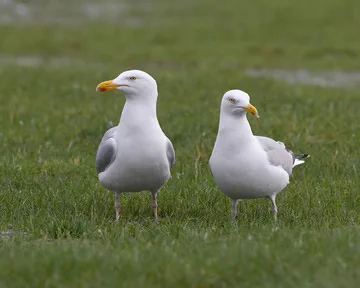
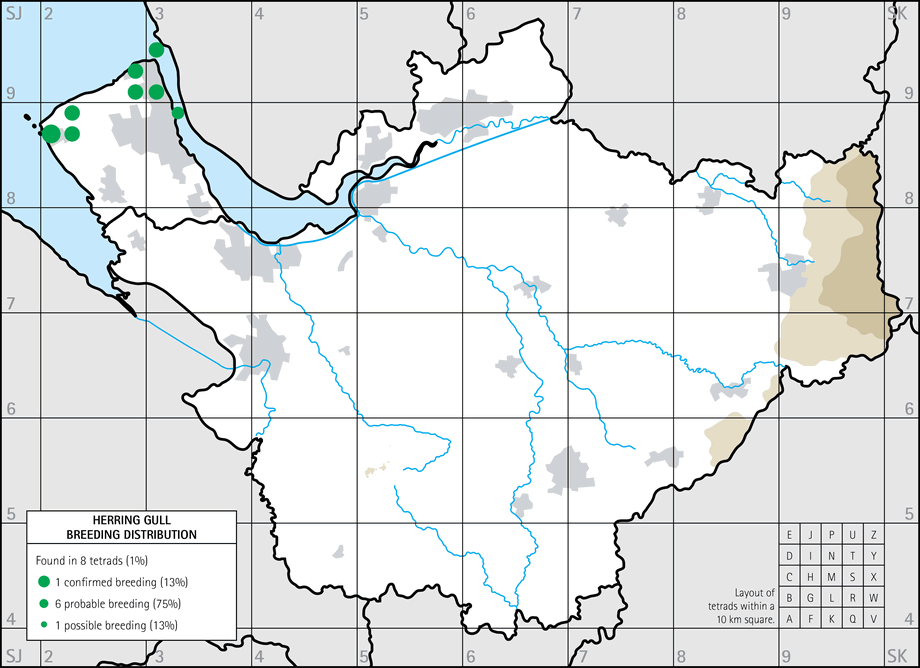
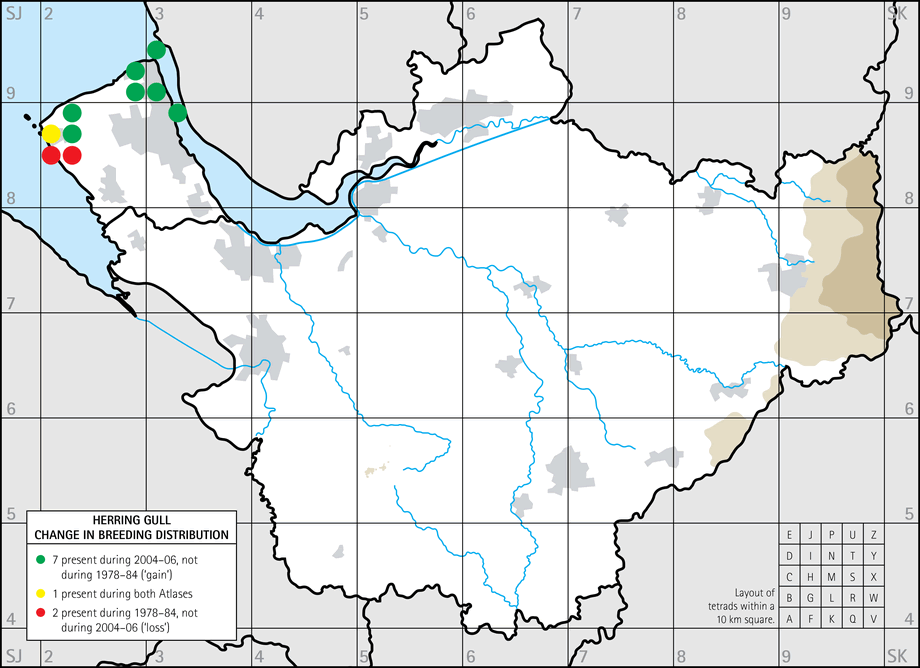
This well known ‘seagull’, whose calls are recognised by many from its weekly broadcast by BBC Radio 4’s Desert Island Discs, is becoming increasingly familiar to some residents of north Wirral as the habit of rooftop nesting takes hold. All of the eight tetrads with dots on the map were connected to rooftops in that area, in West Kirby, Hoylake, Birkenhead, Wallasey and New Brighton: one confirmed breeding through a pair with recently-fledged young, six probable breeding (two with birds seen building a nest, one pair in courtship display and three records of pairs observed in suitable nesting habitat) and one possible breeding with a bird in suitable habitat.
The few previous records of Herring Gulls nesting in the county were all on Wirral. In 1945 a nest presumed to be Herring Gull was seen on Middle Eye, Hilbre. A pair bred, rearing one chick, on a Hoylake rooftop in 1971 but were deterred by the householder in 1972, and in the 1976 national census of large gulls nesting on buildings there were records of a pair at West Kirby and ‘nesting’ at Heswall. At Inner Marsh Farm a pair built a nest in 1995 but did not lay eggs, and in 2003 a pair was seen on a nest but it is not known if they bred. The Cheshire and Wirral Bird Report for 2000 records a pair at Hoylake fledging one young, presumably from a rooftop although the site is not mentioned.
Rooftop nesting by Herring Gulls first started in 1910 in southwest England and is now widespread in Britain, accounting for about 11% of the species. Considerable effort and money has been expended in attempts to deter gulls in some places, almost always unsuccessfully (Rock 2005), and the numbers of nests increased by 10% a year in the quarter-century from 1976 to 2001: from 2,944 nests at 63 colonies in 1976, to 10,865 nests at 128 colonies in 1993-95 and 19,953 nests at 218 colonies in 1999-2002 (Mitchell et al 2004). Many householders do not like having gulls breeding on their houses but one of the main reasons that the species is flourishing is the messy habits of mankind. Herring Gulls feed mainly on inshore fish and discards from commercial or recreational fishing, waste sent to landfill sites and edible litter on urban streets.
In memory of Doreen Botwood
Winter
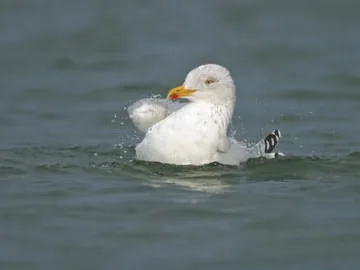
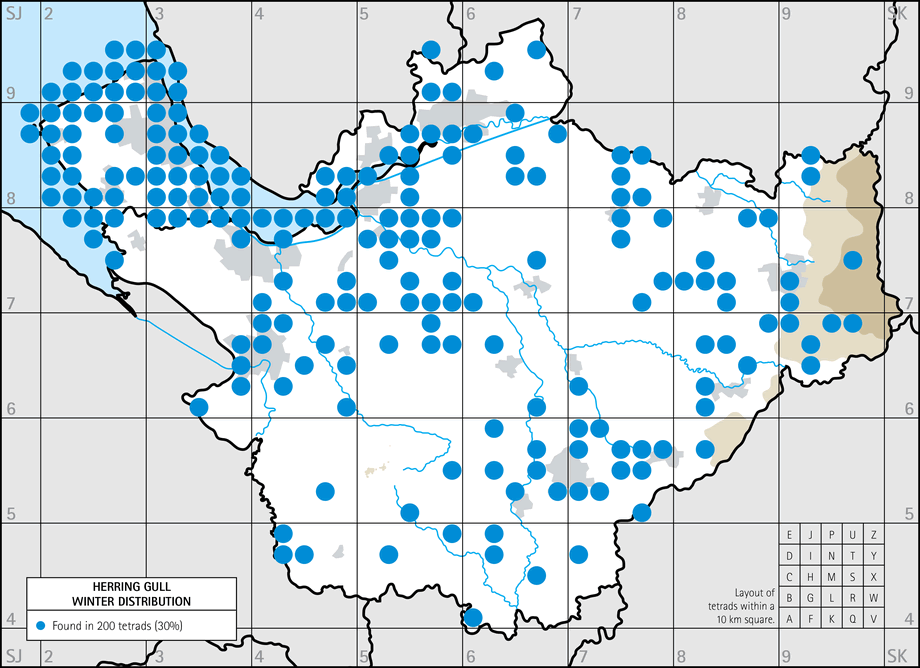
Herring Gulls were reported in winter from slightly fewer tetrads than Lesser Black-backed Gull (200 against 219) but they were more numerous and gathered into larger flocks. The biggest gatherings were at the north-west corner of the Wirral, with maxima of 8,000 on Hoylake shore and 5,000 off Hilbre, but the Gowy landfill site attracted many, with 5,000 being estimated loafing on nearby fields (SJ47L). There were many solitary birds and small groups, however, and the median count was only ten birds.
The old word of ‘seagull’ probably used to be more appropriate. Bell (1962) wrote that ‘the most significant change since Coward’s time is probably its winter status inland’, and Boyd (1951) noted that Herring Gulls had become much more abundant and widespread, beginning about 1927. The distribution map shows that they occupy more tetrads from SJ57 north-westwards, and obviously fewer in the centre and southwest of the county, than Lesser-black Backed Gulls. Herring Gulls are more likely to be found in human sites than Lesser-black Backed Gulls (12% of records against 8%), especially suburban areas of the Wirral, and on tilled farmland. These gulls are omnivorous. Probably most of them feed at sea, taking fish or invertebrates, but many scavenge on refuse tips and take whatever they can find, even small mammals, from farmland.
The Mersey Estuary was the only site in the county to record a roost count exceeding 1% of the British national total (380,000 Herring Gulls) in the January 1993 WinGS (Wintering Gull Survey) when a total of 5,321 was counted. Only 318 were found during the 2004 repeat survey, though.
The Handbook of Birds of the World regards the systematics of the Herring Gull and its close relatives as ‘one of the most complex challenges in ornithology’. Although excessive prominence is given by some birdwatchers to unusual races, and most of the species’ accounts in the annual Cheshire and Wirral Bird Reports are devoted to them, they are rare. Most of the birds from continental Europe concentrate on the east coast of Britain (Migration Atlas). The vast majority of our wintering Herring Gulls comes from northern Britain.
In memory of Doreen Botwood