
Sandbach Flashes: birds and wildlife

About the Atlas
During the three breeding seasons 2004–06 and three winters 2004/05–2006/07, Cheshire and Wirral Ornithological Society (CAWOS) organised more than 350 volunteers to survey all of the county, trying to find every species of bird that was breeding or wintering
House Sparrow Passer domesticus
Breeding
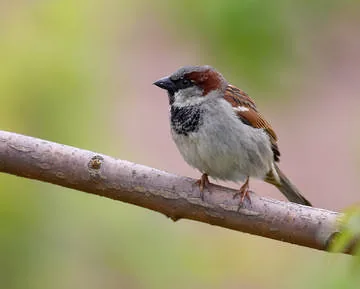
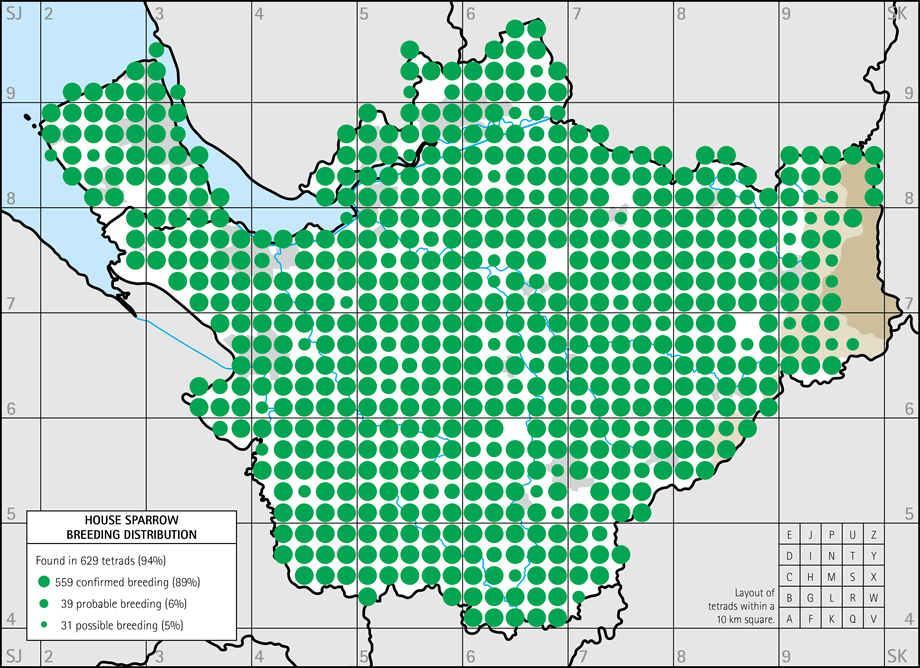
The Atlas map reveals that House Sparrow is no longer in the top ten of widely distributed breeding species in the county, but the population figures show that it is our most abundant bird. This apparent paradox is easily explained: as a social / colonial bird, it is not found everywhere but there are often large concentrations where they do occur.
Their population has declined nationally and they are now (from 2005) on the Red List of species of conservation concern. The population indices showed a 40% drop in breeding numbers in England during the period of our First Atlas (1978-84) and there has been a further 45% drop in twenty years since then (1984-2004). However, these data are mainly from rural areas, almost certainly driven by a fall in overwinter survival as has been experienced by many farmland seed-eaters, and their decline has been greatest in eastern and south-eastern England. House Sparrow density in many rural towns (Summers-Smith 2003), and in some urban and suburban areas, appears not to have changed much for many years although there are well-publicised dramatic collapses in populations in the centres of some big cities. There are several research projects, and much speculation, on the reasons for this, including loss of nest sites from tidier building maintenance, increases in cat predation, pollution from unleaded petrol and the over-use of pesticides; but firm results are still awaited.
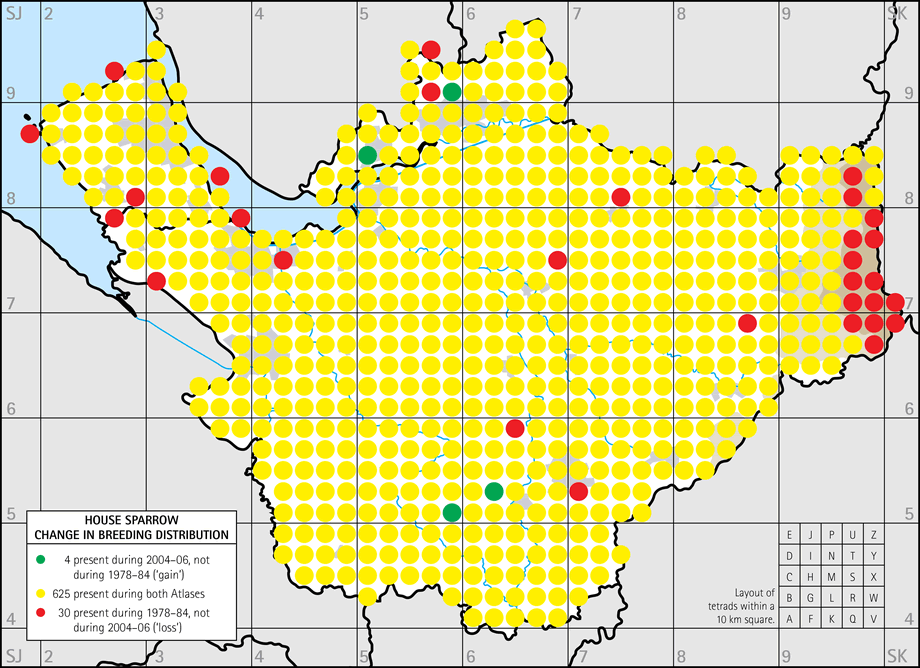
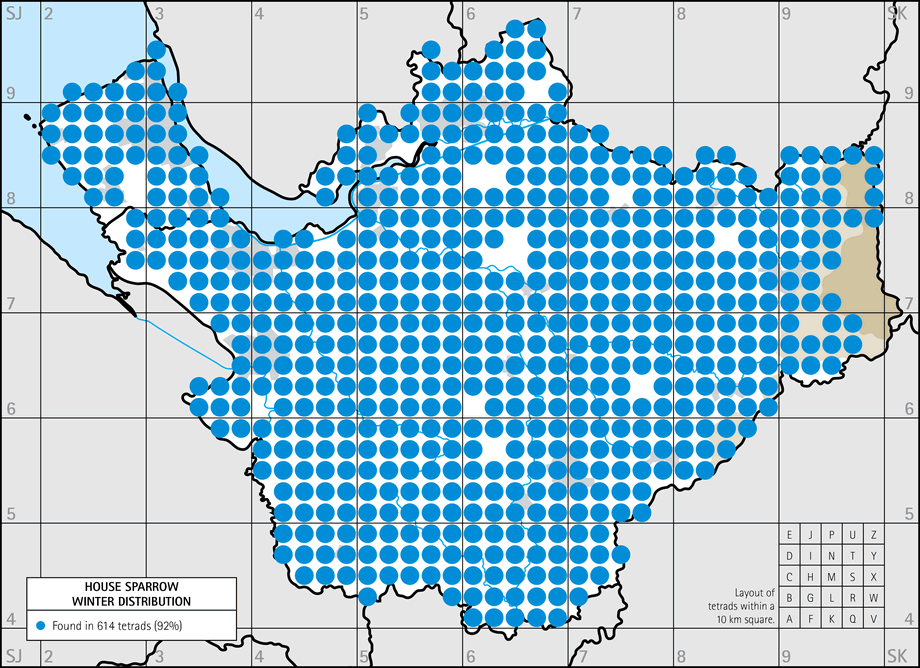
Apart from odd tetrads of under-recording in the First Atlas or this survey, the species has been lost from the far west and far east of our area. House Sparrows do not now breed on Hilbre, where their fortunes have previously been shown to follow the practices of different wardens in keeping chickens, or not (Craggs 1978). The most noticeable area of loss in the last twenty years is the eastern hills. House Sparrows are now missing above approximately the 350m contour mark; a similar distribution has been observed in the tetrad atlases of Northumbria, Lancashire and North Merseyside, and Cumbria. It is probably not a simple effect of altitude, however, and is likely to be the change in agricultural practice and habitation, and possibly rainfall, as the weaver family, including sparrows, generally inhabit arid lands. There is no obvious reason for the change in the last twenty years, which has occurred un-remarked in Bird Reports, but it does mirror that of Starling.
As well as preferring to be with other sparrows, House Sparrows are seldom found far from people, and 80% of the habitat codes recorded in this survey were category ‘F’ – human sites, with 17% being farmland. There has been an interesting change in birdwatchers’ attitude to the species, it having gone from being ignored, often disliked, to becoming a topic of conversation and often a matter of some pride for those of us who have them living near to us.
The BTO analysis estimated a Cheshire and Wirral breeding population of 211,490 (160,420-262,550) individuals, an average of about 42 pairs/km2 across the whole county. Thus, Cheshire and Wirral holds about 2.0% of the UK population; with 1% of the land area of the UK, we have more than our proportionate share of the species. Despite their traditional easterly distribution, perhaps the comparatively benign intensification of our pastoral agriculture has been relatively favourable for sparrows, compared to their fate in the arable counties.
A 2001 survey in urban North Merseyside (White 2002) found amazing variations in the density of breeding House Sparrows, from none to 192 pairs/km2, with an average of 62 pairs/km2. They had almost abandoned central Liverpool and St Helens, but no correlation could be deduced with any geographical or habitat features examined. A similar survey in Cheshire and Wirral would make an admirable project for CAWOS members.
Atlas account sponsored by Peter Royle
Winter
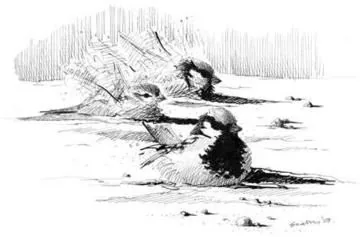
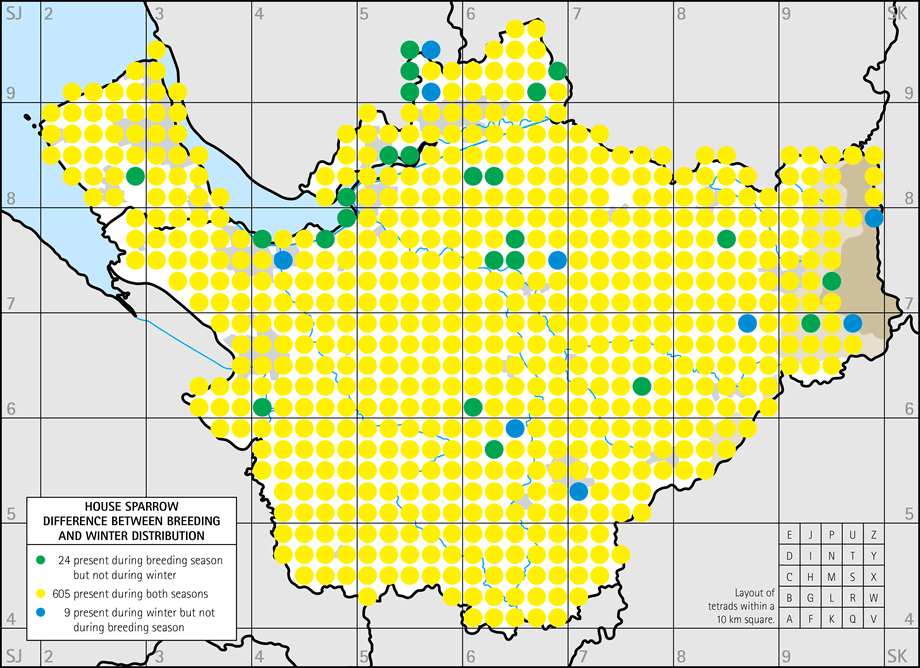
Most House Sparrows live all their lives within 1-2 km of their natal site, so not much difference would be expected between the breeding and wintering distribution, and this is borne out by the maps. Just nine tetrads had birds in winter where they had not been recorded in the breeding season, and 24 the other way round. These small differences show no significant pattern and are almost certainly due to the vagaries of recording effort. Similarly, there was no meaningful change in the habitat codes recorded.
Adults remain focussed on their nest sites all year round, adding material to the nest at any time, and females roost in it on and off throughout the year. They often join flocks along with the males and the first-year birds, however. More than 600 counts of House Sparrows were made by winter fieldworkers, half of them of more than ten birds, with 35 groups of 40 birds or more including five three-figure flocks. They also roost communally, the pre-roost gatherings often betrayed by the birds’ noisy discordant chirruping. Despite this being the time of greatest pressure on their lives, with difficulty in finding sufficient winter food, House Sparrows finish feeding and go to roost extraordinarily early on a midwinter afternoon, usually an hour before sunset. Atlas surveyors recorded roosts in 28 tetrads, especially in evergreen hedges such as privet and leylandii or impenetrable bramble or hawthorn, mostly holding from 10 to 40 birds. These were dwarfed, however, by the massive total found by Brian Martin, 200 House Sparrows on 23 November 2006 roosting in laurels in the car park of a Warrington superstore (SJ58Z).
Cheshire’s early-20th century ornithologists made no attempt to hide their dislike of House Sparrows, and wrote little about their status. Coward (1910) said that ‘... with obtrusive familiarity, the bird monopolises the scraps spread in suburban gardens in winter, frequently to the exclusion of more deserving species, and repays its benefactors by pulling to pieces the crocuses and early spring flowers.’ Boyd’s view (1951) was that it was ‘... far too plentiful’. Bell (1962) added nothing, copying the comment on distribution from Coward and Oldham 62 years previously: ‘This abundant resident is widespread, except on the bleaker hills in the east, but it frequents isolated farms on the high ground’. Perhaps we can deduce from this that there was little change in its status, although with the disdain for recording House Sparrows, continued in early Cheshire Bird Reports, it is impossible to be sure.
Nationally, rapid declines amongst House Sparrows wintering in gardens are indicated by the BTO's Garden Bird Feeding Survey (Robinson et al 2005): it fell from presence in 97% of gardens in the 1970s and 93% in the 1990s to only 83% at the start of this Atlas. The RSPB Big Garden Birdwatch has recorded a drop in average numbers per garden, from 10 in 1979 to 4.4 in January 2007.
Atlas account sponsored by Peter Royle