
Sandbach Flashes: birds and wildlife

About the Atlas
During the three breeding seasons 2004–06 and three winters 2004/05–2006/07, Cheshire and Wirral Ornithological Society (CAWOS) organised more than 350 volunteers to survey all of the county, trying to find every species of bird that was breeding or wintering
Jackdaw Corvus monedula
Breeding
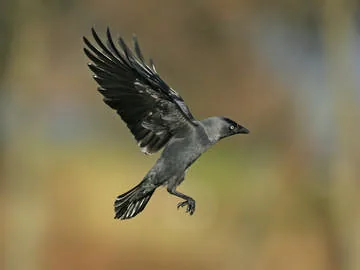
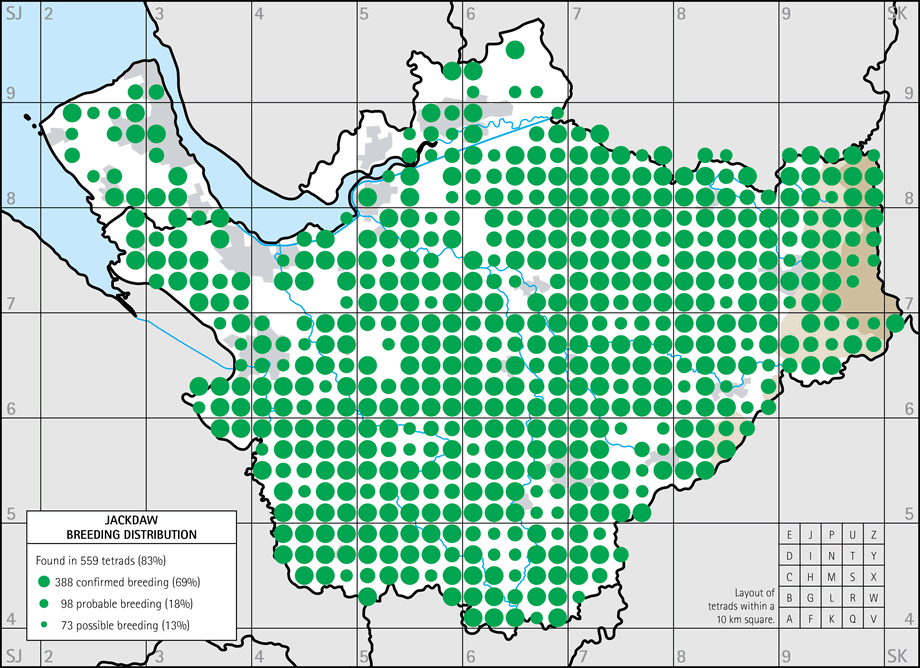
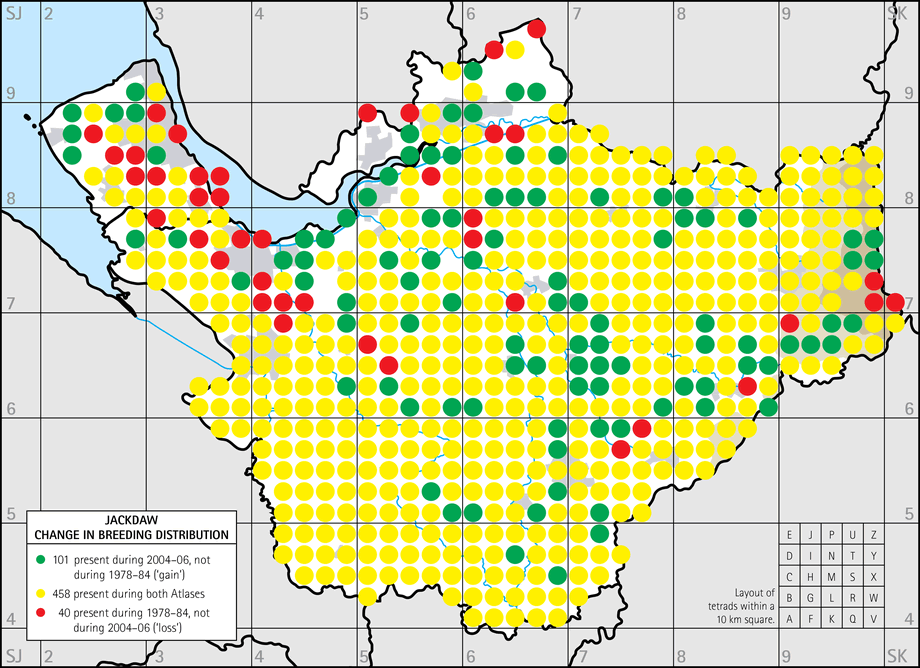
This Atlas indicates that Jackdaws have increased substantially across the county. They were found in 61 more tetrads than during the 1978-84 fieldwork period for our First Atlas, and the number of tetrads with confirmed breeding went up from 303 to 388. They are still quite sparsely distributed in Wirral, where the ‘change’ map indicates that they have been lost from a number of tetrads, and along the Mersey valley, a lack that is mirrored in adjacent counties to the north of the Mersey. Jackdaws are missing from a handful of the squares at highest altitude in the east of Cheshire. Throughout the rest of the county they are now almost ubiquitous, having spread to fill in most of the gaps from twenty years ago. The abundance map shows that they are found at highest densities in the agricultural southwest of the county.
Most of the proof of breeding came from observers seeing birds going to or from their nests, for which they use any sort of large hole, filling it with lots of sticks, often leaving some poking out. Observers in 33 tetrads noted Jackdaws nesting in chimneys, and in tree holes in a further 21, with one pair near Crewe (SJ75H) feeding young in a hole in an ash tree about one metre away from an active nest containing noisy Great Spotted Woodpecker chicks. They can make a nuisance of themselves by occupying nest boxes intended for Barn Owls, and nest widely in church spires. They often form small colonies, with at least eight occupied nests in chimneys of Westwood Grange Country Club, Thornton Hough (SJ27Z) and at least fifty pairs breeding in Dunham Park (SJ78I). The association with buildings shows up in the analysis of habitat codes, with 42% of records in human sites, 34% in farmland and 21% in woodland.
The Jackdaw’s diet is very varied, with farmland insects, usually picked from amongst the grass or crops rather than from probing in the ground, often making up the majority. Many birds in woodland feed their chicks on caterpillars, and they are surprisingly agile and adept at clinging on to thin branches in the tree canopy. They eat a lot of vegetable matter, plants and seeds, and will scavenge for almost anything else including carrion (Coombs 1978). These generalist feeding habits allow it to exploit diverse and ephemeral food resources, and must have helped it to ride out changes in agricultural practice. BTO figures show that their breeding total nationally rose by 30% in the twenty years from 1984. According to the analysis of BBS transects in Cheshire and Wirral, their breeding population in the county in 2004-05 was 32,610 birds (21,960-43,250), an average of 58 birds per tetrad in which they were found.
Atlas account sponsored by John Davies
Winter
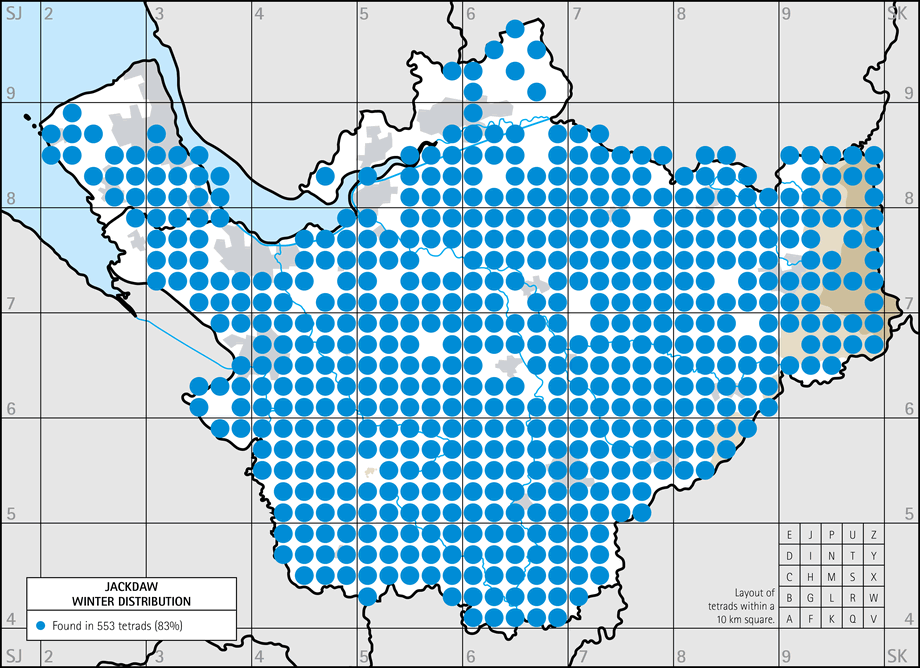
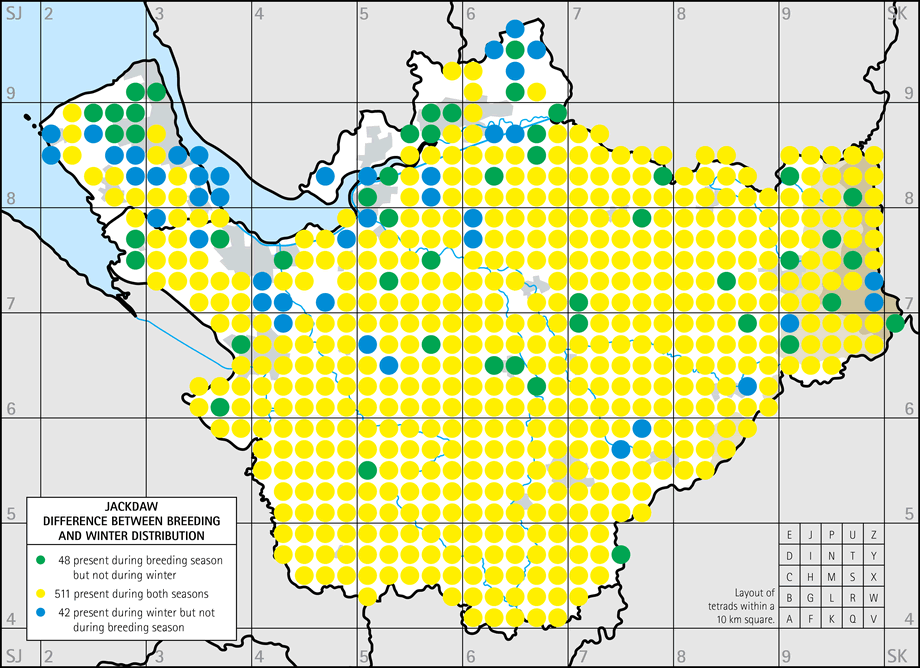
The winter Atlas map for Jackdaws is similar to that for the breeding season, with the main differences in the north of Cheshire and in Wirral. Some breeding tetrads are not occupied, but on the other hand, in winter, Jackdaws are found in a few sites in north Wirral and the Mersey valley where they did not breed, suggesting that their breeding distribution in the north of our area might be limited by a lack of nest sites. English breeding birds are sedentary – and on bright winter days in January some of them show signs of breeding behaviour – but some first-year birds might move south and west for the winter (BTO Winter Atlas). Although some immigrants from Scandinavia and the near continent have been found in eastern England, there is no evidence of any having reached Cheshire and Wirral (Migration Atlas).
Many of them undertake a shift in habitat for winter, with the proportion recorded in human sites halving to 21% as they slacken the association with potential breeding sites in buildings. Most Jackdaws in winter (58%, up from 34% of breeding season records) are on farmland, especially improved grassland, where they feed on seeds and whatever insects they can find, especially weevils, and small snails. One of the species’ specialised foods is ticks, picked from the backs of cattle and especially sheep. In urban areas they use their agility to reach into litter bins and other sources of food discarded by man.
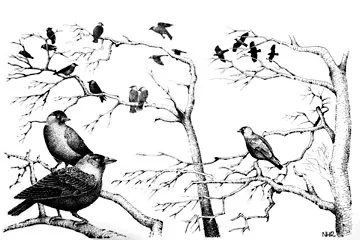
Jackdaws are gregarious birds and usually found in flocks, often mixed with Rooks, from a few birds strong up to several hundreds, and John Headon estimated 2,000 birds near Adlington (SJ98A) in an area of improved grassland left to go to seed. The median count of Atlas records was only 20 birds, however.
One of the features of a late winter afternoon is the loud cackling of flocks of Jackdaws as they make their way to communal roosts. Roosts were recorded in 53 tetrads, as shown on the map. Half of the roost counts were of 50 birds or fewer, but some enormous gatherings were logged, with five of 1,000 or more, all in the east of the county. This is not a complete picture – for instance, a large roost in SJ58 was not reported – but would provide a good base for a thorough study of Jackdaw roosts across the county.
Atlas account sponsored by John Davies