
Sandbach Flashes: birds and wildlife

About the Atlas
During the three breeding seasons 2004–06 and three winters 2004/05–2006/07, Cheshire and Wirral Ornithological Society (CAWOS) organised more than 350 volunteers to survey all of the county, trying to find every species of bird that was breeding or wintering
Jay Garrulus glandarius
Breeding
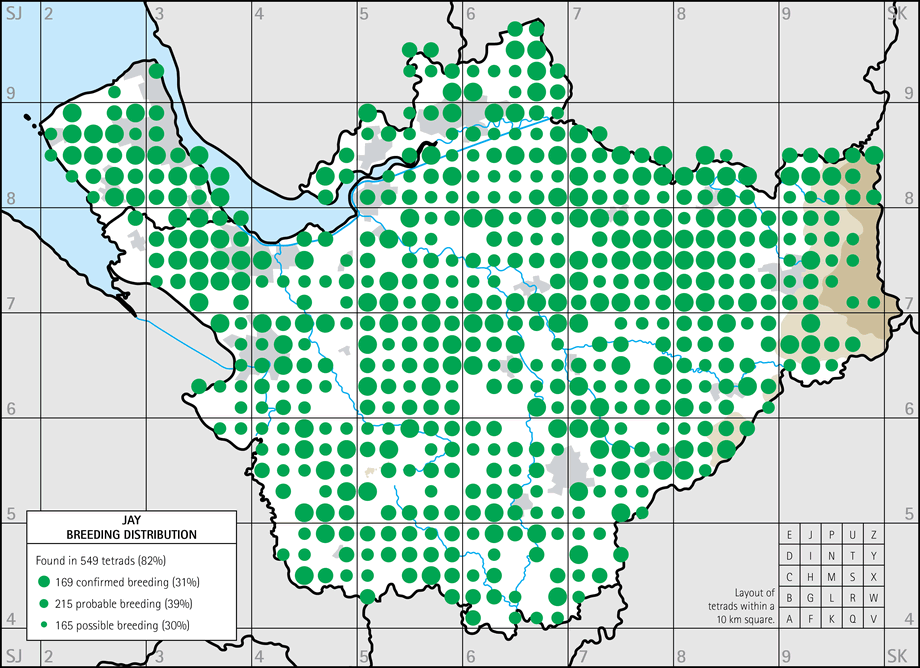
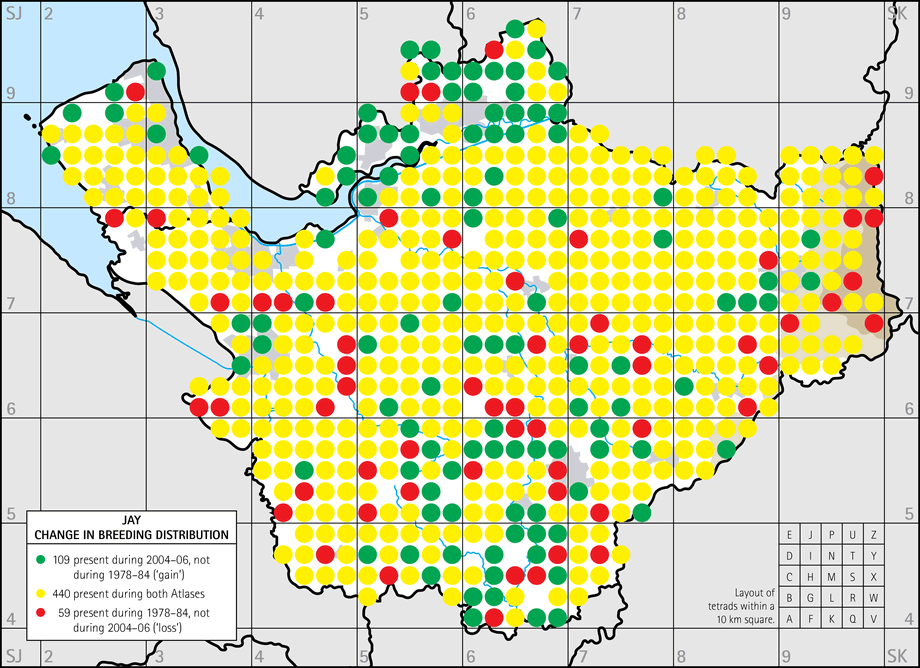
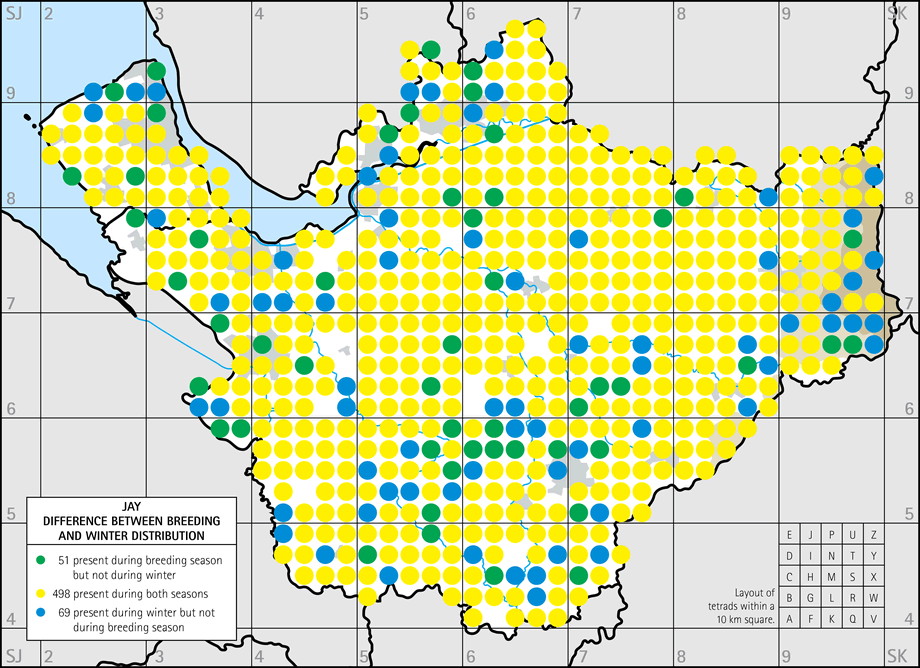
This is the corvid of woodland: the habitat codes supplied came mostly from woodland (65% of records), mostly broadleaved or mixed, with 9% in scrub, 17% on farmland and 8% in human sites. Despite their quite restricted needs, Jays have increased their range since our First Atlas, with a net gain of presence in fifty tetrads. The ‘change’ map shows their increase most noticeably along the Mersey valley and in south central Cheshire, and they have particularly moved into urban areas around Widnes, Warrington, Chester and Crewe.
The national breeding population index has fluctuated but with no overall trend, and their numbers are much the same as during our First Atlas. According to the analysis of BBS transects in Cheshire and Wirral, their breeding population in the county in 2004-05 was 5,520 birds (2,470-8,570), an average of 10 birds per tetrad in which they were found.
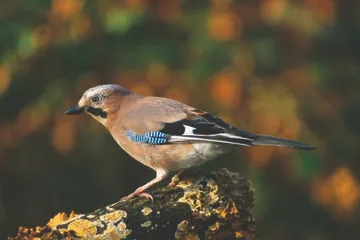
Their display in April can be entertaining to watch, as several birds often chase each other through the trees, and is a good way of locating territories, but the wary birds usually see the human much quicker than the other way round, and often all that can be detected is a raucous squawk and a flash of white rumps as they fly off. Jays’ nests are difficult to find. They are secretive birds, usually building in dense scrub or small trees, and their nests are surprisingly small, often little bigger than that of a Blackbird. Only in 25 tetrads did observers record a nest as proof of breeding, and most confirmed breeding came from seeing adults carrying food for their chicks (53 tetrads) or with recently-fledged young (91). Amongst the categories of probable breeding, 13 tetrads furnished evidence of birds carrying nesting material, and 11 of Jays visiting a probable nest site.
They forage during the breeding season for invertebrates to feed to their young, especially defoliating caterpillars, beetles and spiders. Jays are well known for predating the eggs and chicks of smaller birds. Parents feed their older chicks some acorns that they have dug up from those stored the previous year, even if they have sprouted and have started to become oak seedlings; Jays seem able to distinguish between the green-stemmed seedlings, newly grown and still palatable, and the brown-stemmed young shoots from previous years, which they ignore (Coombs 1978).
Atlas account sponsored by The Arnold Family (Hebe, Clair and Mark)
Winter
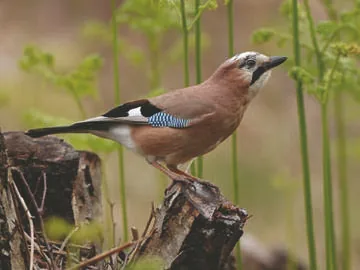
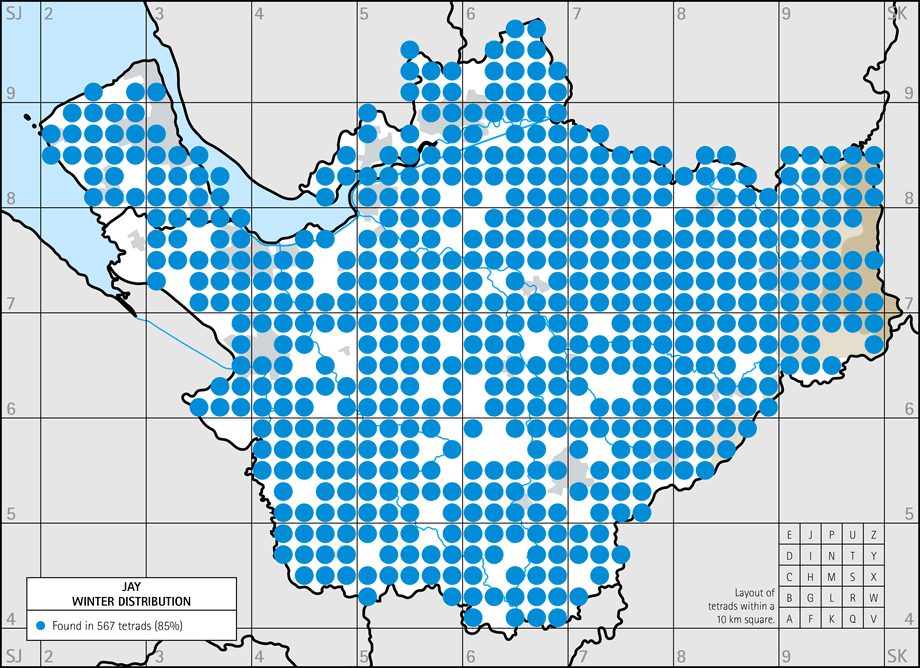
The position of Jay as the woodland corvid is even more obvious in winter. 59% of the habitat records came from woodland or scrub, more than twice as high a proportion as any other member of the crow family. 24% were in farmland, more than half of them hedgerows, and 16% in human sites, over twice the proportion in the breeding season.
The winter Atlas map shows that they moved into some areas where they did not breed, being found in 18 more tetrads, although with gains and losses scattered across the county. A few of the higher altitude squares, vacant in the breeding season, held a bird or two in winter. Most Jays do not move far, British birds being largely sedentary. There is occasional mass immigration from the continent following widespread failure of the acorn crop but Cheshire and Wirral missed out on the last such event, in autumn 1983, with only odd records of more than a few birds, although the publicity given to the invasion perhaps stimulated more recording of the species than normal (CWBR).
Jays are at their most conspicuous in October, when they fly to and fro carrying acorns which they store by burying in the ground, although on 26 December 2005, Brian Baird reported a Jay at Great Sankey (SJ58U) eating nuts and berries that it had apparently stored in an old nest. Each bird will cache several thousand acorns, often up to 1 km or more from the oak tree from which they fell (Coombs 1978). They also hoard beech mast, hazel nuts and sweet chestnuts, and peanuts in gardens, and opportunistically feed on almost anything they can find. They return to the buried items later in the year, starting even a week or two after they finished hiding them, and stored acorns are the Jay’s main winter food. Their ability to retrieve the stored items has intrigued various ornithologists and ethologists. It seems to be based entirely on memory, Jays even being able to retrieve items buried under snow when all external clues appear to have been lost (Coombs 1978). They do not return to all that they buried, and some birds die during the winter, so some of the buried acorns turn into oak trees, often a long way from woodland. For this habit of spreading oaks, Jay is a very important species in the British countryside.
Jay is the only corvid that does not form large flocks. Over the three winters, 472 counts were submitted, more than three-quarters of them of one or two birds, with the largest flocks, of eight or nine birds, reported from seven tetrads. Communal roosts of Jays are seldom recorded, and just two were found during this winter Atlas, three birds in SJ56X and eight on 11 February 2007 flying into rhododendrons in large gardens in SJ68L.
Atlas account sponsored by The Arnold Family (Hebe, Clair and Mark)