
Sandbach Flashes: birds and wildlife

About the Atlas
During the three breeding seasons 2004–06 and three winters 2004/05–2006/07, Cheshire and Wirral Ornithological Society (CAWOS) organised more than 350 volunteers to survey all of the county, trying to find every species of bird that was breeding or wintering
Kestrel Falco tinnunculus
Breeding
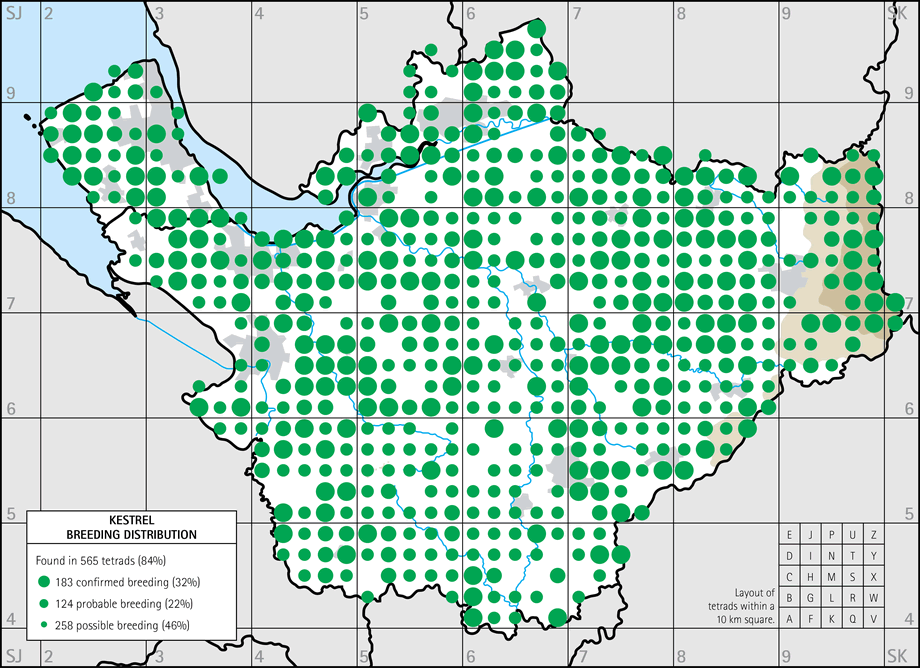
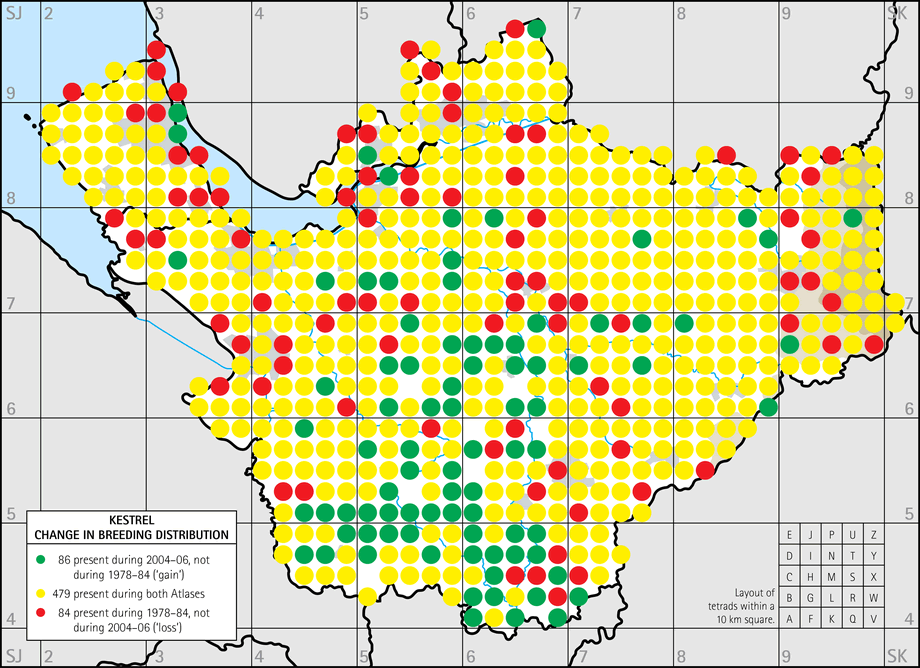
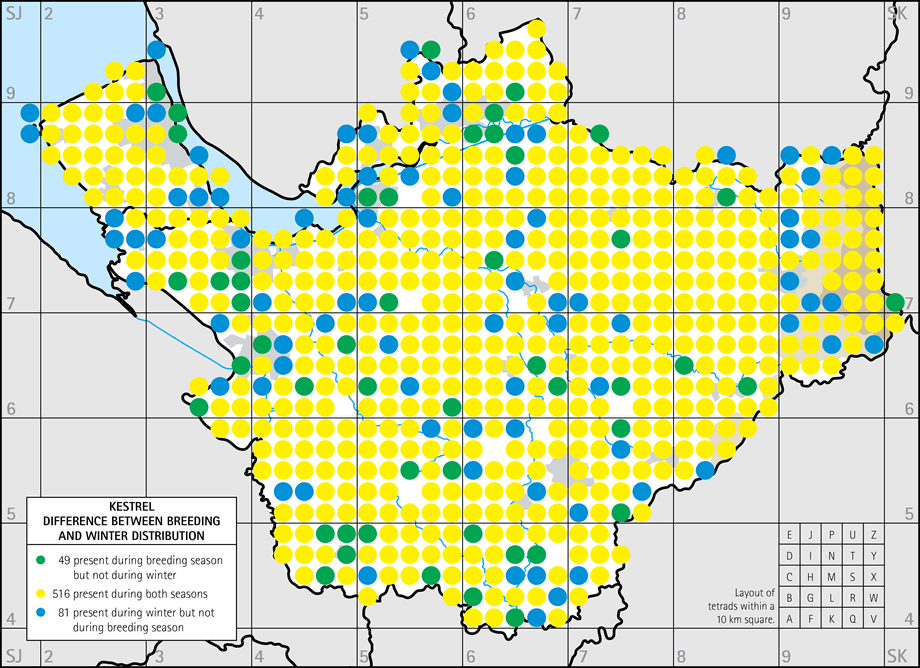
Breeding Kestrels are found at any altitude and almost every habitat. The habitat codes recorded were mostly farmland (63% of records), especially grassland areas, with 15% woodland, 12% human sites, 4% scrub and 3% semi-natural grassland and marsh. They occupy much the same number of tetrads as twenty years ago, but the ‘change’ map shows that their distribution has altered significantly. In our First Atlas, Kestrels were present in almost every tetrad in Wirral, Halton and Warrington, and around Northwich and Chester; whereas now there are substantial gaps in their presence in those areas. On the other hand, the species has spread into much of central, southern and south-western Cheshire where it used to be missing. The net effect is a shift in habitat, with a reduction in urban Kestrels and an increase in rural birds.
This loss from many urban areas has not previously been noted in the county and merits more research as it is not readily explicable. The spread in rural Cheshire is perhaps linked to changed agricultural practices, including the widespread adoption of Environmental Stewardship with uncropped field margins and sympathetically managed hedges. These measures have been vital in Barn Owl conservation, but are benefiting Kestrel which is the diurnal equivalent, filling the same ecological niche.
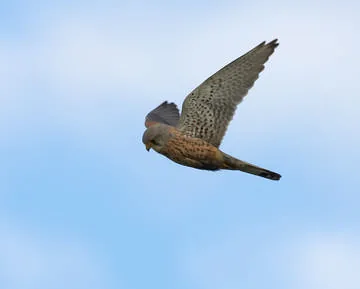
Their most successful and best-known hunting technique is hovering, facing into the wind and keeping stationary by tilting the tail, scanning the ground below for some movement. But hovering is energy-demanding and kestrels often switch to three other methods of hunting: perching, dropping onto prey below; walking on the ground, sometimes looking into mammal-runs in grass, or taking invertebrates; and a low flight, like a Sparrowhawk, used to catch small birds. Their diet is a mixture of mammals, birds and invertebrates. Some Kestrels take mainly Field Voles, and their breeding population varies cyclically according to the abundance of their prey. During this Atlas, 2004 and 2005 were average years, with 2006 a year of very low Field Vole numbers, and in well-studied areas of Cheshire only about one-third of the normal number of Kestrels nested. Urban Kestrels take more mice, rats and birds, up to the size of pigeons, usually fledglings. Females are larger than males, and there is some difference in their diet. Males take more insects, especially beetles, and females take more earthworms. Males are more proficient at catching birds, with young Starlings especially a favoured target.
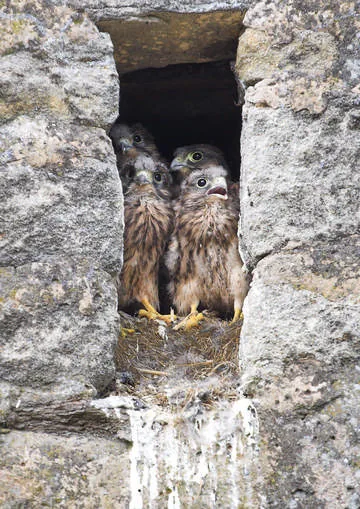
Their wide range of nesting sites gives them an unfettered choice of tetrad: large holes in trees, old corvid nests, ledges on any type of human artefact and nest-boxes are all readily taken. They usually start laying around the end of April, but can be a month earlier in years of plenty, or delay by a month (or not breed at all) if food is scarce. They take no particular steps to conceal their nests, and observers found nests in 77 tetrads, with adults carrying prey for their young in a further 55 and recently-fledged chicks, often with tufts of down visible, confirming breeding in another 51 tetrads.
The BTO BBS analysis shows that the breeding population of Cheshire and Wirral in 2004-05 was 1,300 birds (650-1,960). Kestrels can breed at one year of age, but only 20-40% of females do so, and half that proportion of males, never successfully (Shrubb 1993), so some of those counted on BBS transects will have been non-breeding immature birds. Assuming that 400 were non-breeders and that, in most cases, only the male of each pair was seen – the female being occupied with incubation – the Cheshire and Wirral total of Kestrels is likely to have been in the range 600-800 pairs. This is double the estimate of 350 pairs in the First Atlas, partly because that figure now appears to be too low, and partly because the local population has risen. The BBS figure amounts to 2.6% of the UK population, suggesting that Cheshire and Wirral provide particularly good habitats for Kestrels.
Atlas account sponsored by S. C. Nichols
Winter
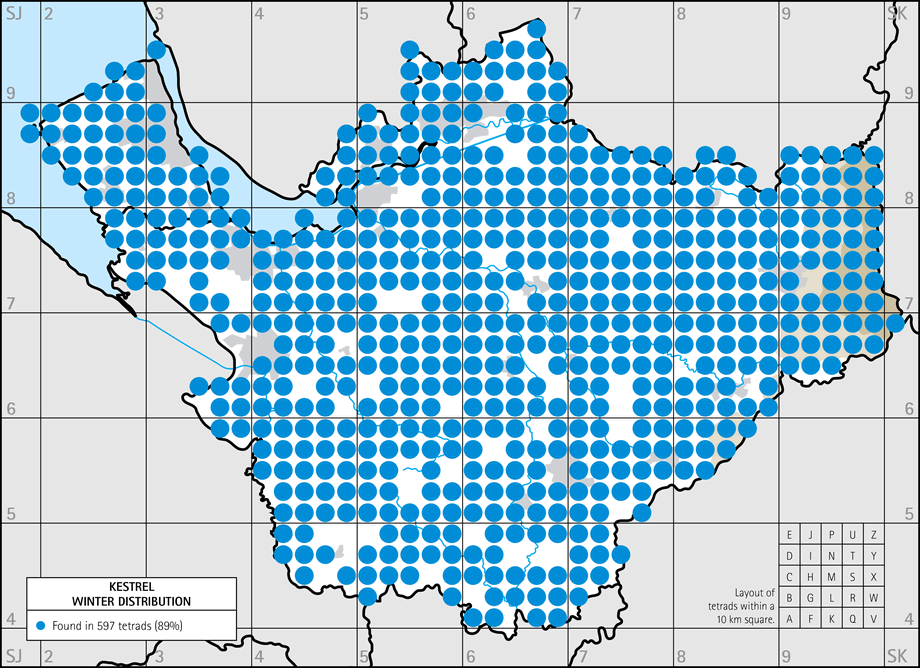
The winter distribution map is similar to that for the breeding season, with a few records in areas where they were not found to breed, and a few gaps where the species was unluckily missed in winter. Kestrels exhibit a variety of strategies for coping with winter. Some pairs remain together on their breeding territory; others split up, with the male staying and the female moving off to defend a separate winter territory, probably re-forming the pair-bond in spring; some first-year birds squeeze into areas between occupied territories; and others migrate long distances, including Scandinavian birds coming to Britain, some of them making it to the west coast and Ireland. British birds breeding in the lowlands are mostly sedentary while those in the uplands tend to move south, and to lower altitudes (Brown & Grice 2005). Birds fledging late in the season are much more likely to travel far from the nest (Migration Atlas). This mixture of approaches means that Kestrels can probably be found in winter anywhere with sufficient food, and that certainly applies in Cheshire and Wirral. Although inhospitable uplands are deserted for the winter (Winter Atlas), the easy of Cheshire obviously offered enough food and shelter during this Atlas survey for Kestrels to be found in almost every tetrad.
The winter habitat codes show that significant shifts from the breeding season. Farmland comprises an even higher proportion (72% of records), with only half as many in woodland than during the breeding season (7%), fewer in human sites (8%), 5% scrub and a doubling to 6% of the fraction of semi-natural grassland and marsh.
The ‘home range’, the area over which an individual hunts, is at its minimum size in autumn, when first-year birds are finding space for themselves; this is probably tolerable because autumn is the time of maximum vole numbers. In grassland areas, Kestrels in autumn use about 1-2 km2 each but this virtually doubles by late winter as some birds die and others move out (Village 1990).
Whilst Kestrels are most often noticed when hovering, especially over roadside verges, they only do so within a certain range of wind speeds; it is too difficult, or energetically costly, in calm conditions or when the wind is very strong. Birds then usually resort to sitting on perches, especially telegraph poles and the like, dropping on to prey. Kestrels seem to avoid hunting in rain if possible, and may spend hours sitting in a sheltered site.
It can be difficult to tell on what they are feeding, and no observer for this atlas commented on prey in winter. Small mammals seem to be the staple if they can be found: Kestrels can detect vole urine, visible in ultraviolet light, and probably use this faculty to select areas with high concentrations of the mammals. Bank Voles, Wood Mice and Harvest Mice are less strictly nocturnal during winter, and thus more likely to be available to Kestrels. Fewer birds are taken in winter in upland areas, reflecting the scarcity of small- to medium-sized avian prey there, but on farmed land with flocks of seed-eaters, birds may form the majority of Kestrels’ winter food (Shrubb 1993). Some Kestrels attack passerine roosts.
Apart from a respite from persecution, there has probably been little change in the Kestrel’s status for a century or more. Alfred Newton’s Dictionary of Birds (1893 - 1896) described the Kestrel as ‘almost entirely a summer migrant’, but Coward and Oldham (1910) helpfully comment that ‘in Cheshire the bird is as frequently met with in winter as in summer’, a phrase that holds good today. There is a hint that the species has changed its habits, however, with Coward and Oldham deeming worthy of special comment the fact that Brockholes (1874) stated that they ‘sometimes breed in a hollow tree’.
Atlas account sponsored by S. C. Nichols