
Sandbach Flashes: birds and wildlife
About the Atlas
During the three breeding seasons 2004–06 and three winters 2004/05–2006/07, Cheshire and Wirral Ornithological Society (CAWOS) organised more than 350 volunteers to survey all of the county, trying to find every species of bird that was breeding or wintering
Lapwing Vanellus vanellus
Breeding
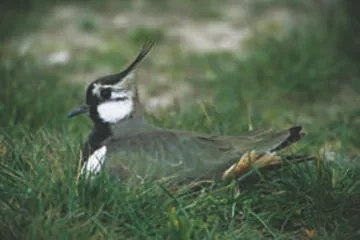
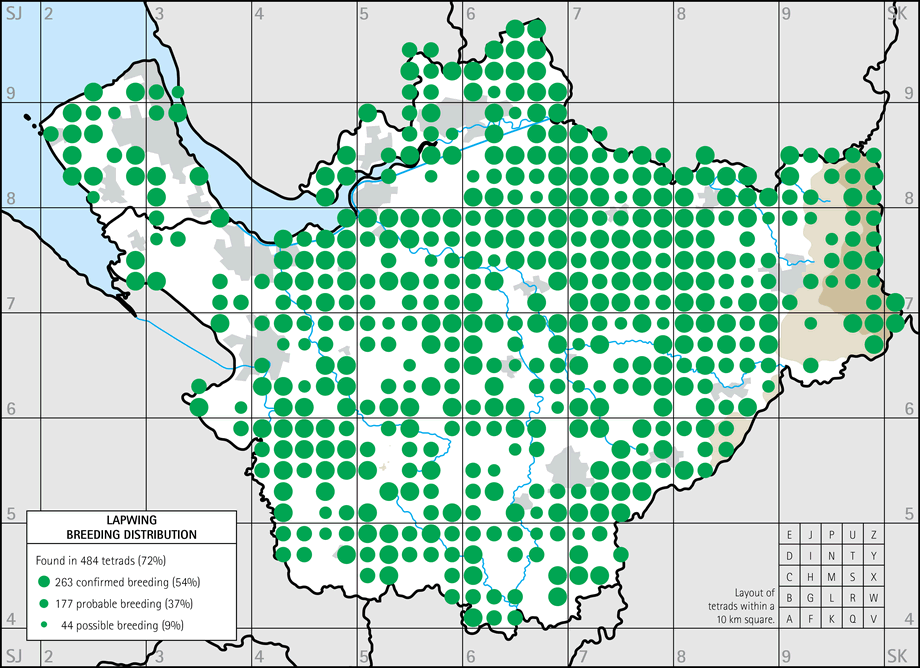
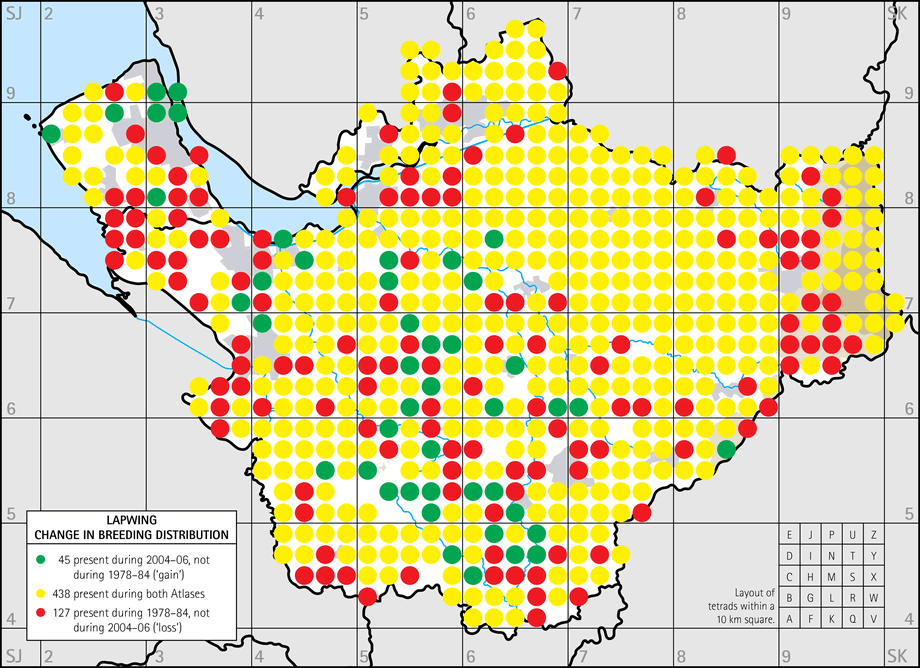
The Lapwing has been widely publicised as one of the birds that has declined as a result of agricultural changes, and is Amber Listed as a result, so the maps for this species have been eagerly awaited. As it happens, breeding Lapwings are probably more widespread than many had feared, being still found in 72% of the county’s tetrads. This is one of the species that makes a good case for undertaking surveys at a finer scale than the national Atlases. Although Lapwing has shown a large population decline, their distribution has not noticeably contracted at the 10-km square scale, indicating that they remain widespread but at lower density (Fuller et al 1995). Comparing with our First Atlas, they were found in 438 tetrads in both surveys, and have been gained in 45, mostly in a band running north-south through the southern part of Cheshire, but these are outnumbered by the 127 losses, scattered widely across the county. The most obvious factor determining their distribution in this Atlas was their avoidance of urban areas. All of the county’s conurbations show up as gaps on the map: east Wirral, Heswall, Ellesmere Port, Chester, Runcorn and Widnes, Warrington, Northwich, Macclesfield, Congleton, Sandbach, Nantwich and Crewe. It seems that they are happy to breed on suitable rough land in industrial areas, such as Birkenhead Docks and the Stanlow petrochemical complex, but not amidst human dwellings.
The habitat codes show that Lapwing is overwhelmingly a farmland bird, with 84% of the records, especially on tilled land (25% of the total): this is more than twice as many records on tilled land as any other species in this Atlas. Others were on improved grassland (24%), mixed grassland/ tilled land (21%) and unimproved grassland (9%). Some birds used semi-natural grassland or marsh, mainly water-meadow/ grazing marsh (3% of records) and ‘other dry grassland’ (2%), and 5% were recorded alongside waterbodies, including sandquarries.
The national population was stable until 1984, coincidentally the last year of our First Atlas fieldwork, then dropped by one half in just ten years, and has now levelled out since then. National surveys in England and Wales showed a 49% population decline between 1987 and 1998, and a 60% fall in northwest England (Wilson et al 2001). The reasons for the decline have been intensively studied. The key factor is that their productivity is too low, with too few chicks surviving to balance adult mortality. Lapwings nest from early April to late June or even July, and some will lay up to three or four times in attempts to raise a brood, but are succeeding far less often these days. On agricultural land, many nests fail owing to predation, mainly by nocturnal mammals. Nests within 50 m of a field boundary have only about half of the chance of survival of those farther away from the edge (Sheldon et al 2007). Although they favour tilled land, as shown by the habitat preferences in this Atlas, they prefer spring-sown crops, especially when adjacent to permanent grassland (Wilson et al 2001); Lapwings often nest in one type of habitat and lead their young chicks, some distance if necessary, to a different type that offers more soil invertebrates. With increasingly specialised modern agriculture, such mixtures of habitats are not often found.
The analysis of Breeding Bird Survey transects shows that the breeding population of Cheshire and Wirral in 2004-05 was 7,980 birds (1,310-14,650). This amounts to 2.5% of the UK total, so the number of Lapwings in the county is quite significant in national terms.
Contrary to the decline on lowland farmland, surveys of the South Pennines Moors SPA, of which the Cheshire moors are a part, showed an 80% rise between 1990 and 2004-05 in the breeding population of Lapwings (Eaton et al 2007).
Atlas account sponsored by Chris Honer
Winter
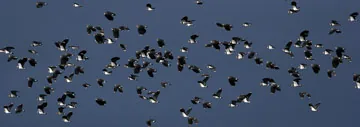
As soon as breeding is over – in June or even during May for some failed breeders – Lapwings gather together, and spend the rest of the year in flocks. Immigrants from continental Europe, as far east as Russia, come here to join local breeding birds, which tend to move to lowland grassland and the coast. Some British birds go to Ireland or France, but it is only the rare spells when the ground is hard frozen that cause most of them to leave. Previous authors emphasised the hard weather movements of Lapwings: Hardy (1941) noted that flocks went to the coast, and returned inland when it thawed. From the mid-1970s to mid-1980s it was almost an annual occurrence for the county bird report to note thousands of birds on the move, with the county almost deserted in spells of severe frost, as in December 1976, February 1978, January 1979, December 1981, February 1983, January 1984, January 1985 and February 1986, but the hard weather movements of January 1987 are the last on record in the county (CWBRs). Perhaps connected with this warming trend, there has been a substantial shift of wintering Lapwings to the east of England, presumably meaning that fewer continental birds are reaching the county (Gillings et al 2006).
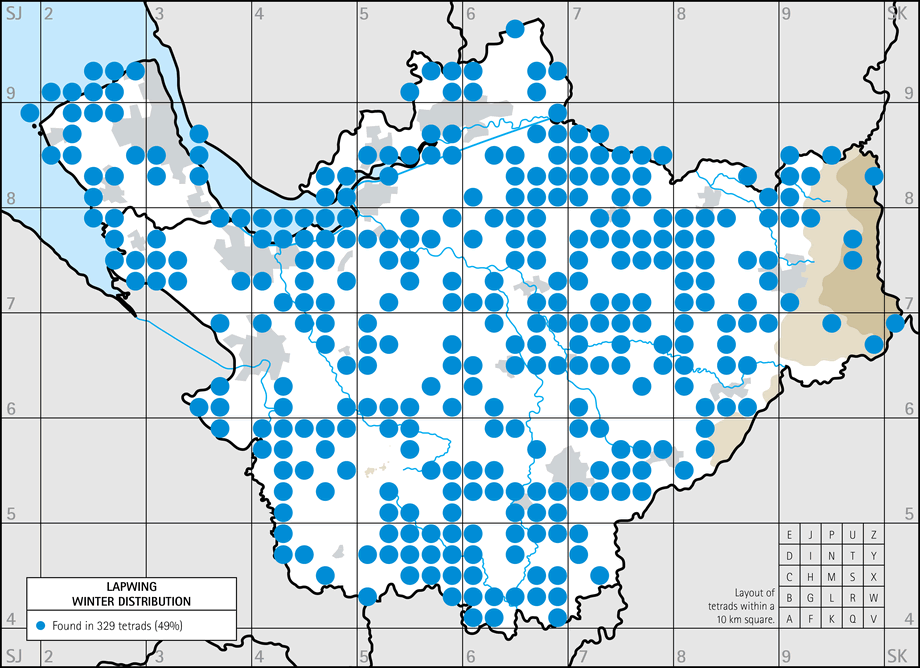
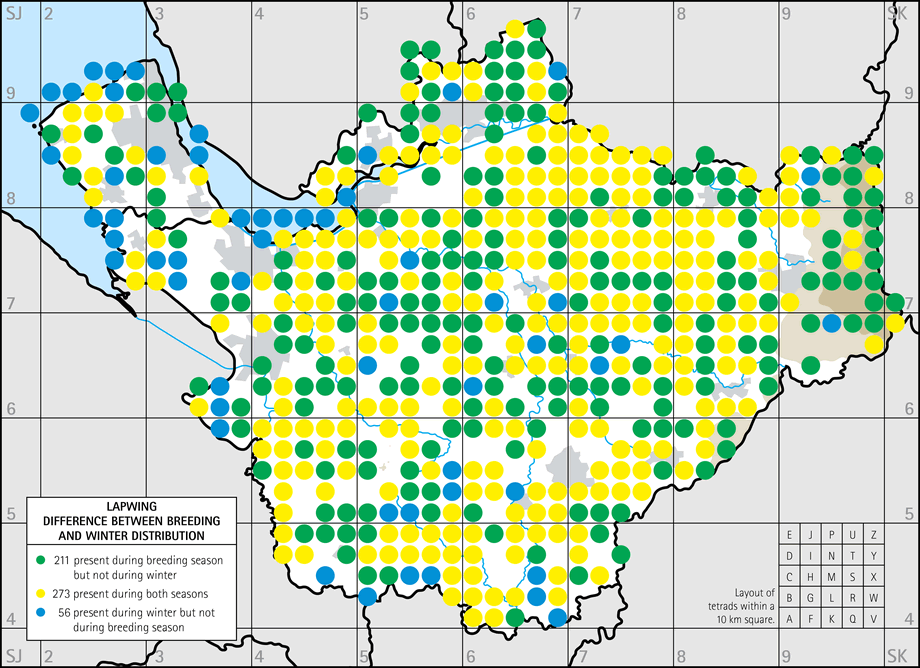
The Atlas map shows that most of the breeding areas in the eastern hills are vacated in winter, as are many tetrads throughout the county as birds join flocks at favoured, and regularly-used, feeding fields. 273 tetrads are occupied in both seasons, with 56 holding birds in winter only, 21 of which are estuarine or coastal, and 211 tetrads were used for breeding only. Most of the records in the hills are of birds returning in January or February to their breeding sites, a characteristic that was noted by Coward (1910) a century ago. He wrote that they usually leave the uplands in October, but in mild winters such as 1897/ 98 they remained on the moors east of Macclesfield throughout winter. During the relatively clement winters of this Atlas, most upland tetrads were blank, however.
Most Atlas observations of Lapwings were accompanied by a count, showing that half of flocks were of 70 birds or fewer, but there were 43 gatherings of over 1,000 birds. Most of these were on the estuaries or adjacent sites, with eleven four-figure flocks elsewhere, headed by 1,500 on the Gowy floodplain (SJ47G) and at Neumann’s Flash (SJ67S). In tidal areas, 6,000 were at Fiddler’s Ferry (SJ58M) in 2004/ 05 and 5,000 on the adjacent saltmarsh in 2005/ 06, but the largest flock in one tetrad, 8,000 birds on Ince Banks in the Mersey (SJ47P) on 14 January 2005 was rightly described by Andy Ankers as ‘a very special sight’. None of these flocks, however, comes close to the 15,000 seen at Witton Flashes – then a favourite winter resort – by Boyd on 25 November 1950, which was probably the largest flock ever noted in Britain (Bell 1962). Modern WeBS counts on the estuaries do not properly represent this inland species, but the five-year peak mean on the Mersey averages over 11,000, and that on the Dee nearly 8,000, usually reaching a maximum in January or February (Musgrove et al 2007).
The submitted habitat codes showed that, as in the breeding season, this is mainly a farmland bird, making up 74% of the tetrads with wintering Lapwings. Most were on improved grassland (35%) but Lapwings favoured tilled land (14%) and stubble (7%) more than most other birds. They visit the estuaries sporadically, comprising 11% of their habitat records, with freshwater (6%) and semi-natural grassland and marsh making most of the remainder (4%). Several observers commented on mobile flocks making use of flooded maize stubble and recently slurried or ploughed fields, from which it was doubtless easy to find their favoured earthworms.
Lapwings often roost by day and feed at night, particularly to avoid having their earthworm prey stolen by Black-headed Gulls. An unusual facet of their behaviour, especially prevalent in northwest England, is the formation of daytime roosts on rooftops of industrial buildings, even in town centres (Calbrade et al 2001). The only example on record in Cheshire and Wirral has been at Handforth (SJ88R), mostly in autumn, but holding 46 birds on 9 January 2000 (CWBR). When feeding at night, Lapwings usually frequent different areas from their daytime haunts (Gillings et al 2005), and we should be aware that we are only recording half of their life in winter: despite a recent comprehensive monograph (Shrubb 2007), there is still more to learn about the species.
Atlas account sponsored by Chris Honer