
Sandbach Flashes: birds and wildlife

About the Atlas
During the three breeding seasons 2004–06 and three winters 2004/05–2006/07, Cheshire and Wirral Ornithological Society (CAWOS) organised more than 350 volunteers to survey all of the county, trying to find every species of bird that was breeding or wintering
Lesser Black-backed Gull Larus fuscus
Breeding
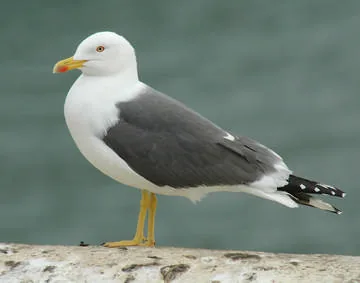
Lesser Black-backed Gulls normally breed near the coast, nesting on flat ground amongst grasses. Ground predators, including foxes and mink, are their main enemies, and this adaptable species has recently realised that the roofs of buildings provide a safe alternative. The habit of rooftop nesting has spread rapidly in Britain, from 325 nests at 11 colonies in 1976, to 2,501 nests at 63 colonies in 1993-95 and 10,790 nests at 125 colonies in 1999-2002 (Mitchell et al 2004). About 10% of the country’s Lesser Black-backed Gulls now breed on rooftops.
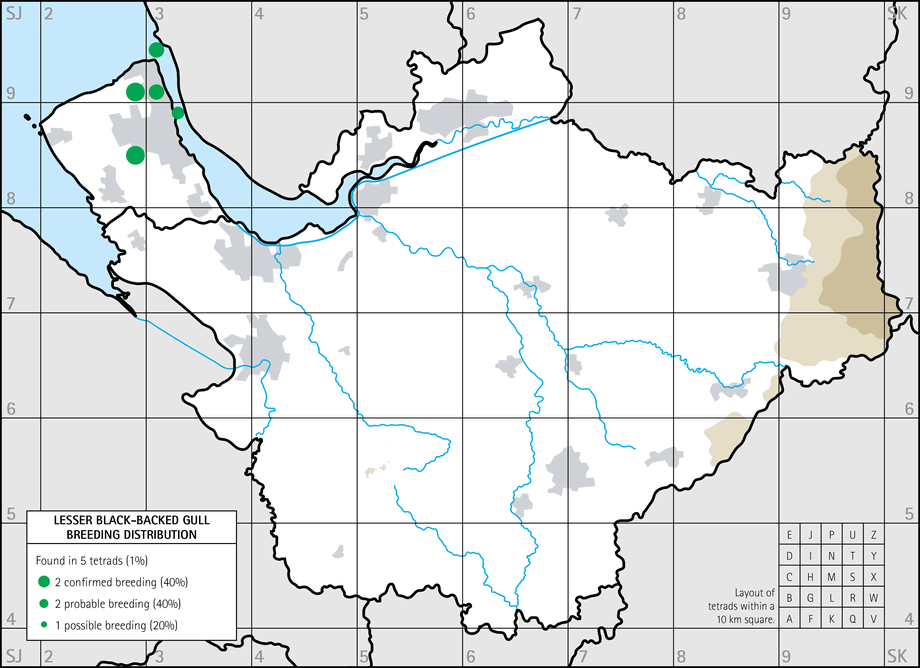
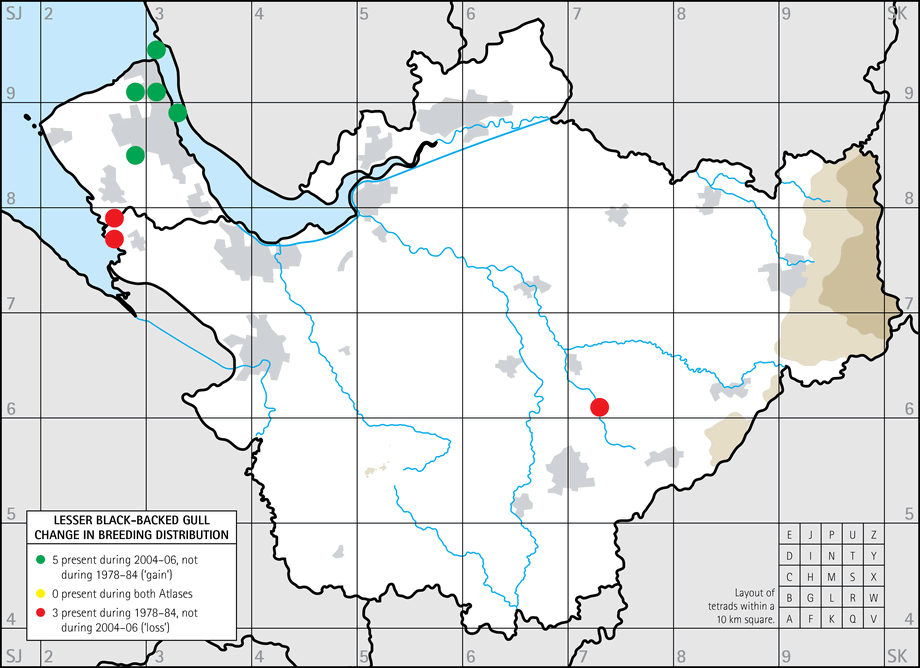
In Cheshire, a pair of Lesser Black-backed Gulls nested at Witton flashes (Northwich) in 1943, with three pairs reported nesting on Burton Marsh in 1955 and 1956, and a single pair there in 1978 (First Atlas). The annual county bird reports show that a pair held territory, displayed and copulated without nesting, at Inner Marsh Farm (SJ37B) every year from 1996 to 2000, being responsible for substantial predation of eggs and chicks of Black-headed Gulls, Coots and ducks. A pair also held territory at Woolston (SJ68U) in 2000. The year 2003 saw the first nesting in Cheshire and Wirral for a quarter-century, and the start of a significant new development, when a pair raised chicks on the roof of a dockside building in Birkenhead (SJ29V). The same site was used again in 2004, Mike Gough reporting the female sitting tight on the nest in poor weather on 20 June, with the male nearby. During this Atlas period pairs were seen on rooftops elsewhere in Poulton, Birkenhead (SJ39A) and New Brighton (SJ39C), with a single bird possibly breeding in a different area of Birkenhead (SJ38J). Much farther inland, in 2006 in an industrial estate at Landican (SJ28X) Steve Holmes saw recently fledged young and adults behaving in a very aggressive manner to anyone in the vicinity.
Lesser Black-backed Gulls also breed just outside the county boundary on the roof of the Ford/ Jaguar building at Halewood (SJ48L); in 2005, there were forty or more pairs (White et al 2008).
The species was recorded during this survey from many other tetrads with no suitable breeding habitat. It is the dominant species on the county’s landfill sites in midsummer, with ringing showing that many of the adult birds are commuting daily from breeding grounds on the Ribble saltmarshes, Lancashire and Walney Island on the Cumbrian coast. There are also many immature birds around: they do not breed until at least four years of age.
Now that some birds have taken to breeding on buildings, there is no shortage of nest-sites for them, and an abundance of food, either fish or other marine items, putrefying waste at landfill sites or, increasingly, take-away food discarded by humans in urban areas. In view of the rapid development of rooftop breeding in other urban coastal areas it would be good to monitor thoroughly the progress of this habit in Cheshire and Wirral.
Atlas account sponsored by Dave Murray
Winter
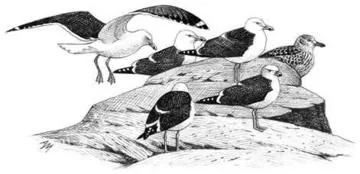
Lesser Black-backed Gulls used to be almost exclusively summer visitors to Britain. Before 1928 Boyd had never seen one in the four winter months, but from then to 1950 he recorded them regularly in November, in December in 14 years, in January in 13 years and in February in ten – sometimes on the ice of the frozen Marbury Mere (Boyd 1951). They have probably adapted to wintering here by being, or becoming, mostly an inland gull, and the sheltered Mersey estuary is unusual in being one of the few places in Britain where substantial numbers have been present on the coast. In the January 1983 national survey, only 13,726 Lesser Black-backed Gulls were recorded at coastal sites, but 10,190 of these were on the Mersey, by far their largest roost in the UK (BTO Winter Atlas). The species’ rise in wintering numbers is shown by the decennial January surveys of gulls roosting inland. In England there were 165 in 1953, 6,960 in 1963, 15,823 in 1973, 36,154 in 1983, 27,230 in 1993 (Burton et al 2003) with a preliminary figure of 43,879 in the 2003/ 04 survey. The Mersey no longer has any special importance, holding only 294 birds on the 2003/ 04 survey date (17 January 2004), with 250 on the same date inland in south Cheshire at Combermere (SJ54X).
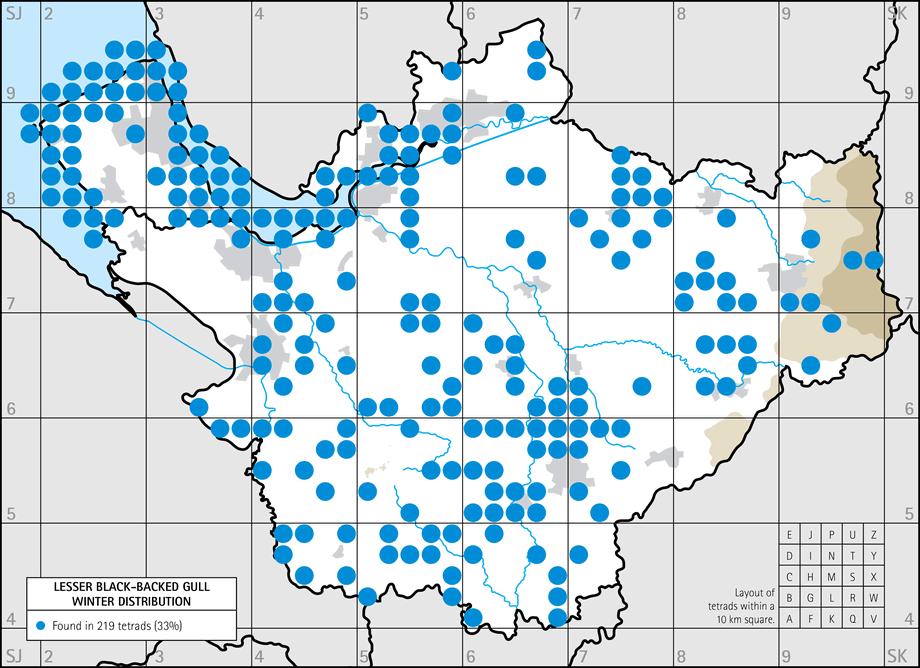
The map shows that Lesser Black-backed Gulls spread out widely across the county. They require a large waterbody for a safe overnight roost but otherwise do not need water and more than half (122 out of 218 (56%)) of the tetrads in which they were reported did not have a freshwater or marine (G or H) habitat code. In their feeding and roosting areas, all of the gulls tend to form mixed flocks, but this Atlas shows that this is the large gull most likely to be found on grassland, comprising 74% of their farmland records compared to 65% for Herring Gull. They especially favour slurried fields and flooded stubble, and take invertebrates, seeds and roots. Landfill sites attract some for an easy meal. Many sightings of Lesser Black-backed Gulls are of odd birds or just small groups, with half of all the submitted counts being of five birds or fewer. There were 33 flocks of 100 or more birds, with the maximum of 3,500 on Hoylake shore. Other four-figure flocks were at Arpley tip, loafing on the nearby Mersey (SJ58T/ Y), on Maw Green tip (SJ75E) and the Mersey estuary night-time roost (SJ48J/ P).
The Lesser Black-backed Gulls wintering in the county are of the race graellsii, which breeds in Britain and Iceland and winters along the Atlantic seaboard southward from Britain to west Africa, with most in Iberia. Each winter a few individuals are seen of the darker intermedius race which breed in southern Scandinavia. There has only been one proven record of the nominate race fuscus in England, in 1961. They breed in northern Fennoscandia and migrate south-eastwards to winter in eastern Africa.
Atlas account sponsored by Dave Murray