
Sandbach Flashes: birds and wildlife

About the Atlas
During the three breeding seasons 2004–06 and three winters 2004/05–2006/07, Cheshire and Wirral Ornithological Society (CAWOS) organised more than 350 volunteers to survey all of the county, trying to find every species of bird that was breeding or wintering
Lesser Spotted Woodpecker Dendrocopos minor
Breeding
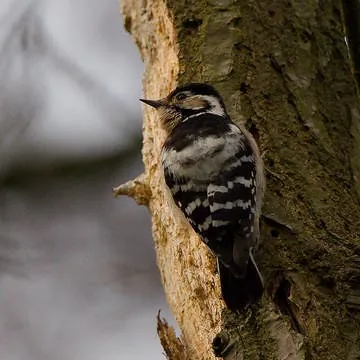
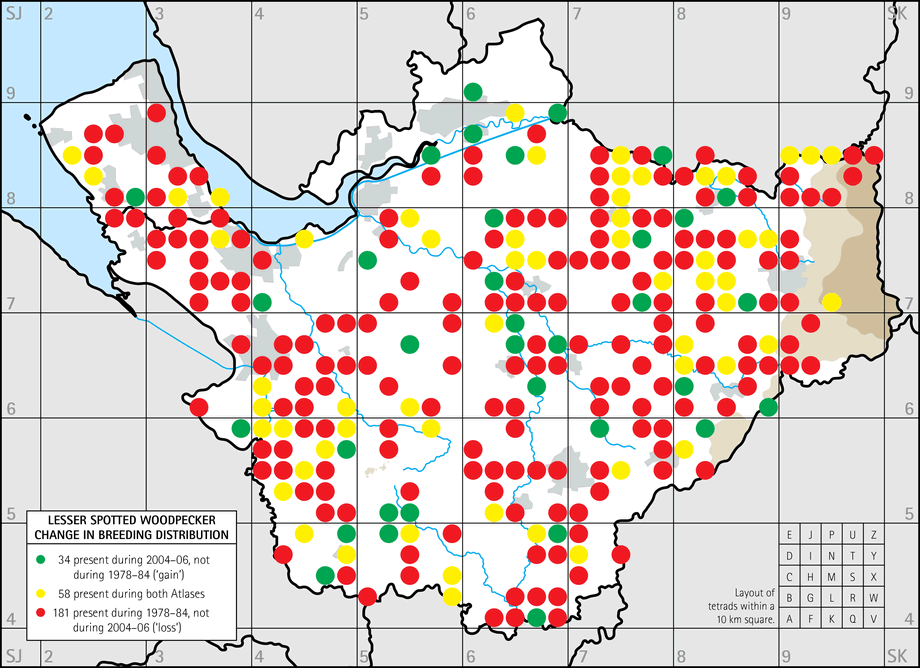
Lesser Spotted Woodpeckers are in trouble. In the last quarter century, across Europe, they have declined more than any other woodland bird. The British population fell by three-quarters from 1984 to 2000, placing them on the Red List, but then they became too scarce to monitor. It is no surprise to see this Atlas ‘change’ map dominated by red dots, with 58 tetrads occupied both in our First Atlas and now, 34 newly occupied since then and 181 holding them twenty years ago but not now. They have been lost from much of the county, with no obvious pattern; previous strongholds north and east of Chester, in SJ37 and SJ46, are deserted now. This is quite a secretive species and might have been under-recorded, but it is likely that the county population now is in the range 50-75 pairs, way down on the estimate twenty years ago of 150 to 250 pairs.
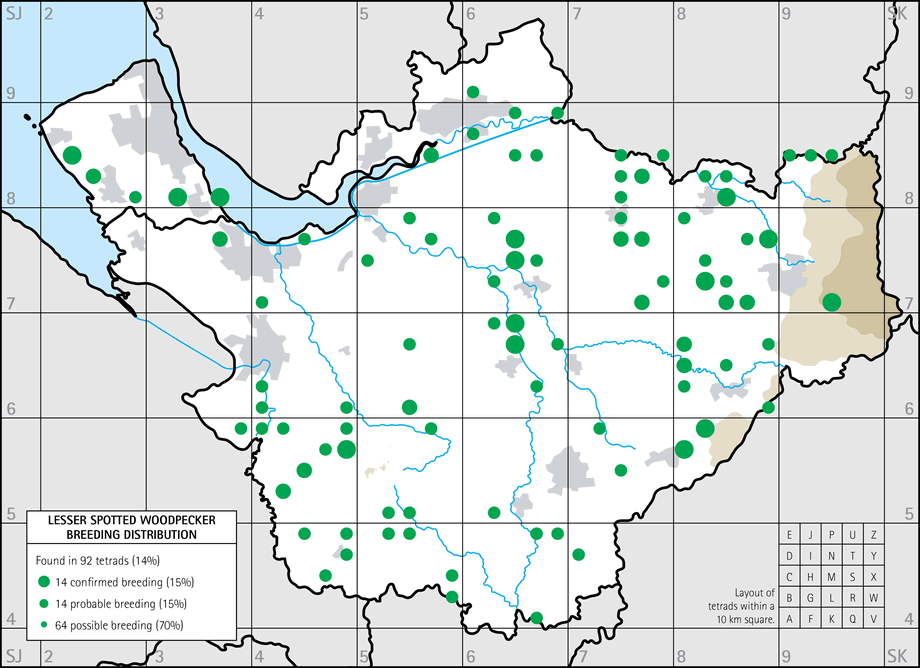
The reasons for the decline are not well established but include competition with, and predation by, the burgeoning numbers of Great Spotted Woodpeckers, and reductions in small-diameter dead wood suitable for foraging. They occupy large home ranges and perhaps landscape-scale changes in woodland, such as loss of mature broadleaved woodland, losses of non-woodland trees such as elms, and woodland fragmentation, may also be important (Fuller et al. 2005). Here in Cheshire and Wirral, Lesser Spotted Woodpecker is close to the edge of its breeding range, which may be contracting. In the atlases of nearby counties it was found in 25% of tetrads in Shropshire (1985-1990), 14% of tetrads in this Atlas, 6% in Lancashire and North Merseyside (1997-2000) and 0.4% in Cumbria (1997-2001).
The submitted habitat codes for this Atlas showed 74% of records in woodland, mostly broadleaved or mixed woodland, with none in coniferous but a significant figure of 11% in waterlogged (carr) woodland – the third highest proportion of any species, behind Willow Tit and Woodcock. Just 3% of records were from scrub, with 12% farmland and 11% human sites. Although they share some habitat characteristics with Willow Tit, the species’ distributions in the county are very different.
In the breeding season they are highly territorial, defending a large area of 50-100 ha and individual birds usually show life-long fidelity to the territory where they first settled. Both sexes participate in the parental duties, with males often taking the larger share. Lesser Spotted Woodpeckers nest late, starting just after oak buds burst, probably because in the breeding season they switch from their normal diet of insect larvae living in dead wood and eat, and feed their chicks on, almost exclusively surface-living insects, especially caterpillars, picked from the foliage and bark of trees (Wiktander et al 2001a).
Proof of breeding was obtained in only 14 tetrads, two from fieldworkers seeing adults carrying food for their young, seven from observations of recently fledged young, and five where nests were found. Unfortunately, no-one recorded the species or condition of any of the nesting trees. Especially in view of their major decline, this would be a worthwhile addition to our knowledge, and it would be good for CAWOS to solicit such information with records of Lesser Spotted Woodpeckers. This species depends on dead trees much more than the other two woodpeckers do, with three-quarters of nests in dead wood (Glue & Boswell 1994).
From work in Sweden, the recommendation for conservation of Lesser Spotted Woodpeckers is to have a minimum of 40 ha of woodland dominated by deciduous trees, which may be fragmented over a maximum of 200 ha (half a tetrad) (Wiktander et al 2001b). Few parts of the county approach that prescription.
Atlas account sponsored by Peter Day
Winter
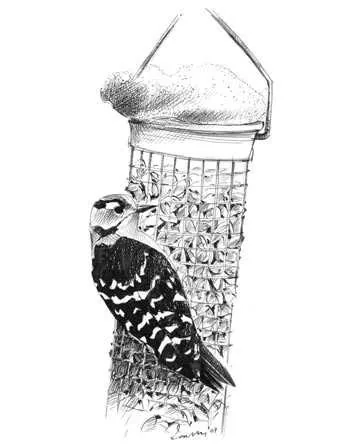
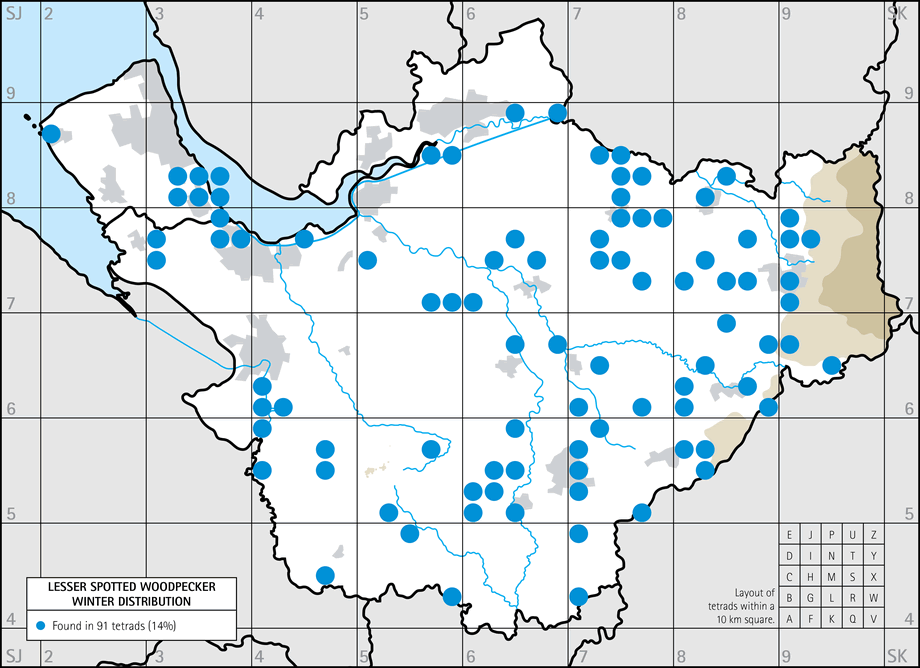
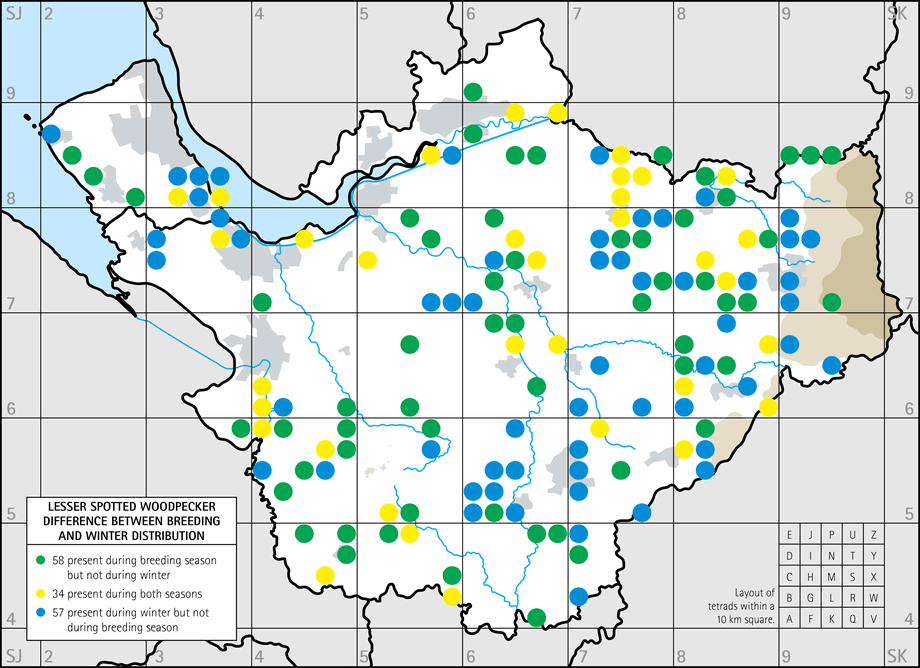
This Atlas showed that Lesser Spotted Woodpeckers occupied the same number of tetrads in the two seasons but with only 34 having birds present in both, with 58 having breeding season presence only and 57 holding a bird only in winter. Some of this could be the effect of visibility; this is an inconspicuous species, spending much of its time near the treetops and requiring some luck for observers to detect it. Previous authors make the same point, Hardy (1941) describing it as widely distributed but often overlooked, and Bell (1962) echoing those comments and adding that the species had been scarcer in the north but ‘now the chances of finding a bird in the north or east appear to be as great as in the south or west of the county’. The winter map shows that Lesser Spotted Woodpeckers are widely scattered, with a big gap in the centre of Cheshire and in the eastern hills, but appearing to have small concentrations in south Wirral, around Knutsford, and Crewe and Nantwich.
Based on studies in Sweden, Lesser Spotted Woodpeckers are solitary outside the breeding season, and these Atlas observations bear that out, with 108 of the 112 winter records of single birds. Just four records were of two together, at least one of which was identified as a pair in February, probably preparing for the forthcoming breeding attempt. Birds roam about a very large home-range, centred on their breeding territory and probably covering several hundreds of hectares, more than one tetrad (Wiktander et al 2001b).
In winter, the submitted habitat codes showed most (63%) records in woodland, but with a reduction from the breeding season and a shift to farmland (20%) and human sites (14%). There were noticeably fewer records from carr woodland, just four compared to 11 in the breeding season, and with fewer in scrub as well, hinting that some birds quit these areas for the winter. An alternative suggestion, that observers did not visit these rather unwelcoming habitats as often in winter, does not hold good: for all species there were 465 records from the three categories of waterlogged woodland (A4, A5 and A6) in the breeding season and 411 in winter, not significantly different.
Their winter food is mainly longhorn beetles, adults and larvae, found beneath the bark of dead wood, and this species feeds during winter mainly on thin dead branches. In general, the volume of dead wood in British woods is increasing as many areas are left relatively unmanaged, but Lesser Spotted Woodpeckers do not seem to be benefiting. A possible explanation is that the types of dead wood that are increasing in these woods (large dead limbs and dead wood on the ground) are not favoured foraging habitats for this species. It is also possible, but not proven, that they are now less able to coexist with the high numbers of Great Spotted Woodpeckers principally because of nest-site interference and competition (Smith 2007).
Atlas account sponsored by Peter Day