
Sandbach Flashes: birds and wildlife
About the Atlas
During the three breeding seasons 2004–06 and three winters 2004/05–2006/07, Cheshire and Wirral Ornithological Society (CAWOS) organised more than 350 volunteers to survey all of the county, trying to find every species of bird that was breeding or wintering
Linnet Carduelis cannabina
Breeding
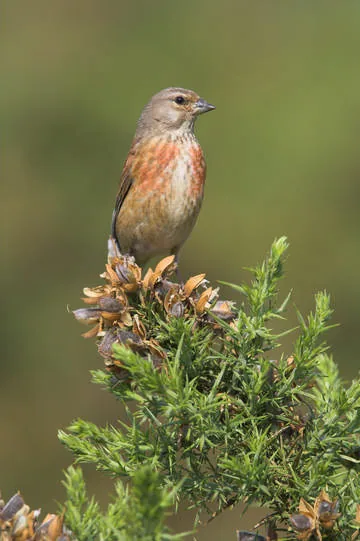
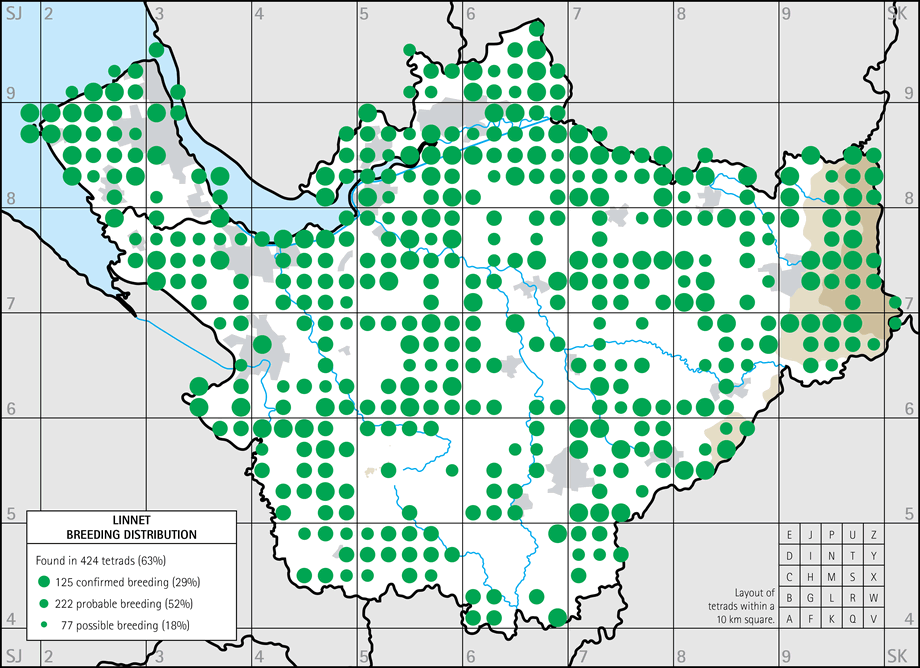
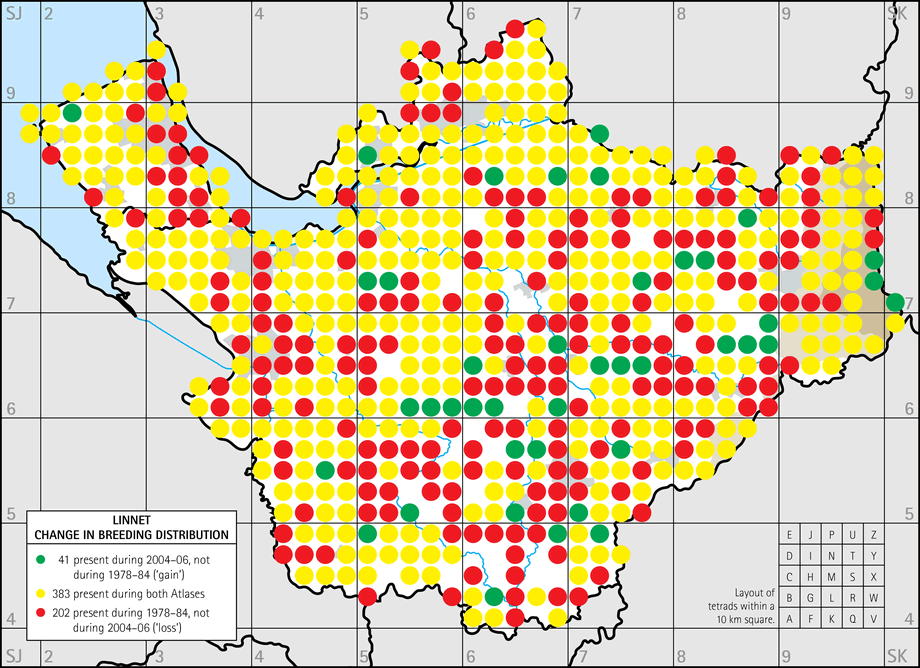
This survey shows that breeding season Linnets were recorded in 163 fewer tetrads than during our First Atlas. There are some areas where it is still almost ubiquitous, notably the western half of Wirral (and this is one of the few breeding species able to eke out an existence on Hilbre) and a broad swathe from Stanlow to Warrington. The most concentrated losses, evident from the ‘change’ map, are in the most intensely agricultural areas in the south of the county. Linnets have no problem breeding in urban or industrial sites, provided that there are some suitable weedy areas.
Linnet was one of the first species to suffer from changed agricultural practice from the 1960s onwards, perhaps because their favoured foods, small weed seeds, were among the earliest to be hit by modern herbicides. The national breeding population was already dropping when our First Atlas started in 1978, and fell by almost 40% during the seven years of that survey (1978-84) but the population has largely stabilised since then, with the decline arrested as some birds learned to feed on oilseed rape as the seeds ripened during the second half of their breeding season (Moorcroft et al 2006). Their national population index was some 20% lower in 2004 than in 1984. Although the Linnet population has dropped, their distribution has not noticeably contracted at the 10-km square scale, indicating that they remain widespread but at lower density (Fuller et al 1995). Despite their decline, Linnets still make it into the top twenty most abundant passerines in Cheshire and Wirral. The BTO BBS analysis gives an estimate with wide confidence limits for the breeding population of the county in 2004-05: 17,830 birds (9,340-26,330), corresponding to an average of about 52 birds per tetrad with confirmed or probable breeding, or 43 birds per tetrad in which the species was recorded.
Adult birds feed themselves on small weed seeds, and regurgitate the contents of their crops for their chicks. Dandelions are the dominant food for chicks of early broods, with rape assuming key importance from mid-June onwards. Although there is far less rape grown in Cheshire and Wirral than in the arable east of England, Linnets will fly long distances from their nest, foraging flocks moving as far as 3 km to find suitable food. Their long breeding season, from April to the end of August, allows some birds to raise as many as three broods. They nest semi-colonially, especially in gorse, hawthorn or other dense scrub, and each pair defends a small area around the nest, but they do not keep to a feeding territory and breeding birds gather together to feed in flocks. More than two-thirds (68%) of the habitat codes were farmland, mostly grassland, with 3% semi-natural grassland, 17% scrub and 7% human sites.
Atlas account sponsored by Hilbre Observatory and Ringing Station
Winter
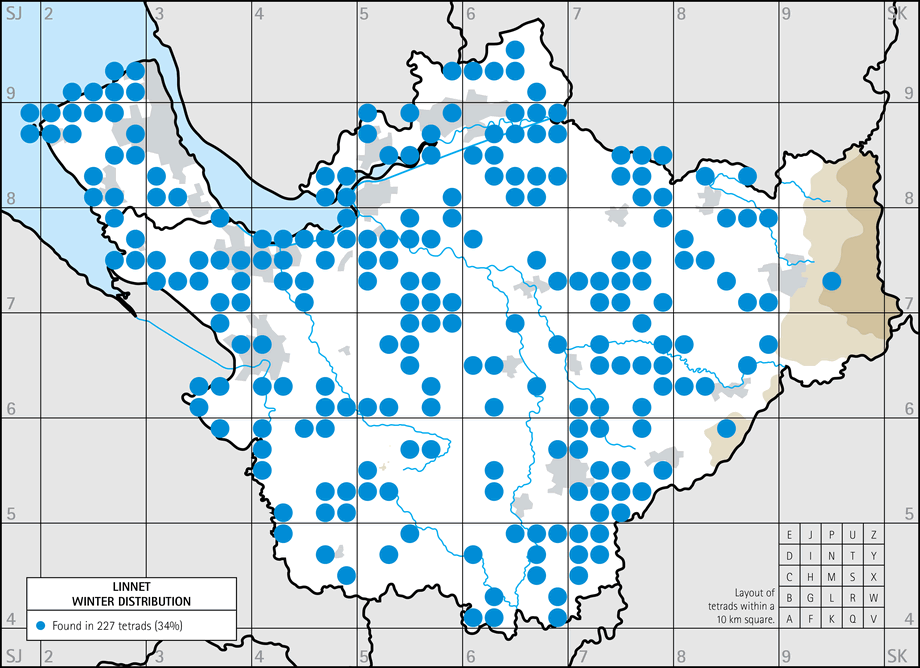
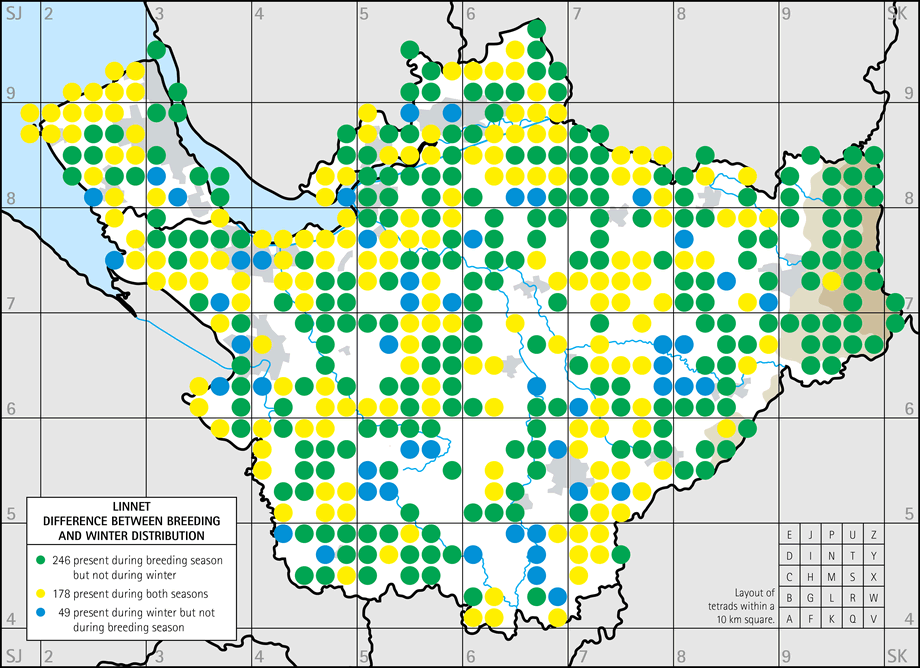
The winter map shows a clear contraction in range in the east of the county compared to their breeding distribution, with Linnets found in only about half of the number of tetrads, including only two squares above 150m in altitude. A marked absence from all areas of higher ground was noted in the BTO Winter Atlas, and it is not clear if the birds that breed there undertake altitudinal migration or if it is these birds that preferentially move out of Britain, because Linnets are classic partial migrants. Some British birds remain in winter – apparently an increasing proportion as our winter weather ameliorates – while others move south to winter in a narrow band along the west coast of France, or in Spain (Migration Atlas).
Linnets congregate in seed-rich habitats including, during this survey, stubble fields, including weedy maize stubble, game cover, set-aside farmland, derelict industrial land and saltmarshes. The submitted habitat codes show an even greater proportion on farmland (77%) than in the breeding season, with the proportion on stubble (14%) higher than most other species. The main other habitats used were scrub (9%), human sites (5%) and semi-natural grassland (4%).
They are gregarious birds at all times of year but especially gather into some large flocks in winter. Eleven tetrads held a flock of 100 or more Linnets, with the largest being 420 birds noted by Colin Lythgoe in SJ74D, feeding in a seeding area of game cover, which conveniently flew on to overhead wires to be counted! They are often found in the same areas as other seed-eaters but seem to keep separate: if disturbed, other species tend to head for the nearest cover whilst the Linnets fly up and circle before descending into the feeding area again. At night, they usually assemble in communal roosts, often in gorse, which also can be large. Just five were reported during this survey, containing up to 150 birds.
None of the previous Cheshire ornithological writers has noted the movement of Linnets away from the hills. Coward (1910) wrote that ‘in winter the Linnet is generally distributed, consorting with Chaffinches in the hedgerows and pastures’. Bell (1962) said that ‘its present status has altered little since the early part of the century’, and added that hard weather movements across the Dee have been seen in January and February. With the warming climate, the annual county bird reports have not recorded a frost-driven movement of Linnets since the early 1980s.
Atlas account sponsored by Hilbre Observatory and Ringing Station