
Sandbach Flashes: birds and wildlife

About the Atlas
During the three breeding seasons 2004–06 and three winters 2004/05–2006/07, Cheshire and Wirral Ornithological Society (CAWOS) organised more than 350 volunteers to survey all of the county, trying to find every species of bird that was breeding or wintering
Little Grebe Tachybaptus ruficollis
Breeding
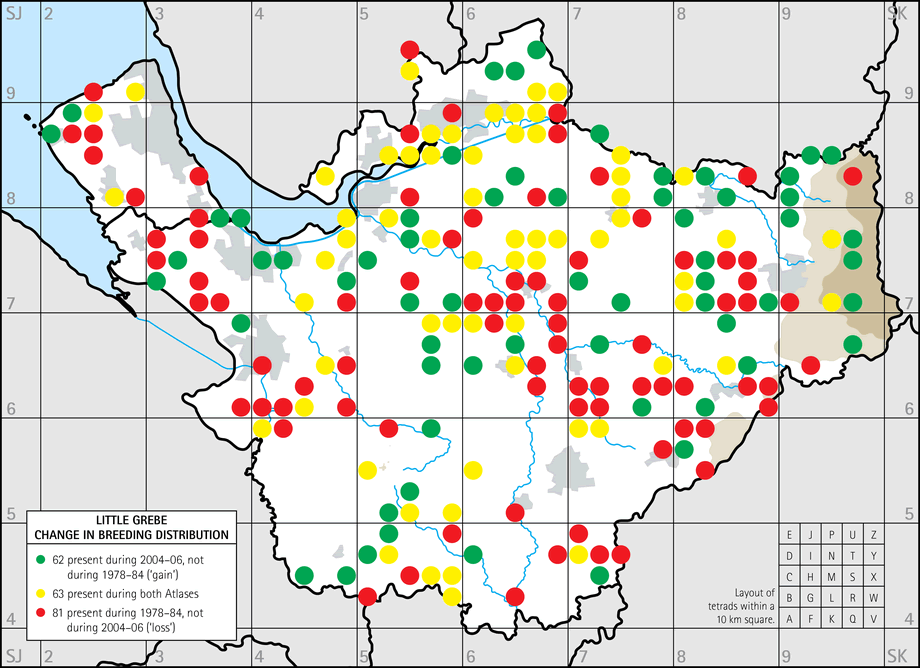
The decline in breeding Little Grebes was one of the surprises of this survey, as it had not been noticed or commented upon previously. Compared to the First Atlas, the species has been lost from many of their former breeding sites in central and south Wirral, south of Chester and the region from Northwich to Congleton. There have been gains in scattered sites across the county, and a noticeable increase in occupied tetrads in the eastern hills; in some areas there appear to have been minor redistributions from one tetrad to another, but the net effect is a loss of 19 tetrads from twenty years ago.
There could be several reasons for the decline in breeding records of Little Grebe. Their food – mainly aquatic invertebrates, especially larvae, and small fish – puts them in competition with the larger fish favoured by anglers, so ponds that have been taken over by fishermen are often inimical to this species, over-stocked with fish and denuded of marginal vegetation. Also, their favoured smaller waters are perhaps those most affected by unsympathetic water use – river engineering, pollution, agricultural run-off and over-abstraction. Brown & Grice (2005) note that the future of the Little Grebe is inexorably linked to the appropriate management of our lowland wetlands and that we should make greater efforts to monitor trends in breeding numbers: this comment should surely apply to Cheshire and Wirral.
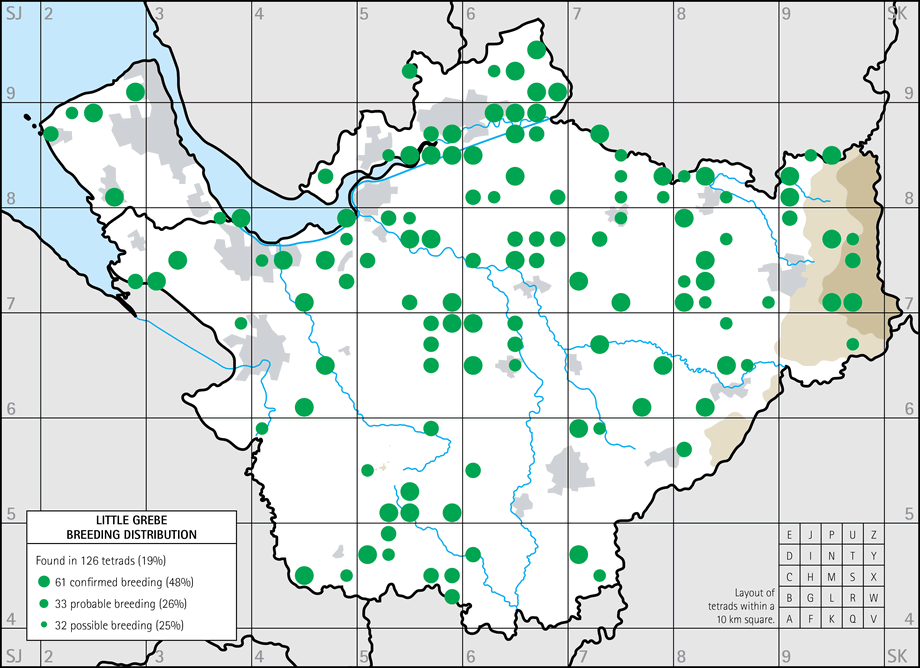
As the Little Grebe has declined, Great Crested Grebes have spread, but there does not seem to be direct competition between them. Bell (1962) said that Dabchicks are on many waters which are too small for Great Crested Grebes but Boyd (1951) had ‘never seen a nest on the little marl-pits as are occupied by Moorhens’. In this survey, 66 tetrads had records of Little Grebe and not Great Crested; 64 tetrads had records of Great Crested Grebe and not Little; and 60 tetrads had records of both species. The submitted habitat codes show clearly the Little Grebe’s bias towards smaller standing waters: 12 pond; 50 small water-body; 48 lake/ unlined reservoir; 4 lined reservoir; 14 sand pit, etc; and 5 on linear watercourses.
Little Grebes are secretive, but their far-carrying trilling ‘song’ – a high-pitched whinnying – readily betrays their presence. It seems that some observers were not familiar with the birds’ trilling calls, however, so perhaps some birds were missed, and a disappointingly high proportion of records was of birds seen in suitable habitat only. Birds return to their breeding areas in the New Year. Little Grebes have a protracted breeding season (February to September) although most eggs are laid from late April to late June (Moss & Moss 1993). The nest, on a floating platform of vegetation concealed in emergent vegetation, is vulnerable to fluctuations in water level, either flooding following heavy rain, or being left stranded in drought. Once the chicks have hatched the birds tend to become more visible, and 55 out of the 61 two-letter codes were sightings of adults with young. The striped chicks are often carried on the adults’ backs, although less frequently than in the larger grebes, and some parents build brood platforms for their young.
Nationally, the species has declined rapidly on linear waterways but that wider populations (including birds on small still waters) are healthy. In Cheshire and Wirral, some tetrads hold more than one pair and the county population may lie in the range 150-200 pairs. With the large number of waters in the county, Cheshire would perhaps be expected to hold an even larger population of this species. A thorough survey of breeding numbers would be useful.
Atlas account sponsored by Joe O'Hanlon
Winter
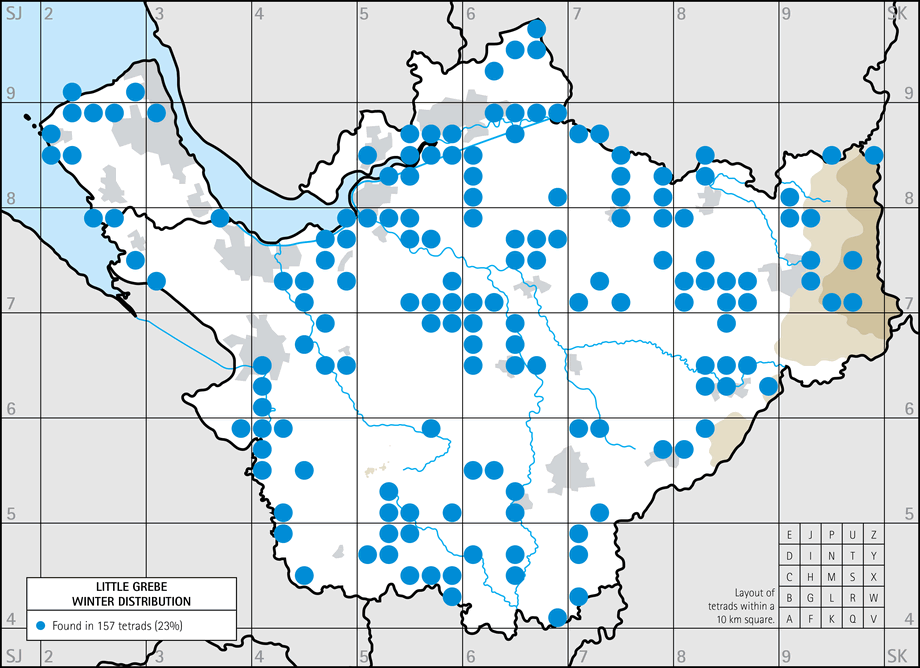
There is a clear shift in habitat and distribution of this species in winter. More than a century ago, Coward & Oldham (1900) noted that ‘The Little Grebe is widely distributed throughout the Cheshire lowlands in the breeding season, and in winter is often seen on waters where it does not nest. At this latter season, even when the ponds and meres are not frozen, it occurs on swift-flowing streams and rivers.’ This summary holds good today, and is well demonstrated by the habitat analysis. In the breeding season, there were 12 records on ponds and 50 on small waterbodies, 66 on lakes, meres and reservoirs with just five on rivers and canals; in winter there is some withdrawal from the smallest waters, with 6 on ponds and 43 using small waterbodies, with a major increase to 35 on linear watercourses, 23 on streams and rivers and 12 on canals. As Coward commented, there was no freezing weather to force the birds to move.
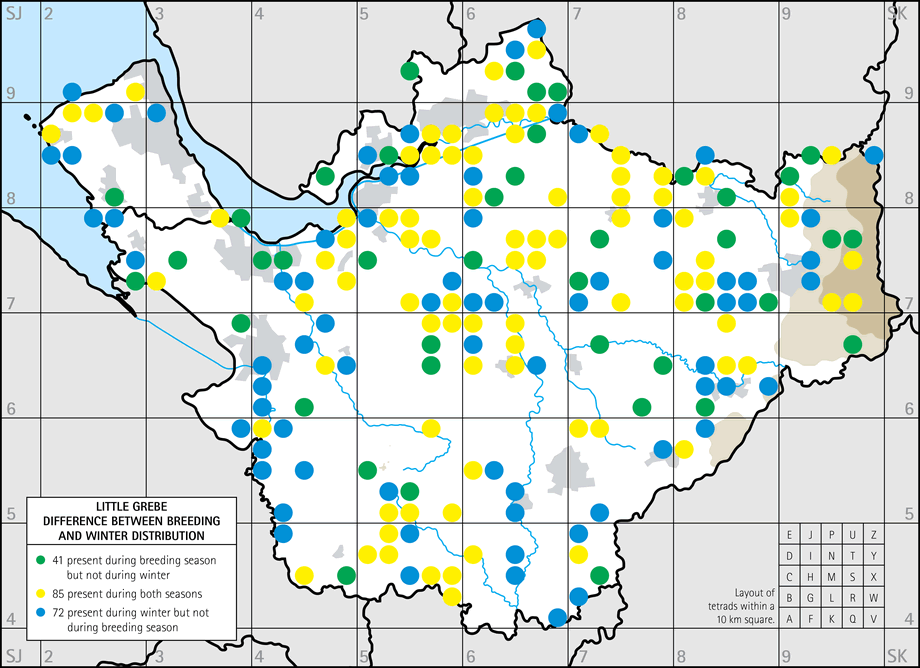
The winter map shows birds present in 72 tetrads that were empty in the breeding season, with an obvious increase especially on the Dee and Weaver, but they were recorded in only two estuarine tetrads: contrary to the suggestions from Vinicombe (1982) that birds breeding inland disperse to the coasts, there is no evidence for this in Cheshire and Wirral (or in the Migration Atlas). 85 tetrads were occupied in both seasons, with their early return to the breeding areas doubtless accounting for some of the ‘winter’ records, such as a pair trilling on Trentabank Reservoir (SJ97Q) on 29 January 2005. The 41 tetrads with breeding season presence that were unoccupied in winter were scattered across the county with no obvious pattern.
Anderson (1993) noted a decline in the wintering population of Little Grebes on the River Weaver in Nantwich, from figures of 12-31 in January to mid-March 1986 to counts of 4-6 in the same period of 1993. It was difficult to ascribe reasons for this, but the decline paralleled the arrival of Mink and the loss of Water Voles, although numbers of Moorhen and Mallard in the area were not affected. Up to 1986, double figure winter counts were recorded in CBRs from at least six sites, but since that year, no site other than the Weaver Bend had reported a double-figure count. This suggests a long-term and widespread drop in numbers. During this Atlas survey most counts were of just two birds and only three tetrads registered flocks larger than eight Little Grebes: 30 were counted at Frodsham Marsh (SJ57E) by Peter Twist in 2005/ 06, 22 at the north Wirral clay pits (SJ28P) were logged by Jeremy Bradshaw in 2004/ 05, and a maximum of 12 was present at Doddington Pool (SJ74D) in two winters.
Little Grebes are seldom seen on migration, and few are ringed, so the extent of immigration from the continent is unknown, but there are two foreign-ringed birds in winter elsewhere in Britain, from Denmark and Latvia. The maximum total WeBS counts account for only about one quarter of the supposed British and Irish breeding population, and many wintering birds must be on small waters and rivers not covered by WeBS.
Atlas account sponsored by Joe O'Hanlon