
Sandbach Flashes: birds and wildlife
About the Atlas
During the three breeding seasons 2004–06 and three winters 2004/05–2006/07, Cheshire and Wirral Ornithological Society (CAWOS) organised more than 350 volunteers to survey all of the county, trying to find every species of bird that was breeding or wintering
Little Owl Athene noctua
Breeding
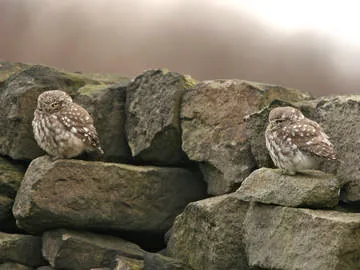
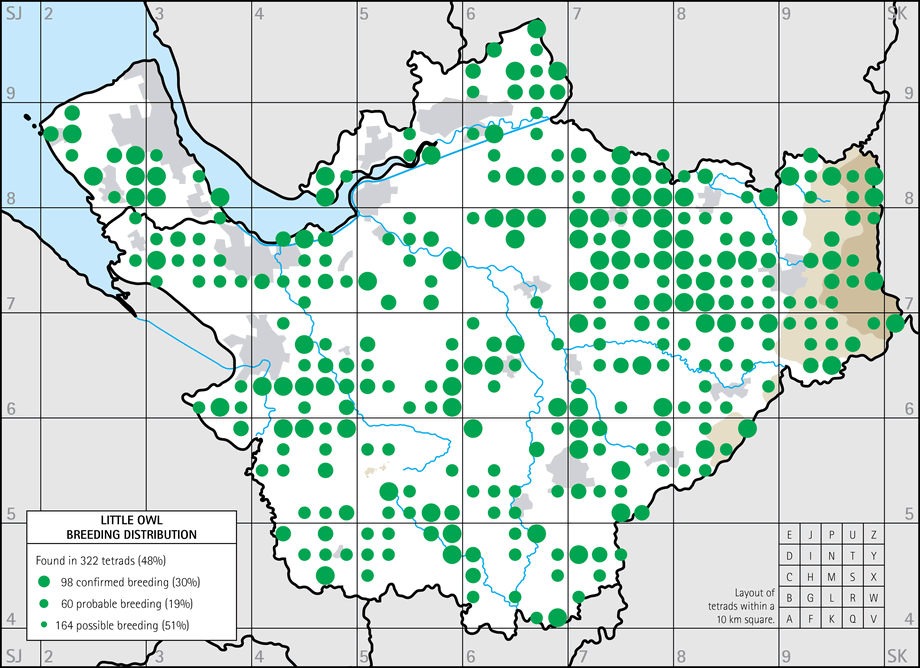
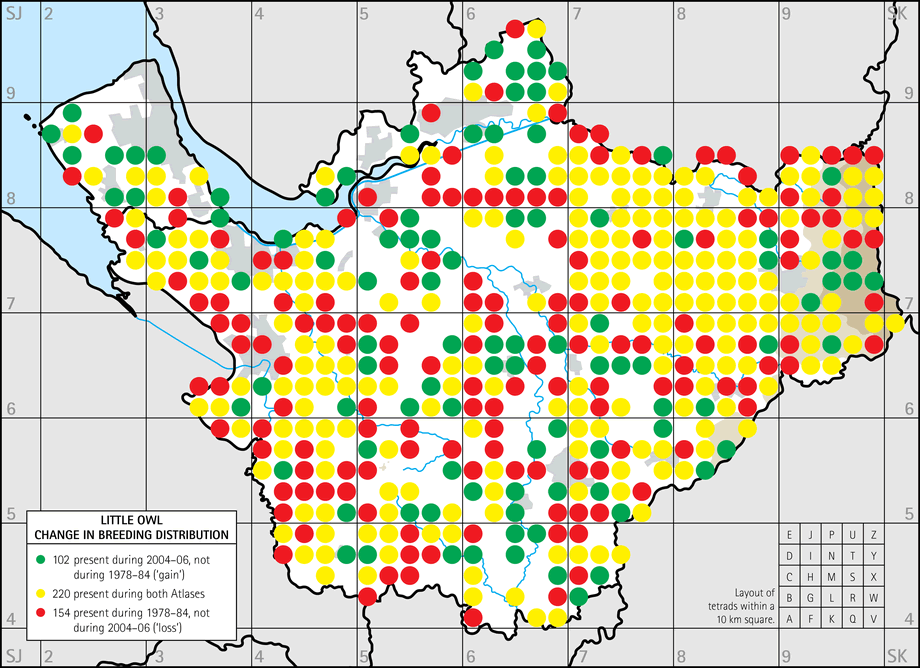
The Atlas map confirms that Little Owls’ stronghold is the north-east of the county, although in the last twenty years they have disappeared from most of the tetrads on the fringe of Greater Manchester. The species has consolidated its position on the Wirral, in the open areas north of Warrington and in the hills east of Macclesfield. Altitude appears to be no bar to them, and Little Owls are found from the lowest to the highest points of the county. Their avoidance of the major urban areas shows up well on the map, with the largest gaps in its distribution in the east Wirral conurbation, Chester, Runcorn/ Widnes/ Warrington and Northwich. They are at the bottom of the pecking order amongst raptors, and particularly avoid areas with Tawny Owls if possible, although this is not obvious at the tetrad scale of the Atlas maps. Two observers reported interaction with Kestrels, in one instance the owls being evicted from their chosen nest-hole.
The male Little Owl begins to mark its territory from the beginning of February, and their laying season spans mid-March to mid-June, with a mean start date of the end of April. Most clutches are three or four eggs, although from one to seven have been recorded. The female sits for about four weeks, incubation usually starting with the first egg and leading to asynchronous hatching. The owlets leave the nest hole after about 30 to 35 days and stay nearby for a week or more until they can fly reasonably strongly. Little Owls are normally most active around dawn and at dusk, and will also hunt by day, especially when chicks have to be fed. They tend to hunt in areas without high vegetation, either from conspicuous perches or on the ground. The main food is large insects, especially beetles, along with small rodents. They also take birds during the nesting season, most commonly Starlings, House Sparrows, Blackbirds and Song Thrushes. In Britain the Little Owl is the classic bird of parkland, scattered mature trees in an open landscape. 60% of the habitat codes submitted in this Atlas were category E (farmland), with 18% each in woodland and human sites.
Hedgerow trees are especially important for them, as are isolated trees in fields. Atlas fieldworkers reported five nests in holes in oak trees, one of them only 2 feet above ground. Other nests were in rabbit burrows and in barns, one of them noted by the farmer to be in potato boxes. Of the 98 tetrads with confirmed breeding, observers found nests in 53, with 36 records of family parties of recently fledged young and 9 of adults carrying food for their young, A further 19 tetrads furnished records of birds visiting a probable nest site (N).
The annual bird population monitoring surveys organised by the BTO show that the national population index for Little Owl peaked at the end of our First Atlas, in 1984, and has halved since then, although the results are regarded with caution and not sufficient to trigger listing on the species of conservation concern. The BTO estimate for the Little Owl breeding population of Cheshire and Wirral, based on the 2004-05 BBS data and a detection probability derived from the national dataset, is 550 birds (with wide confidence limits of 110-990). It is not known how many pairs this figure would correspond to. There is not thought to be a great sex difference in detectability (Newson et al 2008), and only 32 of the 161 Atlas possible breeding records were S, suggesting that most birds were detected by sight rather than sound. Thus, the figure of 550 individuals might refer to some 300 pairs, an average of only one pair per tetrad in which they were recorded, and a big drop from the estimate in the First Atlas of 700-1000 pairs. There is little certainty in these figures, however, and a dedicated survey of the county’s Little Owls would be welcome.
Atlas account sponsored by Astra Zeneca, Club AZ Natural History section
Winter
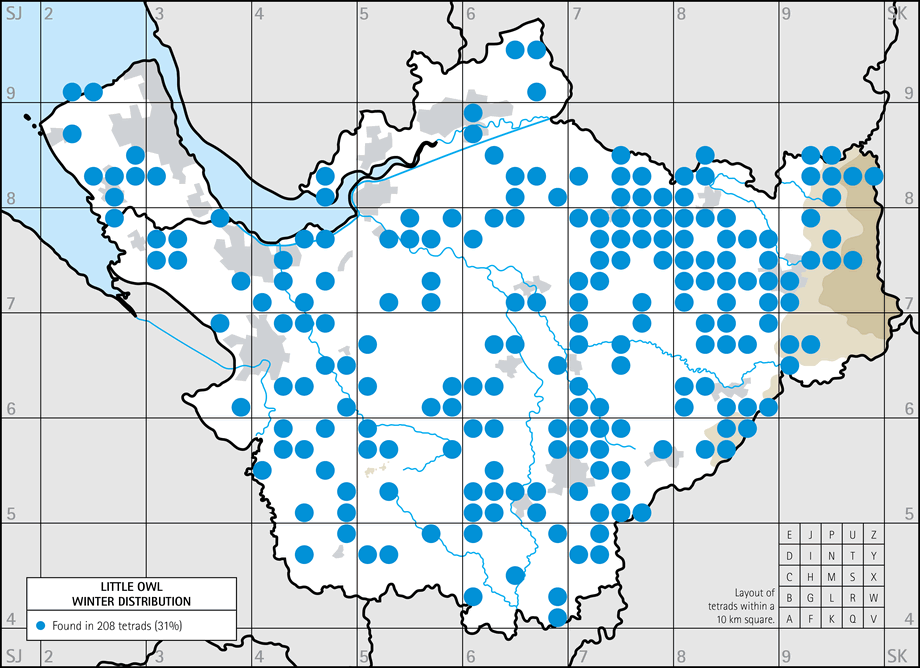
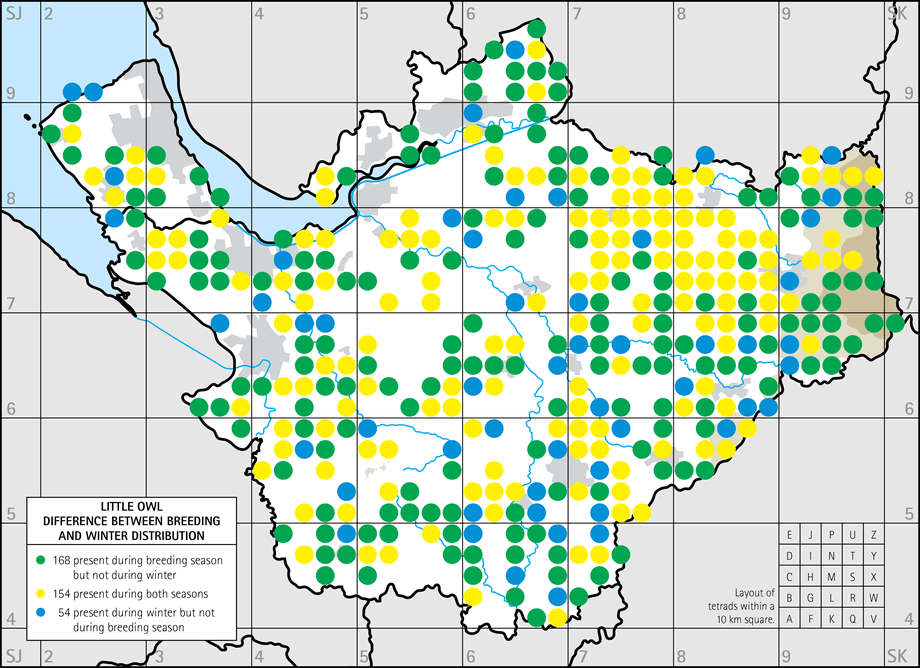
Little Owls were found in 208 tetrads in winter. In 54 of them the species had not been recorded in the breeding season, whilst there were 168 tetrads with breeding season presence where it was not found in winter. There was no consistent pattern to these seasonal changes, except perhaps for a withdrawal from the highest land. These bald statistics seem to counter the normal view that Little Owls are sedentary. Nationally, the median dispersal distances of ringed birds are 2 km for adults and 7 km for birds ringed as chicks (Migration Atlas). It could be that birds were under-recorded, but the BTO Winter Atlas regards them as being ‘more easily located in winter than the other British owls’, with birds often seen in daylight and calling frequently, especially in late winter.
The winter habitat codes show 72% of records on farmland, mostly grassland and hedgerows, with 15% human sites and 10% woodland. There were only four records each in scrub or semi-natural grassland, with none on saltmarsh. They depend on trees for winter shelter as much as for nesting, with birds less often occupying isolated buildings and cavities like rabbit burrows, perhaps accounting for their scarcity and absence in winter from many open areas including saltmarsh (BTO Winter Atlas). An inability to tolerate prolonged periods of ice and snow cover excludes them from many upland areas.
Fieldworkers submitted 140 counts of Little Owls in winter, mostly of one or two birds, but four records of three birds and three counts of four birds, in 2004/ 05 at Hockenhull Platts (SJ46S) and in 2005/ 06 near Burton (SJ37H) and near Tabley (SJ77J).
We have little indication of the Little Owl’s former status in the county. Coward and Oldham treated it with the disdain that introduced species often induce. Boyd noted their rapid colonisation of mid-Cheshire from about 1926, but did not comment on their winter distribution, and Bell (1962) added nothing beyond quoting some fifty-year-old records.
Atlas account sponsored by by Astra Zeneca, Club AZ Natural History section