
Sandbach Flashes: birds and wildlife
About the Atlas
During the three breeding seasons 2004–06 and three winters 2004/05–2006/07, Cheshire and Wirral Ornithological Society (CAWOS) organised more than 350 volunteers to survey all of the county, trying to find every species of bird that was breeding or wintering
Long-eared Owl Asio otus
Breeding
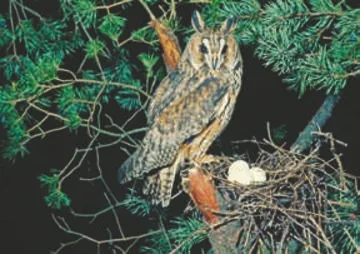
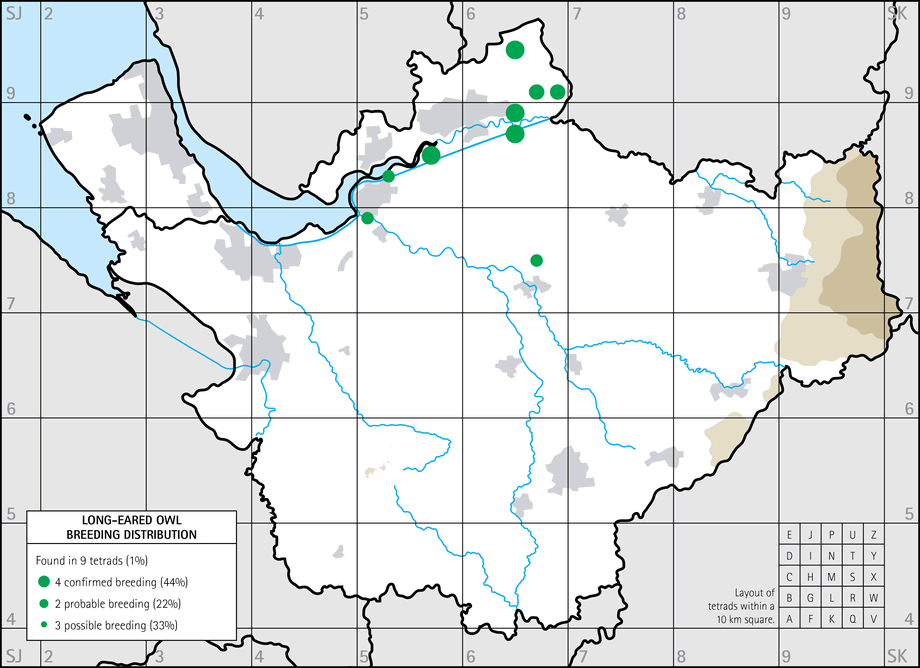
This survey confirmed that the Mersey valley is the only part of the county where this elusive species can regularly be found in the breeding season. They favour dense scrub and young woodland for nesting, with adjacent areas of rough grassland in which to feed. ‘Cheshire is blessed with few suitable habitats and most owls occur far away from natural sites. Instead, Long-eared Owls are found on lands largely created inadvertently by man, by-products of various industries and derelict areas. Many of these habitats, some of which have become rich in small mammals, are often temporary, awaiting further development - landfill, housing, mineral extraction, business parks and so on, to name a few.’ (Lees 1994).
Long-eared Owls hunt almost exclusively at night, with their main method being to quarter an area, flying silently to and fro at a height of about 1 m, and dropping onto their prey. British studies have found small mammals to make up most of the diet, headed by Field Vole, typically half of the items consumed, followed by Wood Mouse, Bank Vole, Common Shrew, Brown Rat, Pygmy Shrew and Water Vole. Odd birds take Rabbit, Grey Squirrel, House Mouse and Pipistrelle Bat. They also take roosting birds, deliberately beating the branches of a bush to disturb their prey; owls often work in pairs using this technique (Scott 1997). House Sparrows are reported to be the bird by far the most commonly taken, but the list extends to at least fifty species.
It is quite difficult to prove the presence of Long-eared Owls and the species has probably been under-recorded. Birds are strictly nocturnal, and their soft, mournful call does not carry far and is mostly given early in the year, typically during February. However, they can be faithful to an area so, once found, it is straightforward to check on them each year. By far the easiest way of finding them, and of proving breeding, is to hear the creaking calls of the young, every few minutes all night long.
Wherever they occur, Long-eared Owls are widespread but thinly distributed, as shown by the figures for occupation of adjacent counties in breeding atlases. They were found in 9 out of 670 tetrads (1.3%) in this survey, 20 out of 870 tetrads (2.3%) in Shropshire (1985-1990), 38 out of 931 (4.1%) in Lancashire and North Merseyside (1997-2000) and 12 out of 1844 (0.6%) in Cumbria (1997-2001).
All texts on the species emphasise its vulnerability to competition, even extending to direct attack, by Tawny Owls, and Long-eared Owls flourish in Ireland and the Isle of Man where Tawnies are absent. Now that Tawny Owls have declined in Cheshire, there is potential scope for expansion of Long-eared Owls, if the habitat is right. A century ago, in Coward’s day (1900), this was the commonest owl ‘in the wooded parts of the Hill Country’.
Atlas account sponsored by Steve Binney
Winter
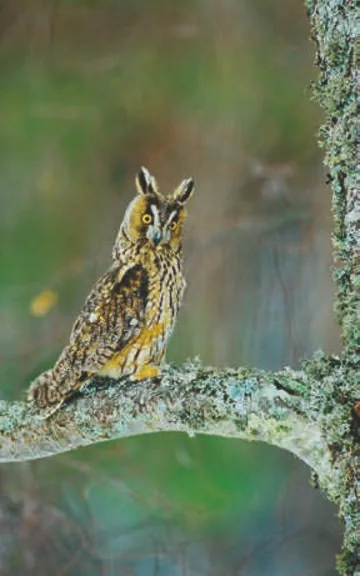
Adult Long-eared Owls do not move far from their breeding territory all year round, but immature birds will wander. Lees (1994) reported that dispersal and movements were greatly aided by water courses where owls can hunt along continuous river banks rich with small mammals, then arrive at suitable overwintering grounds or at potential breeding sites.
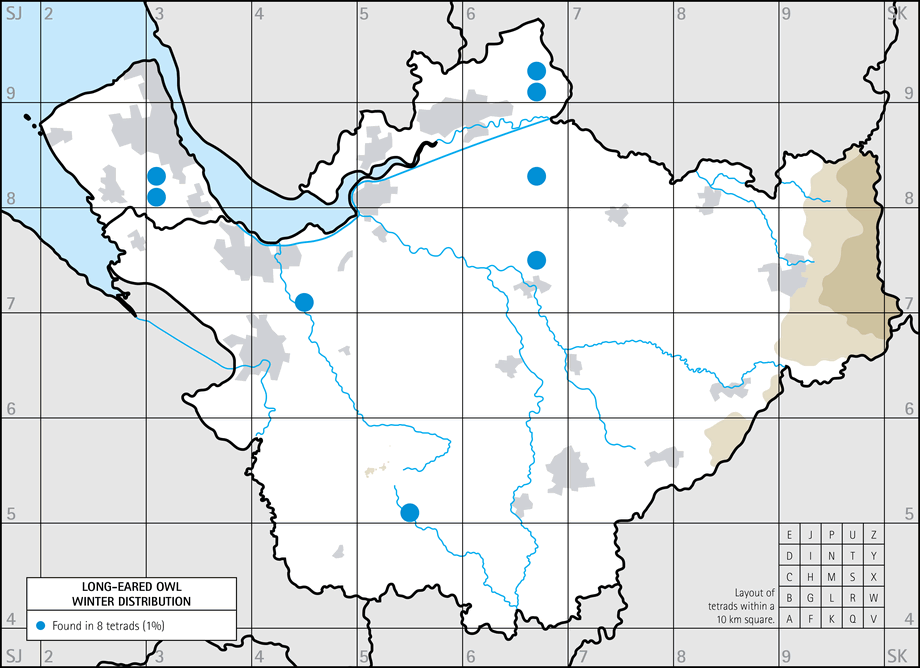
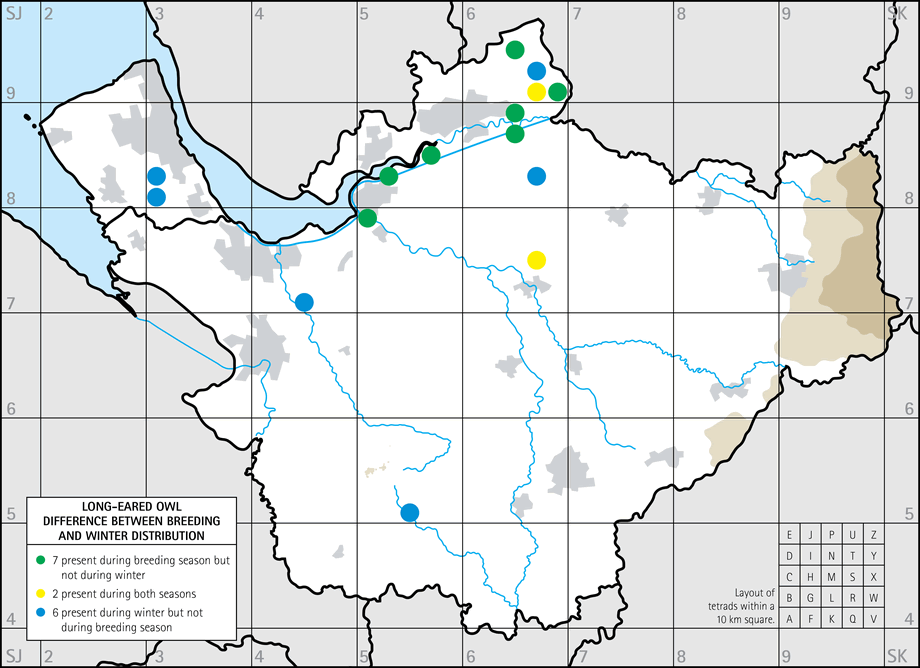
It seems surprising that only two of the tetrads with owls present in the breeding season also had a winter record, especially as adults are probably resident and re-commence breeding activity during our winter period. They have presumably been overlooked in some sites, and they certainly do little to draw attention to themselves in winter apart from their spectacular gathering at communal day-time roosts. Their feeding behaviour changes little from the breeding season, and Long-eared Owls are seldom seen hunting by day except in very hard weather. They take a similar range of prey items as in the breeding season, but tend to eat a higher proportion of birds, especially wintering thrushes and finches, probably mostly caught at their roosts.
Out of the eight tetrads on the winter map, seven did not have Long-eared Owls reported in the breeding season, and some of these are likely to have been occupied by continental birds. The British wintering population is considerably augmented by immigrants from Fennoscandia, the numbers varying from year to year according to small mammal abundance and the severity of winter weather. Three birds roosted together at Brimstage (SJ38B) in 2004/ 05, and two birds were at Neumann’s Flash (SJ67S) in 2006/ 07, but the other records were all of singles.
There is little information on wintering Long-eared Owls in the writings of the earlier Cheshire ornithologists, and the annual county bird reports have contained few records from the mid-1980s until recently. Wintering birds are found annually, in variable numbers, from sites along the Mersey valley from Frodsham Marsh to Woolston/ Risley. Odd birds are reported sporadically from scattered sites elsewhere in the county, but the only other location with a claim to regular occurrence is Neumann’s Flash, with sightings in most of the last ten winters and, in 1999/ 2000, a roost of up to nine birds.
Atlas account sponsored by Steve Binney