
Sandbach Flashes: birds and wildlife

About the Atlas
During the three breeding seasons 2004–06 and three winters 2004/05–2006/07, Cheshire and Wirral Ornithological Society (CAWOS) organised more than 350 volunteers to survey all of the county, trying to find every species of bird that was breeding or wintering
Long-tailed Tit Aegithalos caudatus
Breeding
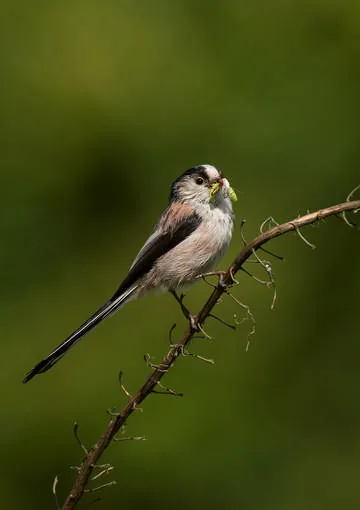
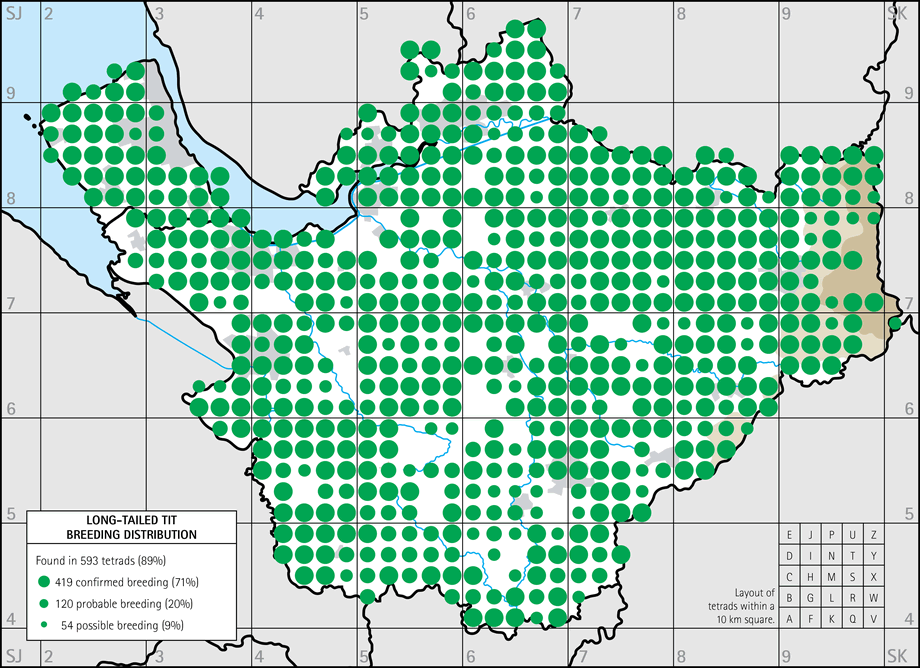
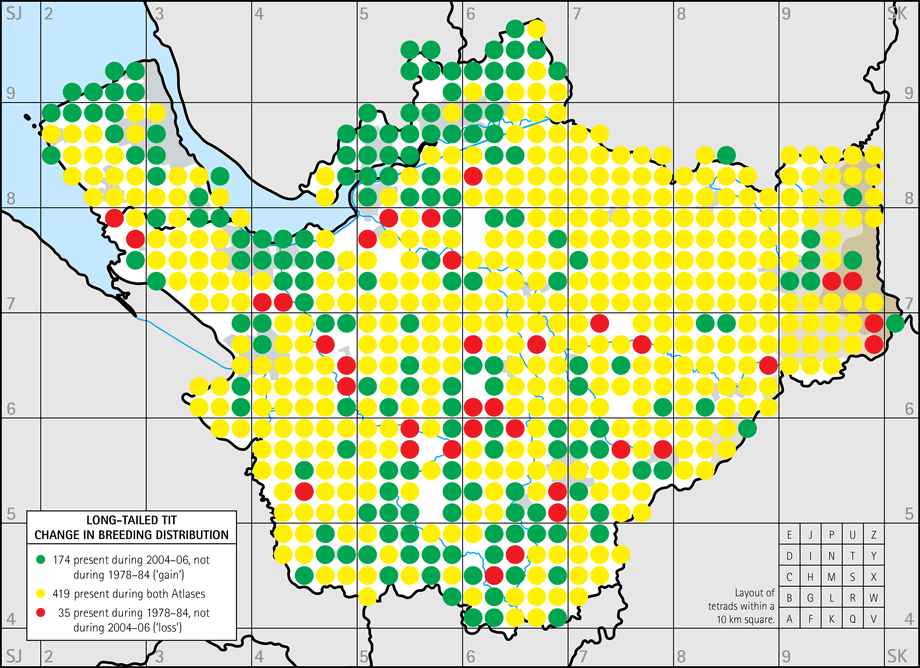
A Long-tailed Tit’s nest is a work of art, once seen, never forgotten. It may contain more than 2,000 feathers, and the outside of the nest is bound together, decorated and camouflaged with lichens. Jonathan Guest suggested, in our First Atlas, that the scarcity of Long-tailed Tits breeding in the Mersey valley, Stanlow/ Ellesmere Port area, and much of east and north Wirral was because of the polluted air and lack of lichens. Since then, reduced levels of atmospheric sulphur dioxide allowed the pioneering epiphytic lichens to move in between 1992 and 2002 (Fox & Guest 2003) and Long-tailed Tits (and Chaffinches) have also colonised the same areas. The only parts of the county from which they are now absent are some of the highest uplands, the saltmarshes and Hilbre, with other unexpected gaps around Frodsham and odd tetrads elsewhere in which the species was unaccountably missed.
This is the thirteenth most numerous breeding species in the county: the BTO BBS analysis shows that the population in 2004-05 was 37,670 birds (21,140-54,200), corresponding to an average of about 70 birds per tetrad with confirmed or probable breeding, an enormous change from the assumed underestimate in our First Atlas of up to 1,500 pairs. Cheshire and Wirral holds a disproportionately high figure of as much as 3.6% of the UK total of just over one million birds. English populations were depressed during most of the period of our First Atlas, probably by winter mortality, and the ameliorating climate of the 1990s has allowed their numbers to rise to a level more than 50% higher than twenty years ago. Presumably also in response to warmer weather, Long-tailed Tits are breeding earlier, with average first-egg dates having advanced to about 6 April, nine days earlier in just twenty years.
This is an easy species in which to prove breeding, 71% of records being two-letter codes. Long-tailed Tits are early nesters, usually building most of the nest in February and March, then leaving it for a month or so before lining and using it. The suggestion is that so many nests fall to predation, often to corvids and mustelids – only some 16% of nests yielded fledged young in one detailed study (Glen & Perrins 1988) – that, if a nest has survived intact for a month, usually whilst there are few leaves on the bushes, it is quite likely to serve the birds well for their breeding attempt. Some nests can be quite obvious, and observers in 65 tetrads found an occupied nest with eggs or chicks, with another 79 tetrads providing breeding evidence through adults carrying food or a faecal sac; but the vast majority of records (268) came from fieldworkers seeing parties of recently fledged young. A typical family party comprises the pair of adults and six juveniles, often with an extra one or two adults. If a nest is lost early enough in the season, some pairs build another, but many birds move to help feed chicks at a nearby Long-tailed Tits’ nest. Research has shown that the helpers are almost always related to the male parent, so the helpers are assisting in raising their nephews and nieces, thus having a genetic interest in ensuring the survival of those chicks. This helping is beneficial to all concerned. At nests with helpers, the chicks are more likely to fledge, the parents can reduce their feeding rate and maintain their own condition better, and the chicks are better nourished and weigh more (Glen & Perrins 1988).
Although most habitat records were woodland (298 tetrads), this is by far the most likely of the four common tits (with Coal, Blue and Great Tits) to be found in scrub (139 tetrads). The other main habitat categories were hedgerow (126) and farmland (105); the species is quite tolerant of human presence (139 tetrads in human sites).
Atlas account sponsored by Tony and Margaret Hayter
Winter
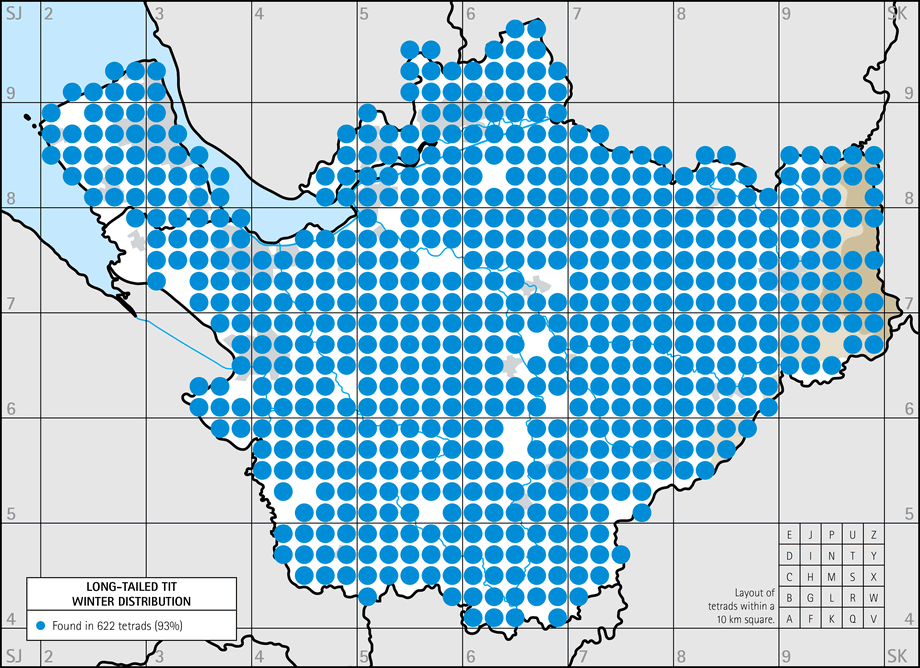
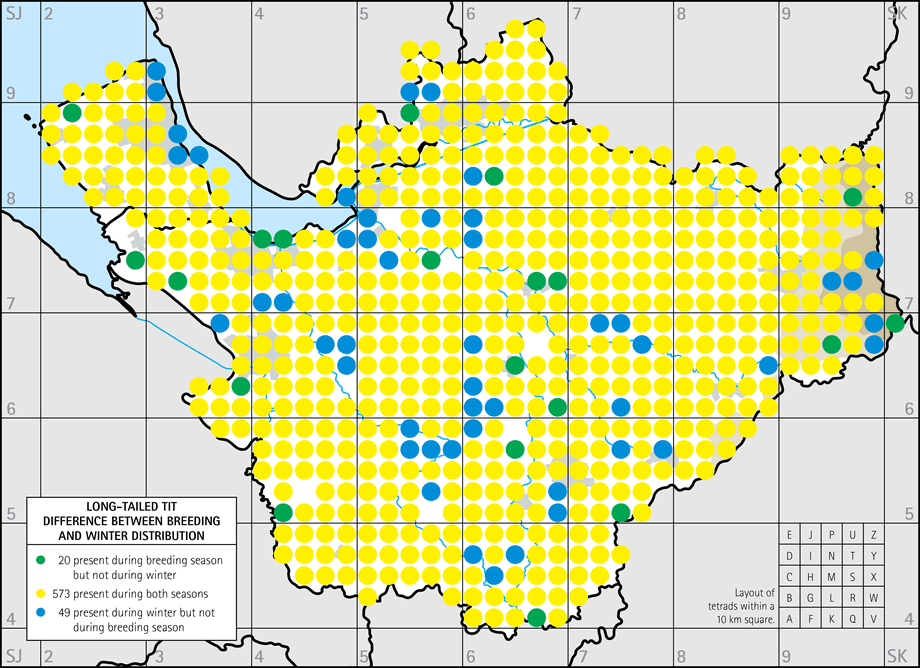
The Atlas maps show that Long-tailed Tits do move somewhat to occupy extra tetrads in winter, and become the eleventh most widespread winter species. 573 tetrads have birds in breeding and winter seasons, with 49 tetrads having birds in winter only, and 20 had breeding season presence but no winter record. The areas filled in during winter include some of the county’s most inhospitable tetrads, five in the highest hills and five in urban east Wirral. Most of our birds appear to be resident or make short distance movements, but some do undertake longer journeys, including a flock of three juveniles, ringed together in June 1981 in Warwickshire and retrapped together on 14 February 1982 at Caldy, 142 km northwest.
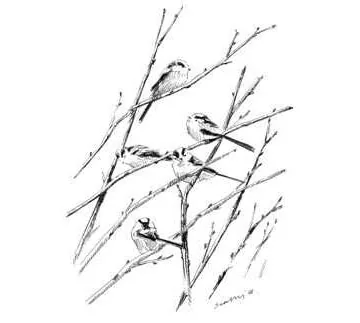
As this record suggests, these gregarious birds spend most of their lives together, seldom seeming to be more than one or two bushes apart from each other. The groups are usually family parties, comprising a brood, its parents and any extra adults that helped to raise that brood. Over the three years, 663 Atlas records included counts of flock sizes: 30% of them held more than ten birds, but only 2% were above 20 in size. The numbers in the larger flocks are difficult to estimate, but on 17 February 2001 I mist-netted two flocks totalling 55 birds going to roost in areas of bramble and rhododendron only 100 metres apart from each other.
The winter flocks are generally territorial, holding an average area of around 20 ha, with larger flocks maintaining larger territories (Glen & Perrins 1988). With such large areas, the birds in one flock do not often come into contact with those in another, but when they do, they defend their boundary vigorously. Long-tailed Tits also roost together, low down in a dense thorny bush. This is one of the few British species where the communally roosting birds actually huddle together for warmth on cold winter nights, perhaps the reason that they stay in parties throughout the winter. Nonetheless, winter survival is often difficult for small birds, and prolonged periods of hard weather have hit the species hard in the past, as Bell (1962) noted, but the mild winters of the last decade or more have allowed populations to flourish.
Analysis of the habitat codes shows significant shifts between breeding and winter seasons. Woodland is still the most favoured but far fewer birds were reported from scrub (7% of records in winter, 17% during the breeding season) and farmland (7% of records in winter, 13% during the breeding season). Instead, birds are found much more in hedges (25% of records in winter, 16% during the breeding season) and in human sites (22% of records in winter, 17% during the breeding season). These changes indicate that birds are preferentially using the warmer and less windswept areas, where they can keep themselves warmer and are more likely to find insects. Long-tailed Tits are usually insectivorous all year round, although some birds in gardens do learn to feed on peanuts and suet.
Atlas account sponsored by Tony and Margaret Hayter