
Sandbach Flashes: birds and wildlife

About the Atlas
During the three breeding seasons 2004–06 and three winters 2004/05–2006/07, Cheshire and Wirral Ornithological Society (CAWOS) organised more than 350 volunteers to survey all of the county, trying to find every species of bird that was breeding or wintering
Mallard Anas platyrhynchos
Breeding
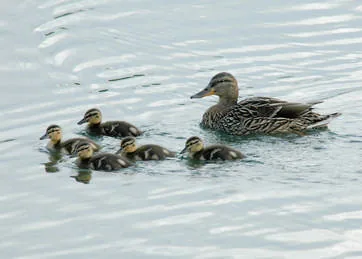
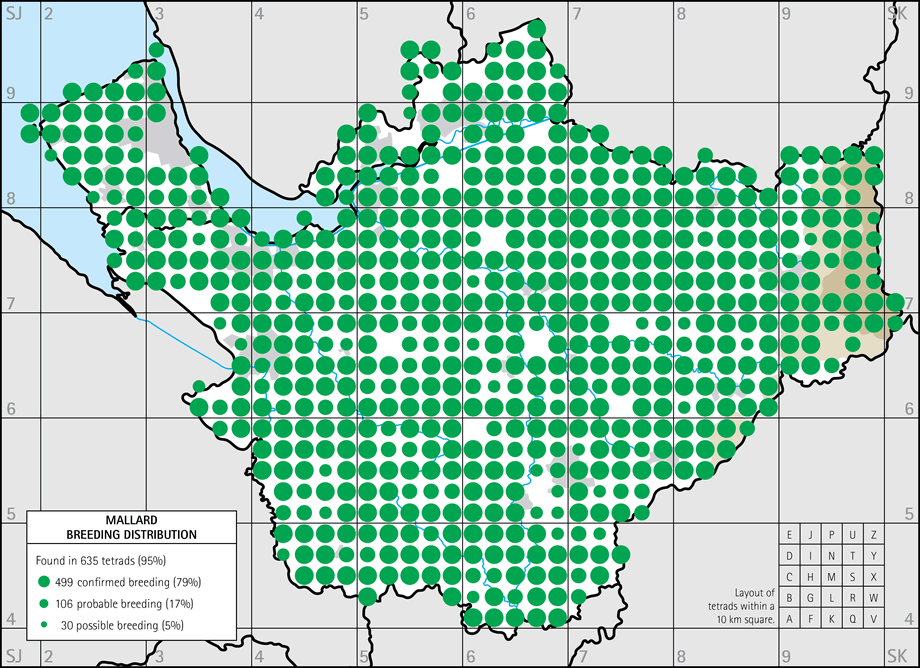
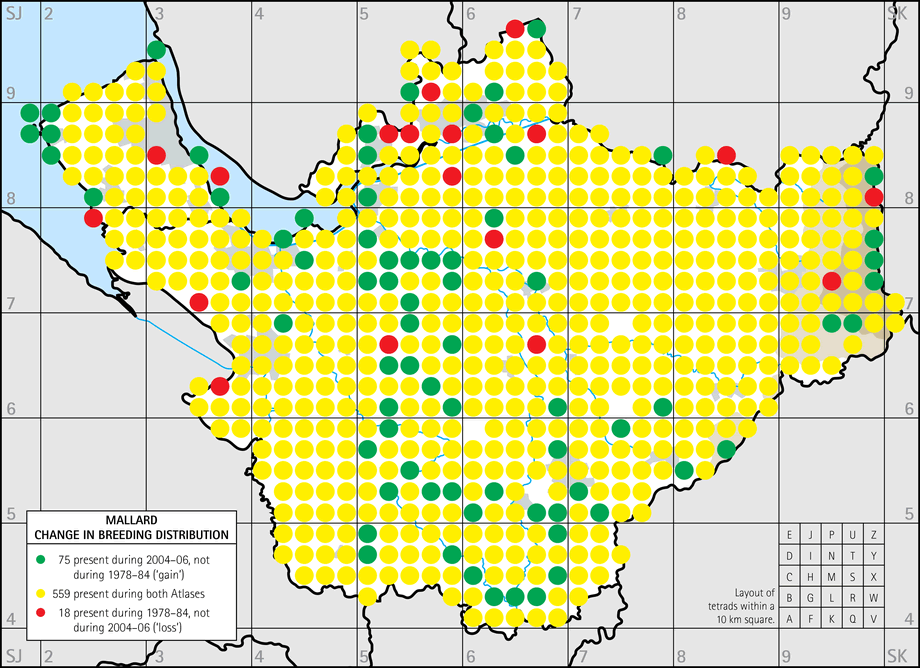
This is the most widespread and successful duck in the world, and also probably the bird best known to everyone in Britain from the age of 2 or 3 onwards. It is now almost ubiquitous in Cheshire and Wirral, present during the breeding season in 635 of the 670 tetrads, by far the most extensive distribution of any waterbird and the fifteenth most widespread species. In the twenty years since our First Atlas it has spread into a further 57 tetrads, having filled all of the major gaps, on Hilbre and north-west Wirral, a broad swathe through the centre of the county and at the highest points of the eastern hills. It is probably only missing from parts of urban east Wirral, as in our First Atlas, and a few upland tetrads.
They were proven breeding in more than three-quarters of the tetrads, nearly all by observers seeing the female Mallard with a brood of ducklings. The drake ignores his mate as soon as she is incubating the clutch of eggs and tries to mate with any spare female. They can breed at any time from March, normally to August, but a brood of week-old chicks was seen at Quaker’s Coppice, Crewe, on 18 November 1996. The nest itself may be well away from water, Mallards frequently featuring in local newspapers for their choice of odd sites from which the mother leads her ducklings across land to reach water. Perhaps because of their semi-domesticated origins, many birds seem quite at home in the presence of humans. Nests were reported in farm buildings and in a house roof space 5m high, although most nests are in undergrowth on the ground. The typical clutch is ten eggs, allowing for large losses from the brood of ducklings. Many observers commented on high levels of predation, of chicks and adults, by mink, rats and red-eared terrapins. The higher success rate of nests on islands probably reflects the importance of nocturnal safety from foxes.
Mallards can utilise almost any type of water. The submitted habitat codes comprised 163 G1 – pond (less than 50m2); 195 G2 – small water-body (50-450m2); 100 G3 – lake/ unlined reservoir; 7 G4 – lined reservoir; 25 G5 – gravel pit, sand pit, etc; 45 G6 – stream (less than 3m wide); 41 G7 – river (more than 3m wide); 26 G8 – ditch with water (less than 2m wide); 43 G9 – small canal (2-5m wide); and 38 G10 – large canal (more than 5m wide); as well as other habitats such as carr woodland, reedbeds and saltmarsh. Some fieldworkers noted their propensity to occupy recently-created ponds[: in urban Runcorn (SJ58K), with little standing water, Mallard was the last species that I found in the tetrad, breeding in 2006 on a small pond so new that it does not appear on the Ordnance Survey maps]. The key food for chicks is hatching chironomid midges, so the best waters have an abundance of insect-rich shallows.
During the 1990s Cheshire and Wirral Bird Reports contained a number of comments about birds breeding for the first time at well-watched sites, and the population at others has climbed steadily. The three years of this Atlas saw record numbers of broods at Woolston: 55, 58 and 53 breeding in 2004, 2005, 2006. Birds there were widespread across the site, including all parts of the dredging deposit grounds, the Manchester Ship Canal and the River Mersey.
The BTO analysis of BBS results shows that the breeding population of Cheshire and Wirral in 2004-05 is estimated at 35,630 birds (with 95% statistical confidence limits of 22,440-48,830). This figure, an average of almost 60 birds per tetrad with confirmed and probable breeding, amounts to 2.2% of the UK total of birds in just 1% of the UK’s area, showing that Cheshire and Wirral is especially significant for breeding Mallard. The county’s status as the ‘pond capital of the UK’ must underlie that importance.
This total dwarfs the estimate of ‘around 1500 pairs’ given in our First Atlas. The national breeding population rose by one-third in the period between our two atlases, but the First Atlas figure must surely have been a substantial underestimate. It is suggested that a large part of the increase in breeding numbers may be attributable to releases of Mallard for shooting (Marchant et al. 1990). Unfortunately, there is no information collated on releases of captive-reared Mallard in Cheshire and Wirral. Nationally, 14% of the shoots submitting data to the National Game-Bag Census released reared Mallard in 1984, but it is not known how this has changed in the last twenty years (Tapper 1999).
Atlas account sponsored by Mark Greenhough
Winter
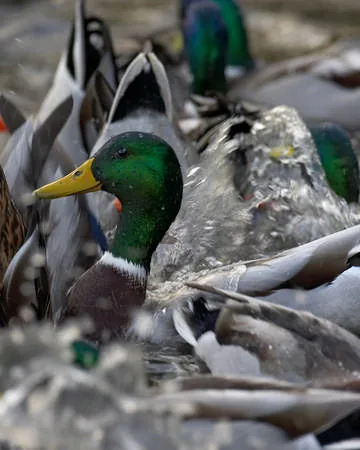
In contrast to the burgeoning breeding population, wintering numbers of Mallard have been dropping since the late 1970s (Banks et al 2006), apparently because of a decrease in immigration from continental Europe. Our breeding Mallard are quite sedentary, with a median distance of movement of 22 km (Migration Atlas). A few birds fly to continental Europe, including a chick ringed at Frodsham in 1968, shot in the Netherlands in winter 1979/ 80: almost all of the emigrants are males. Birds have come here especially from Finland and southern Sweden, with smaller numbers from all other countries from Russia to France. The proportion of immigrants in the British wintering population has declined greatly, from 50 - 60% in the 1950s and 1960s and 40% in the 1970s to only about 15% in the 1990s (Migration Atlas).
WeBS counts show that Mallards are widely distributed across many sites, such that only at the Ouse Washes do the numbers exceed 1% of the British total of 350,000 birds and thus qualify as nationally important for the species. The picture in Cheshire and Wirral has clearly changed in the last forty years, particularly at Rostherne Mere. Coward (1910) noted that on Rostherne, one of the deepest and latest to freeze of the meres, there were often thousands of Mallards when the shallow and more exposed waters were frost-bound. In the first volume summarising national counts of wildfowl (Atkinson-Willes 1963), numbers of Mallard at Rostherne Mere were ‘larger than on any inland water in England’, with peak totals of 4,000 in the early 1960s. At that time, Combermere and Doddington were the county’s next most important sites with counts of 600 and 410 in January 1966 (Bell 1967).
Nowadays the picture is very different. The largest wintering numbers are on the estuaries, with the highest WeBS counts during the three winters of this Atlas of 1,117 on the Dee (including sites outside Cheshire and Wirral) and 883 on the Mersey. Other sites with peak monthly counts in winter exceeding 300, as listed in the Cheshire and Wirral Bird Reports, were Chelford SQs with 885, Hurleston with 367 and the Sandbach Flashes with 315. The largest individual tetrad counts were 476 at Doddington (SJ74D) on a WeBS count in 2004/ 05 and 450 in the Gowy flood-plain (SJ47G) in 2004/ 05. Sadly, 206 birds was the maximum at Rostherne, in December 2006, about one-twentieth of the figure 45 years previously.
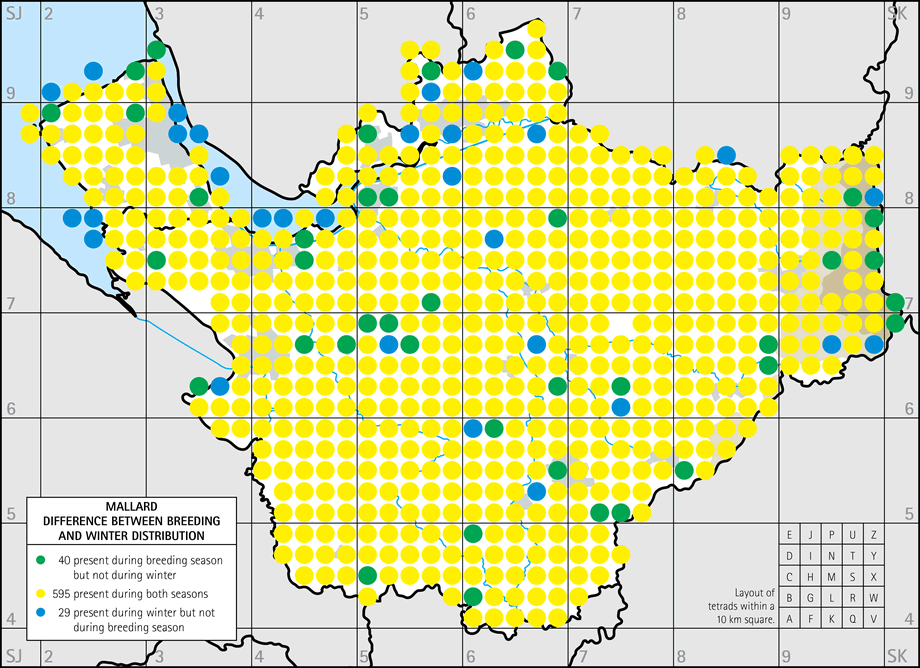
The Atlas map shows Mallards present in winter in 624 tetrads compared to 635 in breeding season. Birds were recorded in most estuarine tetrads, in the shallow waters close to shore, but quit 40 in which they were present during the breeding season. They withdrew from some of the highest eastern tetrads. All of the freshwater habitats were occupied in similar proportions to the breeding season, but with a small shift away from the ponds and smaller standing waters to lakes and rivers, and 32 estuarine/ saltmarsh tetrads. Even in the winter flocks, many birds have one eye on the coming breeding season and they seem to keep more or less in pairs, the male following the female closely. Mallards shift to a more vegetarian diet during winter but take a very wide variety of foods. On water they dabble, upend and occasionally dive in shallow water for seeds and invertebrates. Provided that they feel safe enough, some will feed well away from water, on stubble and other agricultural waste, fruit and of course the inevitable offers of bread from the great British public.
Atlas account sponsored by Mark Greenhough