
Sandbach Flashes: birds and wildlife

About the Atlas
During the three breeding seasons 2004–06 and three winters 2004/05–2006/07, Cheshire and Wirral Ornithological Society (CAWOS) organised more than 350 volunteers to survey all of the county, trying to find every species of bird that was breeding or wintering
Mandarin Duck Aix galericulata
Breeding
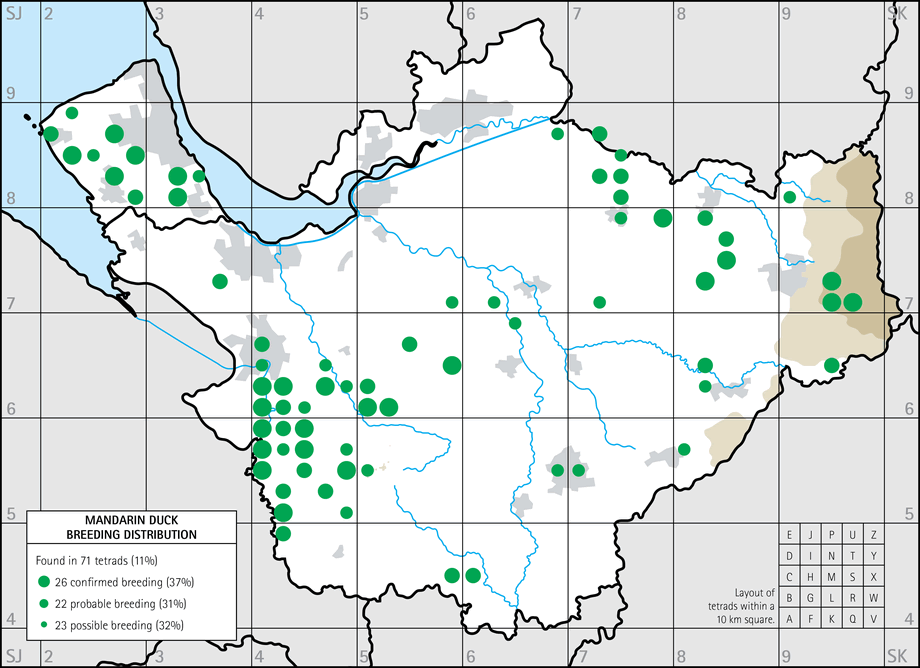
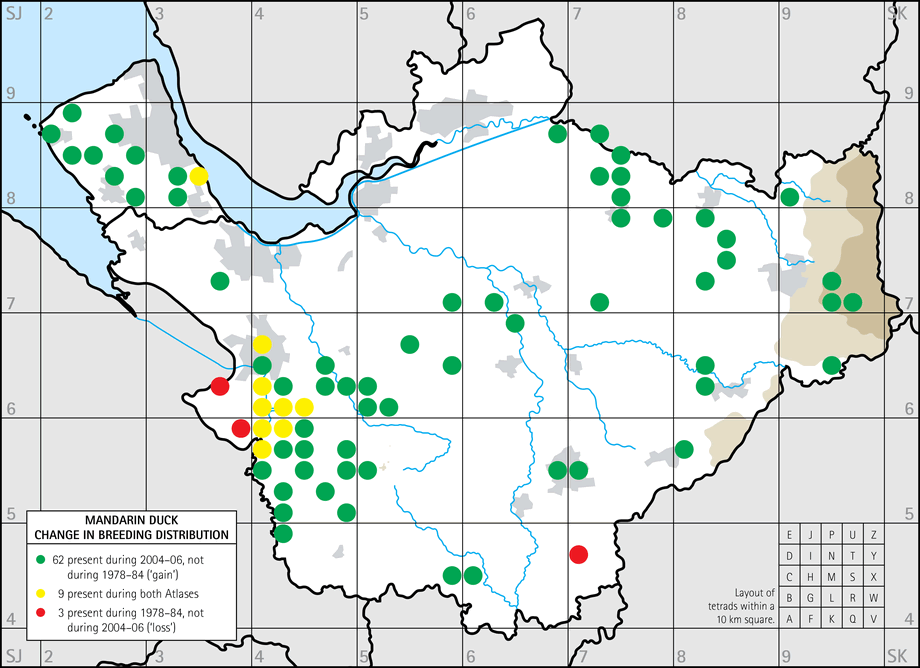
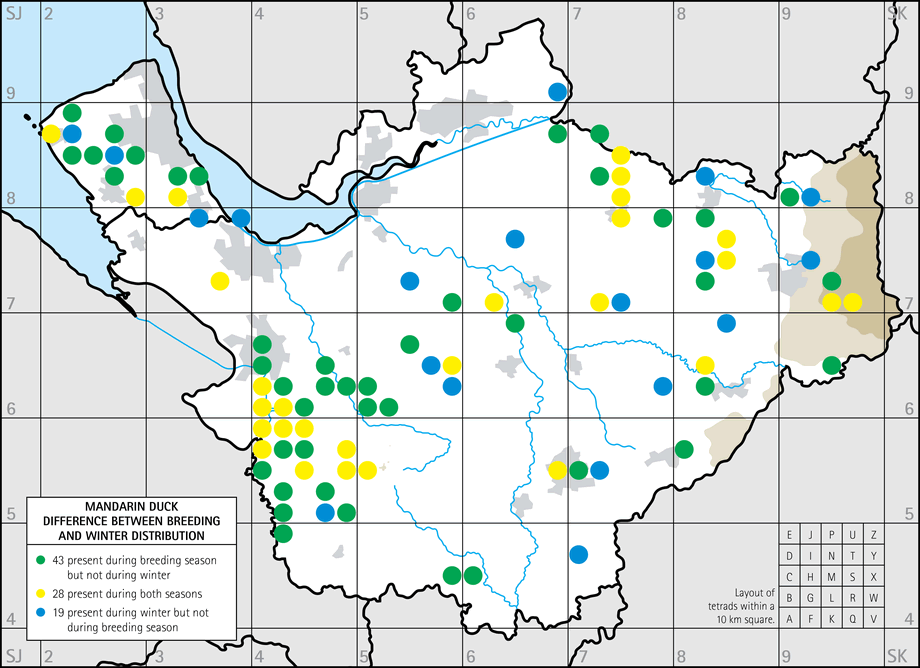
Mandarins have spread amazingly since our First Atlas to become, in terms of confirmed breeding, our third most widespread duck. Twenty years ago they were found in 12 tetrads, with breeding confirmed in 4, probable in 4 and possible in 4; during this Atlas they were found in 71 tetrads, with breeding confirmed in 26, probable in 22 and possible in 23. They used to be confined to the vicinity of the Eaton Estate south of Chester, but now are present in most of south-west Cheshire, all suitable waters in Wirral and parts of east Cheshire including the Langley (SJ97K) and Trentabank (SJ97Q) reservoirs in the uplands, possibly using nestboxes there that were put up for Goldeneyes.
They nest in a hole so the female needs a suitable tree, or a nest-box, not far from water. They usually prefer densely wooded areas near wetlands, especially with a wealth of rhododendron undergrowth (Lever 1977). They feed mostly at night, mainly on insects in spring, and plants, especially polygonum, and frogs in summer.
Most eggs are laid in late April. A normal clutch is 9 to 12 eggs, but Mandarin ducks are prone to egg-dumping, where females lay their eggs in other females’ nests, leading sometimes to enormous clutches of as many as 40 eggs. In one study in Berkshire, at least 56% of clutches were parasitised, and probably many more. (Davies & Baggott 1989a). It seems that some females reject clutches to which extra eggs have been added, and do not incubate them: they may well still reproduce by retaliating and themselves laying elsewhere. The eggs hatch after about five weeks’ incubation in early June. In some natural sites where the core of the tree has decayed, the nesting cavity may be many metres deep, but the ducklings still manage to climb to the outside, leap to the ground below and follow the duck to water.
Fieldworkers in 23 tetrads saw females with young, with broods varying from one to eight chicks. Frank Gleeson’s observation in SJ28X highlighted one of the hazards facing ducklings when he saw one of a brood of 8 young grabbed by a Grey Heron, although it was reprieved when the heron was startled by a dog and dropped the chick.
Recording the habitat of this species is not straightforward because of its dependence on woods and waters. In 39 tetrads they were found on lakes and other waterbodies, with 28 on linear watercourses (streams and rivers), a higher proportion of the latter (42%) than any other duck except Goosander.
The Mandarin Duck is a native of north-east Asia and Japan, introduced to British collections at the beginning of the 20th century. The birds were first brought here for people to admire the plumage of the gaudy male, especially the golden-orange ‘sails’ sticking up from his back, although it is the purple-green crested head that gives the species its name, the Latin galericulata meaning ‘hooded’. The female, although drabber, is striking in her own way, with delicately mottled shades of grey. The Cheshire and Wirral birds originally came from a collection, but the population is now clearly self-sustaining. It seems to be filling a vacant ecological niche, as a tree-perching duck, and is now clearly flourishing in the wild in our county. Observers reported up to four pairs in some tetrads. An average of two pairs per tetrad with confirmed or probable breeding would give a county population of 100 pairs.
Atlas account sponsored by Chester and District Ornithological Society
Winter

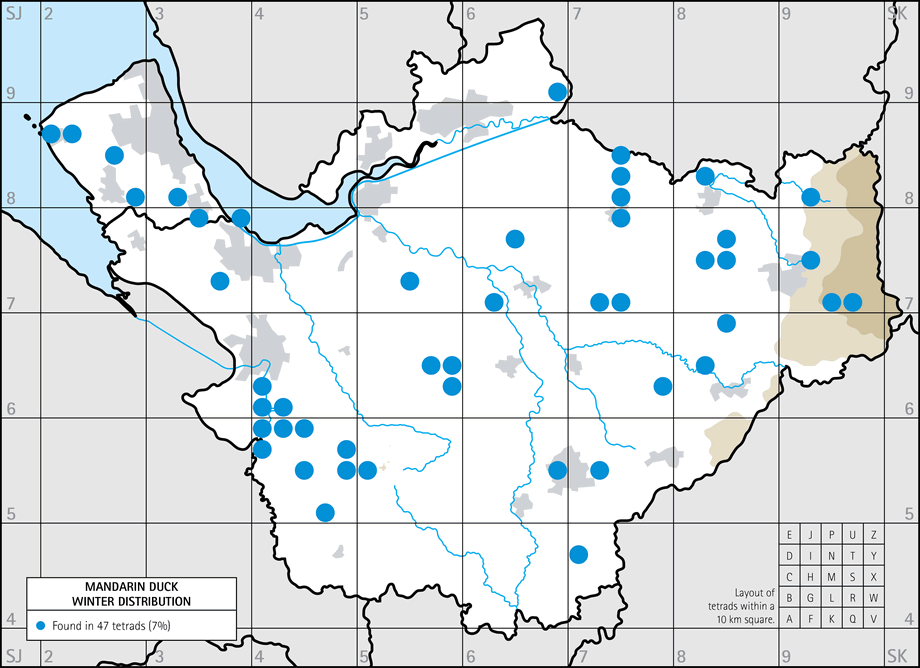
Most of Mandarins’ early breeding activities take place in the first half of winter. Almost as soon as males emerge from their eclipse plumage in late September or early October, they start displaying, and the majority are paired by the end of the year. Although they are mostly paired, it seems that they are not yet on territory, as many of the breeding tetrads are not occupied in winter; 24 tetrads with breeding season presence did not have birds recorded in winter. This is the same behaviour as is recorded in the core of its British range in southern England, with breeding areas being deserted from late summer until the following spring (BTO Winter Atlas)
As well as a concentration onto fewer sites, many birds shift habitat. In contrast to the situation when breeding, few birds in winter were found on linear watercourses: in 38 tetrads they were recorded on lakes and other waterbodies, with only six on linear watercourses (streams, rivers and large canals). Mandarins have been using our largest waters, and at the other extreme, two birds visited a garden pond at Capenhurst (SJ37R). They are not normally an estuarine duck, but a male was swimming with drake Mallards at high tide on the River Mersey near Mount Manisty (SJ37Z) on 24 November 2004. They especially like to feed on nuts, particularly acorns, chestnuts and beech mast.
This species has not been studied in Cheshire and Wirral, and no detail is known of their movements. It is described as ‘rather sedentary in nature’ but clearly makes local seasonal movements (Brown & Grice 2005). At a site in Berkshire, no more than 30 birds were seen at a time on a lake, yet over 500 birds were ringed there in a two-year period (Davies 1988). Obviously there must be some dispersal to enable them to colonise new sites and, as an extreme, a bird ringed in Britain has been recovered near St Petersburg in Russia, perhaps having been caught up in a return movement with other migratory species (Migration Atlas).
Mandarins do not usually congregate in large flocks. Gatherings of ten birds or more were found in the area south of Chester from Eaton to Churton (SJ45D, SJ45E and SJ46A), including the largest flock counted in this Atlas period, 32 birds on a fishpond on 13 January 2005; near Bickerton (SJ55C), where 10 males and 8 females were on a pond with many dead trees; at Little Budworth (SJ56X); and on Trentabank Reservoir (SJ97Q). The largest winter flock ever in the county appears to have been 63 birds at Aldford Brook on 17 December 2001, when all the lakes were frozen.
This Atlas has given us the best picture yet of Mandarins in Cheshire and Wirral, but many accounts of the species emphasise its secretive nature, so they may well be under-recorded.
Atlas account sponsored by Chester and District Ornithological Society