
Sandbach Flashes: birds and wildlife
About the Atlas
During the three breeding seasons 2004–06 and three winters 2004/05–2006/07, Cheshire and Wirral Ornithological Society (CAWOS) organised more than 350 volunteers to survey all of the county, trying to find every species of bird that was breeding or wintering
Marsh Harrier Circus aeruginosus
Breeding
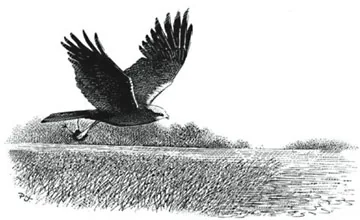
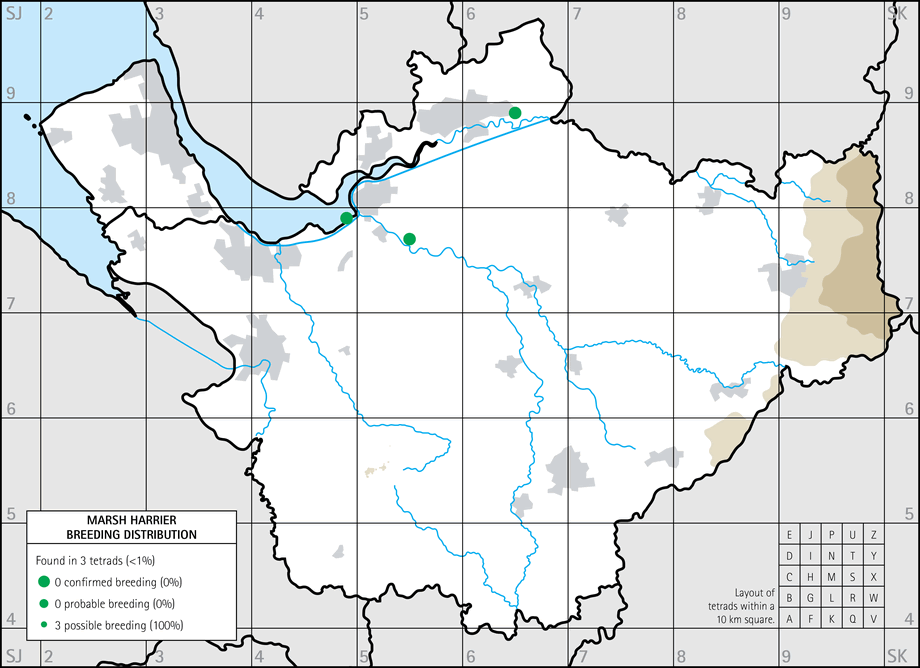
Marsh Harriers have not yet been known to breed in the county – our First Atlas predicted that ‘future breeding seems unlikely’ – but they are considerably expanding their range and numbers, and occur frequently on spring passage. Several birds have been recorded in suitable breeding habitat, including three during this Atlas. The closest approach to breeding so far appears to have been in 2005 when an adult female was present at a site in the north of the county during June and the first half of July, carrying prey into a marshy area. Close inspection, under a Schedule 1 licence, revealed no nest but a regularly-used food-caching site, with recognisable prey items including Coot, Moorhen and Mallard. No male Marsh Harrier was ever seen.
After coming back from the brink of extinction as a British breeding bird, with only one pair nesting in 1971, their population has grown rapidly. A dedicated national survey in 1995 found a total of 156 breeding females, and the follow-up census in 2005 reported 360 breeding females, an increase of 131%. Females are counted, rather than pairs, because about one-fifth of nests result from polygny, usually one male with two females but occasionally three females sharing one male; such nests are just as successful as those of monogamous pairings (Underhill-Day 1998).
Along with the growth in numbers, Marsh Harriers have extended their distribution. They colonised Leighton Moss in North Lancashire in 1987 and have bred there annually since then, but this is the only regularly-occupied site in western Britain.
Their typical nesting habitat has been extensive Phragmites australis reedbeds, comprising 86% of more than 500 nests recorded during 1983-90 & 1995. All but two of the rest were in cereal crops, mostly oil-seed rape and winter wheat, this habit growing rapidly since it was first recorded in 1982 (Underhill-Day 1998).
Many Marsh Harriers pass through the county in spring and autumn, and it is probably only lack of suitable habitat that restricts the breeding population.
Atlas account sponsored by David Kennerley
Winter
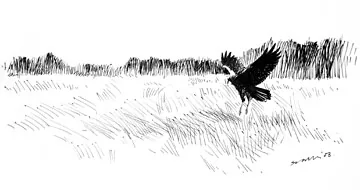
As the British breeding population has risen, so have the number of birds wintering in the country. Probably no more than ten wintered in Britain in 1981/82 to 1983/84 (Winter Atlas), and Clarke (1995) thought that ‘the number wintering in Britain as a whole probably does not exceed thirty’. Ten years later, several small roosts, containing up to twenty birds each, had become established in eastern and south-eastern England (Brown & Grice 2005).
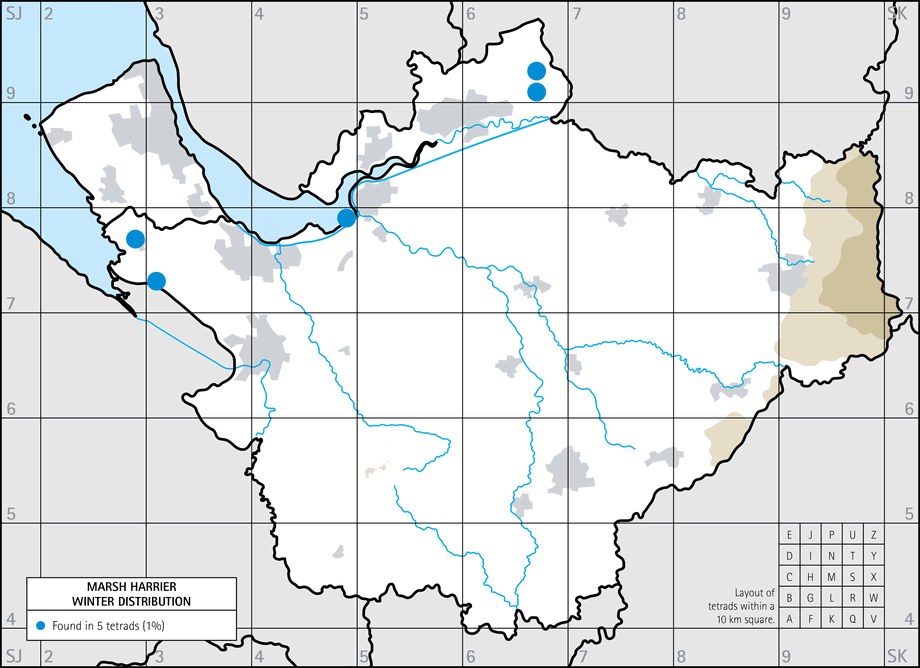
Cheshire and Wirral has shared in that rise in numbers, especially on autumn passage, with occasional birds on late dates that bring them into our defined winter Atlas period, and some that seem to have been genuinely wintering here. This habit has clearly become more common recently, and the period of this Atlas, with five records, referring to four birds, shows the highest known winter total for the county.
The first on record in the county seems to a bird on 1 December 1946 at Thelwall, followed at intervals of twenty years by another on 30 January 1966 at Wallasey, and then on 18 November 1987 at Moore. After just three birds in forty years there were two during the 1990s, on 1 December 1994 at Fiddler’s Ferry and 22 November 1996 at Great Sankey, then annually from 2001 onwards: 10 December2001 at Bar Mere, then a long-staying bird on the Dee saltmarsh, seen from 19 to 27 December 2002 and again on 20 January 2003, usually going to roost with a Hen Harrier off Parkgate Old Baths. As with some of the others, one on 16 November 2003 at Heswall was probably just a late migrant, but the bird on 1 February 2004 on the Mersey at Ince was not (Bell 1967, CWBRs).
Atlas account sponsored by David Kennerley