
Sandbach Flashes: birds and wildlife
About the Atlas
During the three breeding seasons 2004–06 and three winters 2004/05–2006/07, Cheshire and Wirral Ornithological Society (CAWOS) organised more than 350 volunteers to survey all of the county, trying to find every species of bird that was breeding or wintering
Marsh Tit Poecile palustris
Breeding
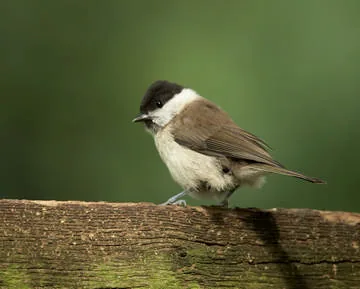
This is the ‘brown tit’ of mature woodland, especially with oak or beech, and their habitat preference – very different from that of the Willow Tit – is well shown by the codes submitted by observers in this survey. Nearly three-quarters of the records (22 out of 30) were in broadleaved woodland (A1), with three in mixed woodland (A3), one each in waterlogged broadleaved and mixed woodland (A4 and A6), and three others. Recent study has shown that the characteristics of the shrubs, especially at heights of 2-4 m, underneath the tall trees are most important for Marsh Tits (Hinsley et al 2007). Damage to the shrub layer, by deer, by shading out by canopy closure and by managed clearance of shrub cover, may underlie the long-term sustained drop in the abundance of Marsh Tits. They are now on the Red List of species of conservation concern, following a sustained fall in their national population ever since BTO census work started in the 1960s. From a nadir in 1998, there has been a small rise, leaving the national population index with a drop of 20% between our two Atlases, from 1984 to 2004.
Detailed demographic work suggests that the decline may have been driven by low annual survival and that neither increased predation nor interspecific competition is responsible (Siriwardena 2006). Nesting success has improved during the period of decline. They defend territories all year round, from 2-8 ha in size, within which they satisfy all of their annual needs, and they are seldom found in woods smaller than 1 ha (Hinsley et al 1995, Broughton et al 2006). Marsh Tits are the lowest in pecking order when competing for nest-holes, and they choose small holes in mature trees, close to the ground, that are probably unattractive to other species (Nilsson 1984). They start laying in mid- or late-April, becoming earlier with climate change, and the average brood of around 7 chicks fledges in early June. Their summer diet is dominated by adult insects, especially moths, bugs, springtails and beetles, and Marsh Tits depend much less on the insect larvae associated with oaks than other tits; they obtain most of their food from the understorey vegetation or from low in the canopy.
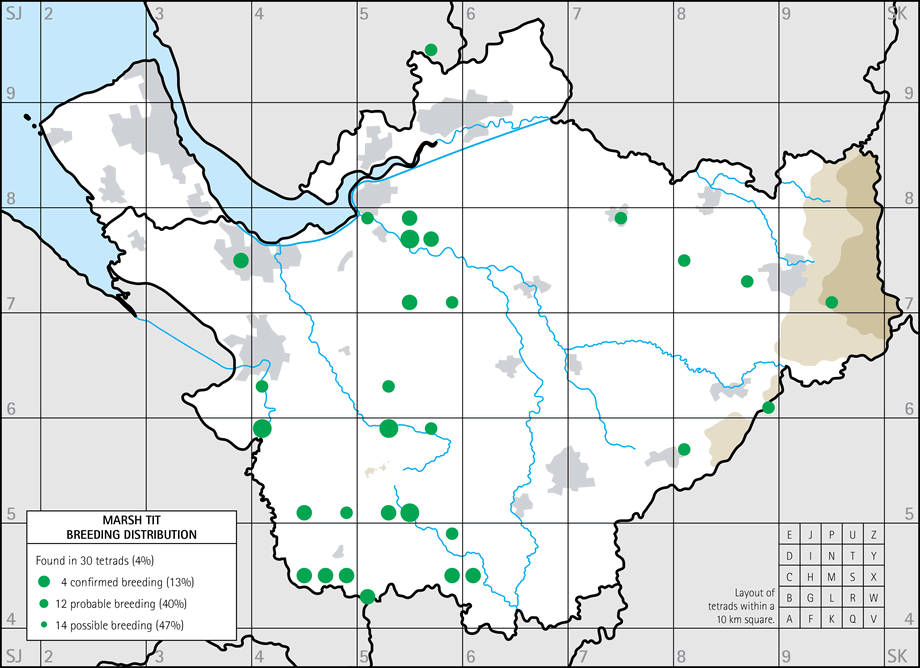
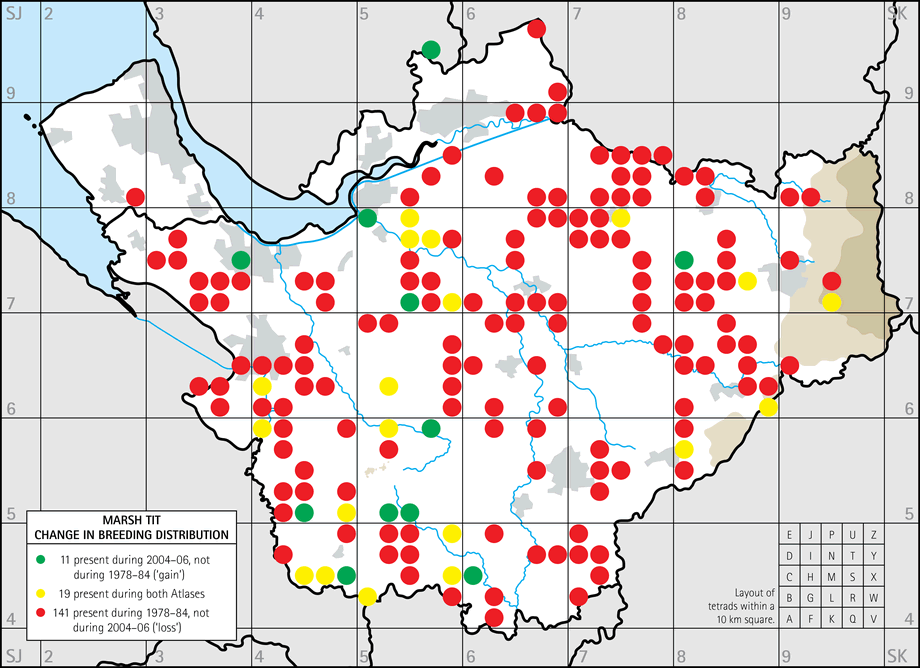
The species was found in 160 tetrads in the First Atlas, but only 30 tetrads in this survey, only four of them with proven breeding. The ‘change’ map shows that locations that were occupied in the First Atlas and still now include much of the county’s scarce mature woodland: the lower Weaver valley around Aston, the Wych valley, the Eaton estate and the Peckforton area. It is missing from the north of Cheshire and from Wirral. The loss of Marsh Tits in Cheshire is much more than would have been expected from a 20% drop in their national population, and this is probably a reflection of changes in abundance and distribution being more obvious at the edge of a species’ range. In its national distribution, Marsh Tit has an obvious gap in the Mersey valley, and the Lancashire and North Merseyside tetrad breeding atlas (1997-2000) showed only one record in Lancashire within 25km of the Cheshire boundary.
Some birdwatchers have difficulty in distinguishing the two species of ‘brown tits’ although their calls are completely different, and the map omits records from two tetrads in which the observer was uncertain of the identification. Now that they are both scarce species in Cheshire, they have completely separated in their local distribution: during this Atlas survey there was no tetrad in which Marsh Tit and Willow Tit were both recorded in the breeding season.
Twenty years ago Marsh Tit was a relatively widespread bird, with a Cheshire and Wirral population probably under-estimated at 150-200 pairs. In this survey, most of the records were of single birds, or pairs, and the county population is unlikely to exceed 50 pairs. The reasons for this drop are probably worthy of professional study. The oft-quoted cause, loss of under-storey from excessive browsing by deer, cannot be the reason in our county where feral deer are still relatively scarce.
Atlas account sponsored by Paul Morris
Winter
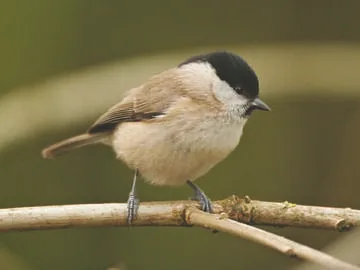
Marsh Tit adults are amongst the most site-faithful of all passerine species. They stay paired throughout the winter and remain on their large territory even in hard weather. They defend the territory against their neighbours, especially using their loud ‘pitchou’ calls. Unpaired first-winter birds, on the other hand, join mixed-species tit flocks in winter, which roam at will, and territorial adults do not defend their territories against these birds; indeed, they may well join a roaming flock whilst it moves around their territory (BTO Winter Atlas). They can be present but quite elusive at times. In 26 years of ringing in February and March at Aston (SJ56P) I caught Marsh Tits in half of the years, but with a seven-year gap from 1994-2000.
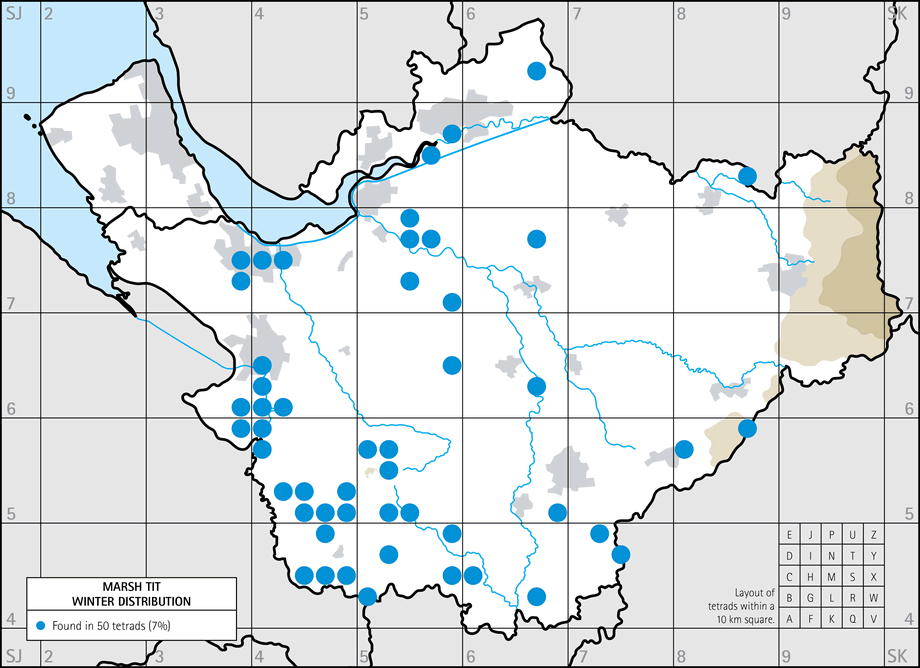
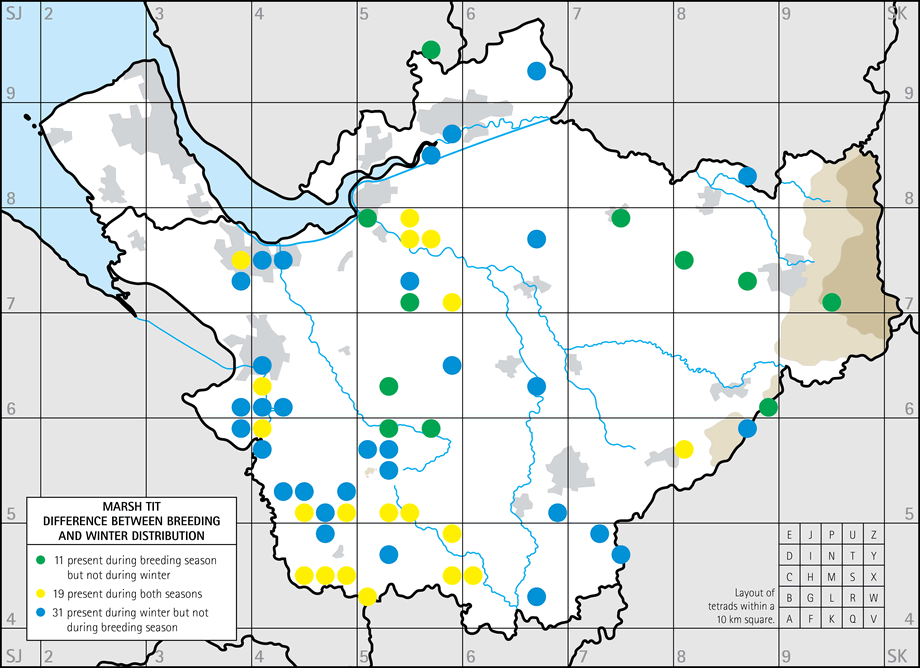
Following this description of their habits, it was surprising to find Marsh Tits reported from 50 tetrads in winter, twenty more than in the breeding season. Many of the extra tetrads with winter records were within one or two tetrads of the core breeding sites, and could be interpreted as dispersal of first-year birds, but up to ten of the records were from isolated tetrads, at least 5 km distant from the nearest known breeding site. Conversely, four tetrads in the east of the county furnished records of single birds in the breeding season, but none was found within those 10 km squares in winter.
Their winter food is more widespread than their apparently restricted breeding requirements. Beech mast is a key part of their diet if present, along with the seeds and fruits of other trees and shrubs, and insects if they can find them. They store food, usually in moss on or near the ground, often for only a few hours during a day, perhaps to avoid it being taken by the larger and more dominant other tit species.
There are no benchmarks for the species’ former distribution or abundance. They were not separated from the Willow Tit until 1897, and all Cheshire records of ‘brown tits’ were lumped in with Marsh Tit; neither Boyd nor Bell makes any significant comment on them in winter.
Atlas account sponsored by Paul Morris